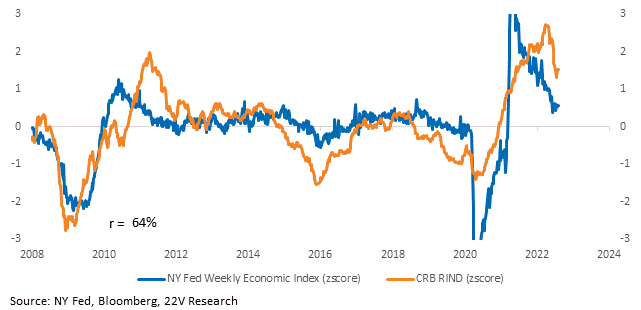
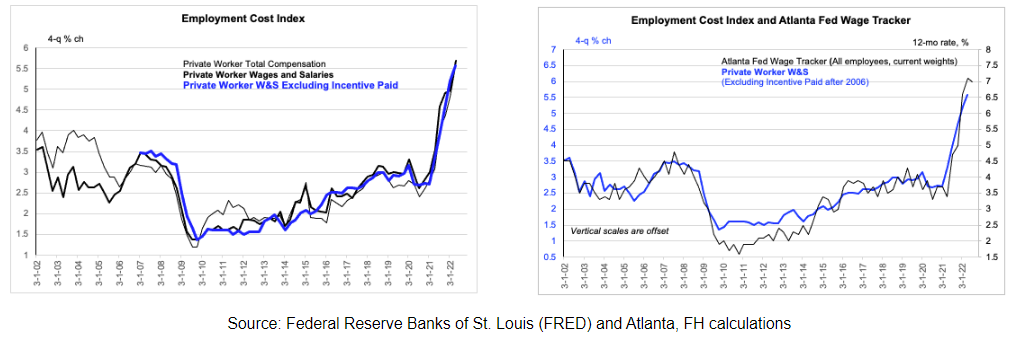
SUMMARY: The NY Fed’s weekly economic index (WEI), a high frequency indicator of real economic growth “scaled to match a 4 quarter GDP growth rate”, increased to 3.2%. That implies that underlying demand growth is still solid and that will continue to keep wage growth at a too high level. We have had very good inflation news, but as Gerard noted yesterday (HERE), if trend productivity is running at ~1% and compensation is running at 5% (which looks to be the case now) underlying trend in unit labor costs is 4%, which is far too high to be consistent with the Fed’s inflation objective or – relatedly – with stable profit margins over the coming year.
Long-Term: The Fed will remain hawkish and economic growth and earnings are headed lower, it’s just a question of how much. For now, the improved inflation readings reduce tail risk, but the reality of lower earnings and economic growth keep us from chasing the market higher from these levels. Our range remains 3800-4200 (more HERE).
Short-term: Outside of a surge in inflation expectations, there is no clear catalyst to challenge the view of stable underlying demand growth, lower inflation, and stable to easier financial conditions. A high UMich inflation reading today, or hot housing data and retail sales next week could help reverse that view, but don’t expect those data points to be outliers. If a change in the path of fed funds is going to come, it is more likely in September. Maybe Powell’s Jackson Hole speech. Bottom line, we think commodity prices should be stable/higher in the short term as economic tail risk is reduced and underlying demand remains firm. That is a support for Cyclicals (Tech does just fine), risk-on factors (gaining w/w, m/m), and Energy in particular.
Margins: ALL of the S&P’s recent ~15% gain has been a result of PE expansion. Forward sales and margins estimates have moved lower since mid-June. Market internals have turned back toward risk-on and Value has gained relative to Growth, which makes sense as positioning is adjusted for less downside risk (slowdown vs deep recession) and a backup in yields. Sentiment shifts have been sudden this year, driven by expectations about growth and policy that remain largely unknowable.
As Gerard has noted (HERE), there have been three phases to the profit cycle during the post-Covid-shock era. 1) Strong margins because productivity was strong as output increased, wage growth was muted, and output prices were strong. 2) Labor costs began to increase as output and productivity growth slowed, but output prices continued to accelerate (inflation). 3) The Fed has committed to stopping pricing power (inflation), intensifying output and productivity weakness while cutting into output price growth, but with stubborn wage growth. So, margins are set to weaken.
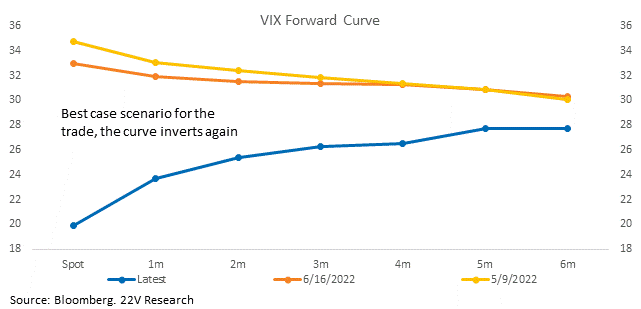
Hedge Trade Idea: The VIX is below 20 but the VIX curve is unusually steep, which means near-term implied volatility (1-month out) is unusually low relative to longer-term implied volatility (3+ months out). We highlight a trade to take advantage of the steepness in the full report below…
MARKET VIEWS: The NY Fed’s weekly economic index, a high frequency indicator of real economic growth “scaled to match a 4 quarter GDP growth rate”, increased to 3.2%. As Gerard noted yesterday (HERE), unit labor costs, if trend productivity is running ~1%, are rising at a 4% pace. Both those readings are far too fast to reduce inflation. Economic activity needs to slow more, increasing the risk of more hawkish commentary by the Fed.
Those are medium-term risks. Short-term, investors seem confident disinflation is happening fast enough. Outside of a surge in inflation expectations, there is no clear catalyst to challenge that view over the next few weeks. Futures are higher this morning as investors are taking good news as good news – Eurozone industrial production beat and UK GDP wasn’t as bad as feared, feeding into a goldilocks narrative. A high UMich inflation reading today, or hot housing data and retail sales next week could help reverse that view, but more likely Powell in Jackson Hole August 25-27. So, commodity prices should be stable/higher in the short term. That’s a support for Cyclicals, Energy in particular.

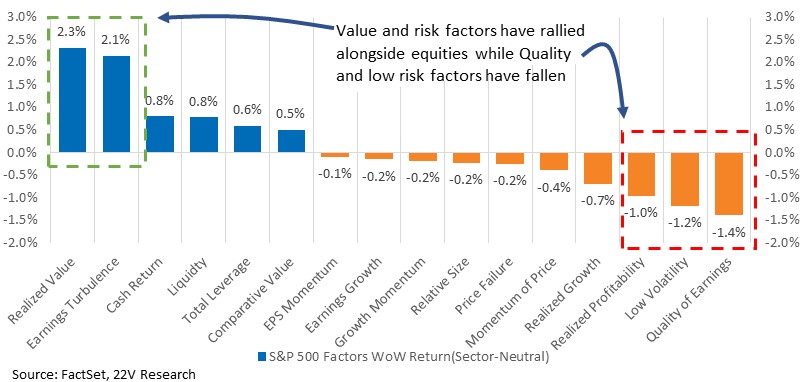
The S&P is up another 1.5% this week, bringing its gain from the June low to almost 15%. ALL of that gain has been a result of PE expansion. Forward sales and margins estimates have moved lower since mid-June. Market internals have turned back toward risk-on too, with Earnings Turbulence names up more than 2% w/w while the de-risking Low Volatility factor is down -1.2%. Value has rallied relative to Growth as well, which makes sense as positioning is adjusted for less downside risk (slowdown vs deep recession), and a backup in yields.
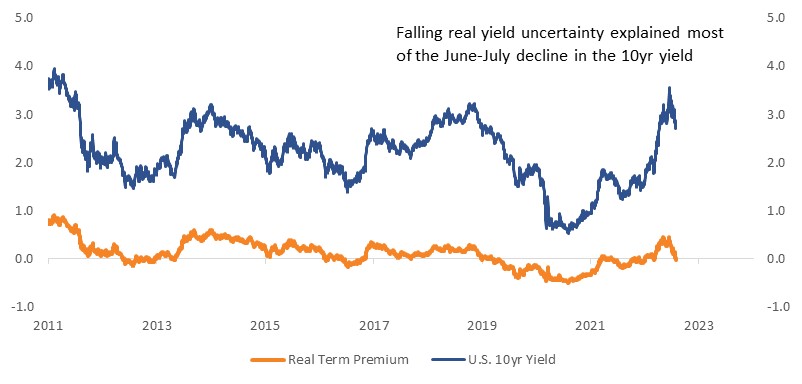
Sentiment shifts have been sudden this year, driven by expectations about growth and policy that are largely unknowable. Equities rallied alongside the decline in Treasury yields, which was driven by lower uncertainty about the future path of rates/yields. There wasn’t enough new information released from mid-June to the end of July to make the path of growth/inflation clear, but there was enough to reduce, NOT ELIMINATE, the risk of a deep recession. Macro volatility should remain high as the economic backdrop increasingly flirts with recession, so investors should expect more rate/equity volatility ahead.
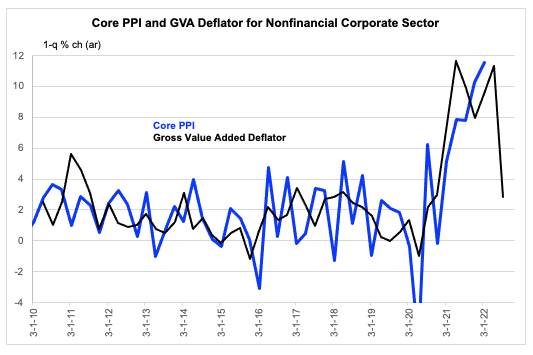
As Gerard has noted (HERE), there have been three phases to the profit cycle during the post-Covid-shock era. 1) Strong margins because productivity was strong as output increased, wage growth was muted, and output prices were strong. 2) Labor costs began to increase as output and productivity growth slowed, but output prices continued to accelerate (inflation). 3) The Fed has committed to stopping pricing power (inflation), intensifying output and productivity weakness while cutting into output price growth, but with stubborn wage growth. So, margins are set to weaken.
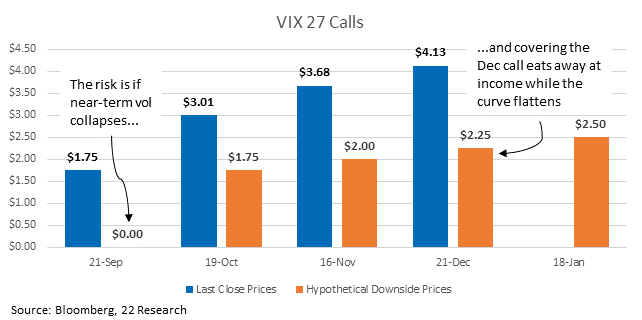
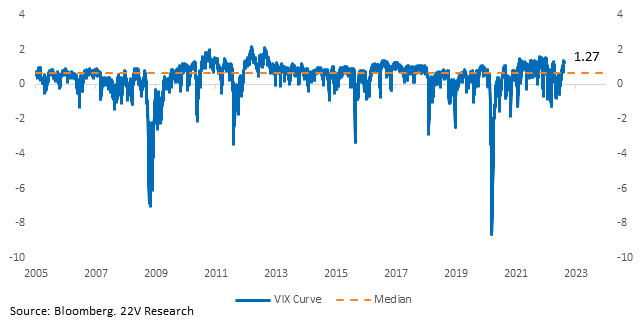
Volatility Equity Linked Strategy: The VIX is below 20 but the VIX curve is unusually steep, which means near-term implied volatility (1-month out) is unusually low relative to longer-term implied volatility (3+ months out). The VIX (30 days) is implying 1.2% daily moves but the 3-month contract still implies 1.7% moves. That more volatility is priced in longer-term is normal, but the degree to which more vol is priced is not.
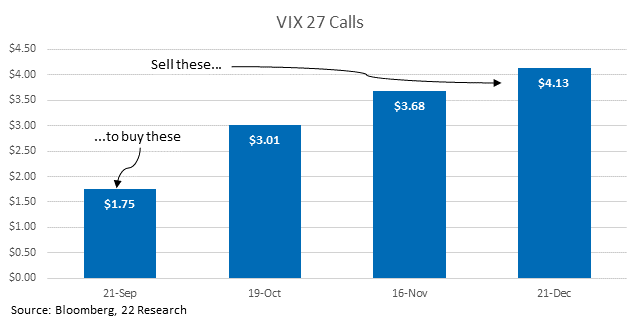
That sets up an interesting trade opportunity. Right now, VIX December 27 calls can be sold at ~$4.13 while VIX September 27 calls can be bought for ~$1.75. The September VIX contract expires after Payrolls and CPI and at the end of the FOMC rate announcement day. So, it captures a lot of risk. The 27 calls have the most volume (this isn’t some genius trade no one can actually do).
IF the threat of re-tightening financial conditions is priced in again and a reversal materializes, the 1-month contract should jump more than the 4-month. So, the trade can be closed out for a profit. Best case scenario – the VIX cures inverts again like it did in April, May, and June of this year during peak bear market vol. 70% of the time the VIX has crossed the 27 threshold, it has inverted.
If risks don’t materialize, then investor can pocket the income and the trade can be closed out or rolled forward. Closed out if the curve is no longer attractively steep and rolled forward if it is. The trade doesn’t work if 1) near-term volatility collapses and the cost of covering the December call eats away at the income while the curve is no longer attractive to roll the trade forward or 2) we’re wrong about the VIX curve flattening in the event of a shock. #1 is the bigger risk. So, this strategy partially expresses a view that volatility will remain high. Otherwise the trade is a hedge (just not a free one). The trade should be closed out or rolled forward before the September call expires otherwise the investor is purely short vol.