
SUMMARY
We analyzed the three most recent national public opinion surveys recording what Americans think of many issues. Our note focuses on a subset of topics covered more constantly by mass and social media, for brevity. Nearly four months out from the next midterm elections, hot topics unsurprisingly include inflation, abortion, the Supreme Court, and the January 6 hearings. We highlight sentiment on these issues from polls taken by CBS News, NPR/PBS/Marist, and Quinnipiac University and skip the well-covered views on elected politicians (links to each are provided). It’s too soon to consider a midterm outcome other than a unified GOP Congress next year. We believe that if the current trends in polling on social issues continue, Democrats are unlikely to suffer as much as President Biden’s worsening net disapproval rating suggest.
POLLS
The NPR/PBS/Marist Poll is the most recent survey in our review. It was conducted June 24-25 and released on Monday, June 27. All the polls we read are demographically rich, none more than this one which we drew from primarily for views on the Supreme Court’s rollback of Roe v. Wade. The CBS News poll released June 26 and conducted June 22-24, is by far the more comprehensive, including 19 separate screens related to the House Select Committee on January 6. Quinnipiac University’s polling operation released its latest Quinnipiac national survey on June 22 before the Committee’s most recent hearing and the Court’s abortion decision.
ISSUES AND OBSERVATIONS
Generally, we found that three subjects unite Americans more than most others: 74% believe non-partisan officials should manage state elections (CBS question 38E), 97% think inflation is a crisis/problem (Quinnipiac question 8), and 77% see domestic extremism as a bigger threat than international extremism (Quinnipiac question 14).
The Gallup Economic Confidence chart at the end this note reaffirms the obvious: voters feel economic conditions are worsening. Views of Reagan and his economic plan were catalysts in the 1982 midterms, as Trump and his 2017 tax cuts were four years ago. Central bankers touring Sintra, Portugal this week have been consistently clear about the collective inflation fighting imperative. Given the acknowledged risk of recession, it’s very hard to imagine any topic shunting economic matters to a lower tier of voters’ concerns this year (and likely next). But hearings on January 6 fill an otherwise slow or redundant early summer news cycle.
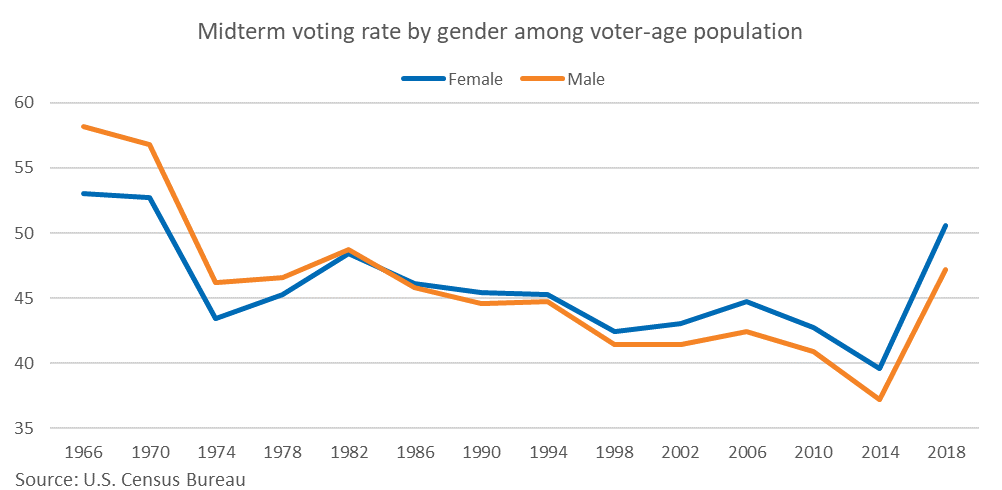
Data depicted in the following chart highlight demographic trends worth watching in November particularly considering the Supreme Court’s recent ruling on abortion. Across US demographics, midterm voting participation spiked in 2018 over the previous “off-year” election by the greatest margin in more than half a century. The 2018 midterm participation by gender exceeded or matched levels not seen in forty years. Since 1986 women have participated steadily more than men and 2018 was no exception.
House Select Committee on January 6
Overall, 80% of CBS News poll respondents disapprove of the US Capitol assault, while 58% strongly disapprove. The survey questions covered ethnic/racial, ideological, voter preference, and age demographics. Unsurprisingly what to call the attack and participants’ motivations differ based primarily on political ideology. Overall, 70% responded that finding out what happened and who was involved is important with 45% viewing it as very important. Majorities of self-identified Trump voters, “conservatives,” and Republicans do not think this is important (52-58% range).
About six in ten respondents to the Quinnipiac poll believe then President Trump bears responsibility for January 6 events at the Capitol. Remember these results were collected and released before yesterday’s hearing. The CBS News poll question 38A on whether Trump should face criminal charges divides Americans evenly overall (literally 50/50%). Please note these results were collected and released prior to yesterday’s hearing featuring Cassidy Hutchinson, the former aide to White House Chief of Staff Mark Meadows.
The Supreme Court and Roe ruling
As the abortion debate evolves into the broader topics of women’s rights to control healthcare decisions and privacy, Quinnipiac found that 62% of registered voters “agree with the 1973 Roe v. Wade decision that established a woman’s right to an abortion” (question 17). Among registered voters in the Marist poll, 55% opposed or strongly opposed the ruling. Overall, Marist (page 16) found that 61% (62% of registered voters) said the ruling made them more likely to vote in four months (78%-D, 53%-R, and 54%-I). This is up from a May 2022 Marist reading of 49% who at the time said they would be more motivated to vote if the Court overturned Roe. Intensity is felt most strongly among women, especially college graduates, and younger respondents (page 15).
We ran the updated Gallup SCOTUS confidence numbers in our Sunday weekly outlook note which showed a decline to 25% from 36% last year. This sentiment is affirmed by the Marist work. “Not very much,” or “no confidence at all” tallies were a combined 58% in the hours after the Court finished work last week, up from a combined 36% four years ago (page 10). As we said, the Supreme Court has cemented its place as a midterm election issue. Assigning values to turnout and votes won’t be possible until verified exit polls are available weeks after November 8.
According to the Marist poll, majorities in the mid-50s oppose adding seats to expand the Court, including 24% of self-identified Democrats (page 22). In terms of electoral motivation, 51% of registered voters said they would “definitely vote for a congressional candidate supporting federal law to restore Roe”. Democrats (86%), college graduates (62%), Millennials (62%), and Biden voters (80%) felt this way most intensely (page 18). Those saying they “definitely would vote against” such a congressional candidate include Republicans (67%), White men non-college graduates (53%), White evangelical Christians (66%), and Trump voters (72%).
Finally on this subject, registered voters thought the Court’s decision was “mostly based on politics” by a margin of 56% to 38%. The gender and partisan intensity recorded on page 17 of the Marist poll encourages both sides to keep the conversation going into the midterms, especially among those feeling aggrieved.
Household Economics
Quinnipiac respondents said “rising prices” was a crisis (59%) or a problem but not a crisis (38%). If you’re an elected politician 97% of anything voters find unfavorable is a job retention challenge unless you can effectively blame someone or something else. That scapegoat is Biden, fairly or not. And while nearly one-third of respondents think the president has any control over it, Democrats are likely to wear this macro displeasure (question 9).
Conclusion
If views and intensity on social issues polled in late June 2022 sustain through Election Day, November 8, Democrats are unlikely to suffer as much as President Biden’s worsening net disapproval rating indicate. It’s too soon to contemplate any outcome other than a unified GOP Congress next year, but the half dozen competitive Senate races bear watching. As we noted at the opening of this note, economic issues dominate American public sentiment, a condition we do not expect to change much this year given the pervasive effect of economics in most households.

That self-identified Independents’ and Democrats’ responses most often track compared to Republicans could be an indicator important to gauging turnout and final November 8 results. Voters’ economic views, midterm election results of the last half century favoring the party not holding White House power, and President Biden’s persistently abysmal net disapproval rating since late last summer support GOP control of the 118th Congress.

