Waller: Return of the Hawk?
- Fed Gov. Waller spoke overnight in Istanbul and explained his process of shifting towards a more hawkish, inflation-centric, reaction function.
- Waller and most of the FOMC have been prone to discrete updates in their policy views, as accumulating evidence eventually leads to a distinct moment of view capitulation and pivot.
- A year ago there was evidence of a “weakening labor market” and the balance of risks skewed to labor vs. inflation with cuts “insurance” against a downturn; now the “labor market is stable and inflation is too high,” making a modest hiking cycle appropriate.
- While he leaned against an October hike, echoing Jefferson and Williams, he noted a preference for “additional hikes to support a timelier return of inflation” to 2%. Those hikes “do not need to come at consecutive meetings” but they should happen “in an acceptable period of time.” This is consistent with our baseline view of Dec and Mar hikes.
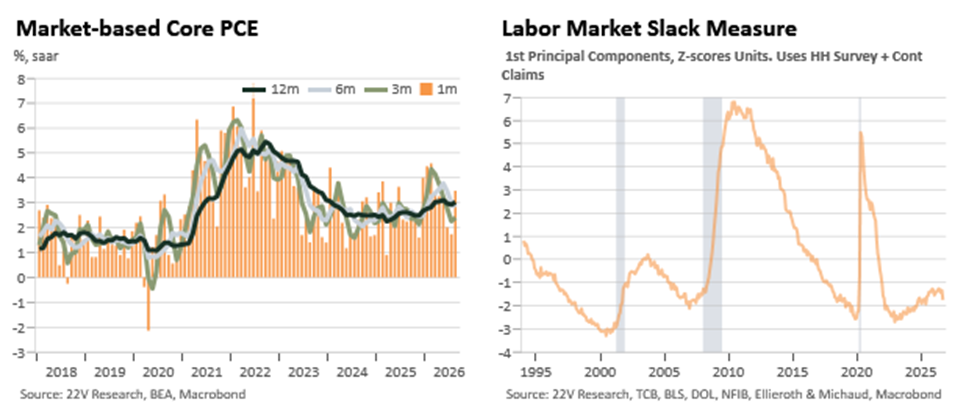
An Increasing Intolerance of Inflation and Shifting Guideposts. Waller’s framing of the inflation data and risks have shifted quite notably over the past few months and years. A year ago, he pushed back on the idea that legacy inflationary concerns should driven policy given the left tail risks in the labor market saying, “the Fed needs a better reason than inflation having been above target for 5 years to not cut rates.” In September, before the meeting, August inflation data, and benchmark PCE revisions, he wanted to “give disinflation a chance” and preferred to focus on 3-month inflation rather than 12-month. Today though, core PCE “has been between roughly 2.5 percent and 3.0 percent since the spring of 2024. This is obviously higher than we want, above our target, and not showing sufficient progress.” He also noted the risk that “the recent acceleration in inflation—after what soon will be five and a half years of it above the FOMC’s target—will lead consumers, investors, and price-setting businesses to revise up their expectations for future inflation.” This shift away from shorter-horizon inflation measures is welcome given the residuality seasonality which still seems apparent in the data, but I’m not entirely sure that it will stick when we next get a few good months of data.
New Hawkish Shocks and an Absence of Disinflation. Waller laid of a set of reasons which are perhaps best framed as falsifying his pre-meeting dovishness; it seems best to see these are scenarios where the dovish case slowly faded away. First, the war restarted and commodity prices moved notably higher again, implicitly falsifying the view from the spring of a spike and then rapid fade in energy prices. A one-off level shock is far different from a sustained one. Second, the AI buildout has started impacting broader consumer prices and projections for the size of it have “ballooned.” Third, further trade conflicts could put new upside pressures on inflation. The inflation expectations worry noted above accentuates these concerns with the spot inflation outlook.
Fundamentally, I still think that Waller, most of the FOMC, and many other economists and forecasters, have been too anchored to bottoms-up shock specific analyses of inflation. This has seen the inflation of the past few years as a sequence of one-off shocks which will fade away and allow inflation to return to target benignly. The surprising persistence and size of the inflationary responses points to a broader environment of hot NGDP growth where inflationary impulses are more easily accommodated.
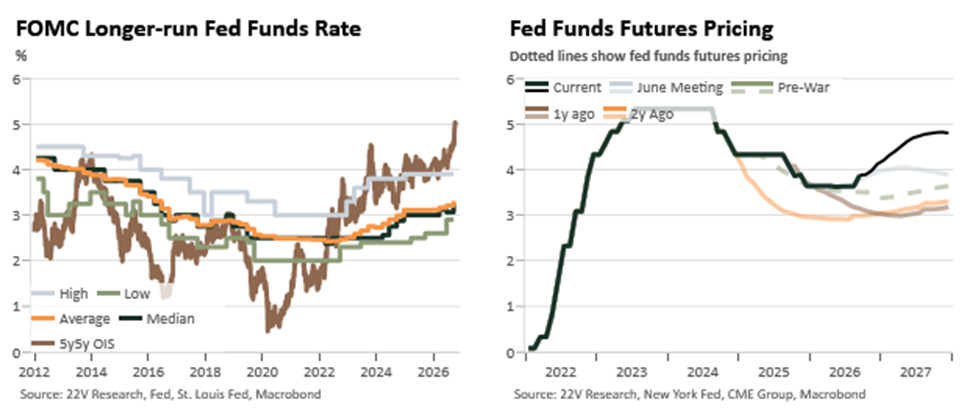
r* is Moving Higher. Lastly, Waller, in a building pivot for many of the centrists, implied that his view of at least short-run neutral is moving higher; alternatively put that non-monetary policy forces are having a fairly durable impact on the medium-term growth outlook. The AI boom is playing in these surprises, as are the fading impacts of the peak in tariffs on growth, but most importantly is the consistently positive news on the US consumer relative to too pessimistic of expectations. As a result, “with evidence that economic activity is strengthening in the second half of this year, I am not greatly concerned that tighter monetary policy threatens a damaging slowdown in the economy.”
On the labor market, while there have been almost no signs of concern in recent Fed commentary there have been only a few acknowledgements that it might be slowly retightening rather than just stabilizing. Given the recent high-frequency data flow in the labor market, continued gradual retightening over time seems increasingly likely from here. The SEP and most Fed officials don’t really seem willing to have that conversation yet because it would skew hawkish unless we get a disinflationary surprises.
The Rates Outlook. Waller was quite explicit in his preferred policy path for a baseline-like economy over the coming months. Appropriate policy from here will see the Fed make “additional hikes to support a timelier return of inflation to” 2%. There is not a sense of real urgency to the timing of these hikes, they “do not need to come at consecutive meetings, but they should be in place in an acceptable period of time.” Given that Waller is often high beta to his own views and is more willing than most Fed officials to move quickly and pivot, I am not entirely convinced despite favoring 3 cumulative hikes that he is one of the modal dots for 2027 is at 4.4% (median is 4.1%). It would not be that surprising if he thought that by late next year the baseline economic outlook would be consistent with returning to a gradual easing cycle.
Waller, along with other recent Fedspeak, leaves us fairly confident in the near-term baseline of Dec and Mar hikes, with either a continuation or stop-then-start possible next year if expected disinflation falters and the labor market has shown signs of retightening (A Guess at What a 5x Hike World Looks Like).