A Guess at What a 5x Hike World Looks Like
- At the September meeting the FOMC laid out a path for 2-3x cumulative hikes contingent on a gradual slowing in inflation and an unemployment rate which stabilized right around current levels.
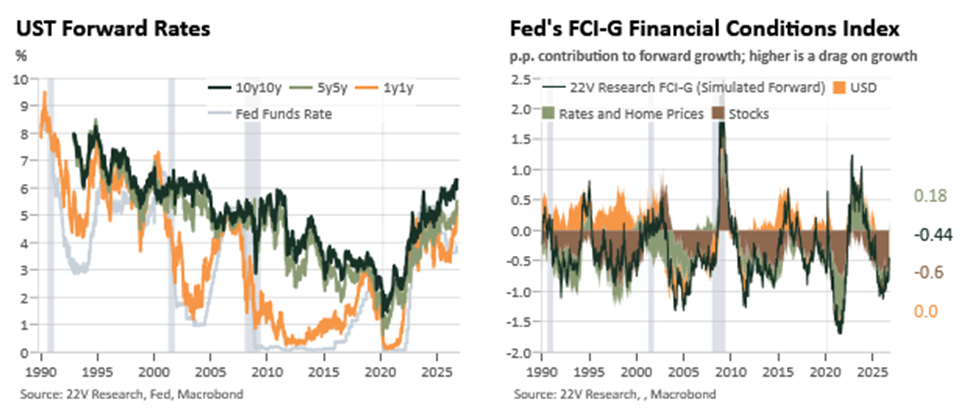
- Market pricing is notably more hawkish with a ~4.5-5x hike path.
- The data today changed the inflation outlook little but presented a notably stronger growth backdrop. This data was likely soft enough on the inflation front that it would take an extremely strong implied print for Sept to make an October hike the baseline.
- To realize the market’s path will require inflation at or above current forecasts (a bit benign but not as implausibly so as they have been) and a labor market which keeps retightening. Hot growth with better-than-expected inflation will keep rates elevated but likely not lead to an additional above-baseline hiking impulse, while hot inflation would.
- The market’s overshooting of the dots seems to have been driven by a rapid shift in its assessment of the growth outlook, a worsening policy risk backdrop, and implicit skepticism of the Fed’s moderately optimistic inflation forecast.
In my view the hawkish risks for the Fed can come in directly come from the inflation data itself, particularly in continued upside stickiness of services inflation (something the Fed has done a poor job acknowledging even as its failed to disinflate over the past 2y), or the labor market and growth continuing to surprise to the upside and retighten from here. This second channel would require likely in-line or hotter inflation data to generate enough additional concern to require further tightening against. Better-than-expected inflation and an improving economy would show a positive supply shock, the first in quite some time, and not be a sign that imminent tightening is required once rates are clearly into a non-accommodative position after 1-2x more hikes.
There are multiple of underlying economic channels which could cause the Fed to get pulled into this more hawkish path by the data. The data today did push back notably on October hike odds, barring an extremely hot September inflation print, so the focus is on the risks to the medium-term assessment of 2027. The below points are likely to be correlated with one another given that they are all more likely to be apparent when the economy is running at or above estimates of potential growth so the reality is that a further move into a more aggressive hiking cycle will likely lean on all of these forces to varying extents. Anecdotally these ideas get far less pushback from market participants than they used to even just a few months ago.
The five main stories that could take us (likely requiring at least a few of them) into a more aggressive hiking cycle as I see them are:
- The war further escalates, and the recent progress made on Middle East oil supplies reverts back to a much lower level and as refined product prices move even farther up, inflation expectations for firms and households start deanchoring more clearly across horizons. This is the one outright stagflationary shock.
- Services inflation shows little sign of deceleration from its currently quite elevated levels as a strong domestic economy allows firms to pass costs through relatively smoothly and keep margins elevated.
- Core goods inflation continues to run notably above the pre-covid benchmark many still assume as a baseline with the second round impacts of the war gradually radiating through global supply chains. On top of this, the direct impacts of the AI boom on inflation are being most acutely felt in electronics prices. Tariff refunds have also been helpfully disinflationary over the summer but that force is fading. Both of these forces
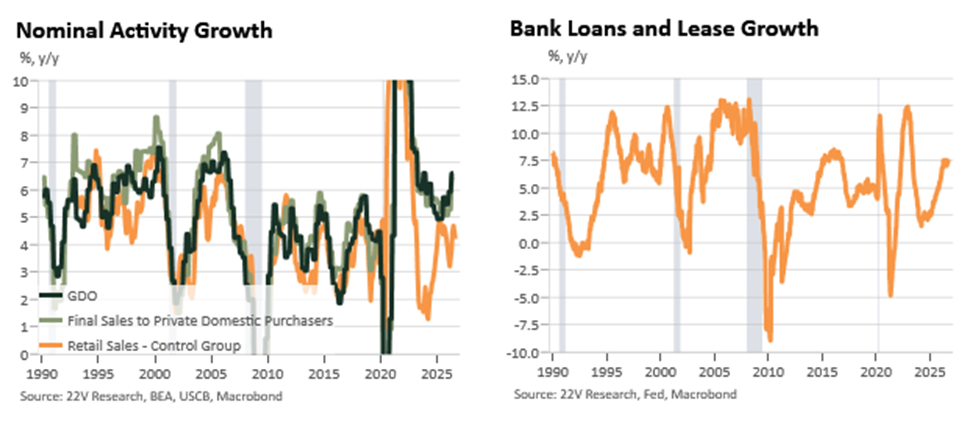
- The reacceleration in much of the economic data means that the initial round of hikes slows growth versus its counterfactual but may not actually slow observed growth all that much. The fading of the credit tightening impulse from 2022-25 plays a large role here as does the global reacceleration in the business cycle, highlighted by the main PMI and sentiment measures. The fading growth impacts of the past few years supply shocks seem to be playing an underappreciated role in the timing of the trough in the labor market late last year and may be a continuing underlying source of growth momentum this year; the near-term impacts of the war could net that out but so far the real growth impacts seem much more apparent overseas than in the US.
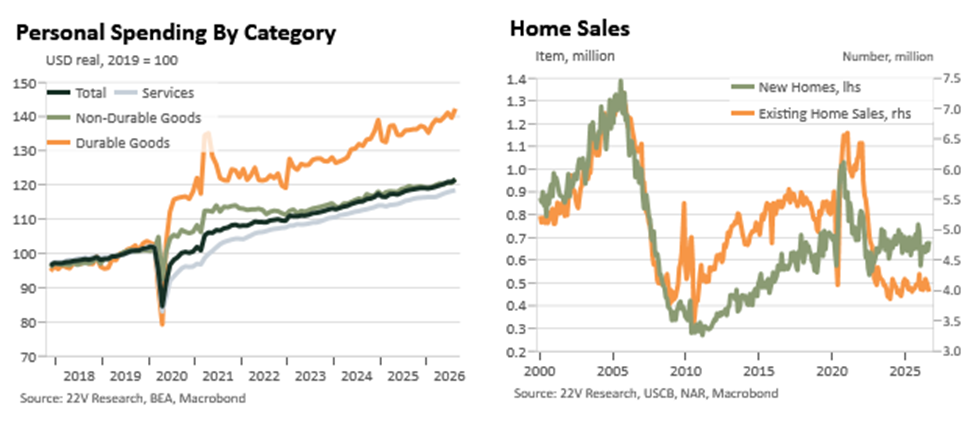
- Related to the above point, the tightening impulse from higher rates is smaller than expected. For example, our daily version of the Fed’s FCI-G model suggests that the changes in interest rates and house prices have gone from providing about 25bps of stimulus to growth at the turn of the year to ~20bps of tightening (FCI-G effectively maps deviations from recent trends through the Fed’s workhouse macro model to show the impact of markets on growth over the next year). In contrast to more normal environments, the housing market is already quite weak and may have relatively little room to fall from here given that much of the data suggests that with stressed affordability concerns volumes are very close to life-event and demographically driven levels. Consumer durables spending has been remarkably robust this cycle even as rates have moved around and may be less sensitive than expected. Consumers and non-financial corporates have also delivered substantially, and their net worth positions may attenuate the usual rate impact further. On top of that, current rate levels consistent with 5x hikes may not appreciably change AI- or tourism-related spending impulses at all. This point highlights a lower impact from a given level of restrictiveness but if the goal is to restrain growth and inflationary impulses, the net impact on policy is observationally equivalent to a higher short-run neutral rate.
My own baseline remains that the Fed hikes again in December and likely March. That is a very tentative baseline and I am quite open to the idea that the Fed may ultimately hike much closer to what the market currently prices as some/all of the scenarios above are realized. Growth is running above the Fed’s estimate of potential, the unemployment rate seems to have cyclically peaked and the labor market may be starting to retighten (even the FRBNY’s dovish Williams said as much), and inflation remains far from target after years far from it.
A 2-3x cumulative hike baseline requires a bit of a slowing in topline growth and an absence of further sharp upside shocks in inflation; that seems the right baseline but the post-covid experience highlights the precariousness of any disinflationary assumptions, particularly when growth has been surprising to the upside.