The Latter Part of Earnings Season Continues the Strong Tone
- The latter part of earnings season largely continued the themes we noted in early calls, largely from the big banks and airlines (see more here).
- The consumer remains very strong, although there is decent evidence that June spending growth represents a local peak due to the moving of Prime Day and World Cup related demand.
- There is growing evidence that lower- and middle-income consumers and seeing wage and spending growth rates catchup with moderately decelerating growth in higher income consumers after a few years of the K-shape (see notes from BAC and PNC). The narrative always made things out to be too pessimistic given the distributions of income and spending but the broadening, around a solid overall trend, should help many firms.
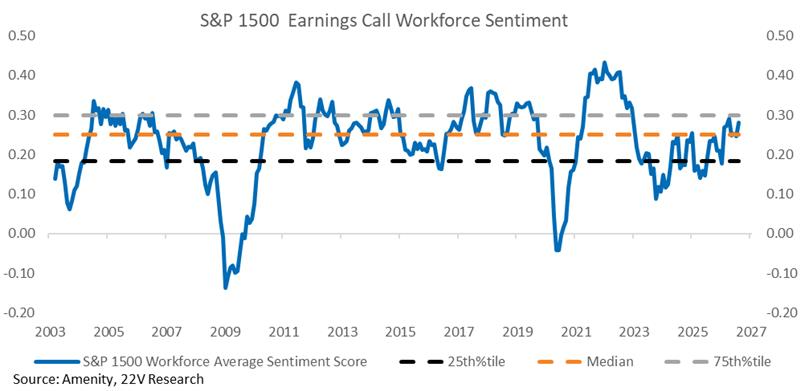
- Corporate sentiment seems to be broadly improving as the shocks from tariffs and the war fade. Domestic demand is broadening out gradually after 3y of quasi-recession.
- In general, the past few quarters have seen a reduced macro emphasis in many calls, which in my experience suggests a less worrisome backdrop with more emphasis on corporate fundamentals rather than macro risk factors (rates, supply shocks, geopolitics, etc).
- Carlyle’s CEO Harvey Schwartz summed things up well: “when we look at our proprietary data, largely KPIs rolled up each month across our nearly 300 portfolio companies, we see a US economy that continues to expand annual rates of 2% to 2.5% in real terms with 6% annual growth in corporate revenues.”
Payments Growth was Very Strong, with a bit of World Cup Flattery. Topline consumer spending continues its very strong pace. There seems to have been a bit of post-World Cup and 4th of July slowdown, as well as a whipsaw effect from Prime Day from July into June, but earnings calls make it clear that it’s probably better to frame it as a June jump rather than any sort of underlying deceleration. Leisure and hospitality remains a bright spot; the card providers and banks have highlighted this frequently across 2026. It is also important to note that outside the reporting from the card companies and banks, we get a fairly poor lens on consumers services spending from listed companies.
- “Now let’s look at drivers through July 21, with volume growth in constant dollars. US payments volume was up 9%, with both credit and debit up 9% year-over-year. A step-down from June, primarily due to retail including the timing of promotional shopping events, the lack of 1-day’s mix benefit that helped June, and the change in the cost of fuel.” – V
- “As we look at the first four weeks of July, our metrics remain relatively stable and strong. Looking specifically at Card not present volume, let’s focus on July compared to June. The sequential decline is primarily driven by timing, including the large retail promotional events that happened in June this year as compared to July last year and by a mix of days.” – MA
- “US Consumer spending was up 11%, the highest level of growth since Q1 2018, excluding periods impacted by the pandemic.” – AXP
- COST same store sales ex gas and FX have slowed a bit from their springtime local peak but remained strong at 6.9% in July.
- “Turning back to the second quarter, consumer spending was healthy, in particular in the US. Consumers continued to prioritize travel with longer lengths of stay and longer booking windows, even as air ticket and hotel prices rose.” – EXPE
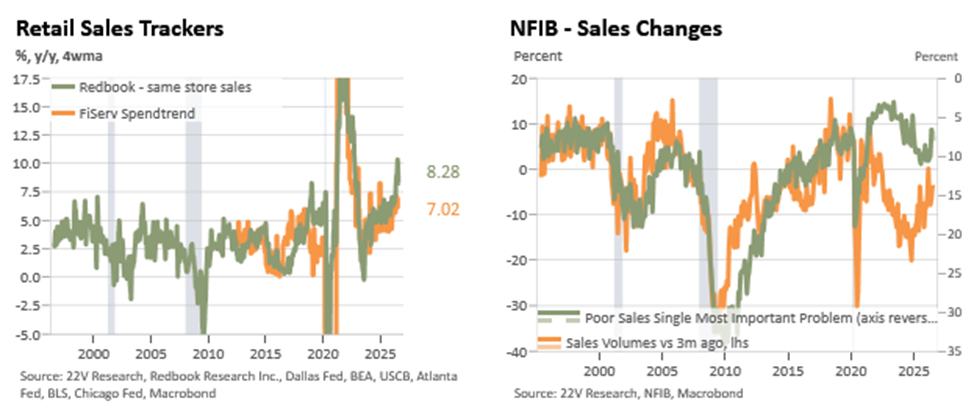
Consumer Strength Keeps Broadening Out. Travel and leisure demand is very extremely strong across cohorts; this may partially reflect the impacts of tariffs and still high rates making goods consumption relatively less appealing. It is increasingly clear that the strength of the consumer is broadening out across income bands and cohorts. The increasing strength of middle and lower income consumers spending is a key part of the topline accelerations seen in many areas, although on a spend weighted basis we have to remember that the upper-income consumer will always matter most. This does not seem to be happening solely as a result of gas prices and is taking place with consumer balance sheet distress declining rather than increasing (see our prior earnings season note for more color from the banks on this point).
Retailers and some restaurants did not share this broad-based optimism though. Tariffs and the reemergence of goods price inflation may be playing a role there, as could still ongoing consumer demand shifts in the post-pandemic ever more online economy.
- “Growth across consumer spend bands saw incremental improvement from Q2, with the highest spend band continuing to grow the fastest. Across our volume, both discretionary and non-discretionary spend remain strong. We do not see signs of the lower-spend consumer weakening in our volumes.” – V
- “On your question about, mass versus affluent engine, I would say they’re holding up well both across mass and affluent. Certainly in the US but across the world as well. We try and track the best we can as it relates to what we’re seeing in spending patterns based on the product codes that are out in the market which serve the different categories of customers. And when we look at that, we’re seeing generally strong trends across both mass and affluent. What you do tend to see is higher growth in the affluent side of spending. But that’s kind of not a new phenomenon that’s been with us for some time now.” – MA
- “Restaurant spending, our largest T&E category, was up 10%. Airline spending picked up further from the strong growth we saw in Q1, also up 10% year-over-year. Our customers are showing strong demand for travel, with global Amex Travel bookings up 22% year-over-year in the quarter.” – AXP
- “When we look at our middle-income consumers who, despite the affordability issues and not being happy about gas prices, they’re in relatively good shape.” – WH
- “I do think we are seeing the bottom and the mid, the middle class is getting back in the game and all these mid-scale, upper mid-scale, everything sort of, that has been fairly weak over the last couple of years is really strengthening.” – HLT
- “In the US and Canada, we expected strong demand trends that extended into July across chain scales and customer segments to continue.” – MAR
- “Sales growth in Q3 was broad-based across generations and income groups, and across both Starbucks Rewards members and non-members, even with the continued pressure on US consumer sentiment.” – SBUX
- “But we’re benefiting and utilizing tariffs [refunds] to be able to drive value to our customers, give us a strong position, especially in farm and ranch, and to be able to be competitive in an environment that we view across retail as a renewed competitive environment as the consumer is pushing for value very much like 2018 and 2019.” – TSCO
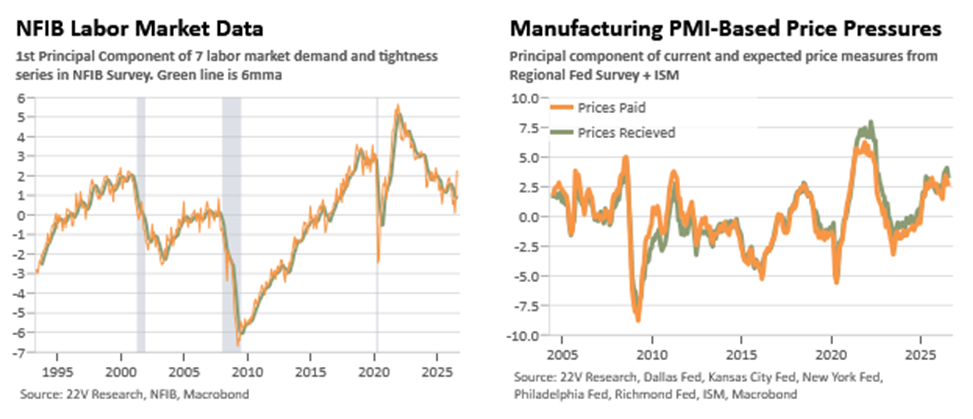
Business Sentiment Seems to Be Turning Higher. After the past few years mini-recessionary slump, corporate sentiment seems to be gradually picking up. This extends to hiring intentions which are slowly improving in the PMIs and related data, as are capex measures. Business travel demand also seems to be picking up in another positive sign.
- “We’ve now had three quarters of sequential growth, that continued into the post quarter, and so we’ve been steady, we’ve been consistent for some time. I think everybody worries about inflation. Everybody worries about renewed tensions in the Middle East, but barring some major impact from that we feel good, given we’ve already had three straight quarters, that we’re in the early parts of recovery.” – RHI
- “All that investment going on in the country, the people that do it aren’t staying in luxury hotels. The people that do it are staying in midscale, upper midscale And that’s, what we’re seeing. And as I think I already said, the biggest single change we’ve seen over the last couple quarters is midweek business transient growth, which is exactly what we’ve been dying to see.” – HLT
- “The good news is that if you look business transient group is up about 5.5% and business transient was up over 2% year-to-date. And I think that’s a very positive sign.” – H
- “There’s… significant levels of private investment going into the economy and in building. And that’s not just around AI, that’s energy, manufacturing, chips, pharmaceuticals. And so, all of that really creates an environment where we see business demand continuing to be strong as we go forward in the US.” – IHG
- “Second quarter comparable US RevPAR increased 5.4%, driven by strong demand across all segments, with US business travel and group exceeding prior expectations and a strong World Cup.” – HLT
- “Outside of the US, the positive effects of the AI CapEx boom are visible across Asia, and reality seems better than market perceptions in Europe. The energy impact is real, but so too are the defense and infrastructure-related industrial orders, which made a meaningful contribution to growth in recent months. All these near-term market dynamics continue to support the longer-term considerations that drive the need for capital investment around the world.” – CG