

July FOMC: the Market says More Roosevelt, Less Maradona Monetary Policy
- Warsh seemed to endorse Mervyn King’s Maradona monetary policy (do little and let the market guide counter-cyclical financial conditions) when the market is clearly supporting policy clarity and potential action (Roosevelt’s ‘speak softly and carry a big stick’).
- The immediate market reaction, with sharp twist steepening as very near-term rates rallied and long-term rates sold off sharply, was driven by wider breakevens with twist steepening real rates, did not suggest confidence. A weaker USD and down equities further confirmed the rates market judgement. Given the harsh reaction it seems that the market was primed to look quite favorably on a hike today or signal of a looming one.
- Warsh offered repeated assurances that the “Fed is on the case” to deliver price stability with the labor market “more or less at equilibrium.”
- It is one thing to incorporate financial conditions, quite another to lean on them entirely without any newly informative guidance about policy or major economic issues. Maradona policy seems much easier when markets have an understanding of who you are as a policy maker. There are always feedback loops between the data and markets, but by suggesting that the Fed shouldn’t play any role in crafting market expectations of its own actions (which govern front-end yields), Warsh seemed to want to remove a key countercyclical stabilizer and, at least temporarily, replace it with term premia volatility.
- While a possible QT substitution for rate hikes had always been a possible Warsh policy action, this goes notably farther and seems to preference short-term borrowing over longer-term investment relevant bonds yields.
- As the June Minutes noted, if inflation comes down quickly and appreciably there will be no need or real debate around hiking from here which may bail out the Fed and the long end. But, at least for a time, the lack of reaction function and FCI clarity makes it less obvious what happens if inflation does not rapidly start to descend.
Maradona Monetary Policy. The Chair’s deference to market pricing over the course of the press conference left one feeling that Mervyn King’s (on the Communications task force) old Maradona monetary policy allusion finds a clear supporter inside the Fed now. Over the past years we have repeatedly noted that markets often move around in tune with higher frequency cycles in the data, eliminating some potential need for fine tuning policy adjustments the Fed might otherwise not make. This has been a cyclically stabilizing force, based off of pricing both potential Fed reactions and shifting inflation risk premia, but leaning too much into the impact of higher rates in tightening financial conditions was clearly a bridge too far for markets today. As I see it, the fundamental issue is that markets are far more comfortable pricing policy actions, even if hawkish and FCI tightening, than pricing in opacity, potential inappropriate policy, or policy induced volatility. The risk is that too much deference to market-led tightening traps the Fed in a BoJ-like loop where higher rates tighten financial conditions as the FX eases and policy doesn’t act, which furthers that loop, whereas a hike or two could arrest that cycle and stabilize the whole curve.
Rates Seem Adrift, and Inclined to Raise Term Premia, without Any Policy guidance. The circularity of removing reaction function and outlook data (“playing the ball not the referee” is a wholy incomplete description of what rates markets do given that the Fed’s reaction function still will lead it to change policy in response to data over time, but how exactly requires either a lot of surprises or some information), while still expecting markets to help policy be appropriately countercyclical and potentially not act as a result, left markets feeling comfortable. Rates markets seem to suggest that the risk of doing too little for too long appreciably increased with even with 1y1y rates (the moderately predictable medium-term) effectively flat on the day, even as near-term rates rallied, and the equilibrium and term premium driven 10y10y was up ~10bps and the USD sold off. The selloff in nominal yields was driven by inflation breakevens across all maturities, worst at the front-end, a sharp change from recent moves, along with an extremely sharp steepening in real yields. This combination of steepening and weaker FX is a classic policy error trade and risk assets responded similarly poorly.
Warsh Insisted that the Fed Will Bring Inflation Back to Target. One suspects that markets would prefer a bit less of Mervyn King’s Maradona and more of Teddy Roosevelt (‘speak softly and carry a big stick’) from the new Chair. Warsh, as he has done in every other public appearance, repeated that “inflation remains elevated… [and] we will deliver price stability.” Warsh certainly seems open to the possibility that the Fed may eventually have to hike / act in order to bring inflation back to target, saying “did the Fed make a change in its policy rate today? No. But I think that’s the beginning of the story not the end of the story.” This certainly seems to leave open the door to eventual hikes if necessary but the broader tone of “watchful thinking, not watchful waiting” did not leave markets convinced that the FOMC is willing to be appropriately nimbly countercyclical.
This is not to say that Warsh was all dove or said nothing about his views on policy at all, he was clear to note that “any central bank, especially a central banker where the labor markets are more or less at equilibrium… who sees underlying inflation moving higher is more inclined to tighten policy [and vice versa],” but without a real sense of how he thinks of inflation at the moment or how rates, the balance sheet, and financial conditions (UST rates, equities, credit, lending) intersect in setting appropriate policy there is little to build off of. Whether he wants us to or not, market participants will learn about the Warsh Fed’s reaction function over time as they do or do not respond to the incoming data.
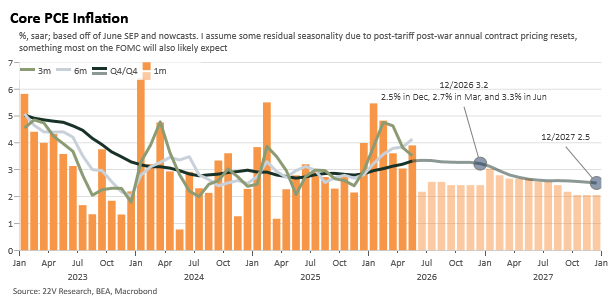
“Mistaken Impression that the Fed’s Implicit Inflation target [is] above 2%.” Unfortunately for the Chair, the actions of the Fed make this far from clear as does his task force on understanding inflation dynamics and targets. This problem far predates him and arguably saw its roots set during the Yellen years, but it has gotten worse over time. The actions of the FOMC over the past few years, and continuing today, show that the willingness to lean on dovish exclusionary measures of inflation and the logic of optimal control in fighting recessionary risks even as inflation was definitively above target[1] has naturally led to uncertainty about a de facto rather than de jure higher target.
His owns views didn’t seem to help much in this sense by only vaguely saying that he looks at a “broader set of inflation data than PCE. So without fully revealing my cards, I am trying to understand like my colleagues, what is the generalized changes in prices.” At this point in the press conference, the market judged this intentional opacity harshly. If he is to insist that the Fed will bring inflation back to target, it seems only fair to know how he will assess the proximity of inflation to target.
In time a range target, or similar maneuver, may help resolve some of these tensions of excess precision. The Chair seems to clearly look up to Greenspan but while his rhetorical flourishes had plenty of Greenspan’s old opacity in them, the inflation side of the mandate is clearly not meeting the Maestro’s definition of price stability as that where household and firms don’t really think about it.
The “Economy is Showing Impressive Resilience.” Warsh’s descriptions of the economy echoed the consistently hawkish-optimistic tone we have heard from the new Chair in his recent appearances as well as from other members of the FOMC.
June CPI had “Not Much” an Impact on the Decision Not to Hike. After Gov. Waller seemed excessively data dependent in remarks prior to the June CPI report, or at least suggested that his patience for any further hot inflation has ended and its now a much more asymmetric reaction function against any single upside inflation surprise, Chair Warsh said the broader Committee is still weighing things patiently and focusing on trend dynamics in inflation rather than reacting to the very highest frequency outcomes.
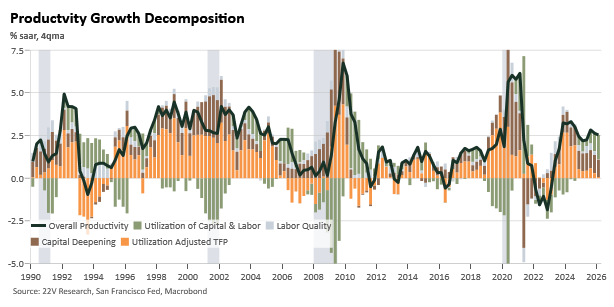
Productivity May Not Be Panacea. Beyond the total rewrite of the post-meeting statement back in June, the clearest impact of Warsh on it has been the new declarative statement that “productivity growth and capital investment are strong.” Warsh repeated an implicit hope that the supply side of the economy can help bring inflation down over time. The strength of this assessment is concerning though. Productivity growth is likely to be quite low in Q2, has averaged under 1% the prior 2q, and broadly shows signs consistent with an ephemeral post-slowdown rebound not necessarily a durable lasting shift in its post-2015 trend. As inflation task force member William White has cautioned, acting dovishly on the basis of an upside productivity growth shock can be very risky but doing so before that surge has even become apparent in the economy would surely risk an appreciable policy mistake.[2]
The Minutes and Other Upcoming Fedspeak Will Likely Be Greeted with Relief. The June Minutes discussion of the conditionality for hiking or not was the most useful piece of Fed communications in some time and offered useful understanding of the reaction function for a range of views across the Committee without offering explicit rate or timing-based forward guidance. One assumes, with a more lively dissenting meeting, the Minutes will be similarly helpful from here. The rest of the Fed also does not seem to be ceding their roles in communicating more informatively.
I.e. don’t risk a mild recession once inflation is below 2.25-2.5% or so if you are convinced that inflation expectations are durably, which if iterated across time and an environment of upside-skewed inflationary supply and policy shocks becomes clearly problematic. ↑
“Somewhat counterintuitively, this means real interest rates rising to prevent current spending from increasing excessively in response to anticipated income gains. If one accepts this logic, then it was an error for Greenspan to lower rates in the late 1990s as productivity surged. Moreover, lowering rates today in the face of a similar shock might be even more dangerous. First, the productivity gains today are presumed, rather than actual as they were in the 1990s. What if they do not materialize?” ↑

