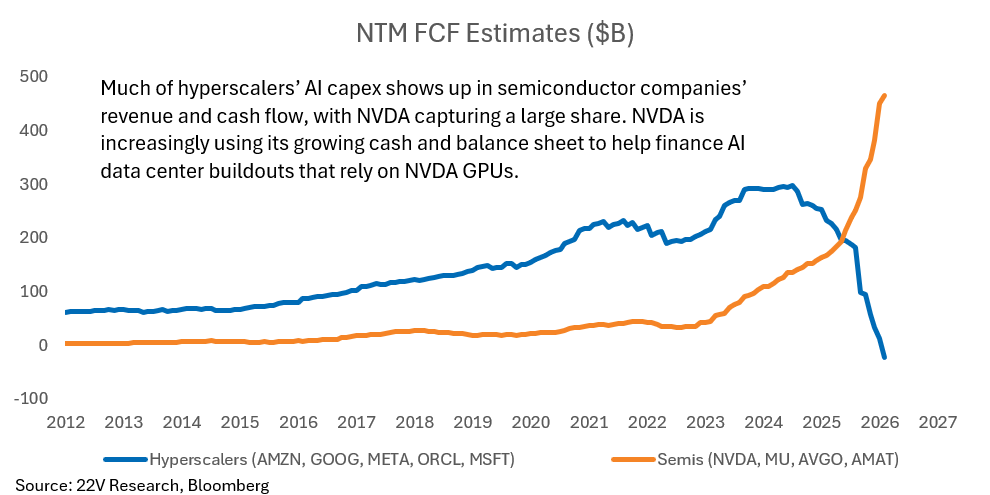
DAILY STRATEGY: Main Point – Much of the hyperscale’s capex shows up in Semi’s cash flow. NVDA is using a portion of that cash flow to fund data center buildouts. Those data centers will presumably buy NVDA chips, but also all the other infrastructure associated with the AI buildout. Investors seem fearful that if Hyperscale’s AI capex slows, a negative feedback loop could develop quickly. Hyperscaler CDX spreads moving wider increase those fears. South Korean stocks being -35% off their June 23rd highs suggests risk to AI capex spending plans (Hyperscaler AI capex is South Korean and Taiwan GDP) and threats from Chinese competition*.
Net net, we thought fundamentals would support Price Momentum through earnings season and that has been wrong. There are too many questions and not enough answers related to the AI buildout. The ROI from Hyperscalers investments and the SCALE of AI value creation are still open questions. I.e. will the benefits of AI go beyond S&P 500 companies. That is needed to justify AI capex expectations. How the profit pool settles for many companies depends on how the open vs closed model dispute resolves. Just to name a few. Time should help investors make more informed decisions (we lean positive), but it will likely take a few quarters.
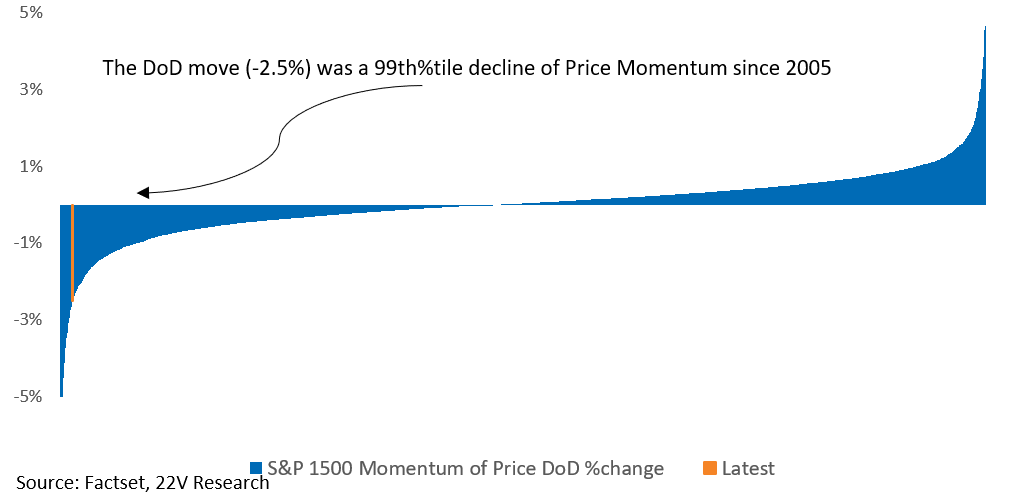
Details – Momentum fell -2.5% yesterday, a 99th percentile d/d move, despite oil and rates moving lower. Chinese competition in chips (CXMT market share expansion) and open models are cited as reasons for the weakness. Along with the increase in CDX spreads for Hyperscalers.
We can help some on the circular finance question. As Gerard highlighted HERE, circular finance deals don’t put the economic cycle at risk**, but the longer term earnings story is becoming more uncertain. NVDA’s latest $750B in AI deals is the latest example of the rapidly increasing value at risk in circular deals (HERE), and the risk profile is compounding as Hyperscaler free cash flow turns negative. More of the growth in the buildout is being funded by companies that benefit from it, clearly a problem if AI ROI disappoints. FYI – the scale of the current AI buildout is on par with the TMT boom. It is not leveraged like it was then, but investors seem to be concerned about that reality.
It is increasingly urgent to monitor what companies are saying about the value creation of AI. AI proving to be worth the investment is the cleanest way to prove the circular finance deals aren’t going to become a problem for issuers.
The margin sentiment and estimates of AI users continue to exceed non-AI users (HERE), but the scale of the circular financing may be shifting the burden of proof. To that end, the clearest evidence is those that quantify the estimated impact from AI.
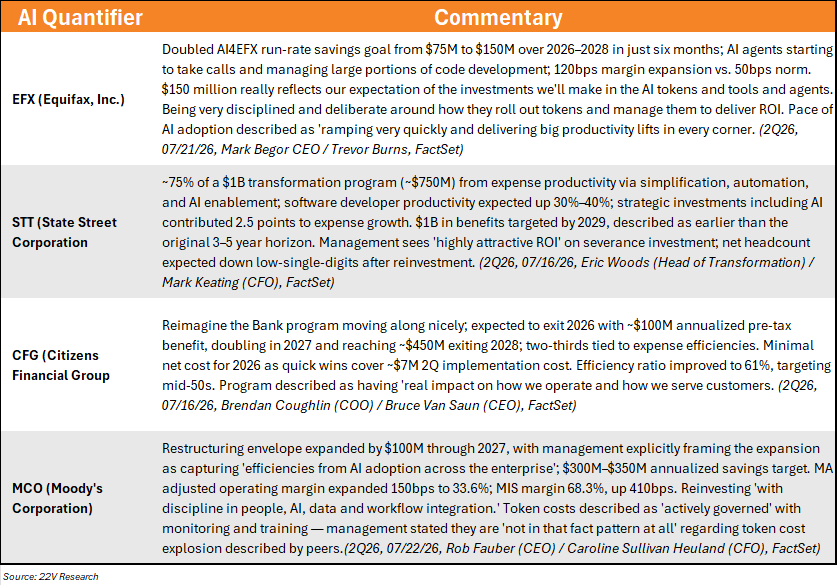
Last quarter, there were 17 companies that guided to, in aggregate, ~80bps of margin improvement (HERE). It is too early to draw a comparison from this quarter to last quarter (only 28% of the way through 2Q earnings). So far in 2Q reporting, only 4 companies have quantified the expected benefit from AI – EFX, STT, CFG, and MCO – guiding to ~20bps. A smaller number, but at this point last quarter, there was only 1 quantifier (CFG). We will continue to monitor earnings.
*There is a lot of economic activity in the AI buildout, but it isn’t all or even most of growth in the US (HERE). The debt isn’t widely held or held by people in weak financial positions. If AI Capex disappeared today, of course there would be an economic headwind, but the buildout, in its current state, does NOT look like the TMT bubble or the housing bubble.
**Competition from Chinese chips is getting attention too (HERE). Michael Hirson, head of 22V China research, emphasizes reports of homegrown DUV chipmaking is not new news and the most recent reports do NOT suggest a further acceleration relative to prior reports. The reports do not indicate China has a model similar to the state-of-the-art ASML DUV either. Hence our focus on earnings uncertainty from rapidly scaling circular finance deals.
Charts and details…
Hyperscaler CDS have moved wider….
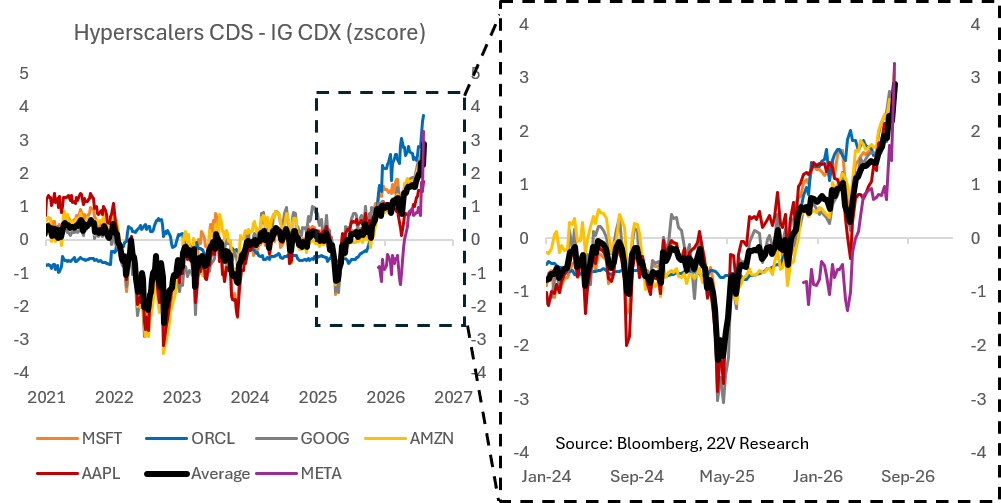
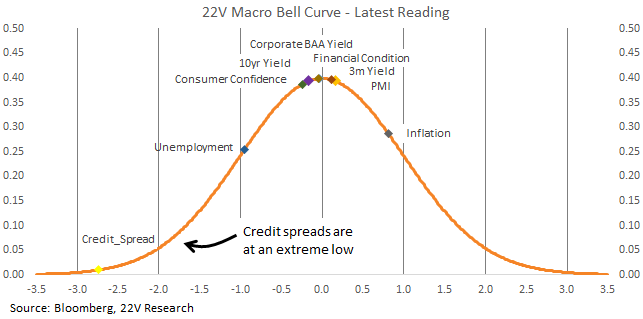
But CDS spreads are unusually low in aggregate.
Details from the Quantifiers are below.
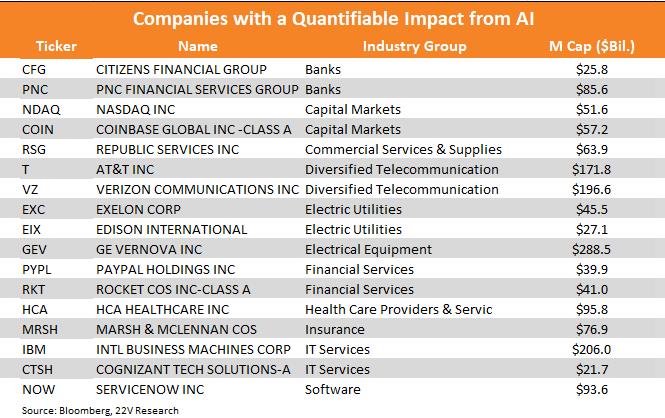
FYI, last quarter’s Quantifiers are here.
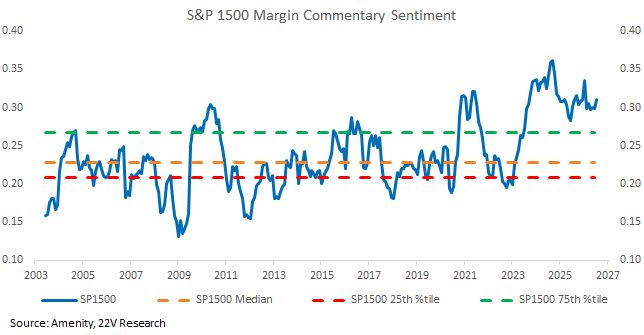
S&P 1500 margin sentiment – how company executives sound about the margin outlook – have hooked back up so far in earnings season. The current reading is the 91.6%th percentile.