

An update on SPCX seems timely. The IPO has concluded with shares now up only 11% from the IPO. (after being up more than 60% within the first 5 days of trading), the Nasdaq early inclusion is complete as is most of the first of buying for index tracking and analysts have initiated on this rapidly evolving company with price targets ranging from $300–$800 inclusive of visions of the 2040s.
SPCX remains catalyst rich and remains a go to name to invest in the emerging space economy. In a market driven by high correlations in the AI trade, SPCX stock should chart its own path with company specific event paths and above peer optionality.
In our initial note on SPCX before the IPO (link) we noted the path would not be a straight line and that it would be catalyst-rich – this view has not changed. SPCX is positioned as a leader in the commercialization of the space economy through payload capacity and development of IT infrastructure (Starlink, ODCs); it has also established itself as a major AI compute provider with the Colossus project. Lastly, optionality and wildcards exist with a new LLM / model release in combination with Cursor due this week and the potential for Terafab in the future.
The next 6 months for SPCX stock will create tradable and position-building opportunities for what is to come in 2027 and beyond. Trading ranges will be colored by sizable unlocks of non-Musk stock (57.5% of shares outstanding), two Nasdaq rebalances and the company’s first two earnings quarters as a public company. Here are a few roadmap items we think are important to consider for navigating this period.
Index rebalances and unlocks – a brief study: SPCX was added to the Nasdaq 100 on July 7th at a float-adjusted market cap weighting. The next rebalances in September and December combined with the scheduled lockup expirations will present two sizable index tracking buying demand points. Based on our analysis, SPCX will achieve a full market cap weight in the Nasdaq by the December rebalance, marking the final lockup expirations (ex-Musk’s shares, which are restricted for 1 year from IPO) and major index tracking demand. The S&P will not be adopting this fast-track inclusion process, and any potential S&P inclusion will have to wait until June 2027 or later.
The chart below represents a timeline through year end indicative of buying demand and potential selling pressure. Please reach out for details on assumptions and to review.
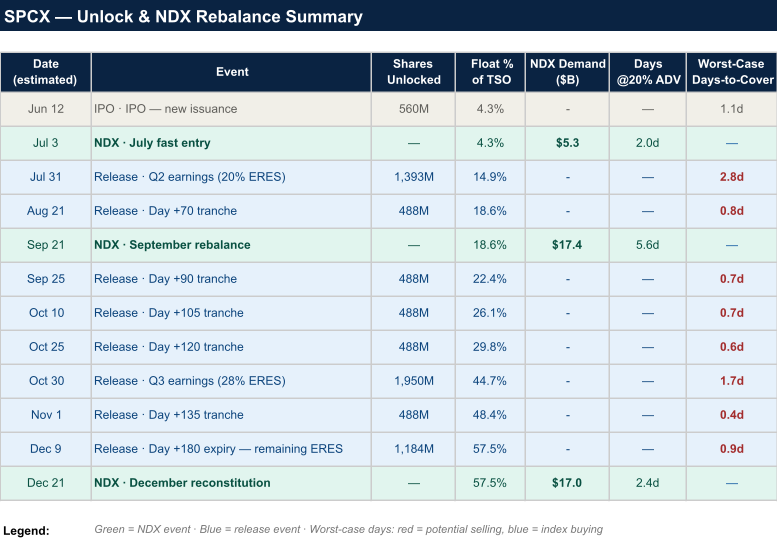
Source: 22V Research; Assumptions: Rebalances occur quarterly (~Sep 21 and Dec 21 2026); Index tracking demand is ~$800B; Nasdaq will weight the full market cap once 33% of the float has been unlocked (in this case at the December reweighting).
Between now and the September rebalance, there will be two points of shares unlocked, the largest one being at Q2 earnings. Once the Q2 earnings date is set, there will be a potential for unlocking an additional 10% of Early Release Eligible Shares (non-Musk stock; ERES). This will be dependent upon shares closing above $175.50 for 5 of 10 consecutive trading days ending on the earnings release date.
The scenarios of share trading are numerous; we would indicate three main points. The share unlocks and quarterly earnings in between rebalances will likely exacerbate any negative news flow. Additionally, any selling pressure could be front-loaded if pre-IPO shareholders that sell are trimming vs. selling entire positions. Lastly, share price will play an important role – if shares remain near the IPO price, there may be limited selling initially, possibly putting additional pressure on any lift around rebalances.
The second period to navigate will be after the September rebalance where there will be a series of smaller unlocks as well as the Q3 earnings unlock of 28% of ERES (Oct / Nov) and 24% of ERES by Dec 9th.
The final Nasdaq rebalance of the year will take SPCX to a full market cap-adjusted weighting in the index, generating roughly the same index buying demand as the September reweighting.
Our assumptions are available upon request and we would welcome a chance to walk through these and discuss potential options trades in tandem with Jeff Jacobson.
Upcoming catalysts and Q2 earnings:
Starship 3 testing and path to commercialization: Per recent reports (link) SPCX is prepping for a July 14th launch of Flight 13. This is one of many tests and we would expect the cadence to remain frequent – supportive tests will support the shares.
ODCs: SPCX has released reference designs and we should expect to hear more updates around test dates.
Terafab: In early June, SpaceX won tax breaks for Terafab in Grimes County, TX and cited an initial $55B cost (joint venture with TSLA). What is not clear is both the timing and the number of years to spread the capex across. Finally, Terafab will want to take part in the CHIPS Act benefits that require groundbreaking before year end as this legislation expires at year end. It is unclear if this will be extended.
Q2 Earnings: (TBD estimated mid-August)
Capex trajectory and composition will be important to calibrate. Below shows the historical and consensus capex as well as mix.
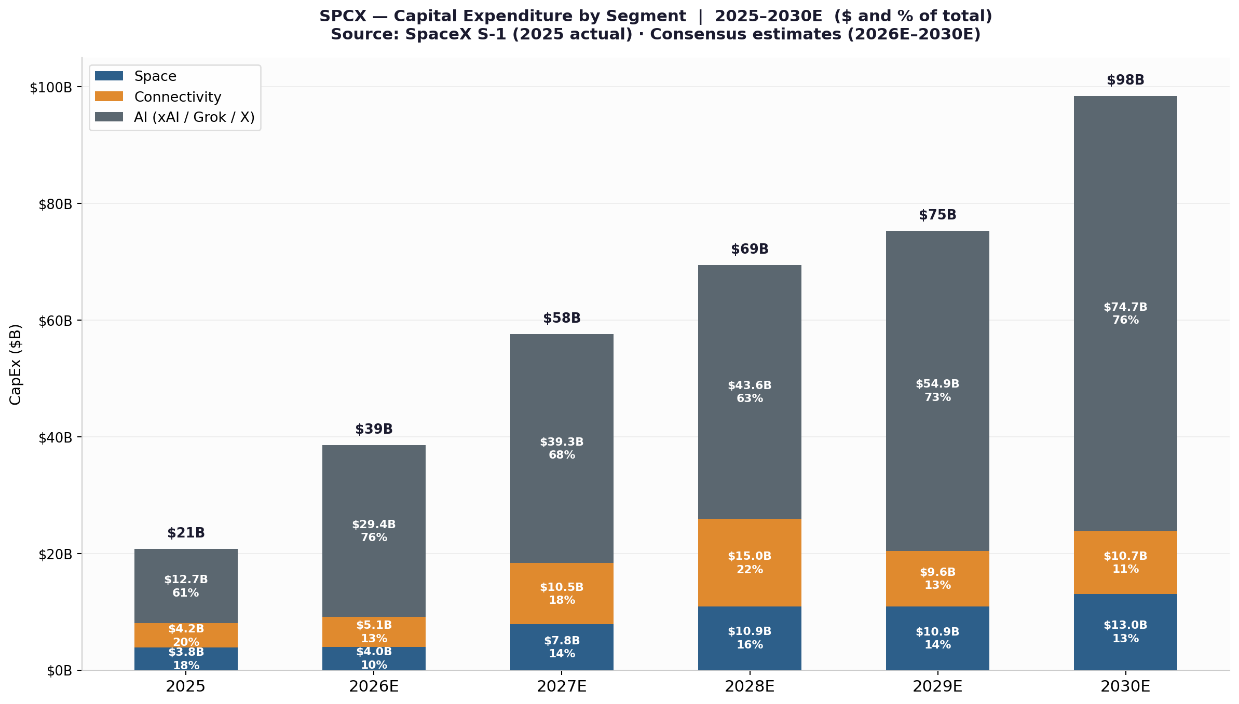
Source: Bloomberg, SPCX S-1
A few things stand out here – the predominant capex driver is AI (comprised of data center, cursor, LLM). Clarity around the business priorities within AI and capex trajectories will be important. The potential mix change as Starship 3 is commercialized and Terafab initiatives move forward is worth monitoring.
The cash position and capex trajectory should not be a point of concern in the near term as the company has strengthened operating cashflow. The compute leasing deals announced prior to the IPO combined with the IPO proceeds and subsequent debt offering provide a reasonable runway through at least 2027.
AI (SpaceXAI): Anthropic and Google compute deals will not be flowing into the numbers in a large way until Q3. Cursor is also expected to close in Q3; therefore, it will not be present in the Q2 financials. The focus will be on the details around durability of the compute deals. Most analysts appear to be placing them in for the period of the agreements, which makes sense given the current shortage of compute.
As a potential negative catalyst, there is a Clean Air Act suit vs x.AI (NAACP v. X.AI Corp.) that targets the unpermitted gas turbines powering Colossus 2 — the site behind the Anthropic COLOSSUS II and Google compute contracts — with a hearing on the preliminary injunction and a motion to dismiss set for August 24, 2026. Notably, the DOJ intervened on xAI’s side, arguing the case should be dismissed on national-security grounds (Grok’s role in classified/military systems); one plausible path would be an injunction paired with a compliance window rather than an immediate shutdown. Only the Colossus 2 portion of the ~$45B Anthropic pact appears exposed, as Colossus 1 runs on separate, largely-permitted Tennessee power — making this a monitorable August catalyst rather than an imminent revenue cliff.
Sites and power generation are noted below for reference.
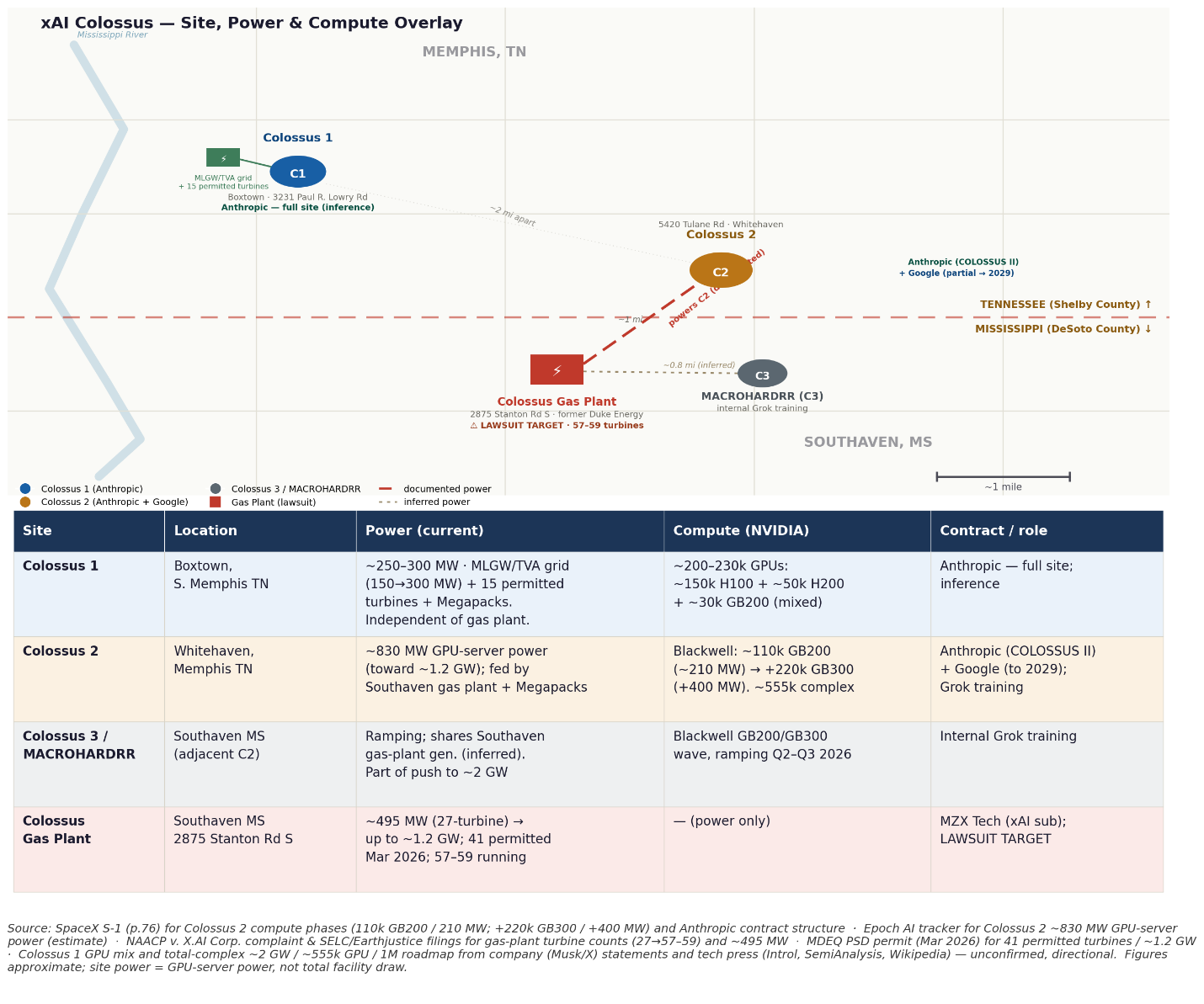
Source: 22V Research, SPCX S-1
Starlink and Space: Investors should look for incremental detail around user base and ARPU. Space as noted above is squarely centered around Starship 3.
SPCX is an anchor position in the emerging space economy and rapidly evolving AI infrastructure marketplace. 2027 and 2028 are proving points and we believe it is far too early to find fault lines in the ultimate success of SPCX’s various business initiatives.
Please reach out if you’d like to discuss further.

