

SpaceX (SPCX) will begin trading next Friday, June 12th. The company is a catalyst rich vehicle to invest in AI and space that arguably could be the first $10T market cap company in the future if the stars align (pun intended). As the largest IPO in history, it will instantly be vaulted into the company of significantly more mature businesses with over $1T in market cap. What differentiates SPCX is the incredible set of ingredients and a master chef (Musk) aligned to build a significant business around commercial space initiatives, ODCs, chips and physical AI. (The Orbital Data Center: A framework for the next AI infrastructure frontier; 5/29/26)
This will not be a straight line. Space is volatile as seen by connected stock reactions to Blue Origin’s recent rocket test explosion. Secondly, the history with TSLA has had significant ranges along the way to massive value creation. The event path around the company will define the timing and entry points as it relates to the larger AI and space macro.
Revenue stacking: SPCX will initially be valued on price/sales as they pursue rapid revenue scaling initiatives and deals. The company has multiple catalysts to compress this multiple by continuing to announce deals and define the trajectory of space launches. While many reports indicate a 90x+ multiple at the IPO price, this is based on 2025 reported revenue and does not consider the Cursor option and Anthropic compute deal, which add to pro-forma revenue. A more current multiple at IPO appears to be ~40x based on these recent announcements. While still a premium to peers in the $1T market cap category, this feels reasonable given the higher growth potential of space and AI. Cerebras (CBRS) just IPO’d and appears to have a 50x+ price/sales multiple.
Taking a simple approach to publicly available estimates, the S-1, and an overabundance of commentary it is not hard to extrapolate that SPCX will be near a $40B revenue run rate by the end of July and exit the year potentially around $45B in revenue (vs $18B of LTM revenue). Anthropic’s $1.25B per month compute deal at Colossus and the expectation of SPCX exercising the option to acquire Cursor (purported to be ~$3B growing to $6B in ARR by year end) in July all have increased the revenue profile.
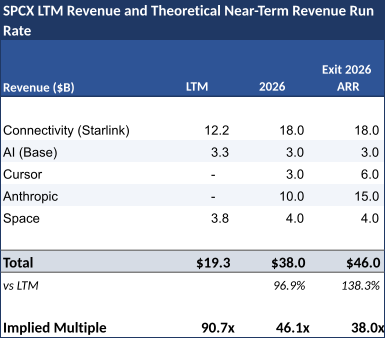
Source: SPCX S-1, 22V Research
Positioning amongst peers in the > $1T market cap club: SPCX will join the $1T+ market cap category with a significantly less mature business model but it will be arguably one of the most catalyst rich names among them. Some key standout differences outside of business maturity are: Smallest revenue of its peers at $18B LTM vs an average of $254B; now one of only three companies with negative FCF (TSLA and AMZN are the other two). SPCX is likely to have negative FCF for the foreseeable future, but the Anthropic deal provides a buffer this year plus the IPO proceeds provide significant running room.
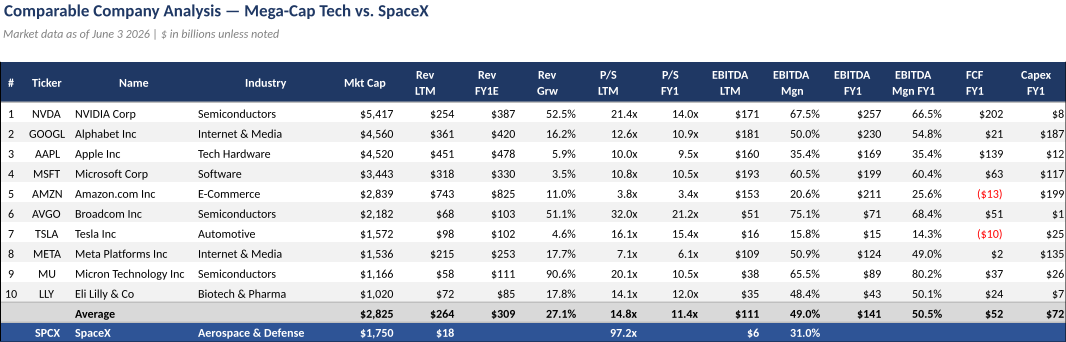
Source: Bloomberg; SPCX S-1; 22V Research
Catalysts and momentum drivers: Below are a series of company and technical catalysts we view as key for the SPCX story over the next 12 months.
Index inclusion and passive buying: The Nasdaq inclusion rules have changed which will lead to SPCX being added in early July based on a float adjusted market cap basis. The S&P is potentially going to follow later this year with an accelerated inclusion. This will start the passive buying demand early and tie well with the staggered share unlocks. While this is significant demand, the early index inclusion and tracking demand should be quickly absorbed given elevated trading volumes consistent with early days of IPOs. Later stage unlocks (end of 2026) could drive shares higher as SPCX trading volume matures and daily turnover as a % of float declines.
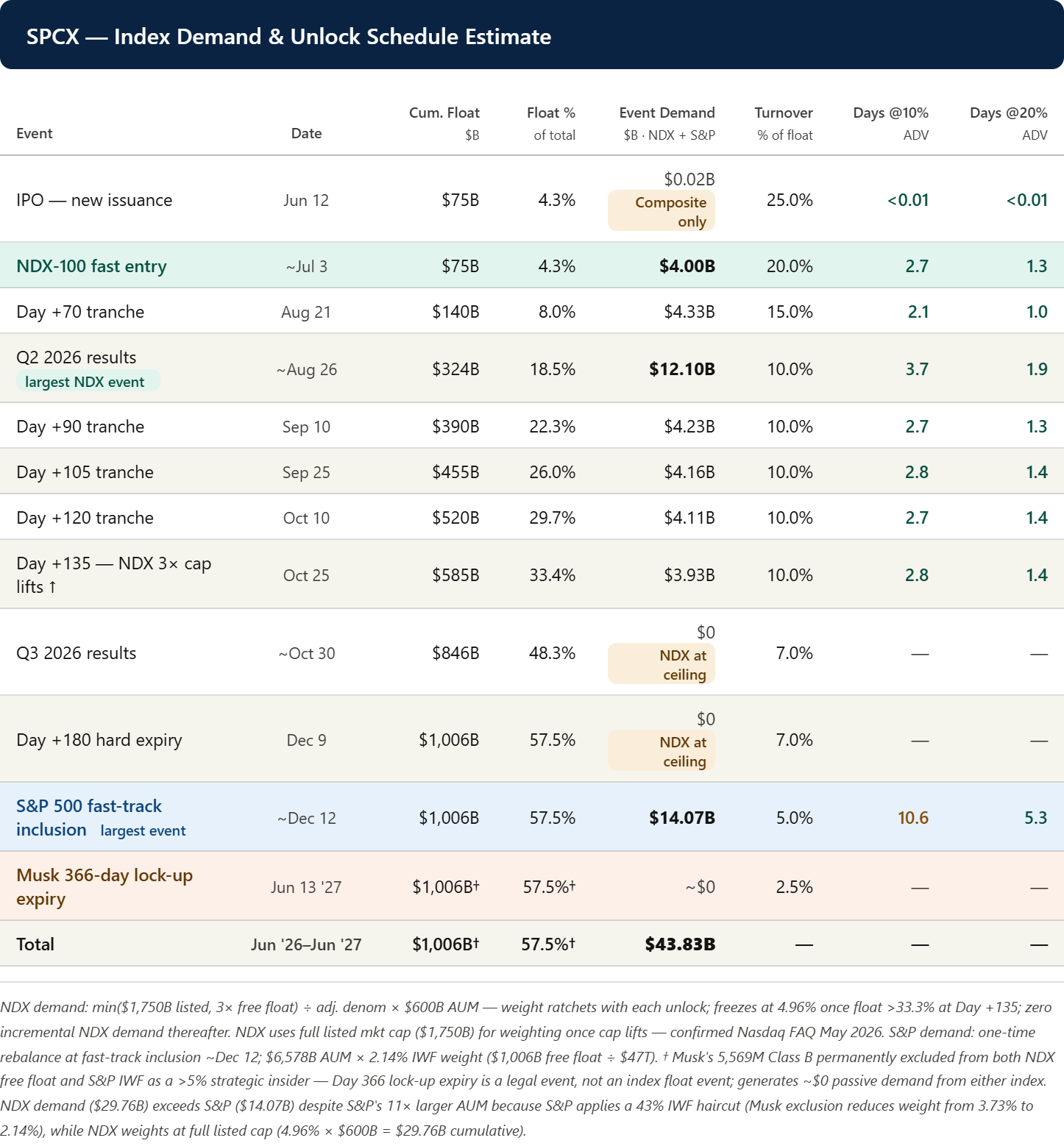
Source: SPCX S-1, 22V Research
Cursor acquisition: Per multiple reports, SPCX is expected to exercise its option to acquire Cursor for $60B in SPCX stock within 30 days from IPO. This could add over $3B of annualized revenue with some reports targeting an exit rate of $6B annualized revenue this year.
Space (Starship 3 and ODCs): The commercialization of Starship 3 and the acceleration of launches will create the most definable upside optionality. The ability to confidently guide launch cadence and average price will generate a clear math to estimate future space revenue. A secondary benefit of this will be unlocking the potential for significant ODC infrastructure. The recent test (Flight 12) in May was a reasonable success and Flight 13 will be forthcoming (date TBD). Per Elon Musk’s tweets, SPCX has built up testing inventory to actively continue testing. The chart below gives a theoretical profile of scaling annual launches against estimates of price in $/kg of payload, base SPCX (non-space) revenue and price/sales assumptions. The output frames the scale of this embedded option.
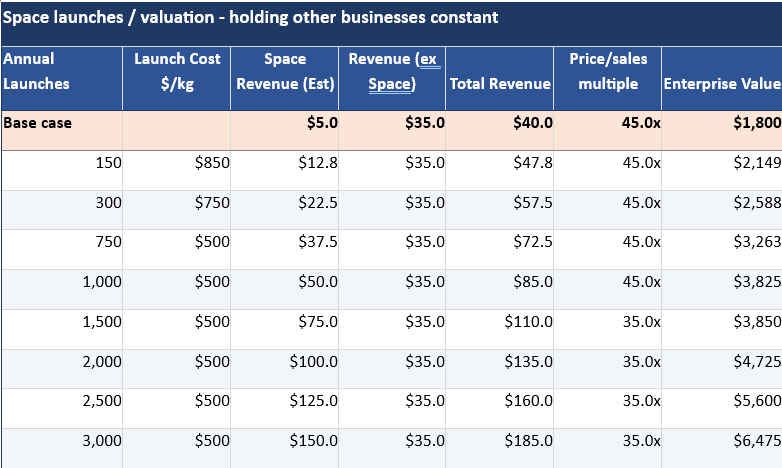
Source: 22V Research; theoretical estimates
Starlink: Less impactful from a catalyst point of view; Starlink V3 success will be watched. While Starlink is benefitting from Amazon’s LEO setback due to the testing delay for Blue Origin, the potential market size and expected declining ARPU will likely keep this from being a near term driver of shares.
Anthropic and Colossus: This is an interesting one – Anthropic is renting 300MW of IT capacity for $1.25B per month which translates to $50M per MW; significantly above the $10M per MW range seen on other longer-term deals. One would assume there is a strategy here for Colossus expansion and a longer-term neo-cloud style deal juxtaposed with Anthropic’s coming IPO. Anthropic needs to maintain its market share gains and best in class performance of its service. The revenue associated with the deal and logic behind it warrants inclusion in current revenue estimates at SPCX.
Long-term thinking to bring the full AI chain together: A big picture AI story that could come together for SPCX would be a successful business plan launched for Terafab and a potential merger with TSLA to pull physical AI, chips and space together into one large company.
Terafab: Musk’s aggressive project to build chips for both ODCs, vehicles and humanoids is expected to get more clarity around ownership, costs and timelines as we reach 2027. This could consume significant capital (first pass over $120B on some reports) but the allocation and timing are TBD. Key questions will be the timing and how it would impact suppliers (like INTC) as well as the revenue impact or potential accelerator for the SPCX or TSLA businesses served.
Tesla: There has been increased speculation in the financial media as to whether SPCX and TSLA will eventually merge. It feels early but an integration of two companies with shared AI resources and projects like Terafab could have merit. Additionally, this narrative could be a backup plan if there are delays to the SPCX space story.
The next 12-18 months of catalysts as well as Nasdaq and S&P index flows are likely to limit the downside for SPCX shares or for the overall story to unravel. On the flip side, at present maturity, the sum of the parts of SPCX is not greater than the whole and a mature and scalable business case for commercial space, ODCs or another successful business plan is required for long term share appreciation.
The SPCX IPO is certainly going to increase the velocity of disclosure around commercial space initiatives and the overall growing AI ecosystem. We look forward to more discussion and debate around this name as the IPO launches.

