

The reports of terrestrial data centers’ death are greatly exaggerated — placing even 1–2 GW of compute into low Earth orbit (LEO) annually by end of decade would be an ambitious outcome, representing under 1% of IEA-estimated global data center capacity by 2030. And yet the commercialization of orbital data centers (ODCs) is no longer a thought experiment. SpaceX, GOOG, Blue Origin, Nvidia and various startups are actively pursuing it; FCC filings show interest in launching over 1.1M data center satellites (heavily weighted to SpaceX); and SpaceX’s upcoming IPO will force a level of public disclosure that makes now the right time to build a framework to understand the pace and the investment themes that will develop.
ODCs face a multi-variable liftoff problem: kW/mt ratios, launch cadence, launch economics, and a definable addressable market within the AI stack all need to move in the right direction — and largely in parallel — for the concept to achieve commercial scale. Our view is the next 2-3 years will be a period of R&D, testing, and early commercialization; and the end of this decade is the earliest realistic point at which ODCs could register as a definable share of annual global data center additions. We endeavor to put a framework around the key variables here: AI addressable markets, weight-ratio KPIs, launch cadence, and relative economics versus terrestrial AI factories.
The treadmill is the central challenge: even in optimistic scenarios, the math on launch cadence, ODC lifespan and payload capacity leaves ODC compute as a fraction of terrestrial additions through 2030. That said, the longer-arc question is worth holding separately — if these variables converge in the 2030s, ODCs could emerge as a credible contender for AI factory market share, competing against nuclear-powered terrestrial builds and other capital-intensive alternatives as the world navigates energy constraints, land scarcity, and geopolitical competition for compute.
Data Centers in Space: Use Cases: ODCs are an elegant sounding solution to the terrestrial NIMBY, land and power bottlenecks that have been appearing. Less water, less land, less noise and the clear benefits of infinite solar power. This combined with a growing desire to build space-based infrastructure and connectivity for future space travel, commercial and defense projects are generating significant interest in building and launching ODCs.
Focusing specifically on AI compute demand and the potential fit within the emerging demand, we view inference as the top contender as noted below for ODCs initially. Radiation is a clear hurdle to overcome for bit-flips and high HBM memory sensitivity along with overall degradation in LEO which will need to be addressed with future R&D and testing.
Inference (Enterprise / Customer): Inference appears to be the dominant use case for ODCs. In our estimation, the more tolerant consumer would be first order and then potentially enterprise customers depending on the testing and outcome for ODC reliability and latency.
Frontier Model Training: Not currently an option. Frontier trillion parameter models require hundreds of thousands of densely packed GPUs (or TPUs) and ODCs are currently modeled to be distributed units of smaller compute. A secondary concern is reliability related to radiation degradation and inaccuracies.
Physical AI: Hyper low latency needs of autonomous vehicles, real-time factory operations and the expansion of humanoids need response speeds that would not currently lend themselves to the current connectivity speed between Earth and space.
Government / National Security: Space is becoming the next arena to show national dominance and that would mean further defense requirements. It feels early but the infrastructure and ability to consolidate and process large volumes of data in space / increase the speed of decision making on the ground will be critical.
ODC Satellite Construction: Kilowatts per Ton: A primary KPI for ODCs will be Kilowatts per Ton (kW/mt) where maximizing the IT capacity of an ODC against multiple constraints will be a key component of scalable economics. First, ODCs in LEO will have a finite life (~5 – 7 years) due to increased radiation and limited fuel to remain in orbit. Secondly, the ODC is an all-in-one system (compute, power, cooling) and the weight of the ODC will compete for finite (but growing) payload capacity into space.
43 kW/mt as a baseline: Based on our research and estimations, 1MW of ODC compute will weigh ~24 tons which translates to payload economics of 43 kW/mt. The compute itself will see a weight reduction (we use 25%) to account for reduced structural, power and cooling components. Power (solar arrays) and cooling (heat dissipation radiator arrays) as well as other components could add 15 mt/MW. These are estimates based on the Starlink solar and researched radiator data. Referencing public filings and reports, this compares to Starcloud publicly targeting ODC weight of 25 mt/MW (40 kW/mt) and SpaceX discussing a goal of 100+ kW/mt (10 mt/MW). The trajectory of the kW/mt ratio will impact price parity analysis (ROI) as well as speed of deployment related to maximizing IT capacity per launch.
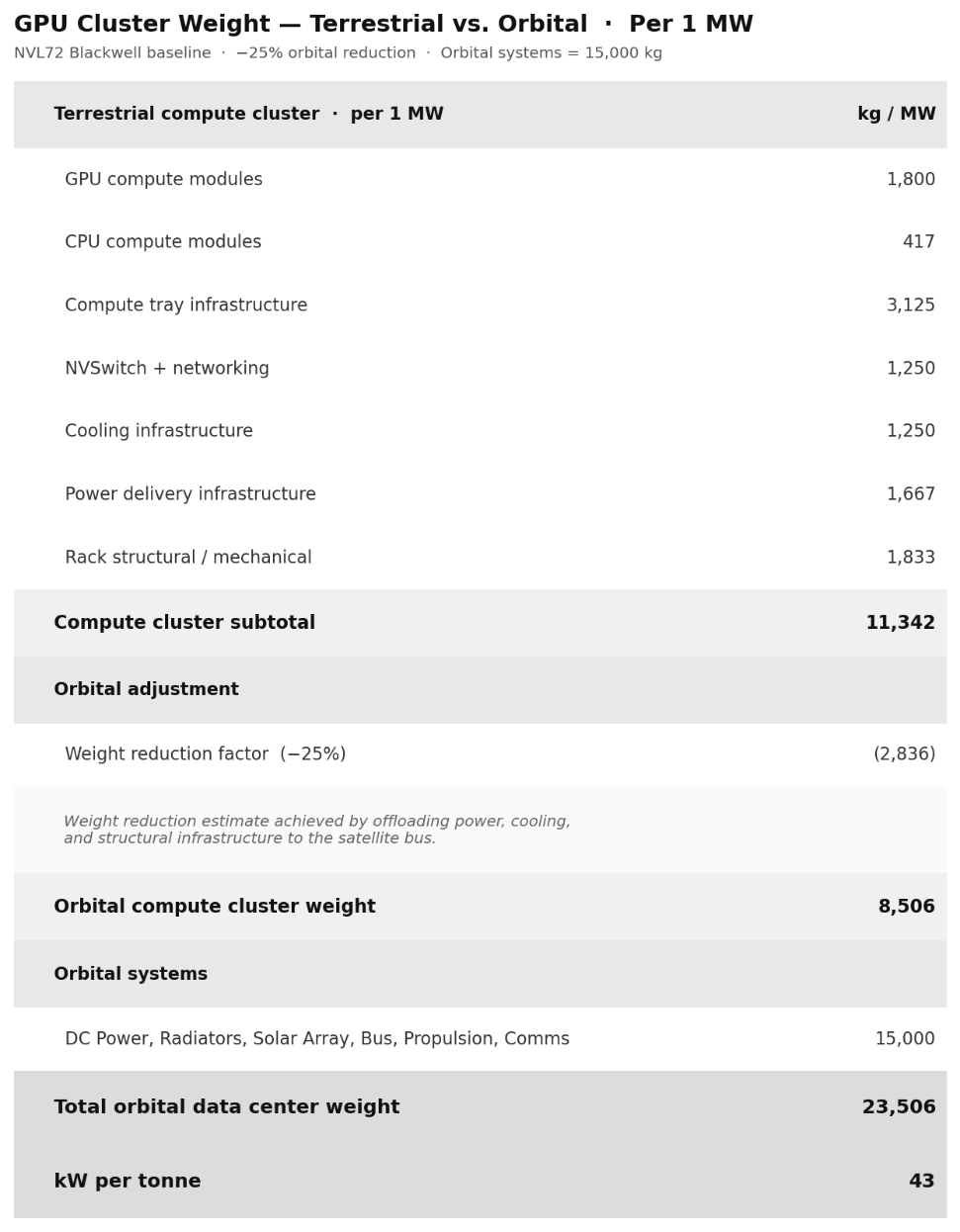
Source: NVIDIA DGX GB200 hardware documentation; HPE GB200 NVL72 QuickSpecs; Supermicro GB200 NVL72 system specifications; publicly reported GB200 NVL72 rack mass/power disclosures; engineering estimates based on disclosed rack architecture, power density, liquid cooling topology, and component integration.
Scaling Launches and Increasing Payloads: While terrestrial data centers have gating factors like power, land, electricians and other bottlenecks, ODC capacity expansion is initially gated by the number of commercial space launches per year and the average payload of those launches. SpaceX is the dominant player by volume and payload. The chart below shows the range of launch providers and payloads as well as reusability. The most frequent flyer is SpaceX’s Falcon 9.
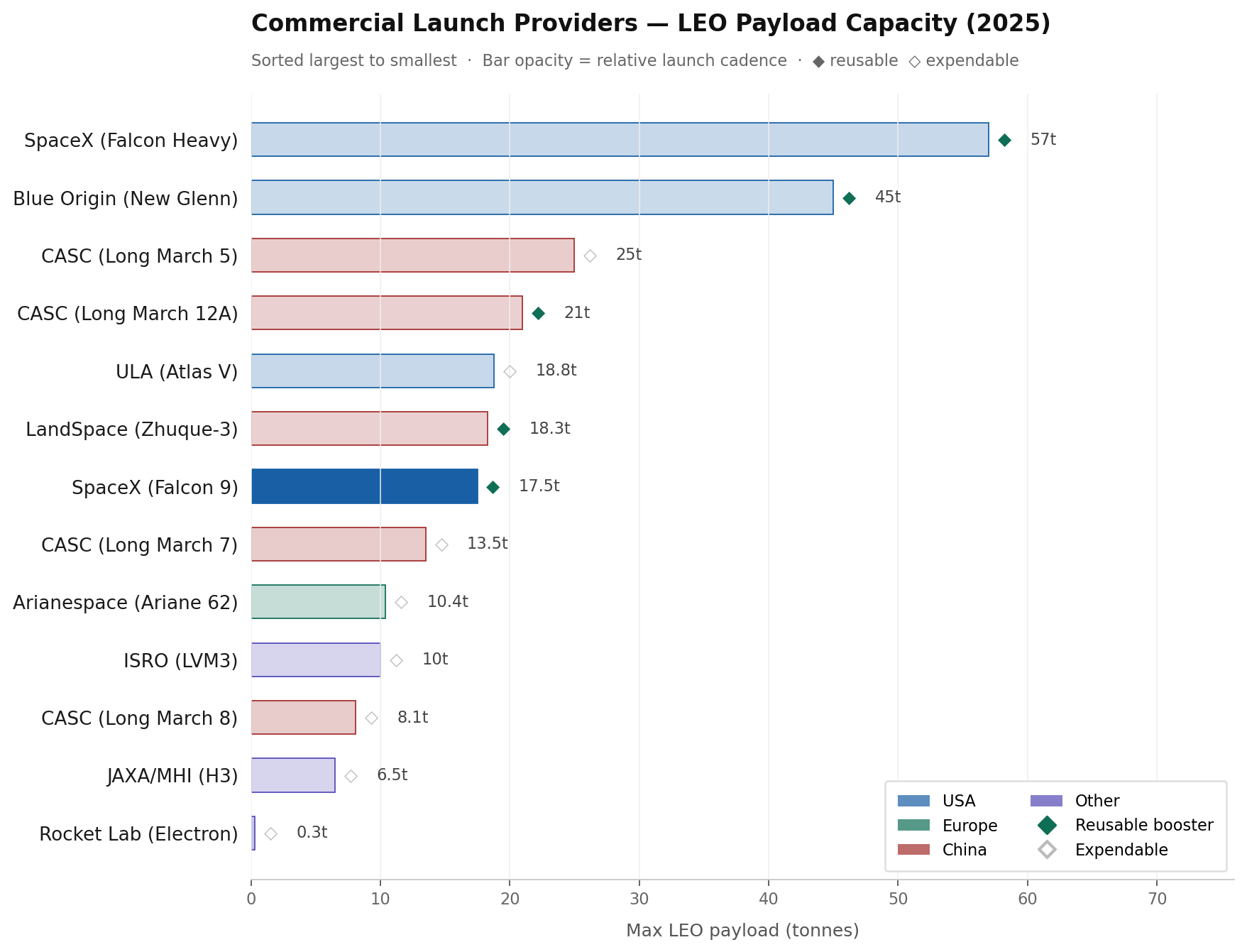
Source: Company disclosures; SpaceX IPO prospectus (May 2026); SpaceNews; NASASpaceFlight.com. Russia excluded.
The next generation of commercialized launches are targeting higher payloads as well as a continued focus on reusable booster stages. SpaceX’s Starship 3 and Blue Origin’s New Glenn are the clearest near-term opportunities for scaling and increasing the affordability of commercial launches.
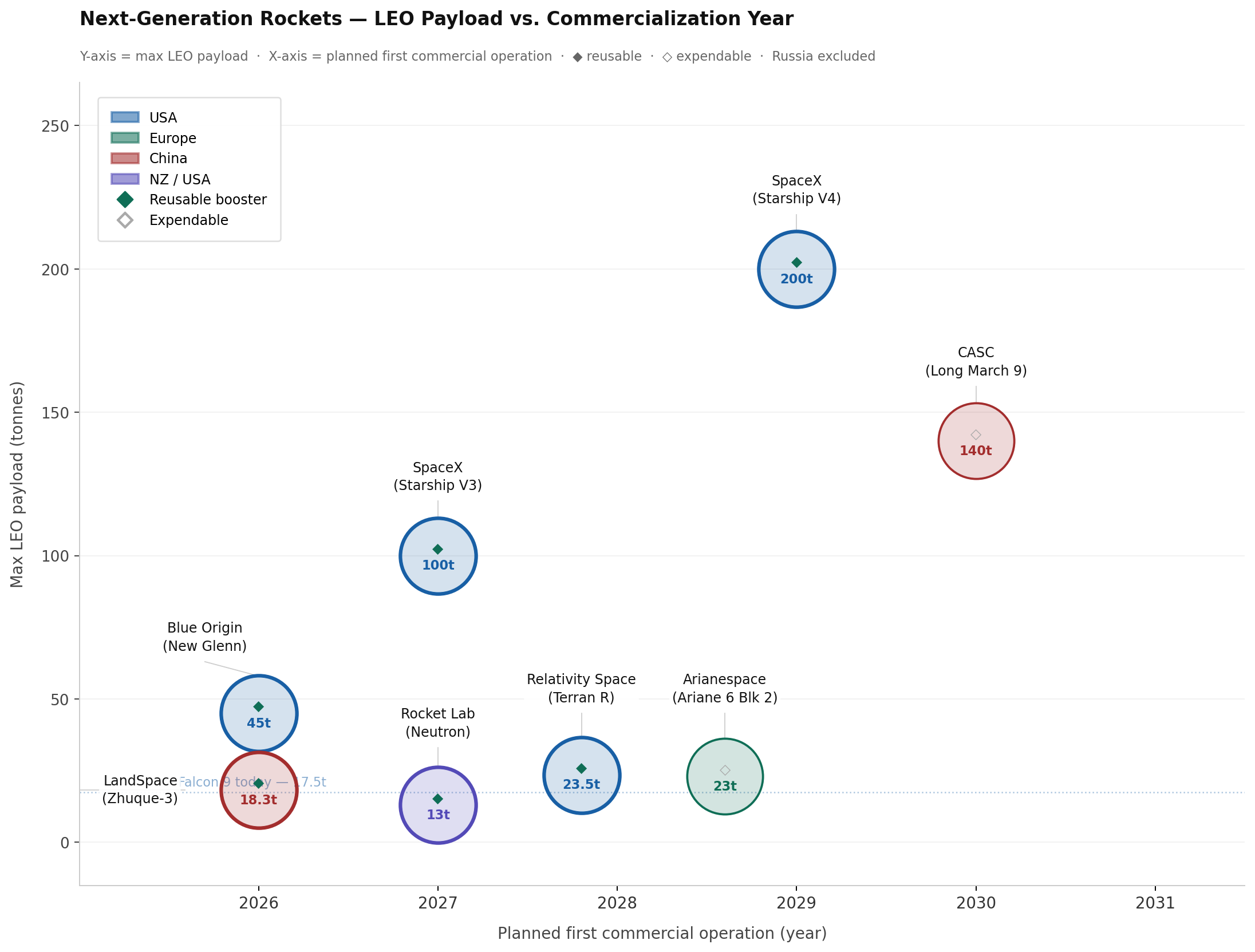
Source: Jonathan’s Space Report (planet4589.org); SpaceX, CASC, Roscosmos payload user guides.
Scaling infrastructure in space at an optimal cost will depend on commercialization of larger payload vehicles and an acceleration of launches per year from the current rate. The chart below indicates current launches and payload capacity per annum and a theoretical range. We could be sending 15,000 mt payload world in a few years and based on various targets in the press, if commercial space launches become daily events that could lead to over 50k mt / annum of payload launched into LEO.
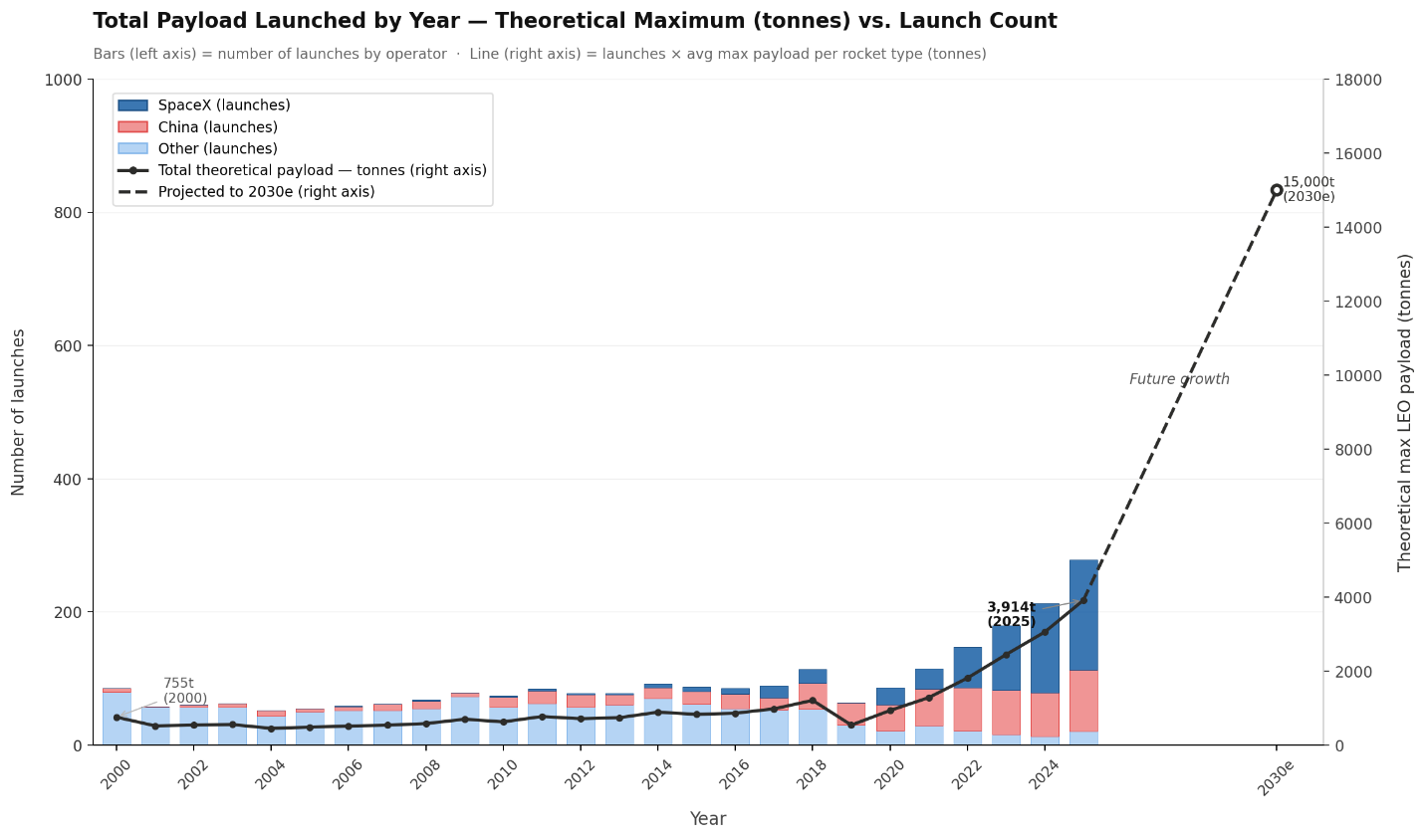
Source: Jonathan’s Space Report (planet4589.org) / 22V Research
ODC Scaling Scenario: The below graphic highlights scenarios of annual MW of compute that could be put into space based on the two primary (non-cost based) assumptions: kw/Ton and launch cadence. We utilize a basic assumption on Starship 3 payload as well as launch frequency ranges upwards of 2-3 launches per day. This is significantly higher than any current estimate or governmental launch clearance, but it shows the possibilities. As it stands today on both accounts, we are starting at the bottom left quadrant.
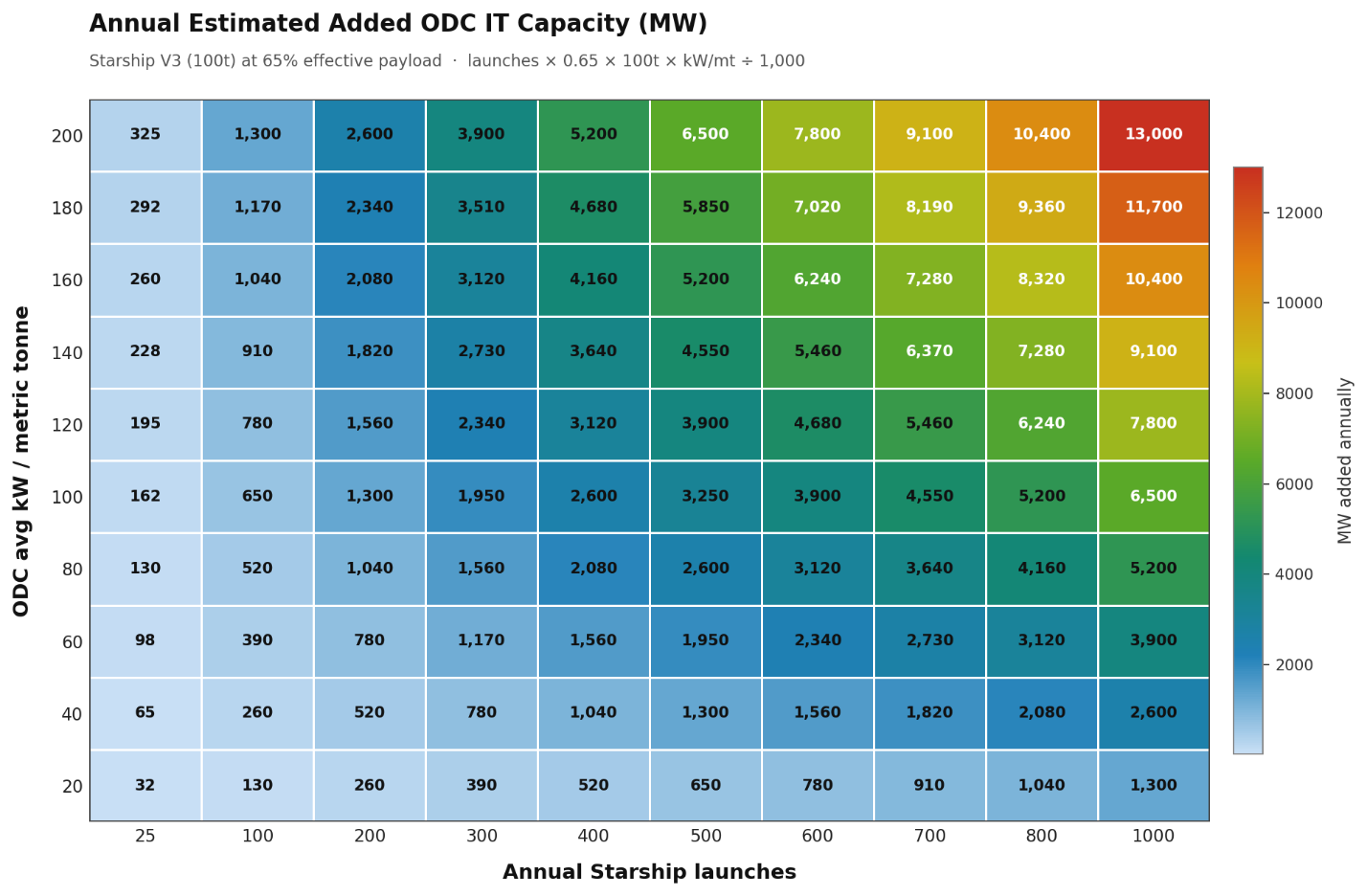
Source: 22V Research
A quick step back: The IEA expects global installed data center capacity to grow from 114GW in 2025 to over 226GW in 2030 (Source: IEA May 2026). This is predominantly driven by AI and would indicate adding ~22GW per year. In a mid-range of 400 launches dedicated to ODC at 100 kW/mt, ODCs could comprise just over 10% of added capacity in one year. These are aggressive assumptions – we are likely years away from surpassing 100 launches per year for ODCs or breaching 50kW/ton weight ratios therefore it might be bold to even expect 100MW of ODC IT capacity to be launched annually by 2028/2029.
The Treadmill: Elon Musk and SpaceX have discussed goals of having 100 GW of IT capacity in space via upwards of 1M satellites. The multi-variable problem to achieving this is tied to kW/mt, launch frequency, failure rate and ODC lifespan. An additional variable will be the share of launches ODCs can take vs other commercial demand in the market. To put it simply, we have not launched any commercial Starship 3 payloads yet. If we were to launch 750 per year exclusively for 100 kW/mt ODCs consistently, the theoretical maximum active GW would be just under 25 GW as we consider lifespan and failure rates. We ran a few calculations, but it would appear a ramp to 3,000 launches per year would reach 100 GW of compute capacity in 10 years.
Economics: The economics of the ODC vs terrestrial (before compute) appear far from parity and appear to be 3-4x terrestrial data centers on our analysis. Significant reductions in launch costs as well as lower solar and cooling array costs will be the primary drivers towards parity. Below, we compare an annualized amortized “before compute” estimate of terrestrial and orbital data centers. Relative to terrestrial data centers that buy power long term and have 20+ year life for shell and cores, ODC costs appear to be 4.2x their terrestrial equivalents based on a 5-year lifespan and current launch economics. If launch costs fall below $500/kg we could see relative costs for ODCs approach 1.9-2.5x. Enhanced cost structures behind power and cooling and/or increased life cycles in LEO would further change the equation.
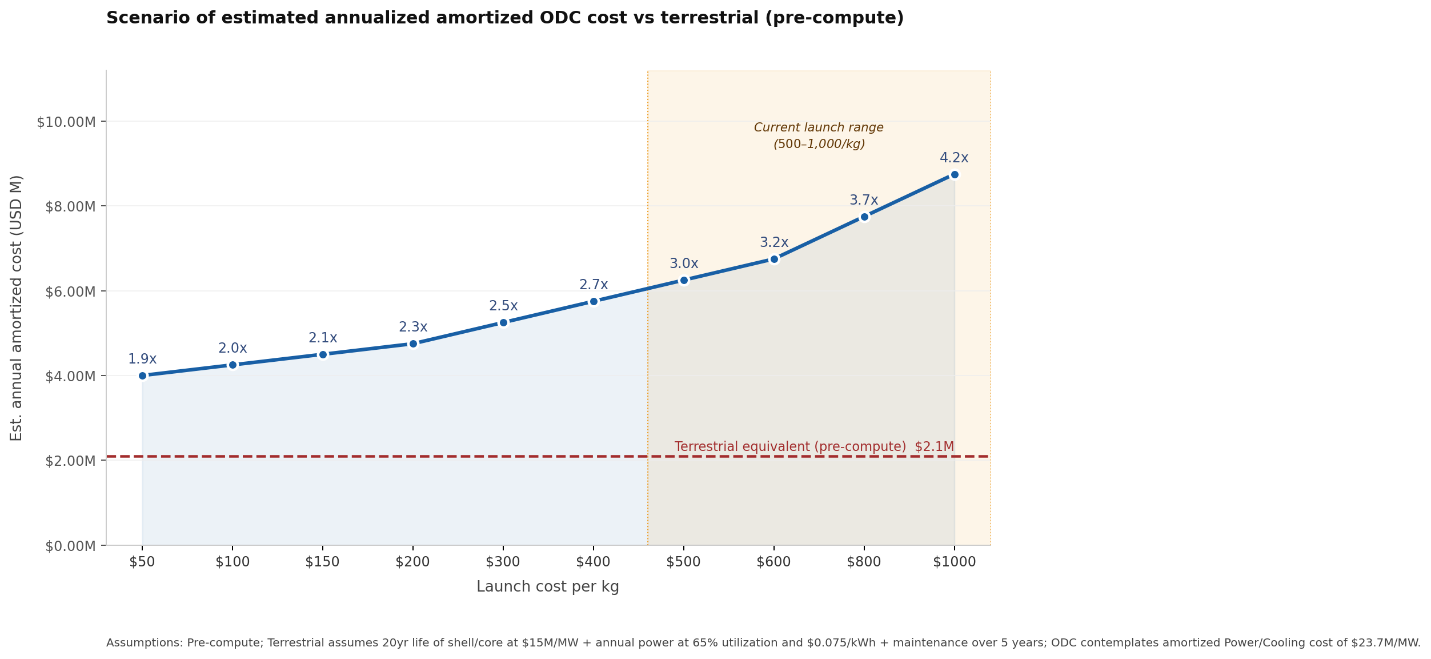
Source: 22V Research
Launch costs and $ / kg. This is one of the key variables to ROI and scalability of ODCs. The current KPI (while not perfect) is the cost per kg (or mt) to launch payload into space. Below are the current costs and future estimated outcomes.
The current expected launch cost (Starship 3) is $900-1,000/kg ($90-100M for estimated Starship 3 commercial prices for launch). The commercialization and reusability of the rockets combined with frequency and scaling of the infrastructure should drive the internal (SpaceX) and external (customer facing) costs down.
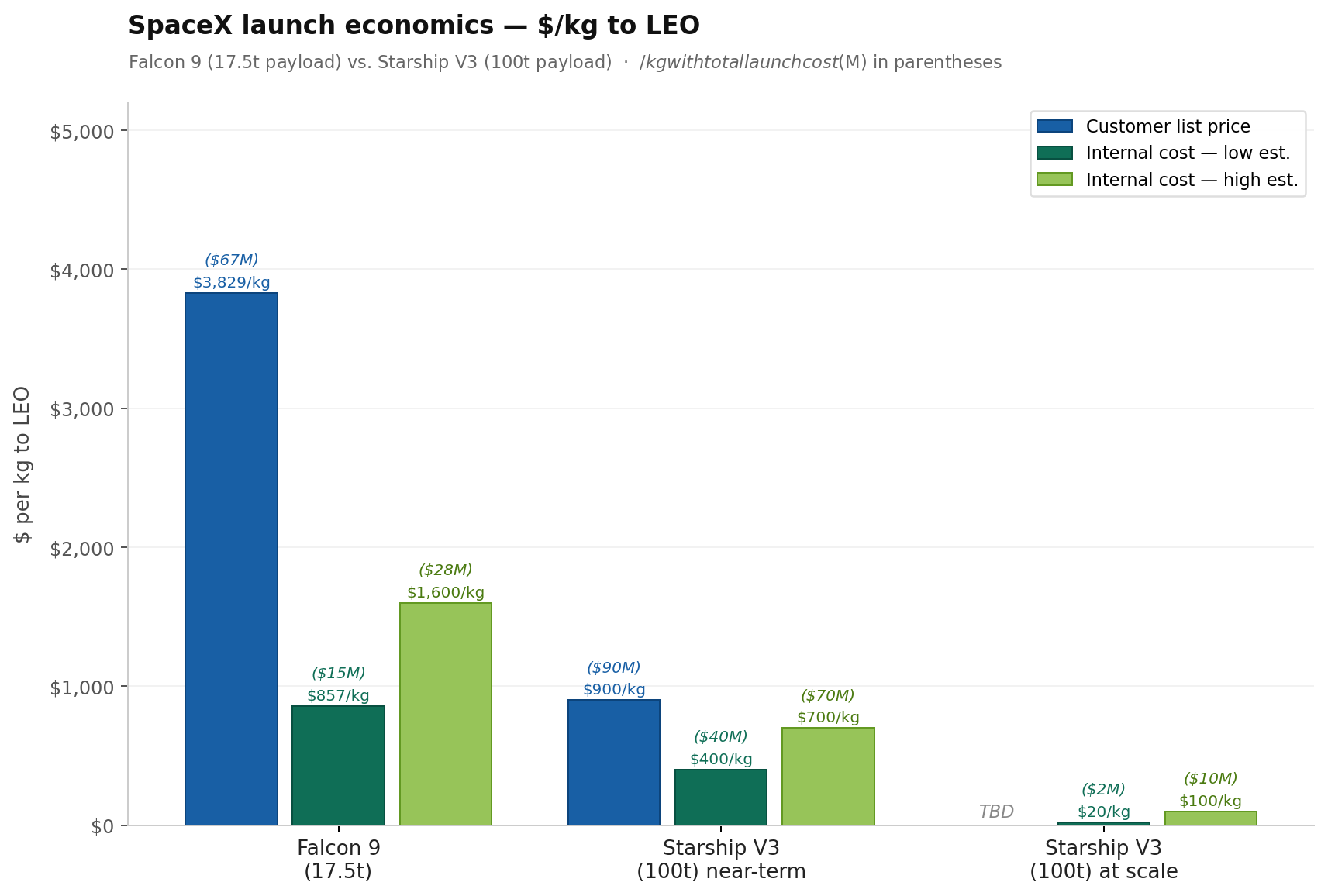
Source: Falcon 9 internal cost per SpaceX S-1 proxy analysis & industry estimates. Starship near-term list price per Voyager Technologies 10-K (Starlab contract, $90M). Starship at-scale targets per SpaceX S-1 ($10–$100/kg goal). Internal cost estimates are analyst approximations — not disclosed in S-1.
Details are limited but ODC startups like Starcloud and Cowboy Space have indicated launch costs need to reach $500/kg to break even. Google cited in a Nov 2025 study the possibility of launch costs reaching $200/kg or lower by 2030. SpaceX has an internal advantage to launch their one ODCs at cost; however, their own tradeoff will be related to commercial opportunities vs ODC economics.
Event path: We are in the early innings for ODCs and there is time to build the depth of knowledge and see what the ultimate outcome will be and when. Based on the event path we have been compiling via recent news and filings, we believe the next 2-3 years will be a period of commercialization and ramp of launch cadence, R&D and testing of orbital compute as well as firming up the addressable market and investment case relative to other solutions.
The pace of R&D and testing will accelerate as events like the SpaceX IPO create an increased velocity of disclosure and more public scrutiny on commercialization of SpaceX initiatives (outside of terrestrial neoclouds and Starlink). At the same time, competitors and the ecosystem around commercial space initiatives are also accelerating.
Key Players to watch:
SpaceX: An obvious name here. Largest IPO in history is expected in June which will increase the amount of public disclosure on commercial space. The near-term focus will be commercialization of Starship 3.
Google: Planning to launch their test of an ODC utilizing their TPU chips in 2027 in partnership with SpaceX. This appears to be one of the most visible and near-term tests. I would direct anyone to read their blog in Nov 2025 with links to a research paper talking about ODCs and their TPUs. (Link)
Blue Origin: While their FCC filing and stated ODC progress is light on detail, they seek to achieve payload capacity of 70 mt and accelerate their launch cadence with the New Glenn rocket. Additionally, they are actively pursuing the TeraWave space broadband project and tangentially involved in Amazon’s LEO (consumer Starlink competitor).
Starcloud: A recent startup with $200M in funding and seeking testing and launches of ODCs by 2028 and end of the decade. They have launched an Nvidia H100 GPU into space and will continue smaller tests before more commercialization. Their target appears to be a ~67 kW/mt satellite.
Cowboy Space: Cowboy Space (formerly Aetherflux), founded in 2024 by Robinhood co-founder Baiju Bhatt, has raised ~$365M with a core thesis integrating the rocket’s upper stage and the data center into a single vehicle to eliminate redundant mass and remove the Starship dependency. They are targeting a more integrated approach with launches by 2028.
Additional early-stage entrants advancing adjacent pieces of the ODC stack include Kepler, Orbital, Axiom, Starcatcher, and Sophia.
Key debates and questions: We leave with a few observations and questions.
- What is the true use case for space-based compute and TAM relative to total AI compute consumption?
- Are parity economics required and how will they be determined as supply and demand for AI compute evolve?
- Will post 2029 AI infrastructure build out be a competition between space or terrestrial nuclear?
- What is the timeline required to complete R&D and testing and reach scalable ODC clusters?
- What is a realistic launch rate of rockets and what restrictions will keep SpaceX or Blue Origin from reaching multiple launches per day (bull case)?
- How large is the backlog of government and non-AI data center commercial demand for space payload and how much room will data center launches have?
- While space solves NIMBY, will there be regulatory or weak public sentiment similar to what we are seeing on data centers focused on launch noise, space debris or other scenarios?
I look forward to and welcome starting the dialogue and discussion on the topic of space and its potential position within the AI infrastructure stack in the coming years.

