- Comments from Gov. Waller today echoed those he gave in late May, signaling an important hawkish swing from one of the higher-beta voices at the Fed.
- He gave no explicit policy commentary but his tone around the risks to the Fed’s dual mandate is clear enough; the implications for the direction of policy depend then on the data and where his baseline view on the neutral rate is (something which may have also been shifting given the recent data flow).
- There is the data itself but also the underlying slower moving risks from another round of inflation, now with a “stabilizing” labor market, as consumers and firms are now more used to higher inflation and passing-through costs and bargaining in a world when it is a part of economic life.
- Waller defended forward guidance’s historic use, but suggested that in the present moment scenario analysis seems to be a far more helpful tool that averaging across a highly uncertain future and calling that a base case. The dot plot’s base case-centered communication strategy seems ever more at risk although it is unclear what, if anything, might replace it.
After being notable more concerned about labor markets for much of 2024-25 and being willing to tolerate a “longer movement back” of inflation towards the Fed’s 2% target as a result, the “risks have completely flipped around.” As is clear enough looking at all the data over the past 9 months, the “labor market seems to be stabilizing in the U.S., inflation’s been taking off. So then that changes how you might want to think about policy.”
In a set of comments which could apply to almost anything in the macroeconomy over the post-covid cycle, Waller noted the importance of unique initial conditions in assessing the likely impacts of monetary policy surprises. Particularly important to the current risks around inflation is concept of ‘rational inattention’, where households and firms pay little attention to small shifts in the economy but large enough shocks can jolt them into action. “If big shocks lead firms to increase the frequency of price changes, the Phillips curve steepens, which changes how monetary policy actions are transmitted to inflation and the real economy” and would potentially be a sharp reversal from the 20y before covid.
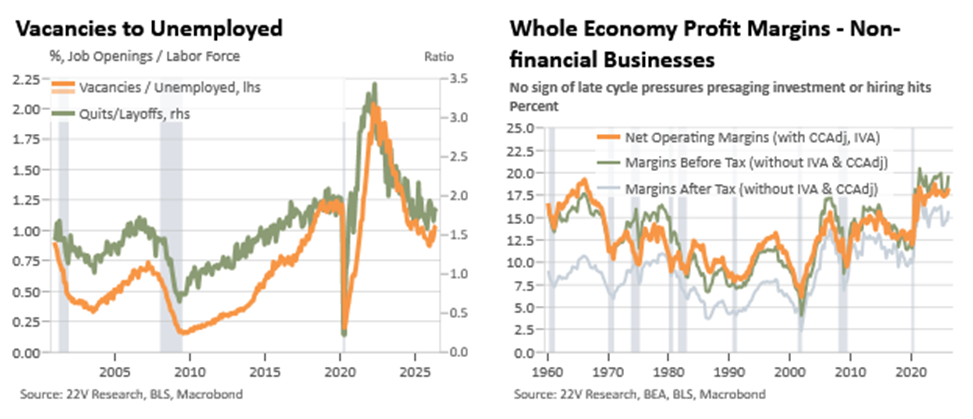
Given the recent move higher in inflation, years into a continuous overshoot of target, the mention of rational inattention dynamics is naturally a hawkish one. Waller’s comment about a steeper Phillips Curve could just as easily apply to the responses of surveyed inflation expectations to realized inflation or bargaining positions around price shocks and firms’ willingness to pass through cost shocks (something elevated margins suggest remains the case even with tariffs, the war, and AI boom). Research from the Boston Fed last year found exactly this result, with price shocks to flexible prices having many multiple times larger impacts on sticky prices than pre-covid, although this effect had shown some signs of normalization as inflation came back down in 2023-24.
Waller seems at least open to the idea of toning down the Fed’s explicit forward guidance. While noting that it can be a “valuable tool” that can help change economic conditions more quickly that policy rates alone, it “is more art than science, and there have been times when it has hindered, rather than helped, policymaking.” In certain circumstances the optimal choice may be to use scenario-based forward guidance, which is much clearer when different economic scenarios each with “a significant probability of occurring and requiring different policy paths.” Alternatively, it may be “best not to use it at all.”
Explicit forward guidance is relatively recent invention and Waller made was clear to note that even if it may not be helpful, it remains “important to communicate your reaction function — be clear about what your objectives are and how you would respond to the data.” When considering the dot plot, as a base case driven tool, this suggests he may be open to some tweaks or wholesale shifts in the Fed’s approach but seems unlikely he would fully jettison the current open communications regime and some sort of economic and policy outlook.