Waller Pivots to Inflation
- Gov. Waller joined a chorus of Fed officials in announcing that he thinks it is now time to remove the easing bias from the FOMC’s post-meeting statement. It will be struck in June.
- While he does not think the data currently calls for rate hikes “in the near future,” he “can no longer rule out hikes further down the if inflation does not abate soon.” He saw 2-3x cut this year as the appropriate baseline back in February.
- Short-term inflation expectations moves higher are “concerning” and we cannot be sure if a series of supply shocks “interact in such a way that… inflation becomes more persistent.”
- One of Waller’s strengths as a Fed official, and utility for us Fed watchers, is that he tends to be high beta to his own dominant risk. Last year labor market concerns were “a big factor” in his support for the final 75bp mini easing cycle. Now, his “focus is on inflation and the effects of the energy price shock caused by the Middle East conflict.”
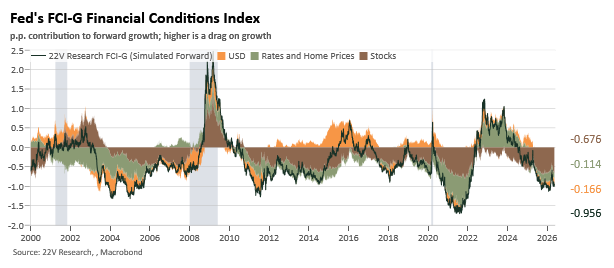
- Market pricing is doing some of the Fed’s work for it, but overall financial conditions remain quite easy with the AI boom more than offsetting the drag from tariffs and the War (so far).
The Dominant Risk is Now Inflation. Waller has spent most of the past few years focused on both the observed gradual easing in the labor market as well as the potential for a more rapid non-linear deterioration in the labor market, with Beveridge Curve handoff from declining job openings to a much more rapid increase in unemployment the main mechanism. Now, the labor market “appears to be stabilizing.” On inflation, he was relatively comfortable looking through the impacts of tariffs in setting policy. The impact of the war and closure of the Strait of Hormuz is much less certain but the skews build on top of already elevated inflation. Among other bad news, core inflation is expected to run at its fastest pace in 2.5 years in April at 3.3%; “none of this is good news.”
The War is Different from Tariffs. Waller noted that some Fed research has shown that the impacts of tariffs are now quite small, but as Gerard and I have both noted before, that is less comforting than he makes it out to be given that core inflation was not decelerating pre-war and core services inflation ex housing seemed to be seeing a mild reacceleration. To me, this suggests that without the war he would have been getting to a similar if slightly less hawkish conclusion over the summer. The war is a much worse cascade of shocks. The basic fact is that “no one knows how the military conflict will play out, or even how quickly a continued ceasefire or peace would restore shipping and allow the repair and reopening of damaged infrastructure. I said in a speech on April 17 that I thought markets were underpricing the risk of prolonged high energy prices, and I still think they are.” Everyday energy prices remain elevated (as a side note Fed officials would be better served by referring to energy and raw materials markets’ dislocations not just energy price increases, which net out supply disruptions and demand responses), “the greater the chance that these increases bleed into prices for other goods and services. The breadth of the consumer price increases in April and the even sharper increases in producer prices last month do concern me.”
Inflation Expectations Cannot be Counted on a Source of Significant Disinflation. For central bankers, the threat of inflation expectations or underlying inflation moving farther from target is the key risk. Even Fed officials with their dual mandate emphasis have almost universally noted that durable low levels of unemployment are only sustainable if they come with inflation that’s low enough consumers don’t really consider it in their day to day. The key for central bankers is “whether the energy price shock is seen to be as transitory as last year’s tariffs appear to be, or whether consumers, investors, and business managers believe it will echo the longer-term disruptions we saw after the pandemic.” The moves higher in short-run expectations are “concerning” in this context. The issue is not looking through one supply shock or not, it is if “a series of what seem to be transitory shocks can lead to persistent inflation and an unanchoring of inflation expectations… there is the question of whether they interact in such a way that longer-term inflation expectations rise and inflation becomes more persistent.” The issue isn’t that people can look through one supply shock, it is that the series of them, maybe all seen as independent events, starts to look more and more like the correct expectation over time. Arguably since 2018’s initial small trade war, this has been an increasing feature of the global economy. Waller does not go on to suggest that we are in a structurally different world but one need only look around to see that after 30 years of almost entirely disinflationary supply shocks, the economy has been different lately.
Labor Market Risks Are Fading. After being one of the more persistently labor market-concerned Fed officials over the past 9-12 months, left tail concerns seem to be fading and “appears to be stabilizing.” Current paces of job growth are at a “historically low level” but “little or no job creation is now consistent with a stable labor market.” The unprecedentedly slow pace of labor slow growth increases risks to the labor market some in his view, but as recent Fed Board research shows there does not seem to be any particularly cyclically impactful effects from low labor supply growth rates when looking across international evidence or US states’ histories. This micro evidence is encouraging and matches the basic intuition that topline cyclical downturns in revenue and income (where 0 might more plausibly be a barrier condition) are quite different mechanisms from labor supply being sluggish.
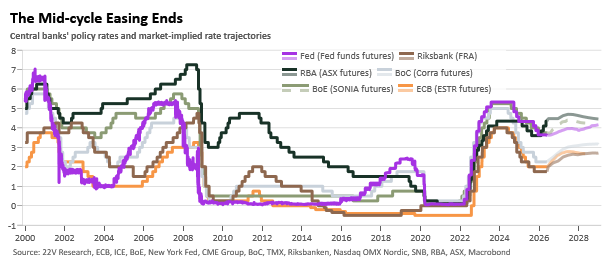
Rates Have Moved Higher. Have They Moved Enough? With short-term interest rates now pricing in a modest hiking cycle through 2027 it is reasonable to ask if we have priced in too much. Overall financial conditions remain quite easy thanks to the AI boom and what has to be considered a remarkably small market response to the closure of the Strait relative to ex ante expectations. As Waller notes his baseline, shared by most at the Fed now, is that “it is time to simply sit and watch how the conflict and the data evolve.” The longer the war goes, the worse the inflationary picture looks, and more likely the Fed may have to hike. Of course, Waller does not grapple with the issue that underlying inflation was already problematic before the war and with the labor market stable the risks are increasing hawkish even if the war resolves soon, although pricing in that world would surely appropriately move down from current levels. The more robust the consumer and the more comfortable firms are in passing through costs, the more appropriate policy skews hawkish relative to the Fed’s old path, regardless of the war.