

SUMMARY
- We used LLMs to map out China’s AI hardware ecosystem, with almost 500 companies spanning compute, power, systems, and specialty materials.
- The ecosystem’s revenues are concentrated in data center infrastructure, including servers, networking equipment, and energy storage; these sectors are booming from the US data center buildout but heavily exposed if it slows.
- With Chinese firms striving to overcome technology bottlenecks in advanced compute, the semiconductor sector is only a small share of ecosystem revenues but a growing share of market cap; domestic chipmakers are making faster progress in memory than in advanced GPUs, highlighted by the upcoming IPO of Changxin Memory Technology (CXMT).
- Capex in AI hardware is now outpacing revenue growth, and Chinese analysts themselves are flagging commoditization risks in select subsegments such as optical transceivers.
- The US and Chinese AI ecosystems are closely intertwined, but geopolitical tensions are pulling at these interdependencies; tech policies are likely to become more disruptive in 2027, with risks to firms in both countries and along various parts of the AI stack.
China’s Sleeper Role in Global AI Supply Chains, Part II
This is part two of our series on China’s role in the global AI buildout. In part I (link HERE), we examined trade flows for a sense of which AI-enabling products China exports, and where US dependencies on China are highest.
In this report, we examine the dynamics at the firm level: how is China’s AI hardware ecosystem developing, and what are the implications for markets and AI development in both China and the US?
To answer these questions, we used LLMs to construct the China AI Infrastructure (CHAIN) database. CHAIN maps 491 listed firms in China’s AI hardware ecosystem – including compute, power management and storage, networking equipment, as well as chemicals and critical minerals. We made a number of methodological choices:
- We excluded software and cloud services at the top layer of the AI stack, including Baidu-Alibaba-Tencent (BAT). While BAT are also important players on the hardware side (especially compute), their broader business spans consumer Internet (search, e-commerce, and gaming).
- By necessity we also excluded unlisted firms, of which Huawei is the most important. This blind spot is getting smaller as more Chinese tech companies go public: this year will see major tech IPOs, including CXMT (DRAM) and Unitree (humanoid robots).
- For sake of consistency, our aggregates reflect the total company revenue/market cap for firms participating in the AI supply chain, as opposed to estimates of their AI-related revenue and market cap. This overstates the revenue share of some parts of the ecosystem; for major server companies such as Hon Hai, AI data centers are currently only 15-20% of revenue.
The Listed Ecosystem: Infrastructure as the Mainstay, Compute as the Aspiration
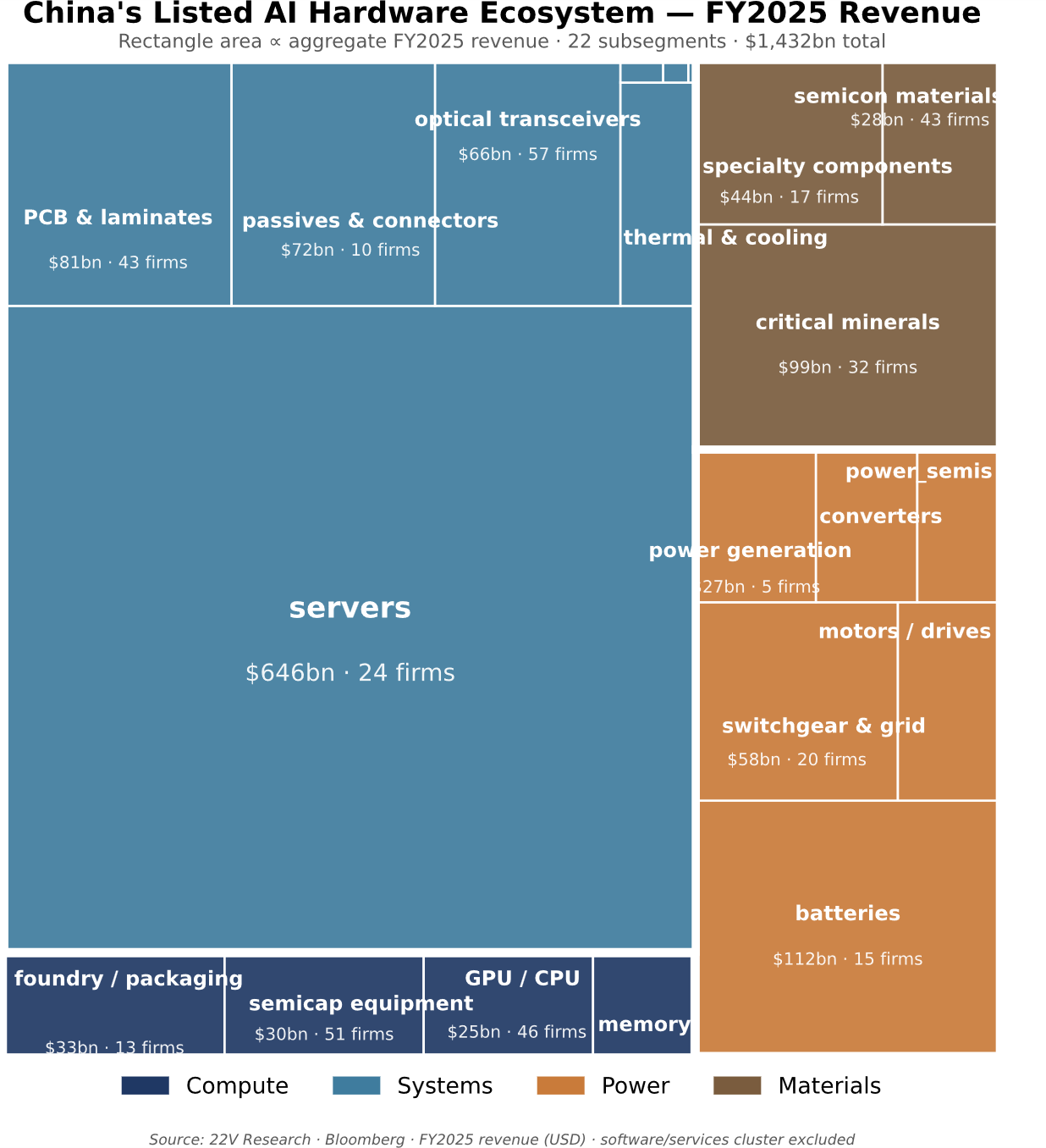
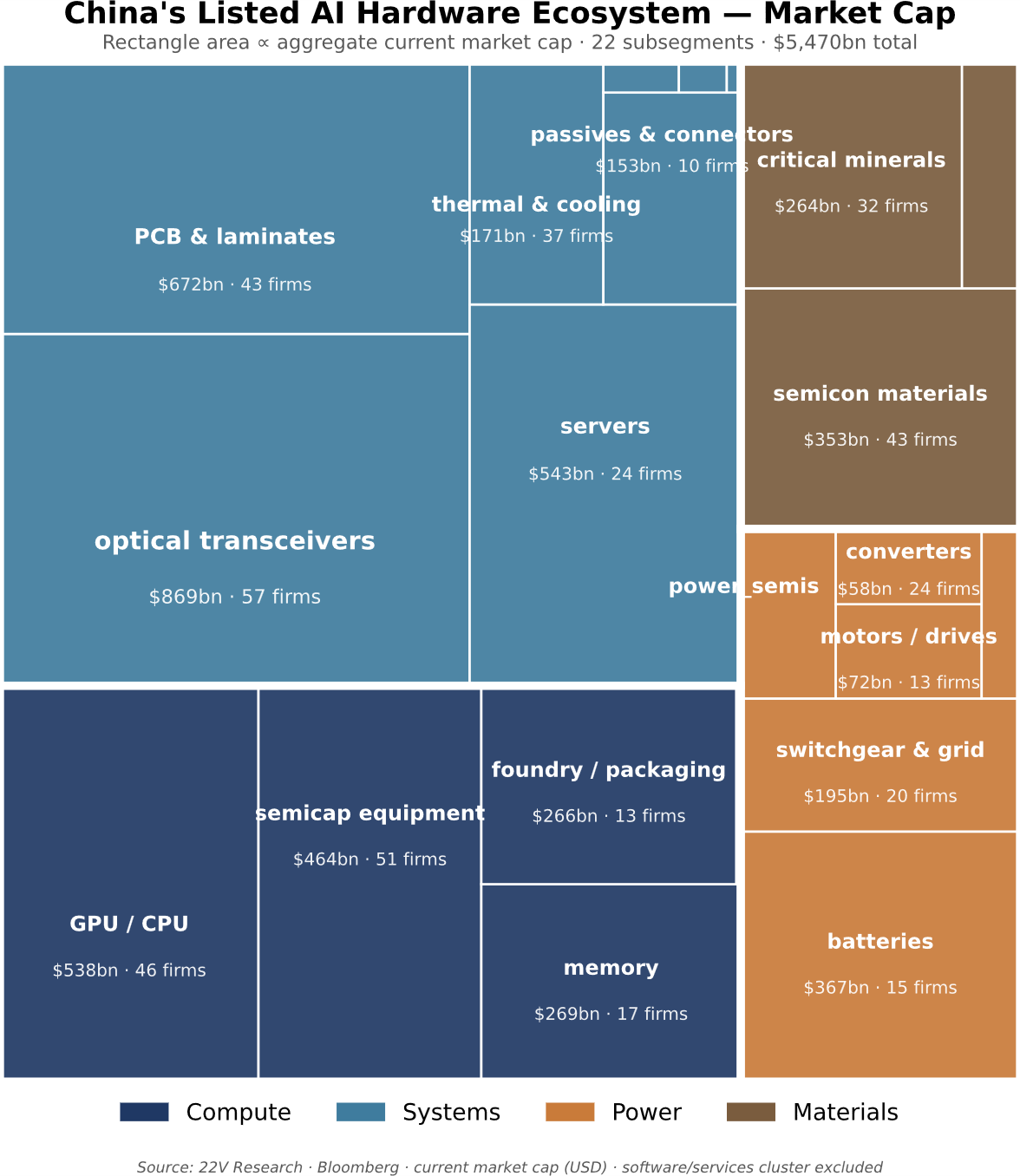
The two charts below show China’s AI hardware ecosystem by revenue and market capitalization, organizing them into four main categories. The overall picture is as follows:
- Systems: Firms that provide the key components of data centers other than compute itself – including servers, networking equipment, thermal cooling – make up more than half (62%) of the ecosystem’s revenue and a smaller share (44%) of market capitalization. Many of these areas, particularly servers, are low-margin products. A key exception is optical transceivers, with firms such as Innolight and Eoptolink riding the US data center buildout to become among the largest firms by market cap in China’s A-share market.
- Power – including lithium-ion batteries, switchgear, and power semis – are another major strength for Chinese industry, accounting for 19% of ecosystem revenues and 15% of market cap. The largest player is battery maker CATL, for which data centers are a fraction of revenues but major target for growth.
- Specialty materials – including critical minerals, as well as chemicals used in semiconductor production – account for 12% of ecosystem revenues and market cap. Given that these are also key chokepoints in AI supply chains, as we discussed in part 1, their geopolitical importance in the US-China (and Japan-China) rivalries is even more significant.
- Finally, compute – logic chips, memory chips, foundries, and semiconductor manufacturing tools – is the smallest of the four segments by revenue (7%). As we noted in part 1, compute is where China runs its large “AI trade deficit,” with US/allied export controls serving as a key bottleneck for China to produce advanced AI chips at scale. China’s leadership is determined to overcome this vulnerability by developing an increasingly complex indigenous semiconductor sector. Investors see some progress, reflected in much larger share of this segment in terms of market cap (28%), a number that will grow with additional IPOs this year.
The Two AI Hardware Plays: Exporting Infrastructure vs. Domestic Compute
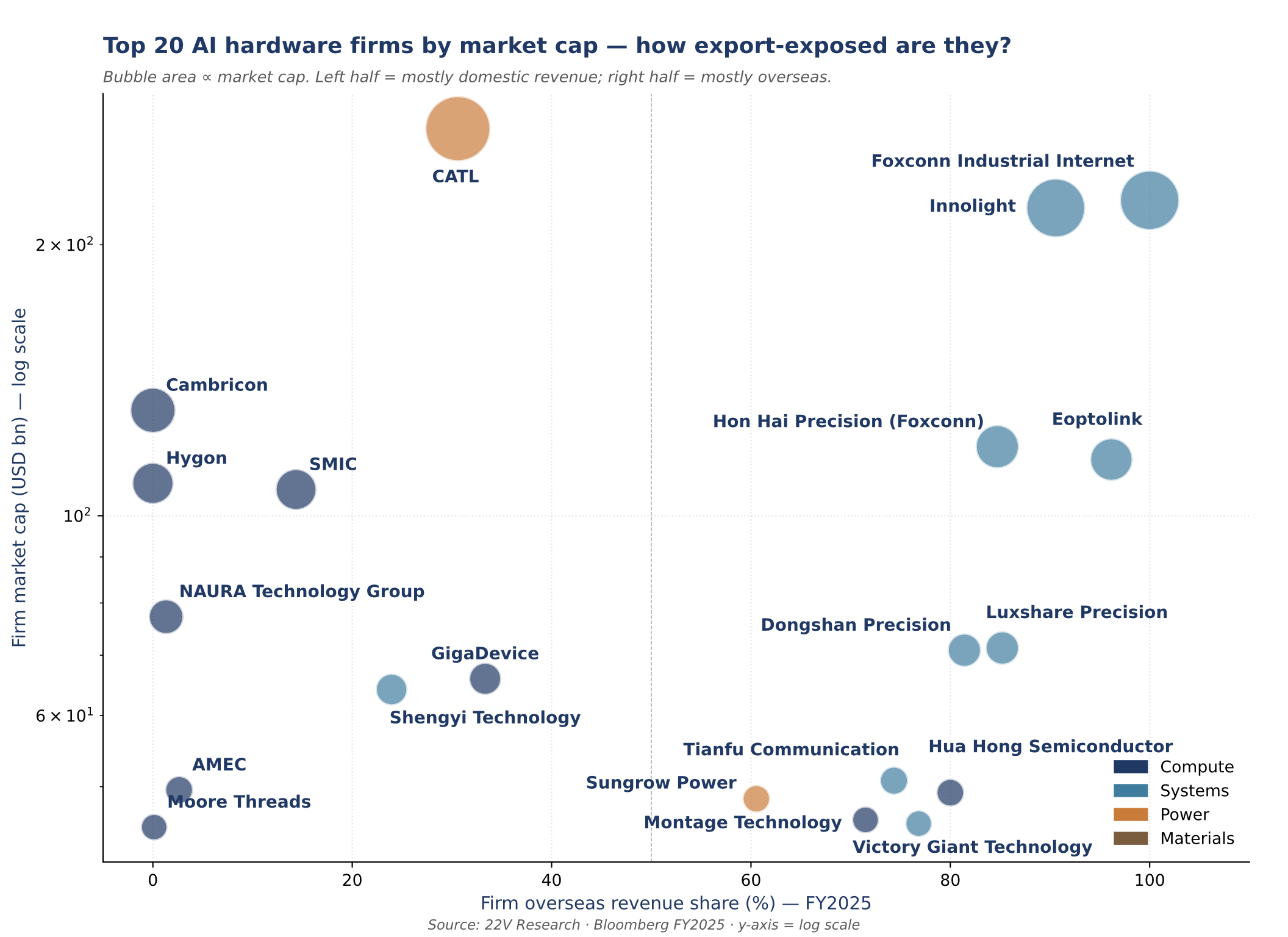
The chart below shows the 20 most valuable firms in China’s AI hardware ecosystem, plotted by market cap (vertical axis, log scale) and by share of revenue earned overseas (horizontal axis). It becomes clear that China’s strength in manufacturing — and bottlenecks in advanced compute – result in two distinct AI hardware trades in the equity market:
- Firms providing data center infrastructure – especially servers, optical transceivers, and other networking equipment – are highly dependent on exports. Overseas sales are more than 90% of revenues for optical transceiver leaders Innolight and Eoptolink. The export-focused infrastructure providers are mostly listed on the ChiNext board of the Shenzhen Stock Exchange.
- China’s compute companies such as GPU maker Cambricon, by contrast, are import-substitution plays with mostly domestic sales. Most of these firms are listed on the Shanghai STAR Market, which has become the main equity vehicle for Beijing’s industrial policy priorities in “hard tech.”
- Power companies, particularly CATL, are somewhat in the middle, reflecting strong exports but also major domestic sales due to China’s heavy investments in renewables and electric vehicles.
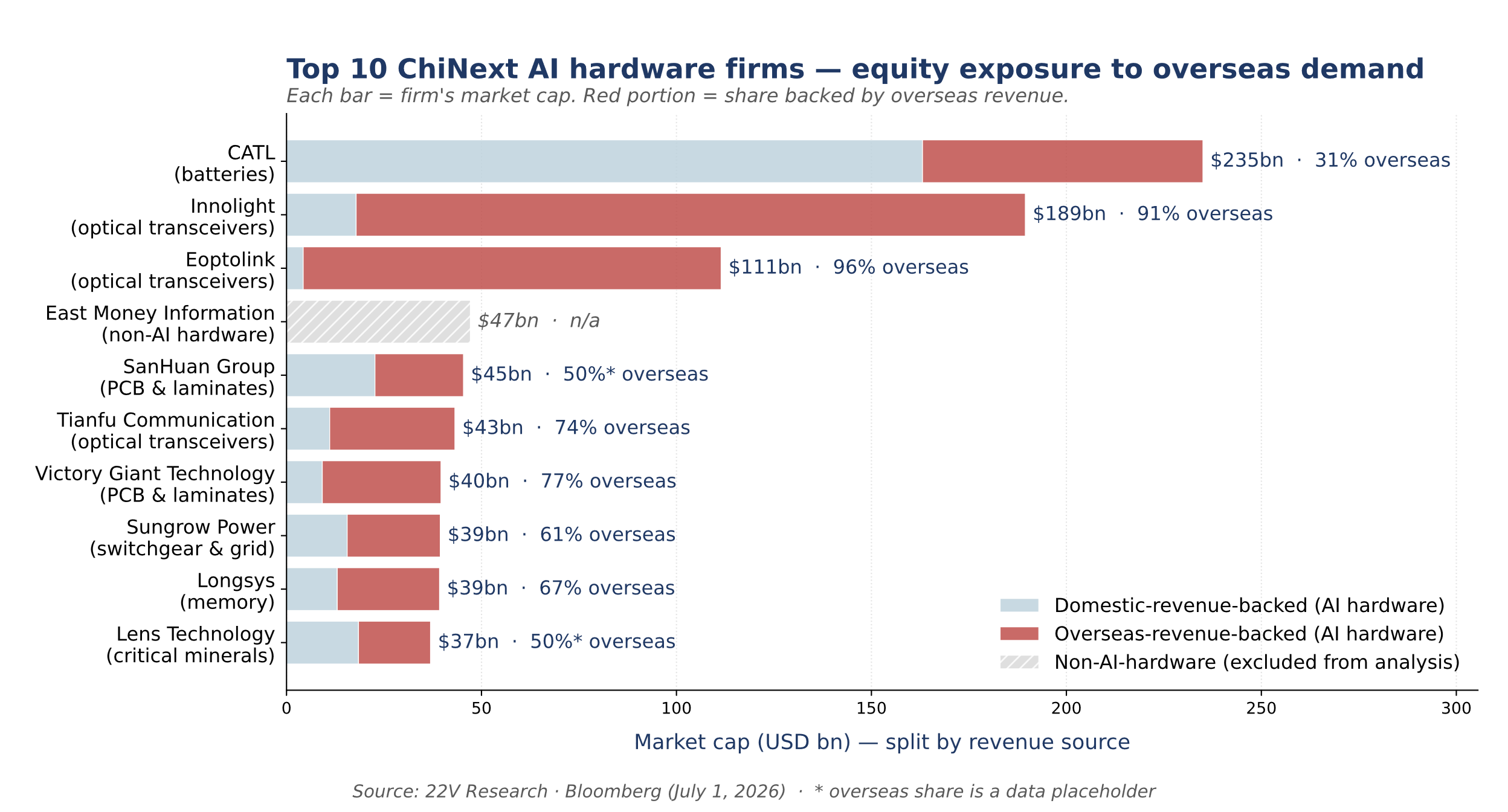
These dynamics result in clear trade-offs. The ChiNext-listed “systems” exporters are already benefitting from the global data center buildout but are heavily exposed to the risk that the buildout is slower than expected. Indeed, nine of the top ten companies by market cap on ChiNext are AI hardware exporters or adjacent names, leaving the index with a very high dependence on overseas revenue (chart below). Some firms also face risks from potential actions that the US government takes to lower dependencies on China for data center supply chains.
The STAR-listed semiconductor companies, meanwhile, stand to benefit from China’s need for advanced compute, but many face heavy R&D needs, uncertain technological and commercial strategies, and fierce competition for the nascent domestic market.
Growth Dynamics: Revenue and Capex
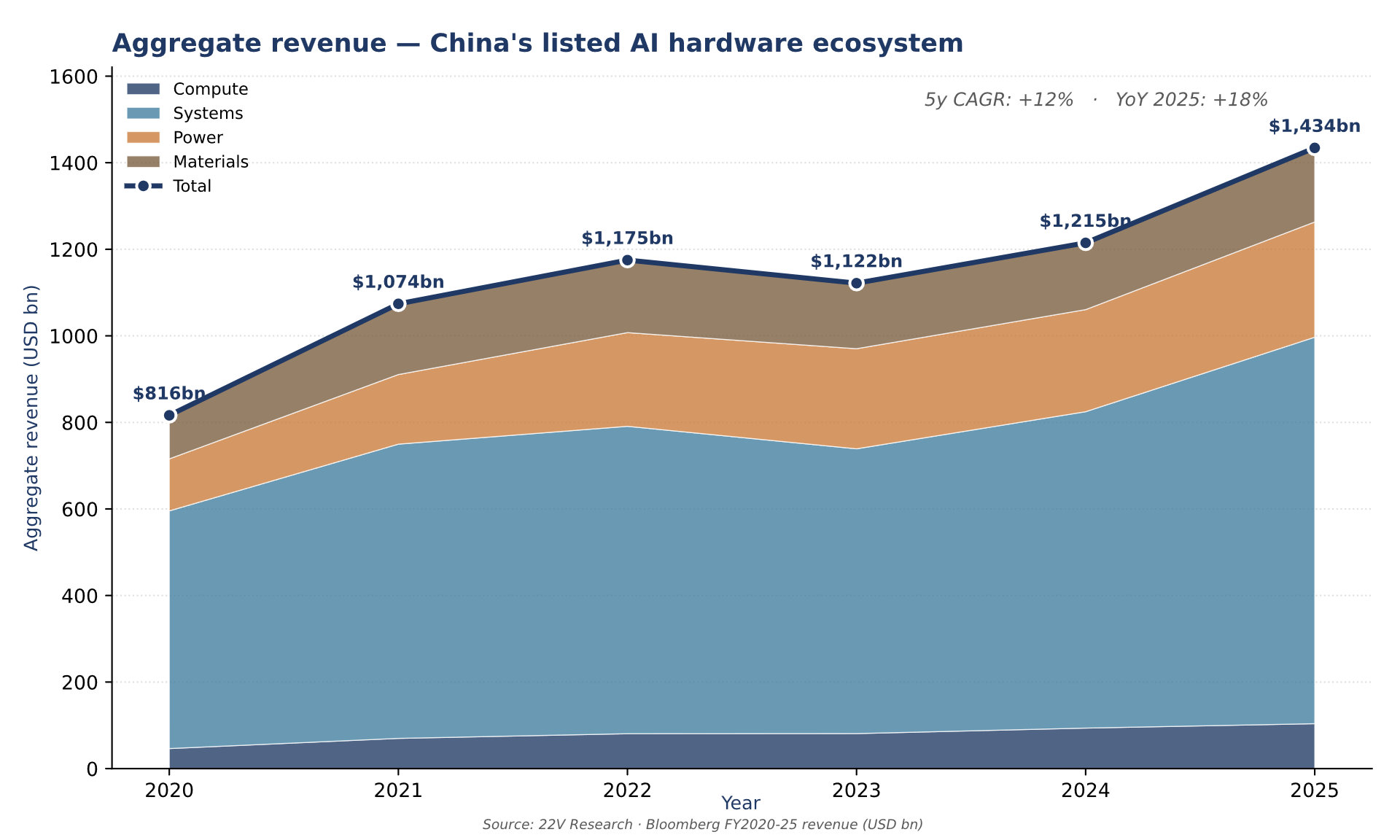
Revenue in the AI hardware ecosystem has been growing at a 12% compound rate for the last five years, with growth turning higher in 2025 (18%) as demand for AI inputs picked up with the global data center buildout. The exceptions were compute (11% growth), where technological bottlenecks prevented Chinese firms from cashing in on demand for advanced AI chips, and materials (11% growth), where China’s export controls on critical minerals were a contributing factor to modest growth.
The more dramatic inflection point since 2025 has been in capex, which surged 28% last year after flat growth in 2024. Capex growth has been particularly strong in compute and in systems, and more muted in power (the battery sector has been digesting excess capacity) and rare earths/materials.
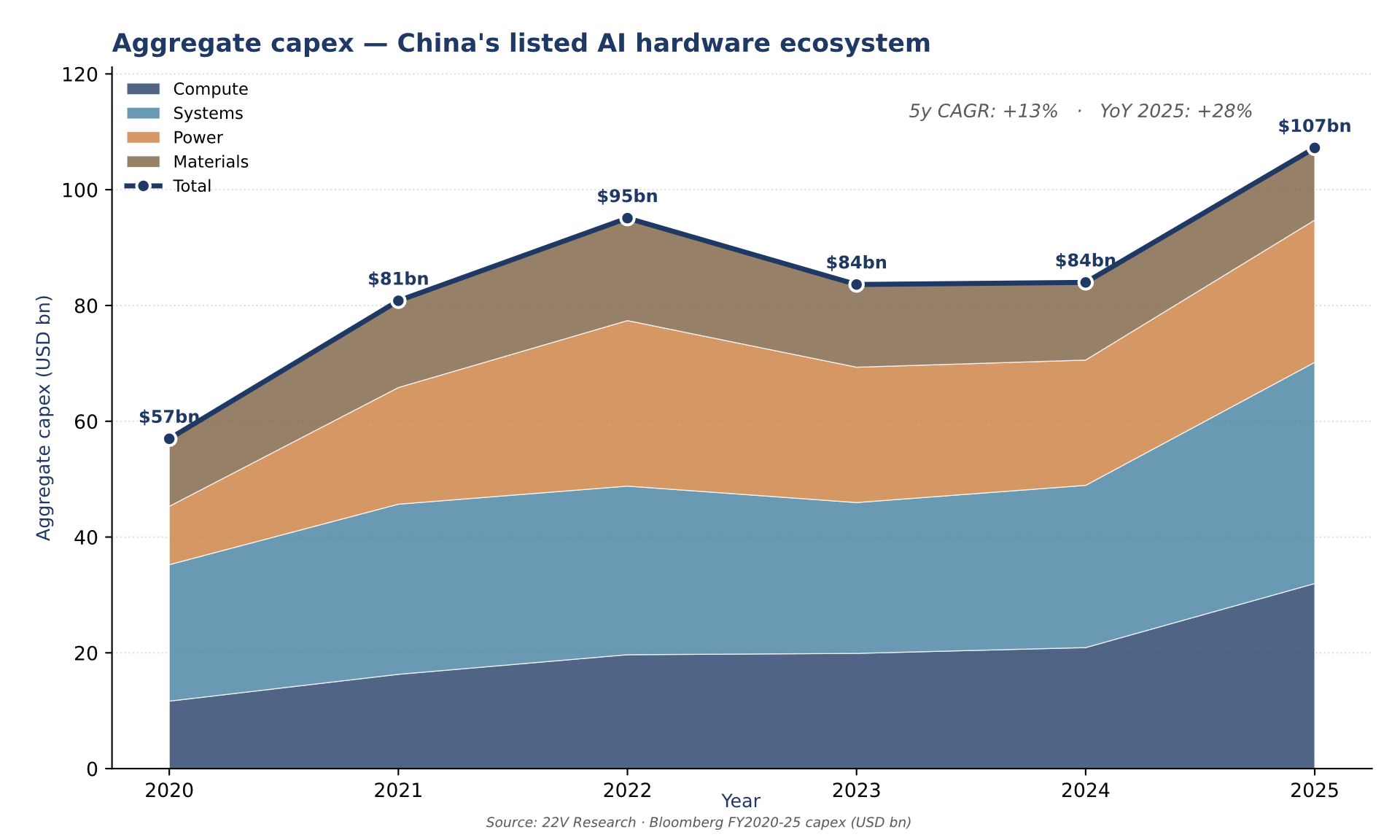
The fact that capex is outpacing revenue growth (28% vs. 18%) highlights risks of margin compression and overcapacity in some sectors. Two sectors in which analysts are increasingly flagging risks of stiffening competition – amid an overall bullish stance – are optical transceivers and domestic CPU/GPUs:
- Optical transceivers saw a cycle of high demand and then overcapacity in 2021 and 2022. A May 2026 report by Dongxing Securities notes the potential for a repeat: “In 2026, the optical interconnect sector’s capacity has significantly increased — the sector is shifting from a ‘high-profit, high-free cash flow’ phase to a ‘high-capex, high-depreciation’ phase.”
- For domestic CPUs and GPUs, the main issue is a host of newly listed semiconductor firms seeking to become China’s answer to Nvidia. This requires heavy outlays of R&D for a still unproven path to commercialization – a phenomenon that one analyst describes through Chinese historical analogy as “many warlords chasing a deer.”
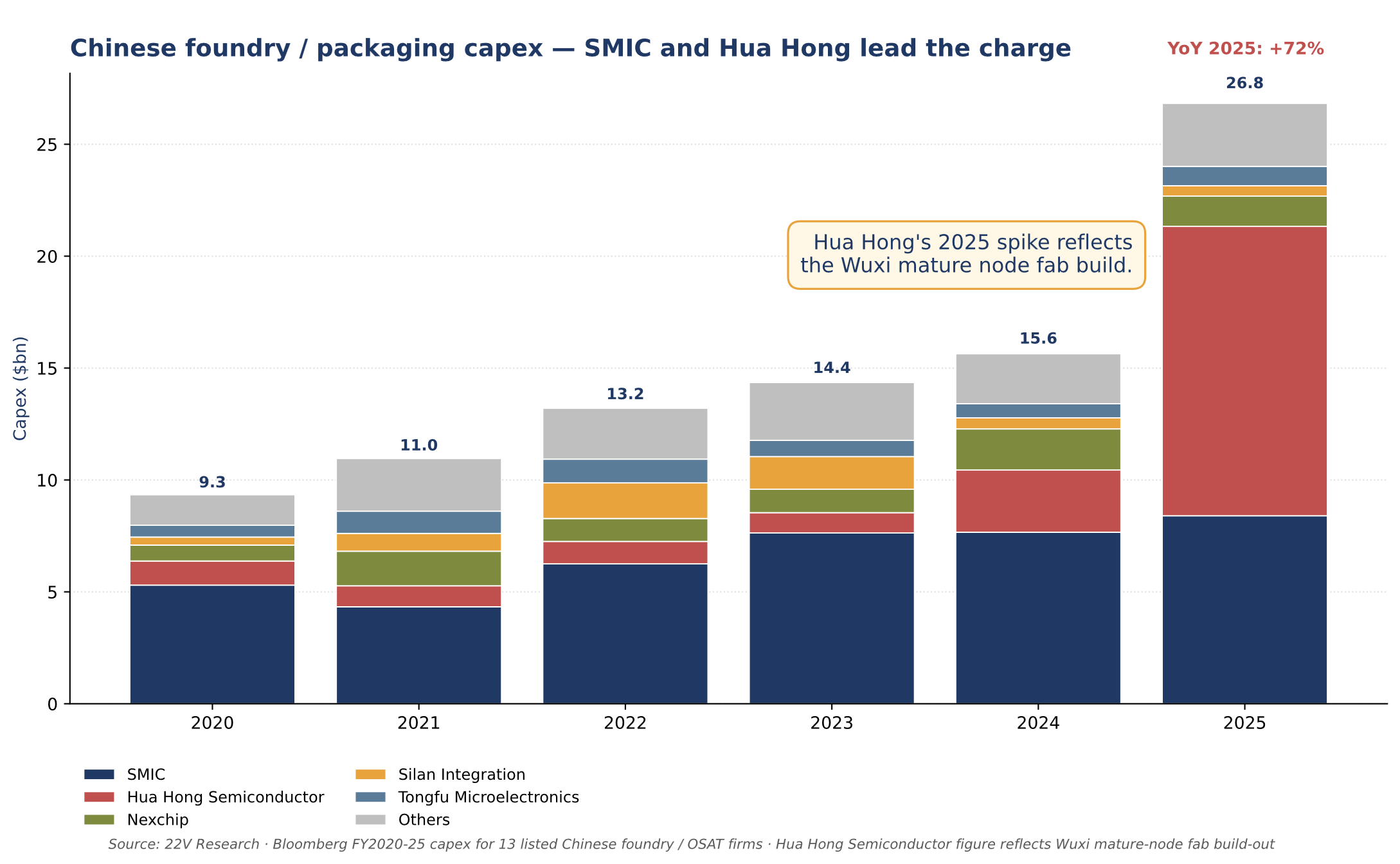
China’s foundry sector led the way in capex in 2025, with a 72% increase. Two firms accounted for the vast majority of that growth: SMIC and Hua Hong, and the headline numbers are distorted by a major new foundry facility by Hua Hong hitting the books in 2025. SMIC and Hua Hong are key players in China’s ambitions to manufacture advanced GPUs, coordinating closely with Huawei. As a result, both companies are in the crosshairs of US export controls – and will remain so.
However, most of the new capacity coming online is to produce mature semiconductors (12 nm and above), such as those used in autos and smart devices. Due to technological bottlenecks, especially US restrictions on ASML’s exports of EUV lithography equipment to China, their production of advanced semiconductors is far smaller.
SECTORAL THEMES
In Compute, China’s Memory Story is Getting Interesting
China’s listed memory sector is composed mainly of firms such as Longsys that make memory modules, buying the chips from the likes of SK Hynix and packaging them for OEMs such as Lenovo. This is mainly a commodity business, and the module makers are getting squeezed by soaring costs for memory chips.
However, China’s listed memory chip story will get more interesting with the upcoming IPO of Changxin Memory Technology Corp. CXMT is the largest DRAM producer in China and fourth largest in the world per SemiAnalysis, which recently did a deep-dive on CXMT (link HERE). The firm plans to go public this year in what will likely be the largest IPO on the Shanghai STAR market since the 2020 IPO of chip foundry SMIC. YMTC, China’s leading NAND producer, is reportedly also considering an IPO.
CXMT’s plans to produce high-bandwidth memory (HBM) are still aspirational, but it is nonetheless benefitting from AI-related demand for conventional DRAM and investing heavily in new capacity; SemiAnalysis expects CXMT to account for 17% of global DRAM capacity in 2027, up from 13% in 2025. Some of this production is for export – with Apple reportedly considering CXMT as a supplier – but CXMT is also increasingly woven into the domestic compute sector as Beijing seeks to promote national champions across the semiconductor sector.
One risk for CXMT’s competitors is that the firm will not just help relieve the memory chip shortage but also pave the way for oversupply when the cycle turns. SemiAnalysis does not see this as an acute risk for now, arguing that the global DRAM market will be undersupplied at least through 2027.
Infrastructure Exporters Face a Shifting US Data Center Landscape
For infrastructure providers such as optical transceivers and power management devices, the US data center buildout has been a major boon. In addition to the risk that US AI-related capex could slow, many Chinese players face a shifting landscape, including the transition to Nvidia’s new Rubin architecture, as well as growing US policy attention to supply chain dependencies on China.
Optical transceiver makers Innolight and Eoptolink are the clearest case of the “Nvidia supply chain” as a theme in Chinese markets. The two firms are widely reported to be among Nvidia’s largest global suppliers of 400G and 800G optical transceivers, alongside US firms Coherent and Lumentum. Both firms are ramping up production of 1.6T devices for Nvidia’s next-generation Rubin architecture.
US policymakers are starting to pay more attention to dependencies on these firms, with the Department of Defense recently adding Innolight to its list of “Chinese Military Companies” subject to defense procurement restrictions. However, cutting these firms out of the supply chain is impractical as they operate in module assembly, a lower-margin and less sensitive part of the optical supply chain than, say, the high-speed lasers produced by US and Japanese firms. The more likely long-term risk is Nvidia’s shift toward co-packaged optics (CPO), which could partially disintermediate the pluggable transceiver market from 2027-28, though Chinese firms are investing to remain relevant through Linear Pluggable Optics (LPO) as a bridge.
Segments of the power management sector, such as Sungrow Power, face similar dynamics. While many of these items are largely commoditized, there is a higher-margin opportunity as data center power management needs become more complex – a theme that 22V’s data infrastructure/commodities analyst Dauvin Peterson noted in a report this week (link HERE). Chinese analysts note that China’s leadership in high-voltage direct current transmission for the power grid — including State Grid’s UHVDC network — provides a foundation of power-electronics expertise that could transfer to Nvidia’s proposed 800V DC datacenter architecture. This is a different application (rack-level distribution rather than long-distance transmission), but similar engineering lineage.
Taiwanese firm Delta Electronics is widely cited in Chinese analyst reports as particularly well-positioned, and is reportedly already shipping 800V DC infrastructure to Nvidia. Chinese firms including Sungrow Power (solar inverters + data center UPS) and Inovance (industrial automation + EV powertrain) have adjacent expertise that could position them to participate as well. However, the policy risks are rising, with Reuters reporting this week that the Trump administration is preparing a ban on new Chinese inverters out of concern that China could disrupt the US energy grid.
Materials: Chokepoints and (Sometimes) Moats
The equity market enthusiasm for Chinese AI hardware providers like optical networking is leading domestic and some foreign investors to look for less obvious Chinese beneficiaries of the global data center buildout, including some of the many niche areas within the materials sector. Some of these areas represent areas of durable advantage for Chinese industries, while others already show risks of commoditization. Themes that come out in domestic analyst commentary include the following:
- Silicon wafers are an example of commoditization, having already seen a collapse in margins as the result of a surge in Chinese investment in recent years. All major Chinese players (such as TCL Zhonghuan) are posting losses, and these dynamics are challenging foreign competitors such as Japan’s Shin-Etsu.
- Semiconductor specialty chemicals (photoresists, CMP slurries, high-purity gases, wet-process chemicals) are another push by Chinese companies (Jianghua Micro, Huamao, Shanghai Xinyang) to substitute for imports, again mostly from Japan (Shin-Etsu, JSR, Tokyo Ohka Kogyo, DuPont, Mitsubishi Chemical). Foreign incumbents still have significant technological moats.
- Our first report noted that critical minerals, including gallium / germanium / antimony / tungsten are key to AI supply chains. Beijing’s use of export controls as a source of leverage against the US and Japan is not always a plus for the Chinese firms in this sector, which include Northern Rare Earth, China Rare Earth Group, and JL Mag Rare-Earth. But it will guarantee continued interest among G7 countries in Western alternatives, such as MP Materials and Lynas. Chinese firms will also look to use access to controlled inputs to compete against foreign companies in downstream products, such as leveraging tungsten supplies to compete in cemented carbide cutting tools and sputtering targets used in semiconductor manufacturing.
FINAL WORD: US-China Risks as a 2027 Watchpoint
This report and the earlier supply chain analysis reveal two competing truths:
- The US and Chinese AI ecosystems are tightly intertwined, including in hardware
- US-China geopolitical tensions are pulling on these interdependencies, creating risks for some supply chains (such as rare earths) and shaping the investment thesis in others (such as China’s domestic chip sector).
These dynamics will be visible but probably not highly escalatory for the remainder of 2026. The two sides will look to maintain their supply chain truce – in which the US refrains from imposing export controls on Chinese tech firms, and China keeps exports of critical minerals flowing – through the visit of Xi Jinping to the US in late September and US midterm elections in November.
However, the risks of geopolitical tensions spilling into AI investment themes rise in 2027:
- With US midterms out of the way, Trump may be more inclined to permit moves against Chinese tech firms. One potential trigger is the growing competition for US frontier models from Chinese open-weight LLMs, and the fact that US firms such as Anthropic have accused many of their Chinese peers – including Alibaba and DeepSeek – of large-scale distillation of their models. Reuters reported earlier this month that US officials have approved a list of over 100 Chinese companies to add to the export control list – including DeepSeek and CXMT – but have held off in order to maintain the supply chain truce.
- Should more slack appear in global data center supply chains, US officials may become more proactive in taking actions to reduce the role of Chinese inputs (inverters, transformers, batteries, and printed circuit boards, optical transceivers) in US data centers. There are multiple authorities for doing so under executive action. Prominent firms in the CHAIN universe are now on the Department of Defense “Chinese Military Companies” list, including CATL, CXMT, YMTC, SMIC, and Innolight. The list carries little immediate consequences but is something of an early warning signal regarding US policy concerns.
- Beijing has signaled very clearly in recent months that it will respond forcefully to US actions that it regards as seeking to contain China’s technology development or to de-risk from Chinese supply chains. China’s key source of leverage remains its dominant role supplying critical minerals used throughout the data center supply chain – including recent attention to Beijing’s controls on indium, used in the photonics chips made by US producer Coherent.
We do not expect a return to the all-out supply chain wars that the two sides flirted with in 2025. However, even lower intensity measures create risks for firms across different parts of the AI tech stack – in both countries.

