

This is the first in a series of reports that examines the intersection between China’s economy and broader AI themes.
SUMMARY
- Chinese firms supply many of the key items used in data center infrastructure, such as energy storage and power equipment; however, China posts a large trade deficit in advanced semiconductors, an economic and geopolitical vulnerability that Beijing is determined to tackle.
- AI-related hardware has been the key driver for China’s equity markets this year, and splits into two main “AI trades”: exporters of data center equipment vs. semiconductor companies seeking to replace China’s imports of advanced GPUs and memory chips.
- The United States relies on Chinese firms for almost 30% of its imports of AI-related products and has a particularly high dependence in lithium-ion batteries and critical minerals; while Chinese firms control some key “chokepoints” in AI supply chains, they may also be a source of supply relief as their investment ramps up.
A Sleeper Role Getting Harder to Ignore
The US and global data center buildout is having a major impact on the economies of Northeast Asia. This is most dramatic in the chipmaking hubs of Taiwan (GPUs) and South Korea (high bandwidth memory), which are seeing a massive spike in exports and knock-on effects in the broader economy.
China lacks the capacity to make advanced chips at scale but plays a central role in the less sexy parts of the data center supply chain, including energy storage, transformers, critical minerals, and chemicals. This quiet story is becoming increasingly important for investors to monitor:
- The scale of AI-related exports is now moving the macro needle in China, accounting for roughly half of the growth of China’s total exports this year. This comes at a time when China’s overall growth is increasingly dependent on trade (see our take HERE).
- AI-related hardware is also now the key driver for China’s A-share market. The ChiNext Index of Shenzhen tech stocks is up 100% over the last year, with companies related to the global data center buildout accounting for nine of the top ten holdings.
- US dependencies on China for data center components are gaining more visibility in Washington. China controls some critical “chokepoints” in data center supply chains but may also be a source of supply relief in others.
China’s “AI Trade Surplus”
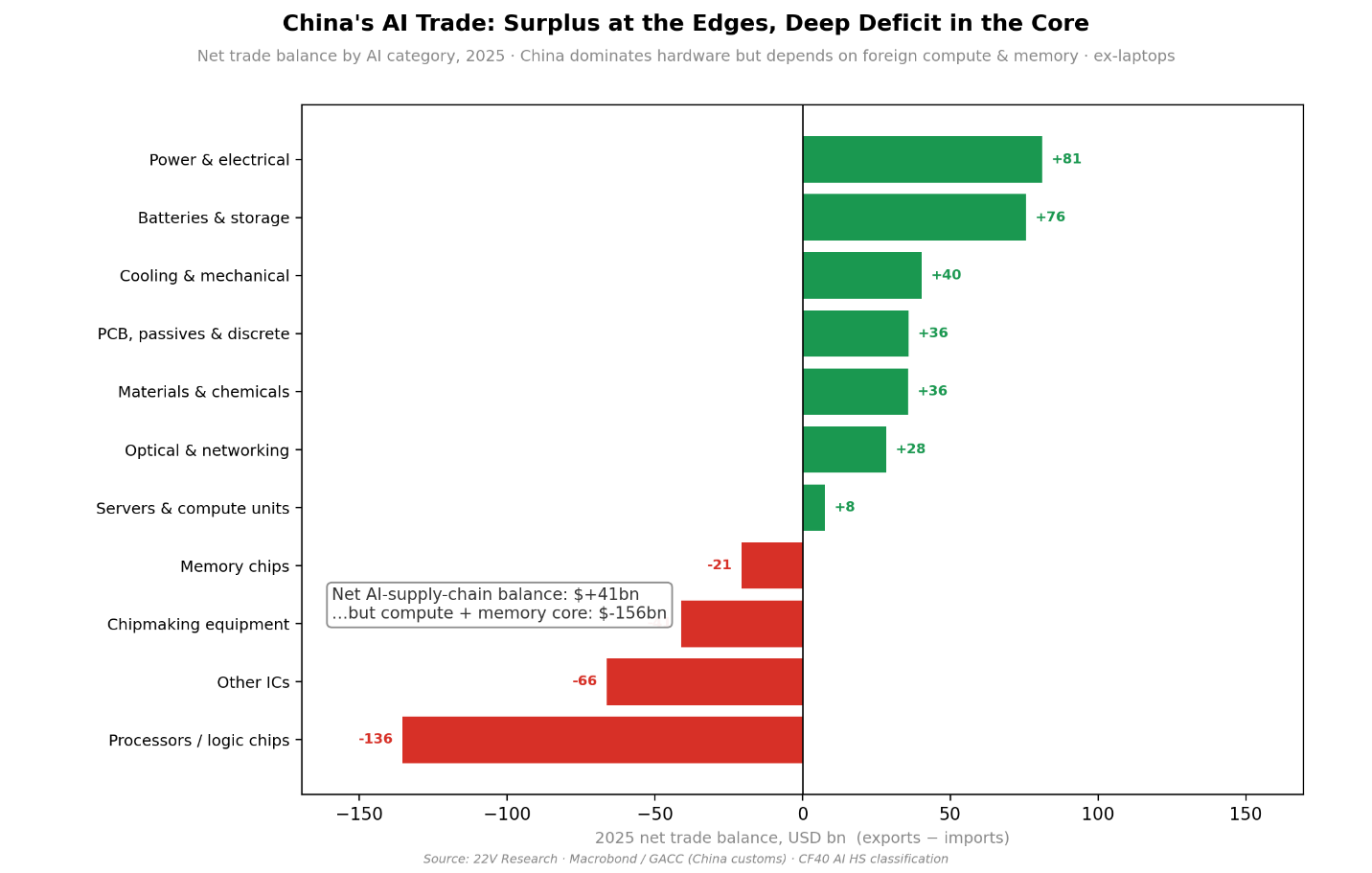
China posted a trade surplus in AI-related goods of $41 billion in 2025 (chart above); our analysis uses a list of AI-related trade products compiled by the WTO and refined by Chinese think tank CF40, with our own discretion applied to exclude certain categories (such as laptops). There is a stark contrast between where China posts a surplus vs. deficit:
- China is a net exporter in a diversified set of items for data centers, tilted to the infrastructure side: power and electrical equipment, batteries and storage, printed circuit boards and servers, cooling equipment, and optical networking equipment. Chinese exporters in these areas have been among the hottest stocks in China’s equity market in the last two years, thanks to booming revenues.
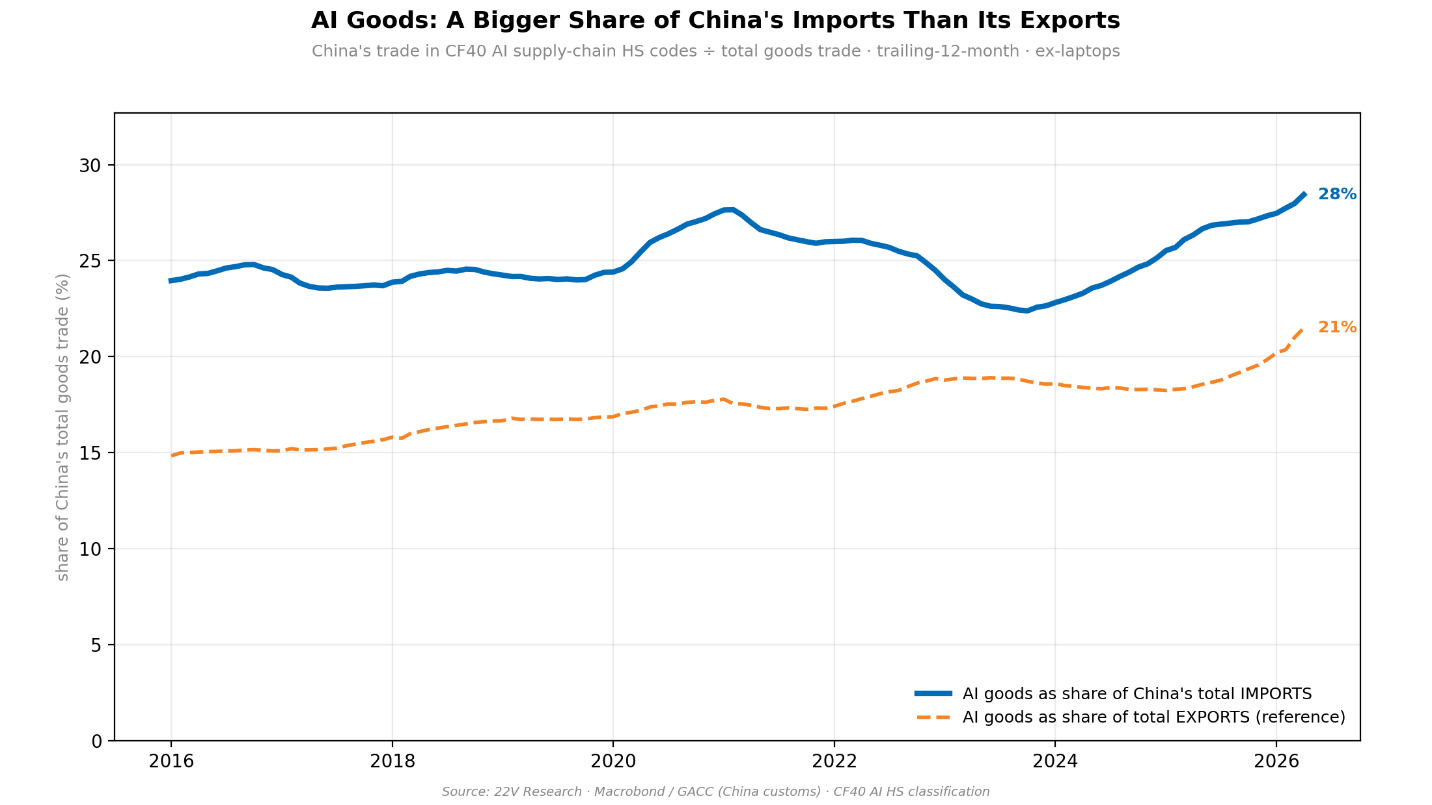
- China’s weak point is in advanced compute – processors/logic chips and memory – where it posts a massive deficit of $156 billion. The raw figures overstate the size of that deficit, since some of these chip imports go into products that are then re-exported. Even so, it remains a key economic and geopolitical vulnerability, and AI-related goods are an even higher share of China’s imports than its exports (chart below). The compute deficit would be even larger, at least in the short term, if it were not for US export controls that limit China’s imports of advanced GPUs (such as from Nvidia). At the same time, export controls sustain the need for imports by depriving China of access to chipmaking tools, particularly ASML’s EUV lithography, which would allow it to produce advanced chips at home. Reducing this reliance on the United States and its allies for semiconductor technology is the single biggest industrial policy goal for China’s leadership.
The Two AI Trades in China’s Markets
The export vs. import split above is mirrored in Chinese equity markets, where there are two stylized AI trades:
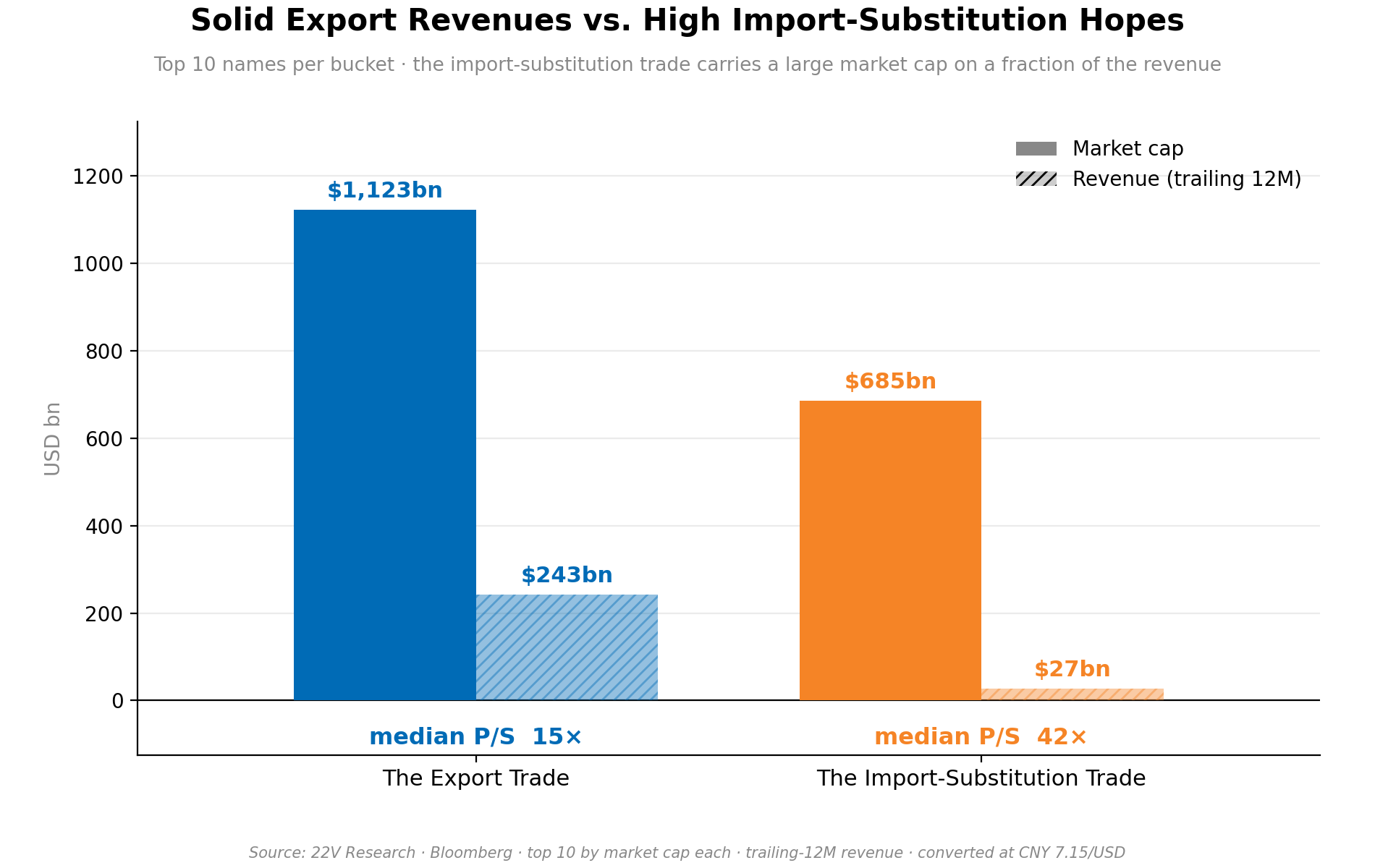
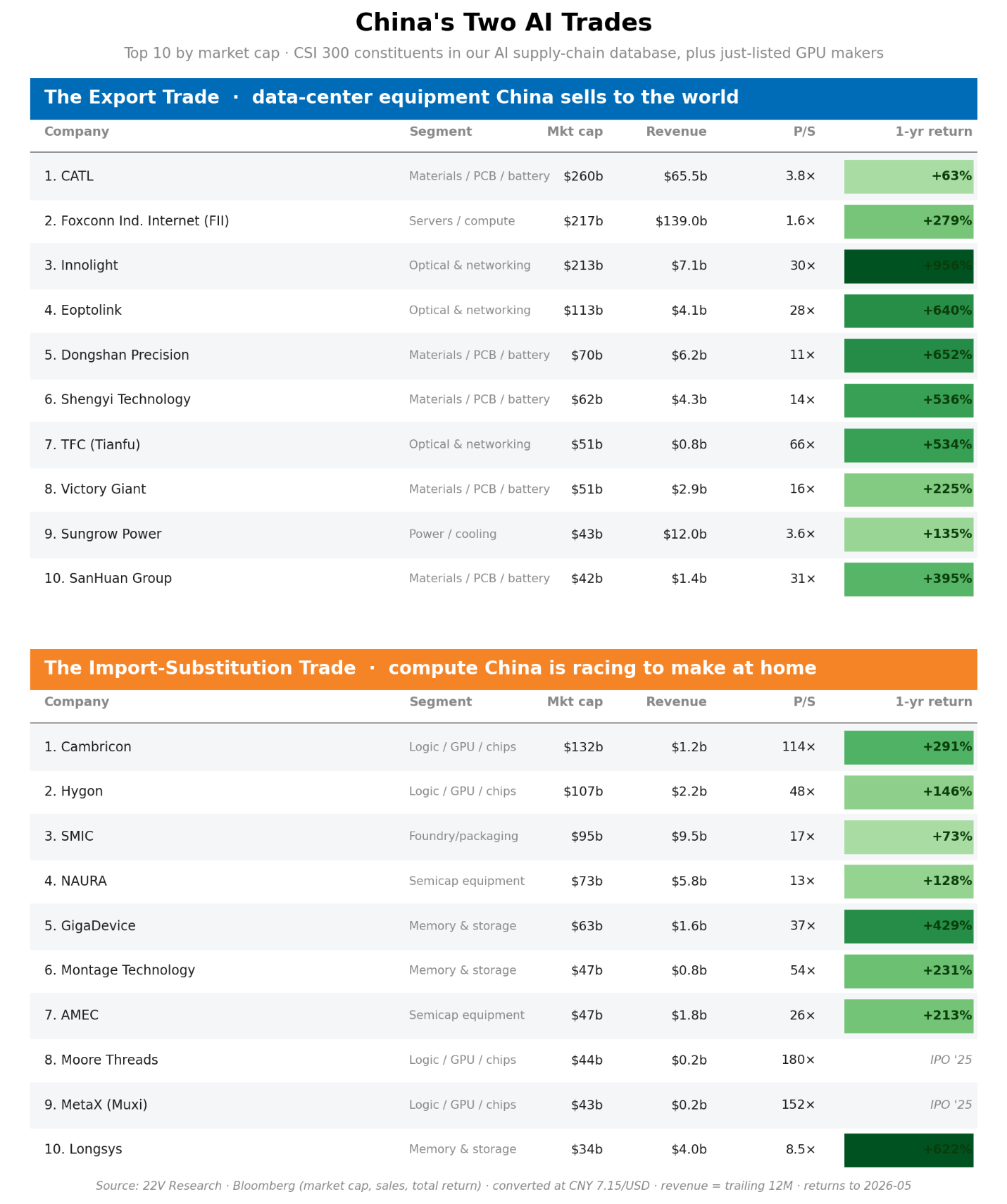
- The companies exporting data center equipment have been the stars of China’s equity markets over the last year. Battery maker CATL benefits from demand for energy storage systems for data centers, while Zhongji Innolight, Eoptolink Technology, and TFC Communication all sell optical networking equipment. The exporters are commercially successful companies that were already plugged into tech supply chains and have seen an additional surge in business from the AI boom. Most are listed on Shenzhen’s ChiNext Board.
- The other side of the AI trade consists of the import-substitution plays – namely, the semiconductor technology companies seeking to break the US/allied tech blockade, such as GPU makers Cambricon, MetaX, and Moore Threads – all of which have recently gone public on the Shanghai Stock Exchange Science and Technology Innovation (STAR) Board. STAR has become the capital markets vehicle for Beijing’s industrial policy ambitions by funding “hard tech” companies with heavy R&D needs that are not yet profitable. Memory chipmaker CXMT, China’s best hope to break South Korea’s stranglehold on high-bandwidth memory (HBM), plans to go public this year in the largest IPO on the STAR board since chip foundry SMIC’s listing in 2020.
The leading players in the export and import-substitution buckets are shown in the table at the end of this report, but the chart below captures a key dynamic: the exporters are booking solid revenues today, while the import-substitution names – mostly fledgling GPU makers – are more speculative in terms of their commercial prospects. Of course, beyond this stylized trade there is a more complex AI story, including Chinese firms that participate in export supply chains as well as China’s domestic data center buildout, and firms focused on “embodied AI” and automation. We will examine the broader ecosystem at the company level in our next note.
The US Dependency on China for Data Centers
Using official trade statistics, the US imported only 14% of its AI-related hardware directly from China. This is down sharply from the 36% level in 2017, as tariffs imposed by Trump in his first term shifted production to third countries such as Mexico and Thailand.
However, this metric understates the degree of practical dependency on China, for two reasons:
- Chinese firms still produce most of the products rerouted to third countries – where the activity sometimes amounts only to final assembly – meaning these goods still trace back to supply chains in China.
- There are a number of key “chokepoints” in which the US is highly dependent on China for key nodes of the AI tech stack, even when the dollar value of imports is small.
Adjusting for Trade Rerouting
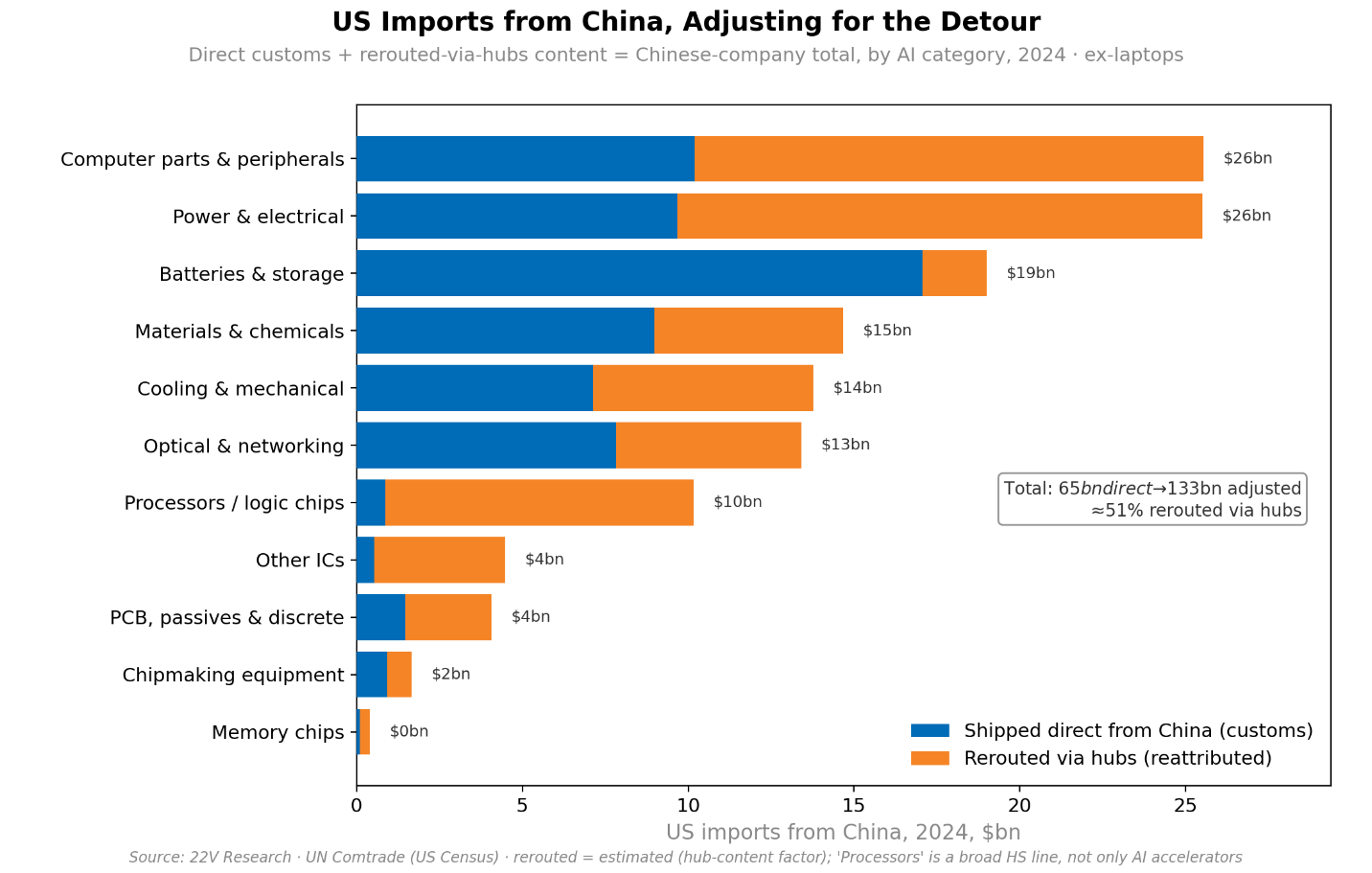
The CF40 Institute, one of China’s best economic think tanks, analyzed US dependence on China for AI supply chains in a report last year (link HERE). To adjust for the rerouting of production due to tariffs, CF40 looked at the growth in exports from China to third countries (Mexico, Thailand, etc.) in each main product line over the same period. Their estimate of actual US dependence on China in 2024 goes from 18% to as high as 24%. Using a similar method (but excluding laptops in the analysis), we estimate that Chinese firms account for roughly 28% of US imports in AI-related products, double the 14% share from direct exports.
In the chart below, we show the US AI-related imports both in official trade data and through an estimate of rerouting. As with China’s exports in general, Chinese firms supply products across the AI stack, especially energy infrastructure: power and electrical equipment (such as transformers) and energy storage and batteries.
China’s Chokepoints
The value of US imports alone does not necessarily indicate where US dependence on Chinese supply chains is highest. To capture that dynamic, the scatterplot below shows the dollar value of imports in key categories, along with the share of US imports provided by Chinese firms. Some of the high-dependency items are major imports, such as lithium-ion batteries. However, some of the areas of highest US dependency are rare earths and permanent magnets, which have a low dollar value but are critical upstream components.
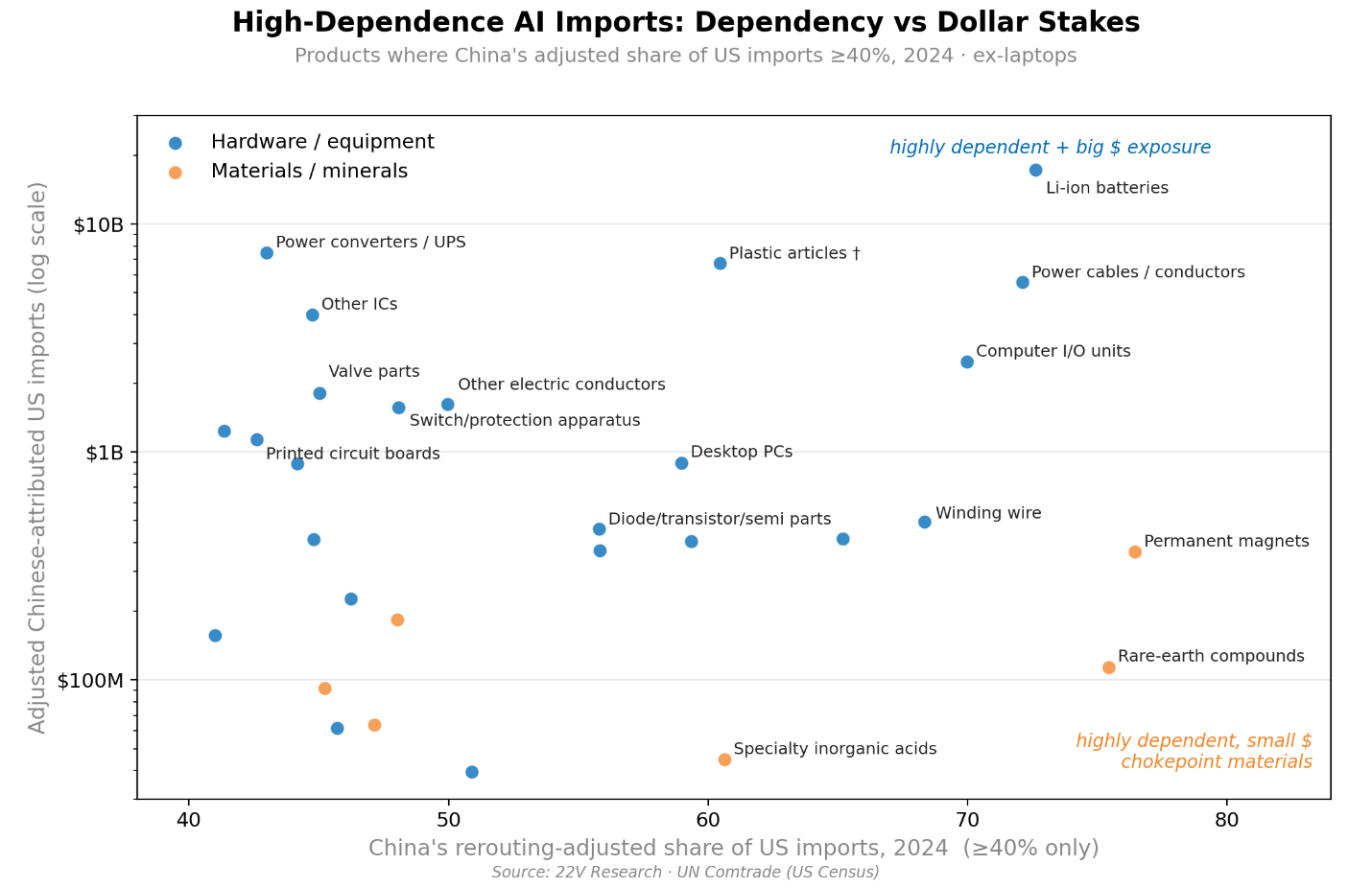
Rare earths and the related area of permanent magnets are the clearest case of “chokepoints” subject to US-China geopolitical tensions. These items are used throughout the data center supply chain (see a nice infographic from the US Geological Survey HERE). China’s ability to cut off the flow of critical minerals such as gallium and germanium – both used in semiconductor production, among other industries – was the decisive factor in forcing Trump to agree to a supply chain and tariff truce with Xi Jinping last fall.
While Trump reaffirmed that truce with Xi in Beijing in May, it has not been smooth. Trump included the CEO of optical chipmaker Coherent in the business delegation to China, reportedly to lobby Beijing to loosen restrictions on indium phosphide. Per Reuters reporting (link HERE), those restrictions threaten to become a gating factor for the US data center buildout.
Critical minerals will remain a key area of contention. The US-China relationship should be broadly stable for the rest of this year, but flareups around dueling export controls are only a matter of time. Beijing has established an extensive regime to tighten and loosen specific critical mineral supplies as it sees fit. The US Commerce Department has kept the peace with Beijing by refraining from imposing significant US export controls on a Chinese firm since October – the longest stretch in years – despite US officials proposing a long list of candidates (reportedly including DeepSeek). This may not be politically sustainable, and members of Congress are looking to advance legislation (the MATCH Act) that would remove some discretion over export controls from the administration.
While Washington is of course well aware of the US vulnerability to China’s rare earth controls, it is not the only area of data center supply chains provoking anxiety. US officials are also concerned about security and supply chain risks associated with imports of printed circuit boards and looking to boost domestic production (CNBC article HERE).
China as a Source of Supply Chain Relief?
The flipside of the “chokepoint” risk is that China’s industry is also the best place to look for an expansion of supply that lowers prices and wait times for key nodes in the global data center buildout. Given the economic and geopolitical incentives, Chinese firms are investing heavily across the AI stack, and we have seen this script before (see batteries and solar modules). There is indeed potential for over-investment and even eventual excess capacity in some of these industries, especially if the global data center buildout should slow relative to expectations.
One of the key areas to monitor for disruptive dynamics – positive and negative – is semiconductors. The ability of CXMT to successfully produce HBM, for example, could help relieve the memory shortage – if with major consequences for SK Hynix, Samsung, and US efforts to maintain HBM as a chokepoint on China’s AI development. (As we discussed on a guest webinar to start the year, Chinese firms are making faster progress in HBM than in logic chips).
We will be writing more on the potential for shifts in China to affect broader economics around AI. Our next piece will focus on describing China’s AI hardware ecosystem in more detail.
The authors thank 22V summer research intern Grace Julian for her contributions to this report.

