

A picture is worth 1,000 words
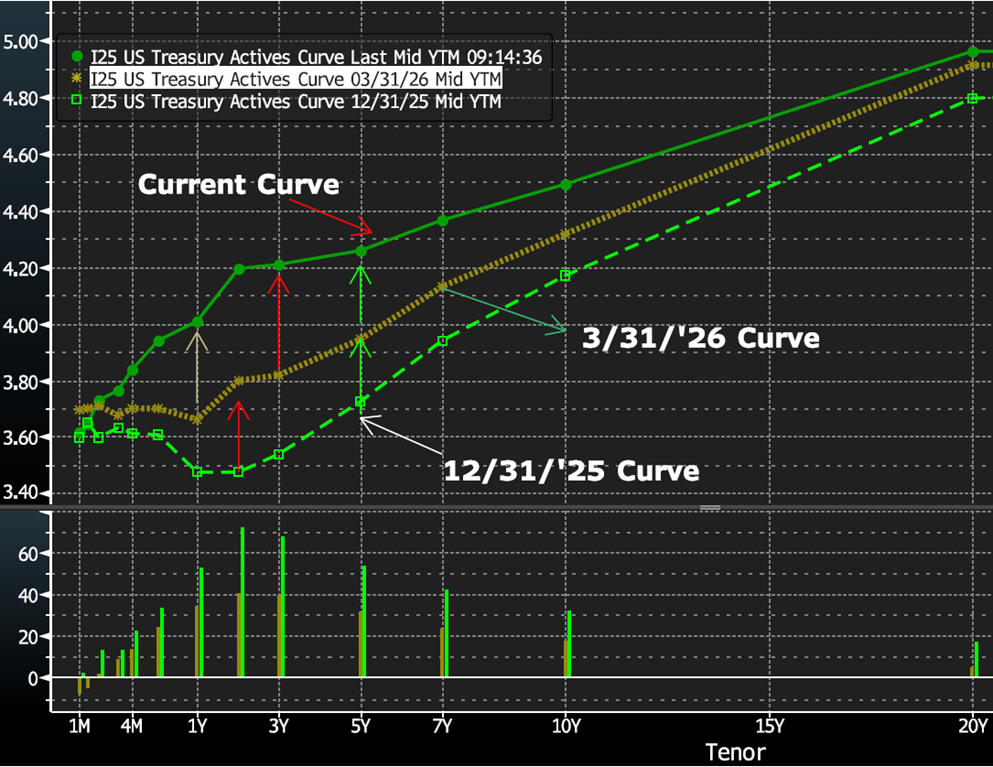
Source: Bloomberg
- The move up in the curve has been significant and has accelerated recently given the more hawkish bias from the Warsh led Fed. From our perspective, the key takeaway here is the move up in the belly of the curve (2-5yrs) where we would argue the predominant amount of lending takes place. Importantly, the belly of the curve is no longer sub-Fed Funds effective and more recently has steepened nicely – a positive for bank lending dynamics.
Should banks focus on growing Net Interest Income or protecting the Net Interest Margin?
- We do understand this question, especially given the last 3 years where loan growth has been hard to come by and margin optimization has really been the key lever as it pertains to NII. Many investors have decried the lack of C&I loan growth over the last 3 years as a reason for not being more positive on the group. Now that loan growth has accelerated, we believe that banks should take the initiative and embrace growing NII even if it does come at the expense of margin (within reason of course).
- Over the last few years, the pitch has been “fixed-asset reprice” which had started to wane as the front end of the curve had inverted relative to Fed Funds later in ‘25, but recent inflationary data has pushed the belly of the curve up significantly in the first 6 months of the year. While this will likely extend the reprice story, we believe that the more impactful way to rotate the balance sheet is taking advantage of new loan growth at the higher curve. The simple example of having $1bil of fixed rate reprice up 50-75bps is a nice positive, but adding an extra $1bil of loan growth on top of that at the higher curve is obviously better for PTPP. Of course, the question is where do you fund that growth? From what we can see as we shop the different bank CD offerings, the relationship rates are currently at various discounts to the Fed Funds effective rate with 4-9 month terms in the 3.25%-3.50% range vs. FF effective at ~3.63%. If you look at a last 12 month view of 1 year CD’s that are not based on relationship pricing (new to bank customer/stand-alone account), the APY is much lower (1.97% as of 6/17).
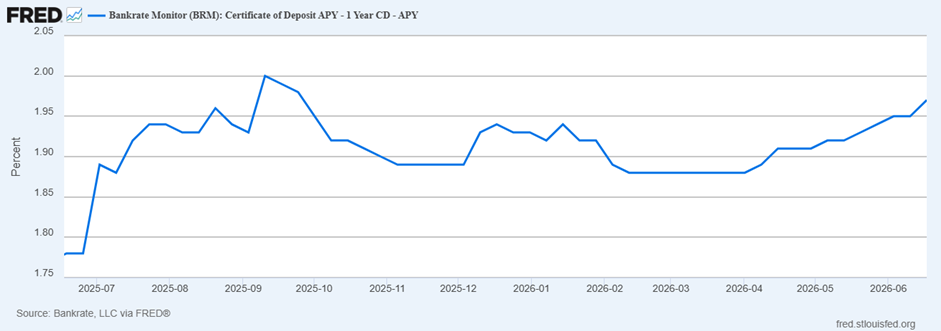
- While you’d obviously like to fund that loan as cheaply as possible rather than near or at the Fed Funds rate, the point is simply that based on the shape of today’s curve, asset yields have improved significantly over the course of this year relative to deposit costs which have only increased marginally – a net positive for the banks.
- What about some spread tightening on new loans? Again, a fair question which we would look at wholistically. Looking at the 3 year part of the curve, we’ve had expansion from 3.8% to 4.2%. If deposit costs are staying relatively benign and asset yields are improving by 40bps, in theory should the banks give up a little spread to capture the predominance of that improvement? We would argue, yes. Banking is a mature competitive industry both on deposits and loans. It would stand to reason that a move that substantial should come with a willingness to be a bit more aggressive on spreads to still capture a meaningful improvement.
Threats to the Narrative – Deposit Costs
- While we have admittedly painted a somewhat rosy picture, rate hikes and/or an acceleration in deposit costs could make the glidepath more challenging. While we acknowledge that as a risk, we’d make a few observations:
- First, setting Kevin Warsh’s more hawkish press conference and the resulting Fed fund futures curve aside for a minute, one needs to weigh how quickly the new Fed Chair may move on policy from a practical perspective. Listening to the press conference, we were struck by his creation of a broad task force designed to look at all facets of monetary policy. We appreciate a fresh perspective on policy and not necessarily following a predecessor’s footsteps without rigorous analysis. In our minds, this doesn’t detract from the Chairman’s inflation fighting bona fides at all. The inflation rate hasn’t been 2% in quite some time. While we appreciate the commitment to reigning in the inflation rate, we would assume that the Fed would shy away from the optics of “lurching” from one policy extreme to the other. In short, going from 3 cuts in late ’25 only to hike a few times (if the forward curve is correct) less than a year later while oil prices are starting their decent might not be the greatest “look.” On the labor front, we do acknowledge the improvement as more supportive of tighter policy, but again, one would think the Chairman would like to give the task force a bit of time to reach some conclusions before starting a hiking regime.
- The takeaways for us are twofold – the more time it takes to decide on policy, the better when it comes to keeping the deposit costs low while asset yields improve. Even if the Fed does begin hiking later in the year, the banks will do their best to lag those betas as best they can.
When do we get clarity on Clarity?
- What feels like a never ending saga should come to a close over the next 5 weeks as the floor closes during the last few days of July/first few days of August. We’d point out a few items:
- Trump has a policy lunch today hosted by Rick Scott to discuss key policy priorities for the remainder of the session. If the President’s focus remains on the Save Act, blocking FISA reauthorization, etc, it’s not a helper for the Clarity Act.
- The Bank Policy Institute is leaning into illegal finance in their last three letters to members. Without traditional bank guardrails like BSA/AML & KYC requirements, it could become harder for moderate Democrats to support.
- With this week essentially done from a legislative standpoint, every week that passes reduces the probability of enactment. As we’ve discussed before, we tend to lean towards Clarity having a more difficult path to the finish line then the market currently expects. While Washington is always in flux, we think any push out of this legislative session will be viewed as positive for the industry.
So what do we like here from a stock specific standpoint?
- US Bancorp (USB) – After coming into the most recent conference season with their stock underperforming, USB gave a solid update noting that 2Q NII was coming in toward the upper end of the 6-7% YoY growth range, while also trending above the 6-7% YoY fee guide for the Q, all while expenses are expected to come in as guided (+3-4% YoY). USB also reiterated their full year guidance and will update the FY guide for the BTIG close on the July call. We’d make 2 points:
- Exposure to the 3 month – 5 year part of the curve. USB has often made reference to their sensitivity to this part of the lending curve as the area that is most impactful/helpful for them. For those who have been concerned on the deposit front, it also appears that the intentional mix shift more to consumer-based (which is up 2 points in the last several quarters) is bearing fruit and should also appeal to investors. In sum, we feel that the glidepath to a 3% NIM by YE’27 is intact.
- On the fee side, we also continue to think that the self-help story here is intact, with payments revenue continuing to improve towards a mid-single digit YoY growth rate. The addition of BTIG into the 2H’26 guide and beyond we expect to also be a helper to the fee growth story. We continue to see upside to our $64 target which is ~11x our FY’27 estimate.

