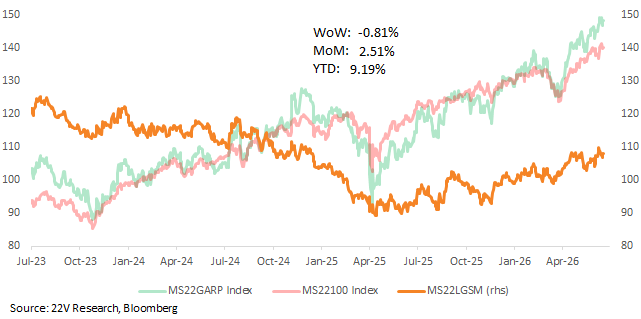
We continue to see a high probability of a catch-up in fundamental factors, particularly EPS Momentum, Earnings Growth, Value, and GARP. While recent commentary has increased perceived Fed rate hike risk, trend revenue and EPS growth are strong, and near-term recession odds are very low, preserving a backdrop supportive of fundamentally driven factor gains.
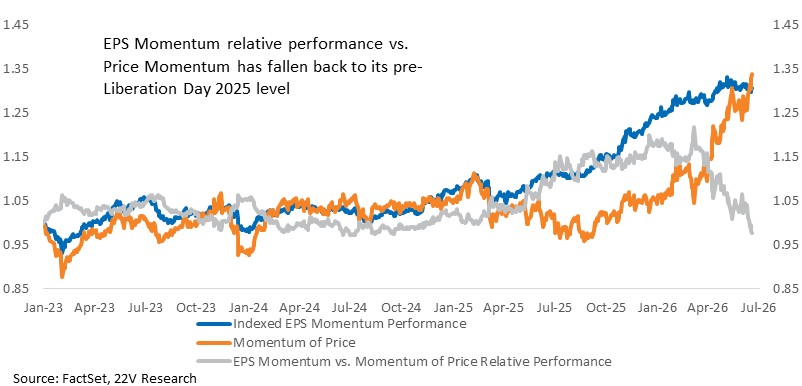
Within Momentum factors, Price Momentum has accelerated sharply relative to EPS Momentum this year, largely driven by contributions from the AI Theme, Technology in general, and Industrials. Looking ahead, we see increasing potential for the AI theme to broaden beyond its traditional Technology leadership, to include Chemicals and ECL, and that is likely in turn to drive a meaningful catch-up of EPS Momentum relative to Price Momentum.
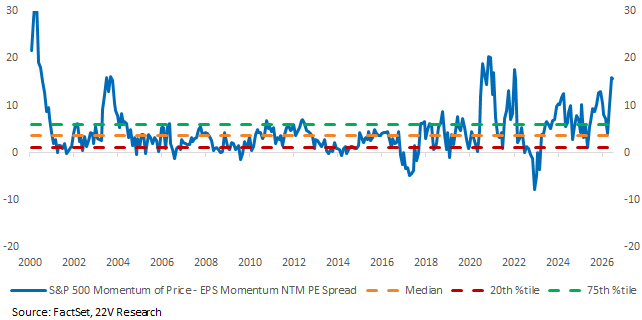
Valuation further supports this view. The NTM P/E premium of the top-decile Price Momentum basket relative to EPS Momentum has reached its 97th %tile, suggesting a stretched relative valuation backdrop. We continue to expect Momentum factors to gain, with EPS Momentum posting a better risk-reward profile.
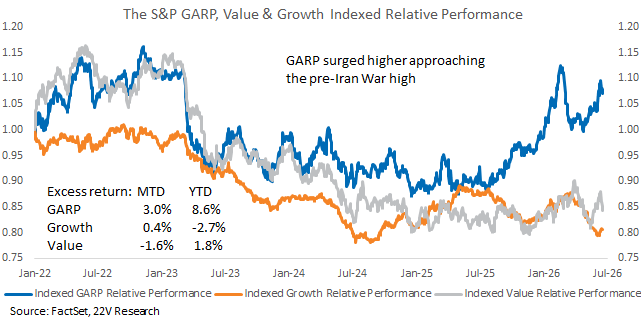
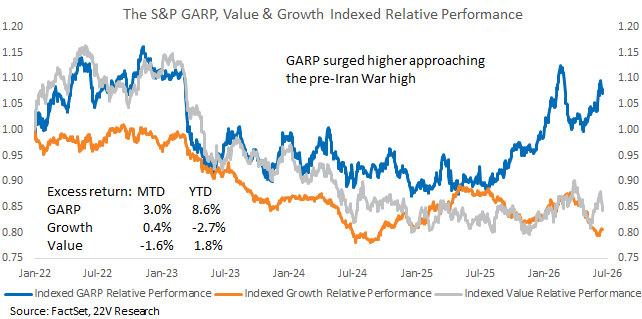
In addition, GARP remains the standout performer. The S&P GARP basket rebound sharply as geopolitical tensions eased since May. With the Strait of Hormuz tentatively reopened and geopolitical risks easing from here, GARP should continue to outpace Value, which also benefited reduced geopolitical tail risks. Growth remains attractive given the Fed has signaled that slower economic activity is needed to reduce inflation pressures.
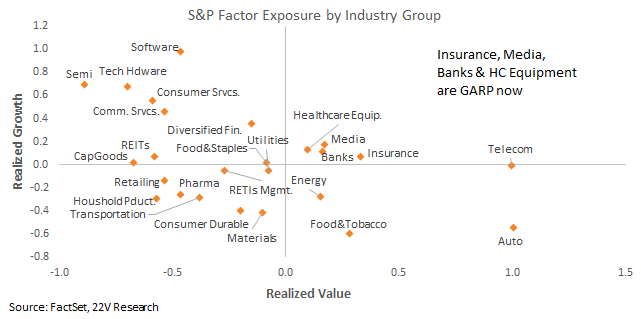
Banks, Insurance, Media, and Health Care Equipment currently emerge as the industry group most exposed to both Value and Growth. For investors seeking exposure to those areas, the tradable long only Small Cap GARP Swap (MS22GARP) and long-short Swap (MS22LGSM) which long Small Cap GARP vs. short OEX names both benefit from the theme, and have gained 15.6% and 9.2% this year respectively.
A “Catch-Up” of Fundamental Factors Increasingly Likely: As we highlighted (HERE), an SOH reopening would support a near-term “catch-up” of fundamental factors, including Earnings Momentum, Earnings Growth, Value, GARP. Though the Fed hike risk elevated based on Warsh’s reaction function, near-term recession risk remains low and that should leave fundamental factors “catch-up” roughly unchanged. Since Liberation Day 2025, EPS Momentum has consistently outperformed Momentum of Price. That relationship reached a turning point this year: Momentum of Price accelerated sharply while EPS Momentum advanced at a much milder pace, leading to larger spread between the two.
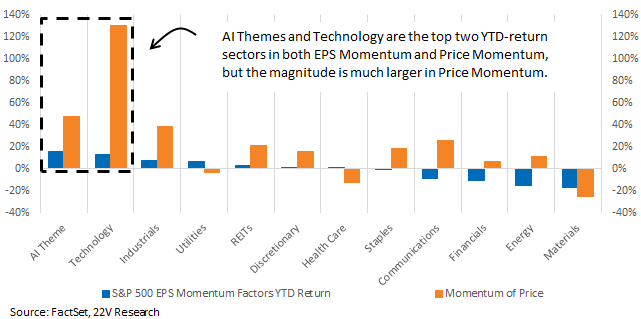
Breaking down that outperformance, the top three sector categories driving EPS Momentum and Price Momentum are the same – AI, non-AI Tech, and Industrials. Stronger gains by higher Price Mo names across industry groups has allowed Price Mo to close the gap with EPS Momentum YTD. Looking forward, we see increasing potential for the AI theme to broaden beyond its traditional Technology leadership. As 22V AI analyst Jordi Visser highlighted in his last weekly video (HERE), attention is shifting toward chemicals and the materials layer as the rising complexity of NIVDIAs Vera Rubin brings the previously missing chemical layer into focus. Similarly, 22V’s Commodity analyst Dauvin believes that ECL is in a position to be a relative and absolute outperformer (HERE). A broadening of the AI chain into these adjacent areas — Chemicals and ECL within the Materials sector – could drive a meaningful catch-up of EPS Momentum names.
Currently the NTM PE spread between top decile Price Mo vs EPS Mo NTM PE is at its 97th percentile, S&P 500 top Price Mo basket is now much more expensive relative to EPS Mo. We continue to expect Momentum factors to gain. However, given the high overlap in sector exposures and return drivers between EPS Momentum and Price Momentum, EPS Momentum appears to offer the more attractive risk-reward profile from current levels.
In addition, GARP names have significantly outperformed YTD and MTD. The basket struggled from the onset of the Iran war but rebounded sharply as geopolitical tensions eased. Continued moderation in geopolitical risks reduces the odds of the kind of financial conditions tightening that put GARP fundamentals under pressure. Value is also likely to benefit from continued geopolitical easing, following its rebound earlier in May, with Growth seeing improvement recently on slower growth expectations, though both are at a smaller magnitude than GARP.
Within the S&P universe, Banks, Insurance, Media, and Health Care Equipment are the leading GARP industry groups, which appear best positioned to benefit from a continued recovery in the factor.
For investors seeking implementation vehicles, we run a tradable Morgan Stanley Swap (Bloomberg ticker MS22GARP) that captures the Small Cap GARP constituents as well, which has gained 15.6% YTD. The pairwise long-short swap (ticker: MS22LGSM) which long Small Cap GARP vs. short OEX names has also returned 9.2% YTD.