SUMMARY
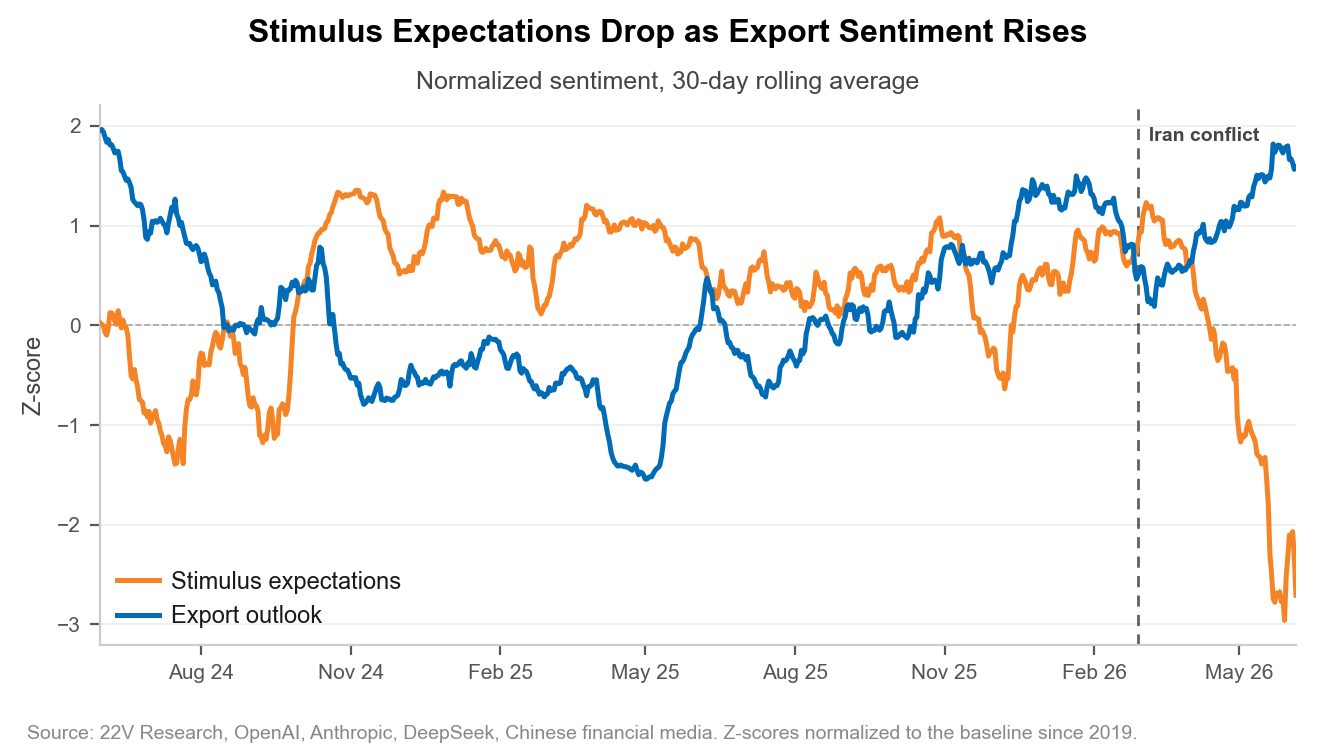
- Analysts’ near-term expectations for stimulus have dropped sharply; we expect fiscal spending to normalize after an abrupt slowdown in the last few months, but not enough to be meaningfully stimulative.
- The macro outlook relies on the relatively narrow base of exports and high-tech industries; consumption and property sentiment are weak, and analysts have lately lost some of their optimism towards the excess capacity campaign.
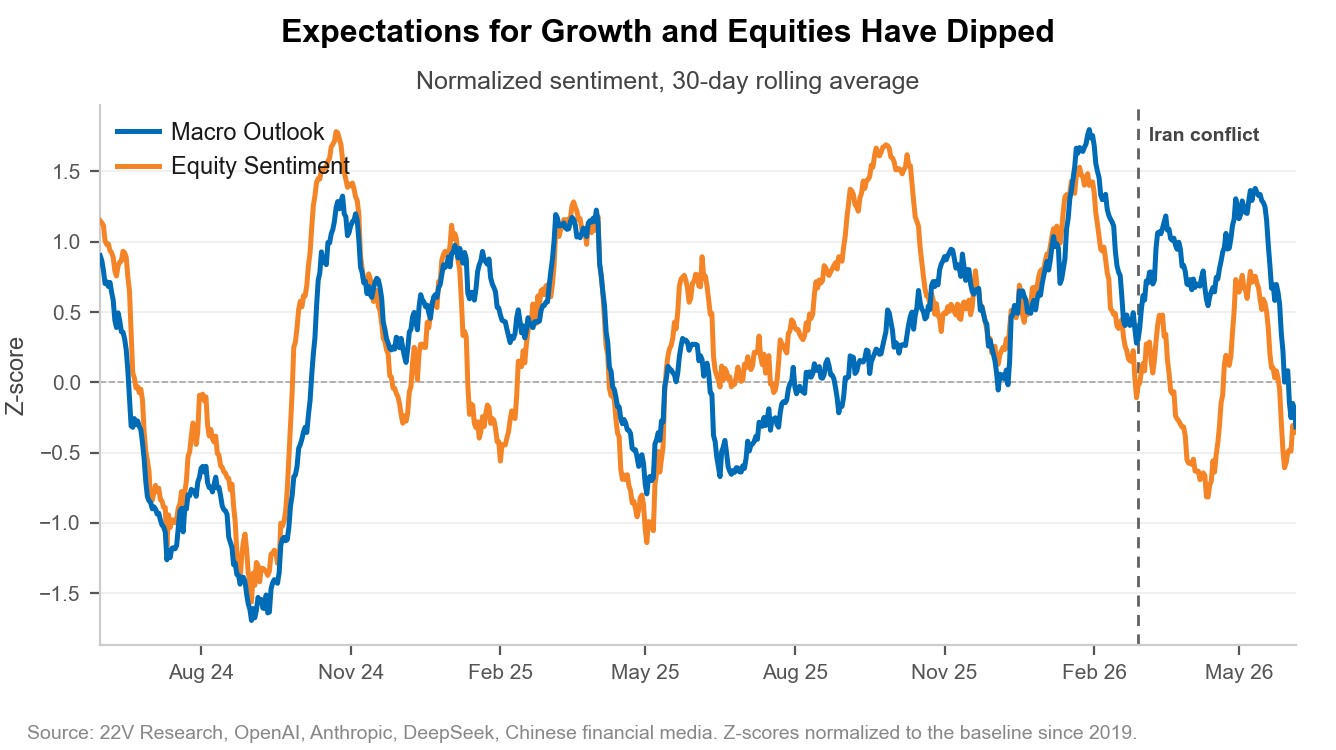
- The soft macro backdrop means that equity market gains are likely to remain concentrated in AI-related companies; this is a balancing act for the authorities, who are keen to fund high-tech but must be wary of speculative risks.
In this report we discuss the latest signals from our proprietary China Economic Sentiment Series (CHESS) tool. CHESS uses LLMs to measure the sentiment of economists and analysts commenting in China’s domestic financial media and research reports.
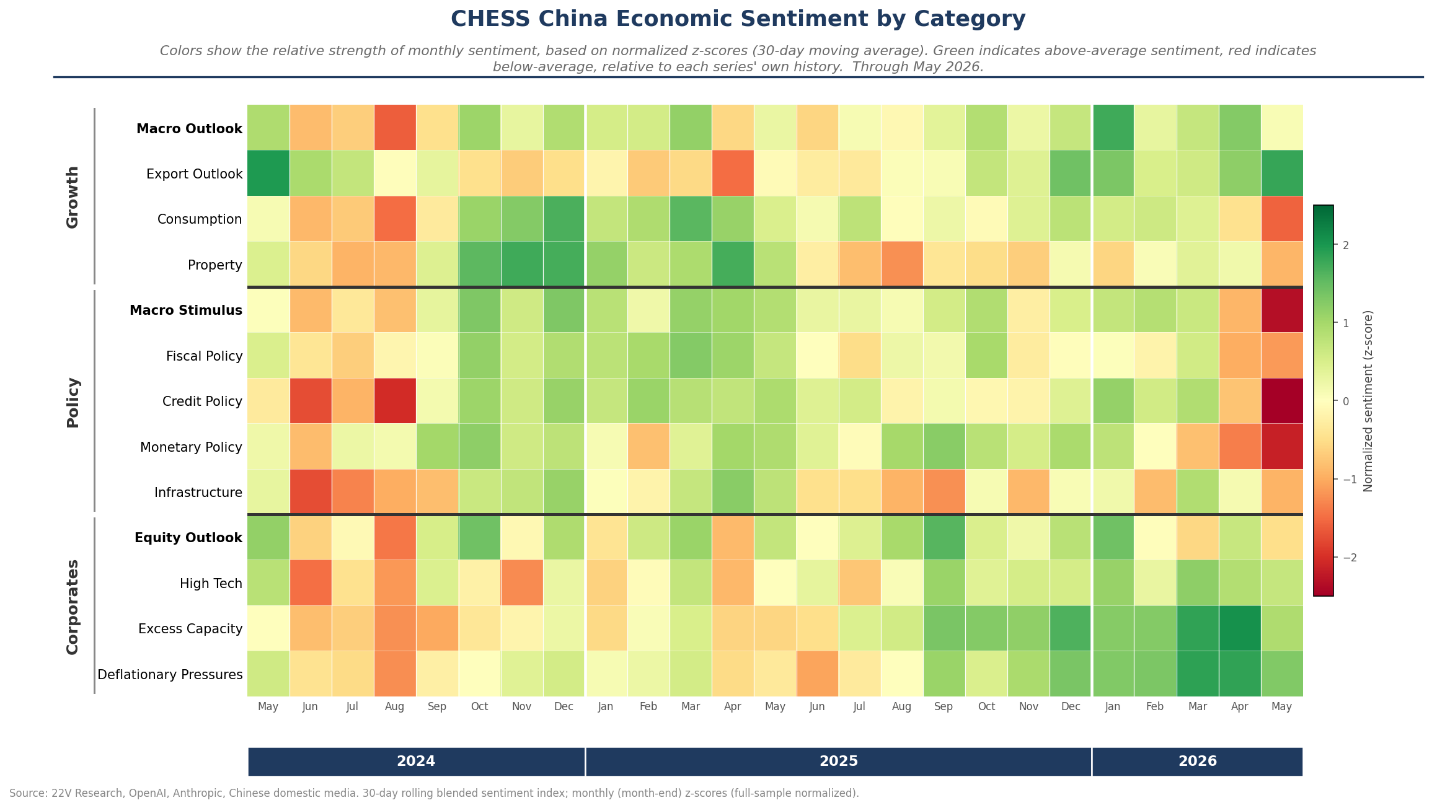
The heatmap below captures shifts in sentiment across key areas of China’s economic and financial outlook. Sentiment scores are normalized, meaning the scores are relative to the historical mean for that series (this helps adjust for an inherently bullish bias in the raw scores). Main findings:
- Sentiment toward the macroeconomic outlook has recently dipped to a level around neutral.
- The bright spot for growth remains exports, where sentiment is highly positive.
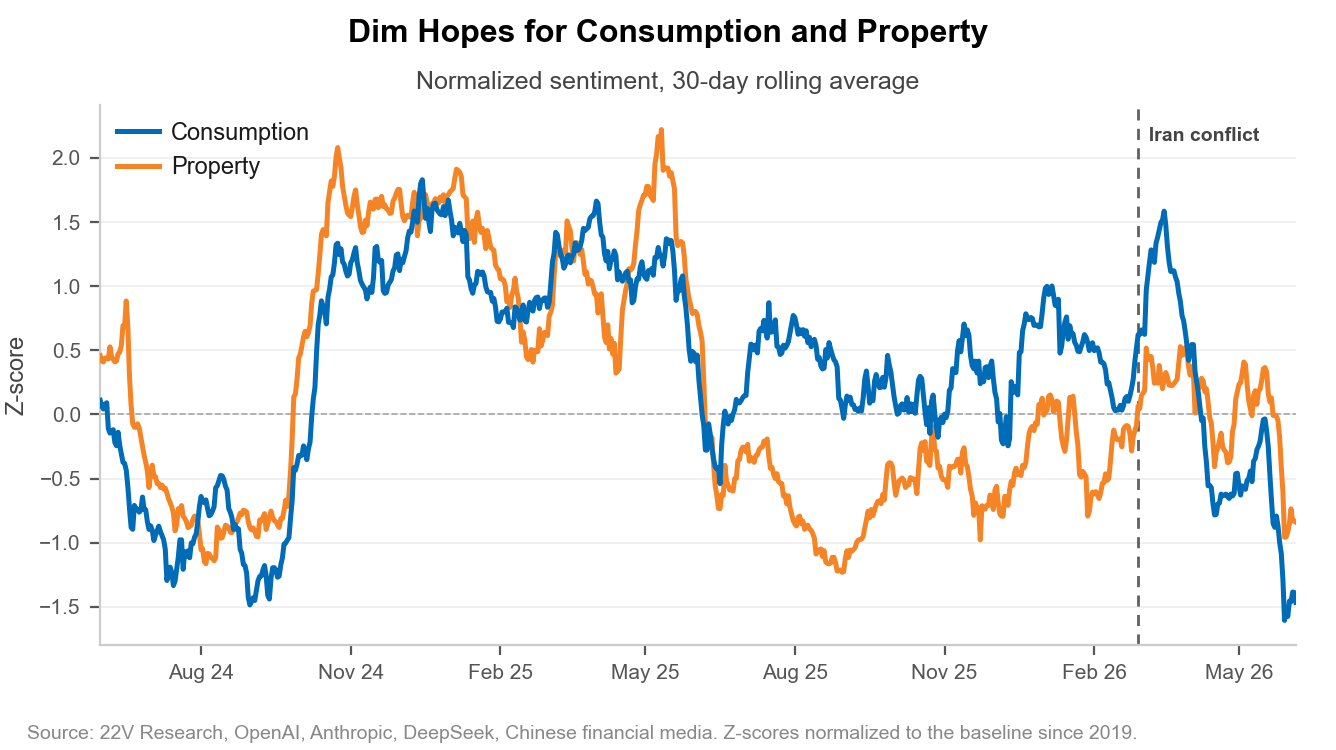
- By contrast, sentiment towards key domestic demand drivers is weak: sentiment toward consumption has turned negative, modest optimism toward property has faded, and expectations for stimulus have fallen to multi-year lows.
- Analysts see signs of slowing momentum in China’s campaign against “involution”/excess capacity; while enthusiasm for high-tech industries is high, expectations for the overall equity market have turned slightly negative.
The overall takeaway from analysts is that China’s near-term outlook rests on a relatively narrow base of exports and high-tech industries, with little expectation that policy support will shift this dynamic soon.
If one regards CHESS as representing the consensus view in China’s economic circles, there are two ways to parse these signals – particularly low stimulus expectations:
- If analysts are correct about stimulus expectations – as we largely think they are – it implies that China’s economic backdrop will be weak this summer, hampered by soft domestic demand.
- If analysts are wrong, and Beijing announces significant policy support for domestic demand, the potential upside for investors is high given low expectations.
Why We Expect Summer Growth Doldrums
The last three years have seen a pattern in which China’s economy starts the year strong, slows over the course of Q2 and Q3 on weak demand, and then ends the year with a modest lift thanks to increased policy support. In 2024, that support came in the form of the September “policy pivot” that boosted capital markets and relieved financial pressures on local governments. In 2025, the support came through the announcement in July of an “anti-involution” campaign and de-escalation of the US-China tariff dispute.
This year, the Q2 slowdown arrived in April (see HERE), and we do not expect May activity data (due to be released on June 16) to show a major improvement. While China’s economy has been resilient in the face of the Iran conflict, exports are a narrow base to sustain growth, especially if the conflict starts to weigh on global trade volumes. AI-fueled equity market returns are providing some positive wealth effects for households, but these are small relative to the impact of housing prices, which continue to fall outside of the largest cities (see our take on the property outlook HERE), and the chilling effect of a weak labor market.
We expect fiscal spending to partially rebound in Q3 after a recent slowdown, but only enough to stabilize growth rather than reinvigorate domestic demand. At the end of July, China’s Politburo will hold its quarterly meeting on the economy. At that meeting, and starting in advance, Beijing will signal a boost to infrastructure investment, particularly high-tech projects related to the Five-Year Plan (e.g., grid infrastructure to support data centers), funded by policy banks. There may also be incremental steps to revive consumer spending, particularly in services. These efforts will reduce the recent drag from fiscal policy but will not be significantly stimulative, leaving growth riding largely on exports.
We broadly expect Beijing to lag behind the curve in delivering forceful support for domestic demand, for the following reasons:
- Declining US-China tensions reduce Beijing’s perceived need to boost growth and confidence. This is a big difference from summer 2024, when Beijing decided (wisely) that it needed to prop up the economy in advance of a potential Trump electoral victory and trade war.
- The return of PPI inflation has, for now, lowered Beijing’s concern about entrenched deflationary pressures (though we expect this improvement to be temporary).
- Despite very weak levels of consumption and hiring, there are few signs of acute social stability pressures.
- Booming high-tech exports are reinforcing Beijing’s confidence in its innovation-led, investment-heavy economic strategy.
Equity Winners to Stay Narrowly Concentrated on AI Themes
The subdued outlook for domestic demand will hamper a broadening of China’s equity market beyond companies associated with the global and domestic AI buildout. As in the US, there is a slew of high-profile tech IPOs approaching, including:
- ChangXin Memory Technologies (CXMT), China’s homegrown DRAM memory maker
- Unitree Robotics, the largest and most visible of China’s humanoid robotics makers (fresh from its recent appearance on America’s Got Talent)
- YMTC, China’s leader in NAND memory chips
- Baidu’s AI chip subsidiary (Kunlunxin)
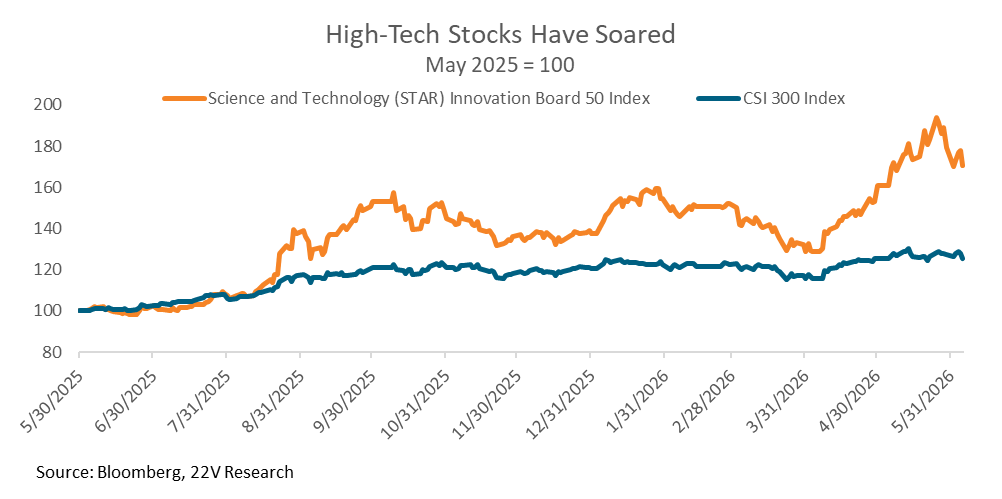
This will be a tricky balancing act for the authorities, who are very keen to keep equity capital flowing to industrial policy darlings, especially on the Shanghai STAR Market Board, but are also worried about highly concentrated trades fueled in part by rising margin financing. The STAR 50 Index, composed mainly of “hard tech” companies in sectors such as semiconductors, biotech, and new energy, is up 70% in the last year, compared to a 25% gain for the broad CSI 300 Index.