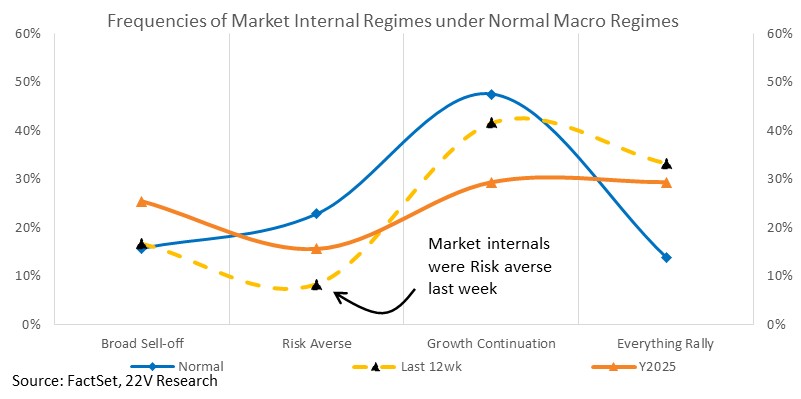
A hawkish interpretation of last Friday’s stronger-than-expected payroll report triggered a sharp shift in market internals, pushing the market into a Risk Averse regime for the first time since late January. While market internals can change quickly from week to week, the broader macro backdrop remains characterized as a normal expansion (HERE). Historically, normal expansions are a supportive environment for risk assets.
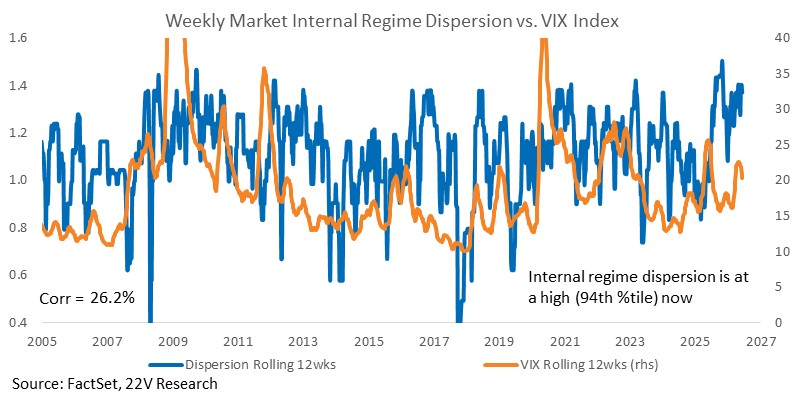
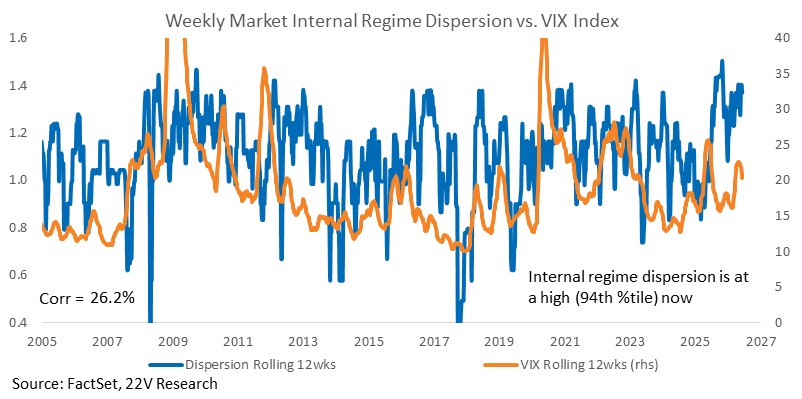
At the same time, internal regime dispersion has climbed to its 94th percentile and is unusually high relative to implied volatility. That spread and the elevated regime dispersion reflects the growing uncertainty about economic resilience, inflation, and monetary policy. Such environments are typically associated with increased factor rotations and frequent market leadership reversals.
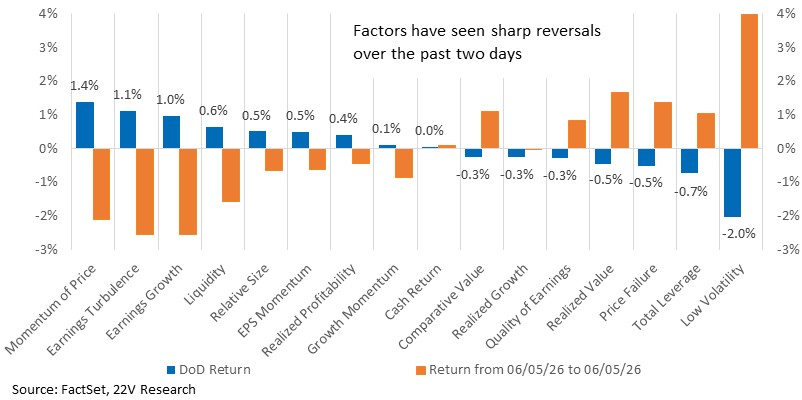
The above helps explain recent trading dynamics. Defensive sectors and Risk-off factors outperformed following the payroll release, but reversed sharply this week as Technology, Momentum, and other growth-sensitive exposures regained leadership.
The market remains highly sensitive to incoming inflation data, making the upcoming CPI report a critical catalyst. A benign inflation outcome – defined as a reading of <=0.3% m/m core CPI – would reinforce the rebound in Growth, Momentum and Risk-on factors. A hotter-than-expected reading – a >0.3% m/m core CPI reading – would reignite concerns about the need for higher-for-longer rates and drive another rotation back toward Risk-off, Value and Defensive leadership.
Sharp Rotations Post Payroll Suggests Persistently Higher Volatility: The more hawkish than expected Payroll led to a risk-off shift last Friday, driving the whole week into a Risk Averse internal regime. That was the first Risk Averse Regime since the end of January and indicative of the growing investors concern over data that shows the economy/inflation accelerating. Internal regimes are volatile week to week, and while the macro regime remains in a normal expansion (HERE), the economic backdrop continues to be a support for risk assets.
Since the start of the War, market internal volatility has increased, and regime dispersion has been elevated. Regime dispersion in its 94th %tile reflects increased disagreement among investors. That is also consistent with the still subdued VIX. Investors are still divided on the implications of resilient economic data and the future path of monetary policy. While that debate continues, expect greater factor rotations and narrower market leadership.
Yesterday’s rapid factor rotation confirms the divergence of views as almost all the factors directionally reversed from last Friday. Factors tied to the AI boom, including Momentum and Risk-on factors, all rotated back into factor leadership. AI idio is the tailwind for those factors while inflation concerns is the headwind. With another month before the next earnings reporting season, macro data has the potential to continue disrupting AI-driven risk-on factor trends.
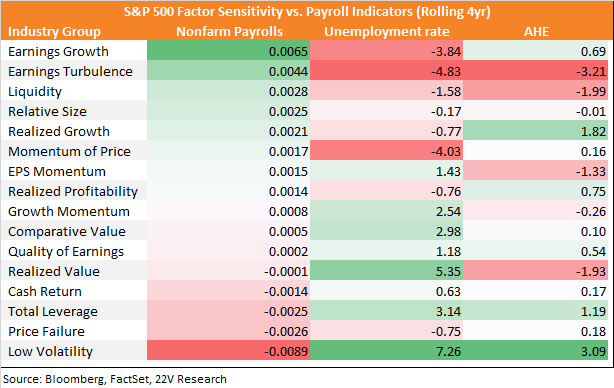
Strong nonfarm payrolls used to be supportive for Risk-on and Growth factors, but today investors’ major concern is inflation (HERE), so strong payrolls increase concerns that the Fed will adopt of restrictive policy stance. Tomorrow’s CPI release is another potential defensive/risk-off rotation trigger. Core CPI coming in <0.3% m/m would encourage an extension of the Risk-on, Growth, and Momentum rebound, while a >0.3% reading would intensify the post-payroll concerns and lead to a Risk-off and Value rotation.
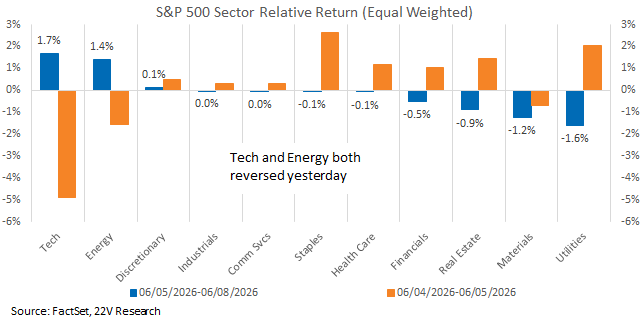
Defensives and Financials took leadership following the payroll report but gave back of those gains yesterday as Tech and Energy rotated back into leadership. Sharp swings between defensive and cyclical leadership are characteristic of the internal market debate. Sector data suggests that leadership remains fragile and tactical, with investors rapidly adjusting exposures as rate expectations evolve.
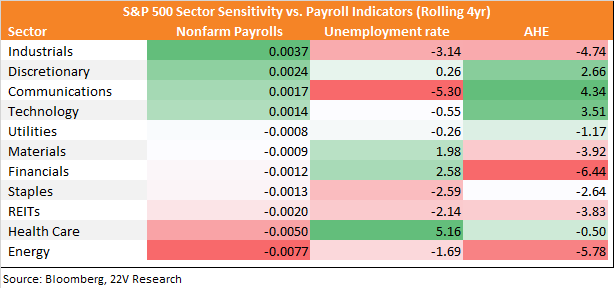
Employment sensitivity with sectors suggests better payroll data favoring Early Cyclicals at the expense of Defensives traditionally. For now, persistent high inflation will reverse that pattern and favors Defensive, while lower inflation signal should continue to support Early Cyclicals and growth-sensitive sectors.