Back Quantitative

Quant Market in Numbers: Macro Regime Remains Supportive Despite Inflation Risk

Published on June 2, 2026

Download the PDF Report

By

Dennis DeBusschere

Sophia Wang

Kevin Brocks

Market internals were volatile in May (HERE), but the broader macro backdrop remains firmly in a Normal economic expansion regime. Based on our Macro Regime Classification Model, recent geopolitical developments and the Iran War shock have not translated into a meaningful increase in recession risk. Most macro variables remain firmly in their normal ranges. One notable exception is credit spreads, which are extremely low relative to history. The current spread level suggests investors are assigning a very low probability of an imminent economic downturn.

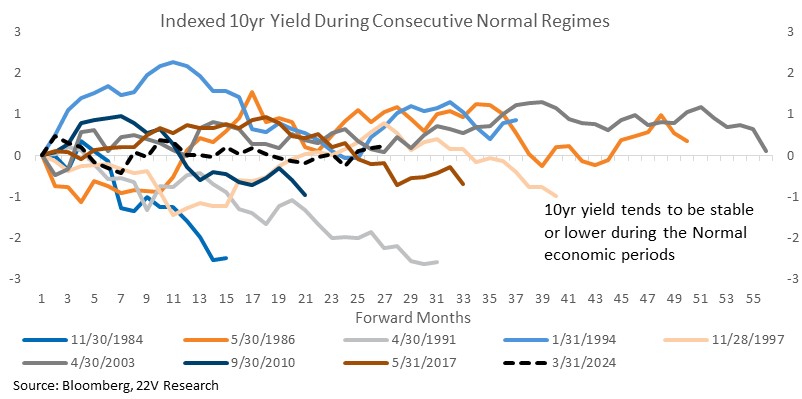
Under a normal expansionary backdrop, the S&P has typically generated steady gains, and the current cycle continues to closely track those historical episodes. At the same time, the 10yr yield has generally been stable or drifted modestly lower during extended Normal regimes. While inflation concerns and Fed repricing pushed yields higher in mid-May, our base case remains that 10-year yields are unlikely to move materially higher as long as the expansion remains intact.
Inflation remains the primary macro risk identified in our investor survey (HERE). While current inflation levels do not suggest heightened recession risk, sustained inflation surprise could tighten financial conditions and trigger meaningful market rotation. Under a scenario where core PCE rises 0.3% monthly through year-end, core inflation would approach 3.8% YoY by the end of 2026, potentially requiring a more restrictive Fed stance. Although this is not our base case, higher inflation remains the most important risk to monitor.

Should tighter financial conditions emerge, leadership within equities would likely shift. Historically, Low Volatility and Quality of Earnings factors have benefited from rising financial constraints, while Risk-On and Earnings Growth exposures have underperformed. At the sector level, Energy, Banks, and Insurance appear best positioned to benefit from a higher-inflation environment, while AI-driven winners such as Semiconductors and Technology Hardware would face relative headwinds.

In short, the key risk from higher inflation remains rotation rather than recession, with the macro regime still signaling continued expansion, constructive equity performance, and contained 10yr yield.

Macro Regime Remains Supportive Despite Inflation Risk: Though internal market regimes were volatile in May (HERE), the macro backdrop remained in a stable Normal economic expansion regime. Based on our Macro Regime Classification Model, the current economic expansion started in Mar of 2024. The war shock has done little to increase Recession risk as consumer trends and economic growth remain resilient.
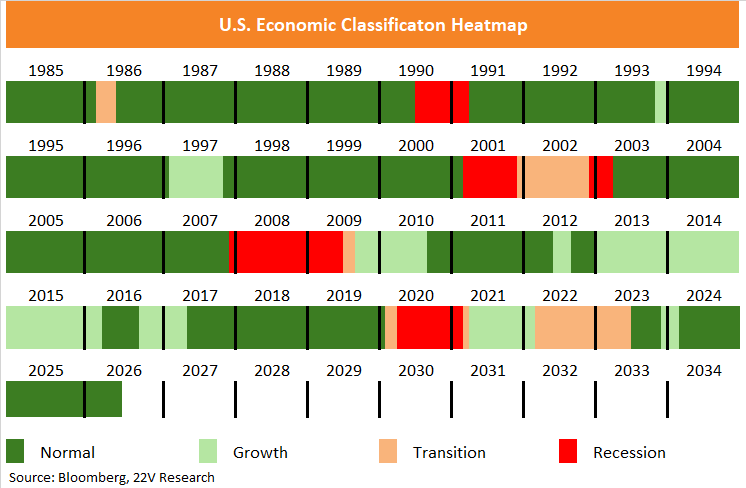
A chart with numbers and a number of years

AI-generated content may be incorrect.

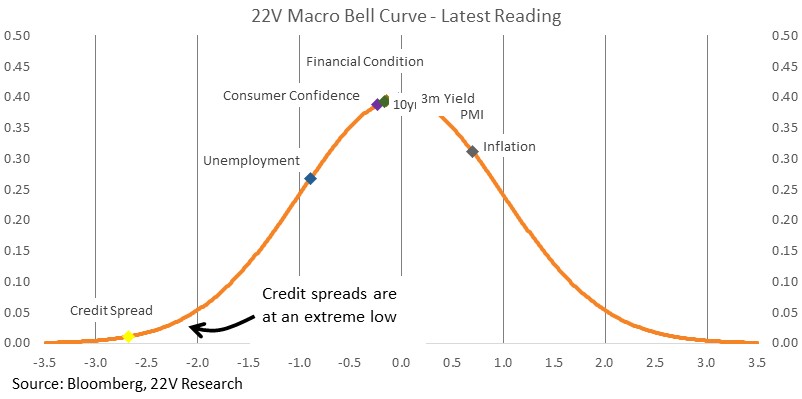
The latest macro data reinforces the normal expansionary regime classification. Most economic series are in their normal ranges (1 Std range). The most notable outlier is credit spreads, which remain at an extremely low level relative to history. Credit markets have historically been among the most effective forward-looking recession indicators, and the current spread implies that investors are demanding very little compensation for default risk, implying that the market is not pricing an imminent recession.
Historical analysis of consecutive Normal regimes suggests a constructive backdrop for risk assets, as the S&P has generally delivered positive returns throughout the duration of sustained Normal regimes. The current cycle, which began in March 2024, closely resembles prior Normal periods. As a result, equities will be likely to grind higher as long as the macro regime remains stable.
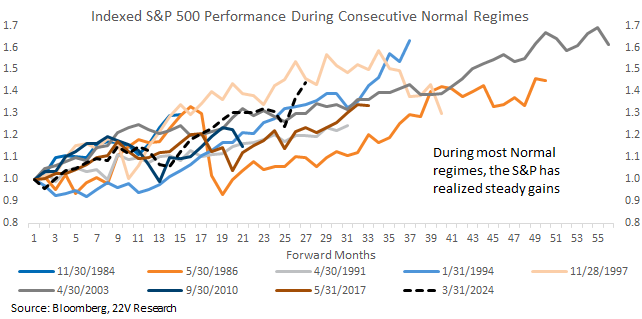
A graph of different colored lines

Description automatically generated

For the bond market, 10yr yield has generally remained stable or drifted modestly lower during extended Normal periods, rather than undergoing sustained and significant increases. Though yield spiked higher in mid-May on inflation concerns and repricing of Fed policy, the broader macro framework suggests the 10y yield is unlike to move higher further. Our Economic Analyst, Peter Williams sees fair value for 10yr yields at 4.25–4.5%.
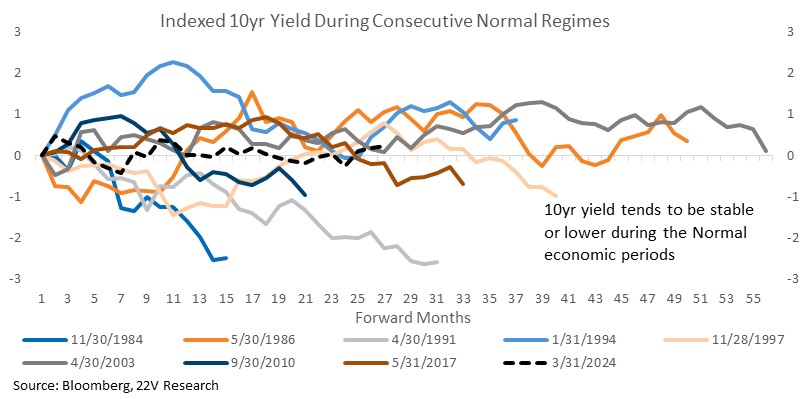
A graph of different colored lines

AI-generated content may be incorrect.

According to our investor survey, inflation and rates are the biggest risk to the macro backdrop (HERE). Investors are especially worried about inflation. Oil shocks and closure of the Strait of Hormuz (SOH) continue to bring uncertainty about the direction of price levels. Inflation readings at their current level do not suggest increased near-term recession, but does increase the odds that financial conditions tighten. That is more about market internal rotations than overall market direction.
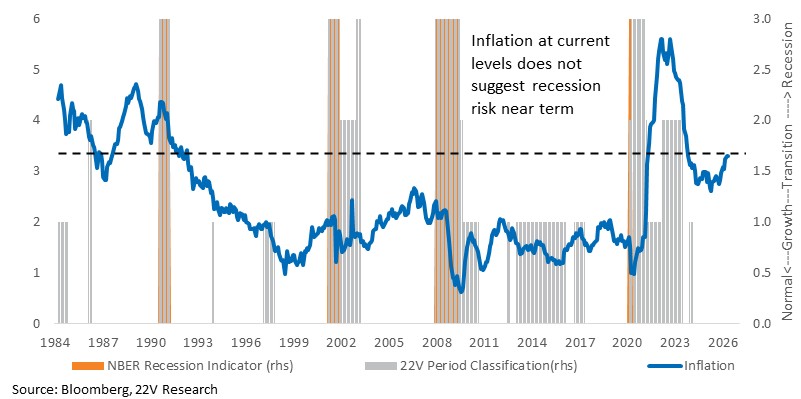
An 0.3% monthly increase in core PCE through year end would bring the y/y reading to 3.8% at the end of 2026. At that level we would expect to see the Fed tighten financial conditions to slow growth and rein in inflation. That is not our base case now as we expect growth will slow organically, allowing the Fed to leave financial conditions near their current accommodation level. The point here is to put numbers (0.3% m/m core PCE readings) around what would constitute inflation higher enough to trigger a shift in Fed policy.
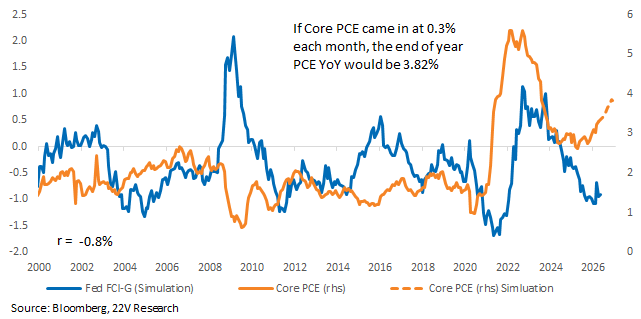
A graph of blue and orange lines

AI-generated content may be incorrect.

If inflation were to surprise to the upside with tighter financial conditions needed, Low Volatility and Quality of Earnings are likely to reverse higher while Risk-on and Earnings Growth, which are performing well, would face downside risk. Momentum and Size factors used to have positive sensitivity to financial conditions while AI idio risk has weighed more on their returns this year, which may be less driven by financial conditions now.
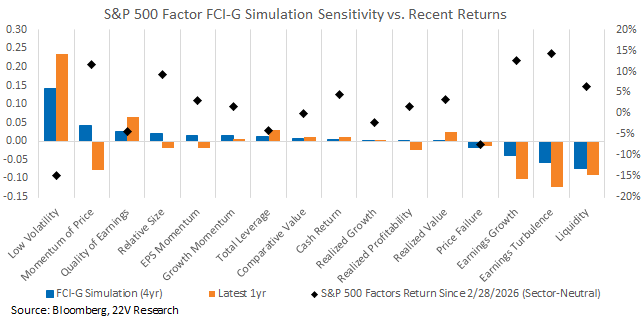
A graph of different colored squares and black diamonds

Description automatically generated

Semis and Tech Hardware are the best performing industry groups this year on the massive AI buildout. Those groups have negative sensitivity to financial conditions. If core inflation prints 0.3% or higher, Semis and Tech Hardware would face headwinds while Energy, Banks and Insurance are more likely to be benefit.
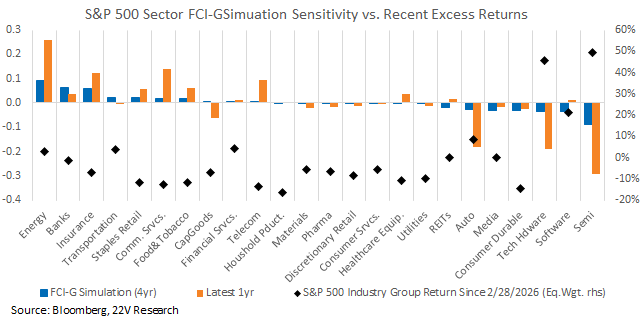
A graph of different colored squares and black dots

AI-generated content may be incorrect.

DISCLOSURES AND DISCLAIMERS

Analyst Certification

The analyst, 22V Research Group, primarily responsible for the preparation of this research report attests to the following: (1) that the views and opinions rendered in this research report reflect his or her personal views about the subject companies or issuers; and (2) that no part of the research analyst’s compensation was, is, or will be directly related to the specific recommendations or views in this research report.

Analyst Certifications and Independence of Research.

Each of the 22V Research analysts whose names appear on the front page of this report hereby certify that all the views expressed in this Report accurately reflect our personal views about any and all of the subject securities or issuers and that no part of our compensation was, is, or will be, directly or indirectly, related to the specific recommendations or views of in this Report.

22V Research (the “Company”) is an independent research provider. The Company is not a member of the FINRA or the SIPC and is not a registered broker dealer or investment adviser. 22V Research has no other regulated or unregulated business activities which conflict with its provision of independent research.

22V Research, LLC is a professional services and independent publication organization. 22V Research, LLC is not a securities broker-dealer, not a member of the Financial Industry Regulatory Authority (FINRA), not a registered investment advisor (RIA) and not a member of SIPC.

Securities transactions, when offered, are offered by 22V Securities, LLC through LPS Capital, LLC. Certain employees of 22V Securities, LLC are dually registered as securities representatives of LPS Capital, LLC or Analyst Hub Securities, LLC. 22V Securities, LPS Capital and Analyst Hub Securities are members FINRA, SIPC.

https://brokercheck.finra.org/

Current Ratings Definition.

SECTOR OUTPERFORM: An “outperform” rating anticipates the company will outperform the S&P Regional Banking Index (peer group).

SECTOR PERFORM: A “market perform” rating anticipates the company will perform in line with the S&P Regional Banking Index (peer group).

SECTOR UNDERPERFORM: An “underperform” rating anticipates the company will underperform the S&P Regional Banking Index (peer group).

Limitation Of Research And Information.

This Report has been prepared for distribution to only qualified institutional or professional clients of 22V Research Group. The contents of this Report represent the views, opinions, and analyses of its authors. The information contained herein does not constitute financial, legal, tax or any other advice. All third-party data presented herein were obtained from publicly available sources which are believed to be reliable; however, the Company makes no warranty, express or implied, concerning the accuracy or completeness of such information. In no event shall the Company be responsible or liable for the correctness of, or update to, any such material or for any damage or lost opportunities resulting from use of this data. Nothing contained in this Report or any distribution by the Company should be construed as any offer to sell, or any solicitation of an offer to buy, any security or investment. Any research or other material received should not be construed as individualized investment advice. Investment decisions should be made as part of an overall portfolio strategy and you should consult with a professional financial advisor, legal and tax advisor prior to making any investment decision. 22V Research Group shall not be liable for any direct or indirect, incidental or consequential loss or damage (including loss of profits, revenue or goodwill) arising from any investment decisions based on information or research obtained from 22V Research Group.

Reproduction And Distribution Strictly Prohibited.

No user of this Report may reproduce, modify, copy, distribute, sell, resell, transmit, transfer, license, assign or publish the Report itself or any information contained therein. Notwithstanding the foregoing, clients with access to working models are permitted to alter or modify the information contained therein, provided that it is solely for such client’s own use. This Report is not intended to be available or distributed for any purpose that would be deemed unlawful or otherwise prohibited by any local, state, national or international laws or regulations or would otherwise subject the Company to registration or regulation of any kind within such jurisdiction.

Copyrights, Trademarks, Intellectual Property.

22V Research Group, and any logos or marks included in this Report are proprietary materials. The use of such terms and logos and marks without the express written consent of 22V Research Group is strictly prohibited. The copyright in the pages or in the screens of the Report, and in the information and material therein, is proprietary material owned by 22V Research Group unless otherwise indicated. The unauthorized use of any material on this Report may violate numerous statutes, regulations and laws, including, but not limited to, copyright, trademark, trade secret or patent laws.
