Back Quantitative

Quant Market in Numbers: Fed Sentiment Model Update: Hawkish, Inflation-Driven Tilt Ahead of the First Warsh FOMC

Published on June 7, 2026

∙ Download the PDF Report

By

Dennis DeBusschere

Sophia Wang

Kevin Brocks

The Federal Reserve entering its quiet period ahead of the next FOMC meeting and the first with Kevin Warsh as Chair. Today we update our Fed Reserve Sentiment Model and model, which paints a picture consistent with recent macro readings: Labor Market sentiment has continued its rapid improvement, while inflation has become the most negative category. Inflation is the clear dominant macro concern today, accelerating significantly since the start of the Iran war. High inflation has led to Monetary Policy sentiment shifting hawkish as well.

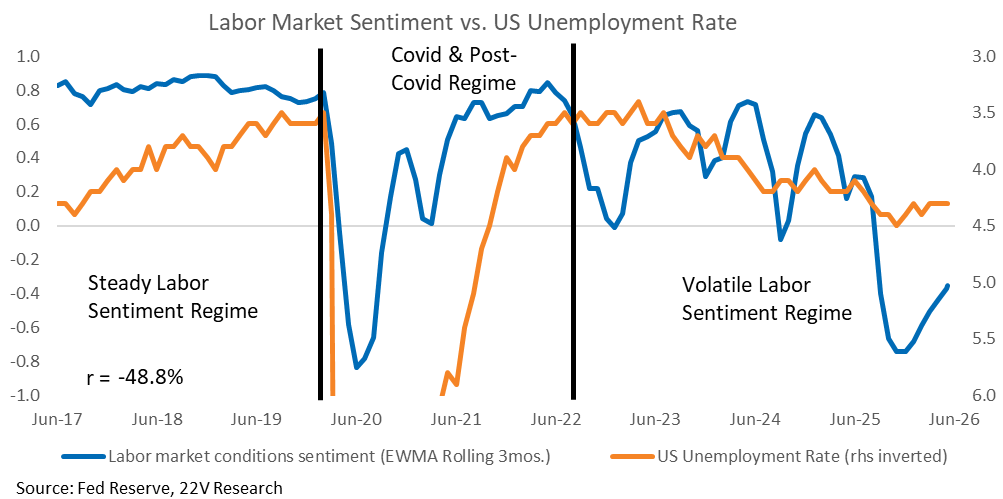
Labor Market sentiment used to be negatively correlated with the unemployment rate, and the consecutive improving Labor sentiment readings suggests the current strong labor market is likely to continue. In the meantime, correlation between Inflation sentiment and actual inflation is now negative, implying that like investors, the Fed views inflation as an increasing risk.
A graph of a bar chart

Description automatically generated with medium confidence

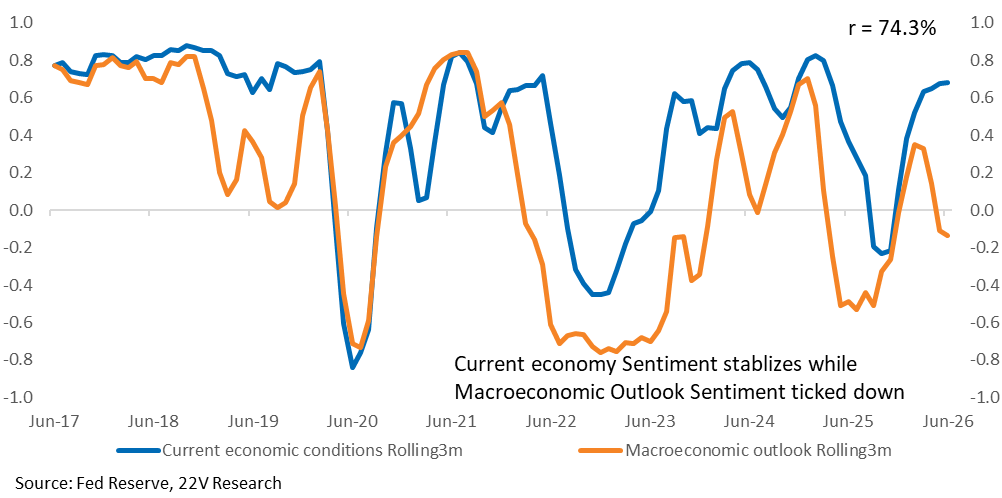
In addition, Macro Outlook sentiment has diverged from still-strong Current Economic Conditions sentiment. Historically, current conditions tend to follow changes in the outlook with a lag. This suggests an increased risk of slower economic growth in the coming months.

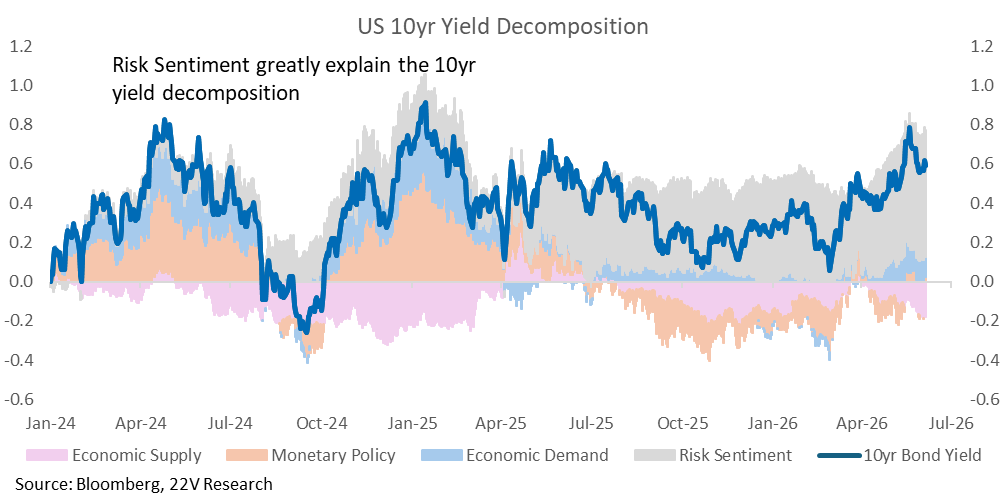
Consistent with the Fed sentiment signals, the 10-year yield decomposition shows inflation-driven risk—not Fed policy risk—as the primary driver of yields. Still too strong core inflation trends remains the biggest risk of 10yr yields moving materially higher.

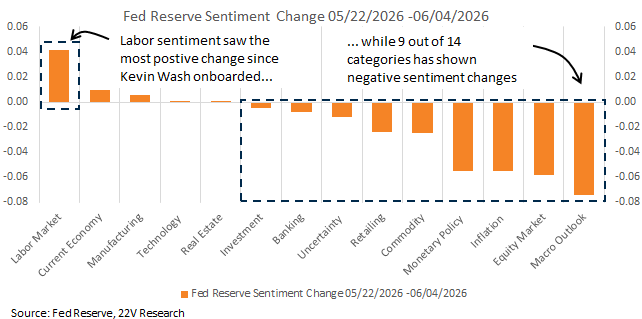
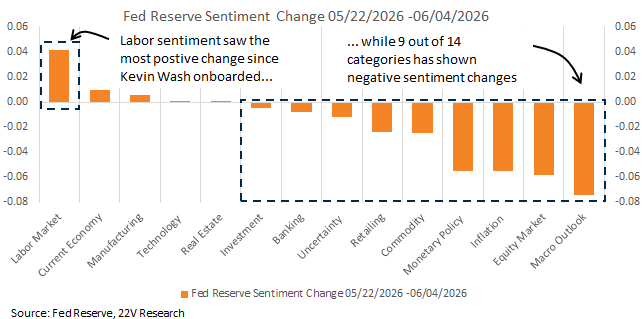
Hawkish, Inflation-Driven Tilt Ahead of Warsh’s First FOMC: Since Kevin Warsh took over as Fed Chair on May 22nd, Fed speaker sentiment toward the Labor Market has improved, consistent with signs of still firm labor demand. Fed sentiment toward the Current Economy and Manufacturing have also improved. The remaining 9 of 14 categories have declined, especially for Equity Market and Macro Outlook. While none of the documents released since 5/22 originate directly from Kevin Warsh, the model’s readings still capture the broader Committee’s communications and characterizes the tone of the institution through the Chair transition.
A graph of a bar chart

Description automatically generated with medium confidence

With the unemployment rate stabilizing at 4.3% since March, Labor Market sentiment has rebounded, continuing to extend the move off a recession-like low in December. Importantly, the slope of this improvement from the 4Q25 trough is milder than prior recoveries during the Volatile Labor Sentiment period: both September 2024 and January 2023 saw Fed sentiment rebound far more sharply. As 22V economist Gerard MacDonell notes (HERE), the employment report on Friday fits the continued expansion theme and is probably somewhat hawkish for rates.
A graph of a graph showing the rate of the us unemployment rate

AI-generated content may be incorrect.

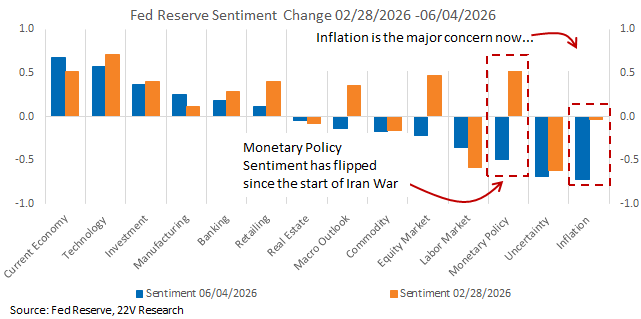
Inflation is now the dominant concern for the Fed and Investors: Our investor survey highlighted that investors regard inflation as the biggest risk to economy, a view consistent with Fed sentiment: across all 14 economic categories, Federal speakers now treat inflation as the principal concern. At the onset of the Iran War (2/28), Inflation sentiment was mildly negative; today it is the most negative category, marking a dramatic deterioration since the start of the war. Alongside this drawdown, Monetary Policy sentiment has flipped from firmly positive to one of the most negative categories. As a reminder, we define positive Monetary Policy sentiment as dovish and negative as hawkish, so this shift signals a decidedly more hawkish stance.
A graph with blue and orange bars

AI-generated content may be incorrect.

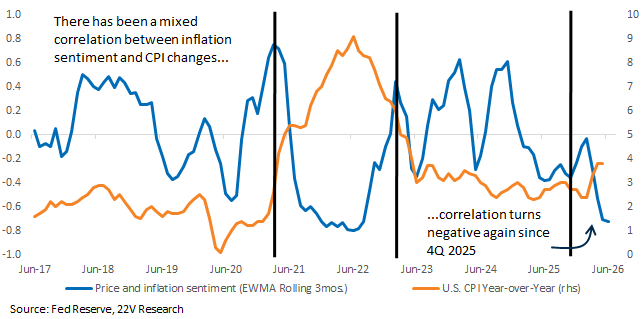
Historical correlations between Inflation sentiment and CPI moves have been mixed. Since last November, inflation sentiment has been negatively correlated with CPI prints, especially since the Iran War. The conclusion is that the Fed views incremental inflation data as an increasing risk.
A graph of blue and orange lines

AI-generated content may be incorrect.

A widening divergence between current conditions and the forward outlook: Current Economic Condition sentiment and Macro Outlook sentiment have historically been highly correlated, but recent readings show the two diverging: Current Economic Conditions sentiment remains elevated, while Macro Outlook sentiment has deteriorated into negative territory. This drawdown reflects the negative Macro Outlook signals that our Federal Reserve Sentiment Model (Whitepaper HERE) detected in Governor Jefferson’s speech on May 27th and Governor Bowman’s speech on May 29th. The specific quotes from Bowman (HERE):

“The U.S. economy has been resilient, but the labor market remains vulnerable to adverse shocks and PCE inflation has moved up, due largely to higher energy prices. And my outlook remains influenced by the conditions resulting from the conflict in Iran.”

Jefferson (HERE):

“I expect inflation to decline later this year as the effects of tariffs and the energy shock wane, but I view risks around my inflation outlook as tilted to the upside.”

In both cases, the deterioration in Macro Outlook sentiment stems primarily from inflation. Based on prior patterns, Current Economic Condition sentiment tends to lag Macro Outlook sentiment for several months, and current deteriorating outlook suggests economic slowdown risk over the coming months.
A graph of blue and orange lines

AI-generated content may be incorrect.

Our current 10-year yield decomposition shows that risk sentiment is the predominant factor explaining the 10-year yield’s return. This indicates that higher inflation and the heightened risk-management it creates is the key driver of the yield level, not Fed Monetary Policy sentiment. The implication is that, even though Fed Monetary Policy sentiment has flipped in recent readings, changes in inflation sentiment are likely to exert greater influence on 10-year yields.
A graph of a graph showing the value of a stock market

AI-generated content may be incorrect.

DISCLOSURES AND DISCLAIMERS

Analyst Certification

The analyst, 22V Research Group, primarily responsible for the preparation of this research report attests to the following: (1) that the views and opinions rendered in this research report reflect his or her personal views about the subject companies or issuers; and (2) that no part of the research analyst’s compensation was, is, or will be directly related to the specific recommendations or views in this research report.

Analyst Certifications and Independence of Research.

Each of the 22V Research analysts whose names appear on the front page of this report hereby certify that all the views expressed in this Report accurately reflect our personal views about any and all of the subject securities or issuers and that no part of our compensation was, is, or will be, directly or indirectly, related to the specific recommendations or views of in this Report.

22V Research (the “Company”) is an independent research provider. The Company is not a member of the FINRA or the SIPC and is not a registered broker dealer or investment adviser. 22V Research has no other regulated or unregulated business activities which conflict with its provision of independent research.

22V Research, LLC is a professional services and independent publication organization. 22V Research, LLC is not a securities broker-dealer, not a member of the Financial Industry Regulatory Authority (FINRA), not a registered investment advisor (RIA) and not a member of SIPC.

Securities transactions, when offered, are offered by 22V Securities, LLC through LPS Capital, LLC. Certain employees of 22V Securities, LLC are dually registered as securities representatives of LPS Capital, LLC or Analyst Hub Securities, LLC. 22V Securities, LPS Capital and Analyst Hub Securities are members FINRA, SIPC.

https://brokercheck.finra.org/

Current Ratings Definition.

SECTOR OUTPERFORM: An “outperform” rating anticipates the company will outperform the S&P Regional Banking Index (peer group).

SECTOR PERFORM: A “market perform” rating anticipates the company will perform in line with the S&P Regional Banking Index (peer group).

SECTOR UNDERPERFORM: An “underperform” rating anticipates the company will underperform the S&P Regional Banking Index (peer group).

Limitation Of Research And Information.

This Report has been prepared for distribution to only qualified institutional or professional clients of 22V Research Group. The contents of this Report represent the views, opinions, and analyses of its authors. The information contained herein does not constitute financial, legal, tax or any other advice. All third-party data presented herein were obtained from publicly available sources which are believed to be reliable; however, the Company makes no warranty, express or implied, concerning the accuracy or completeness of such information. In no event shall the Company be responsible or liable for the correctness of, or update to, any such material or for any damage or lost opportunities resulting from use of this data. Nothing contained in this Report or any distribution by the Company should be construed as any offer to sell, or any solicitation of an offer to buy, any security or investment. Any research or other material received should not be construed as individualized investment advice. Investment decisions should be made as part of an overall portfolio strategy and you should consult with a professional financial advisor, legal and tax advisor prior to making any investment decision. 22V Research Group shall not be liable for any direct or indirect, incidental or consequential loss or damage (including loss of profits, revenue or goodwill) arising from any investment decisions based on information or research obtained from 22V Research Group.

Reproduction And Distribution Strictly Prohibited.

No user of this Report may reproduce, modify, copy, distribute, sell, resell, transmit, transfer, license, assign or publish the Report itself or any information contained therein. Notwithstanding the foregoing, clients with access to working models are permitted to alter or modify the information contained therein, provided that it is solely for such client’s own use. This Report is not intended to be available or distributed for any purpose that would be deemed unlawful or otherwise prohibited by any local, state, national or international laws or regulations or would otherwise subject the Company to registration or regulation of any kind within such jurisdiction.

Copyrights, Trademarks, Intellectual Property.

22V Research Group, and any logos or marks included in this Report are proprietary materials. The use of such terms and logos and marks without the express written consent of 22V Research Group is strictly prohibited. The copyright in the pages or in the screens of the Report, and in the information and material therein, is proprietary material owned by 22V Research Group unless otherwise indicated. The unauthorized use of any material on this Report may violate numerous statutes, regulations and laws, including, but not limited to, copyright, trademark, trade secret or patent laws.
