SUMMARY
- We use sentiment analysis to assess macro- and industry-level views of how China’s exports will fare amid the Iran energy shock.
- At the macro level, domestic economists are notably optimistic that exports will prove resilient and support overall growth; we are more skeptical that exports will be enough to offset weak demand and expect China’s growth to slow in Q2.
- Industry-level sentiment shows three key themes driving export-enthusiasm, with implications for Chinese beneficiaries and foreign firms competing against them: clean tech, the AI buildout, and China’s cost advantage in carbon-intensive sectors (particularly those tied to coal).
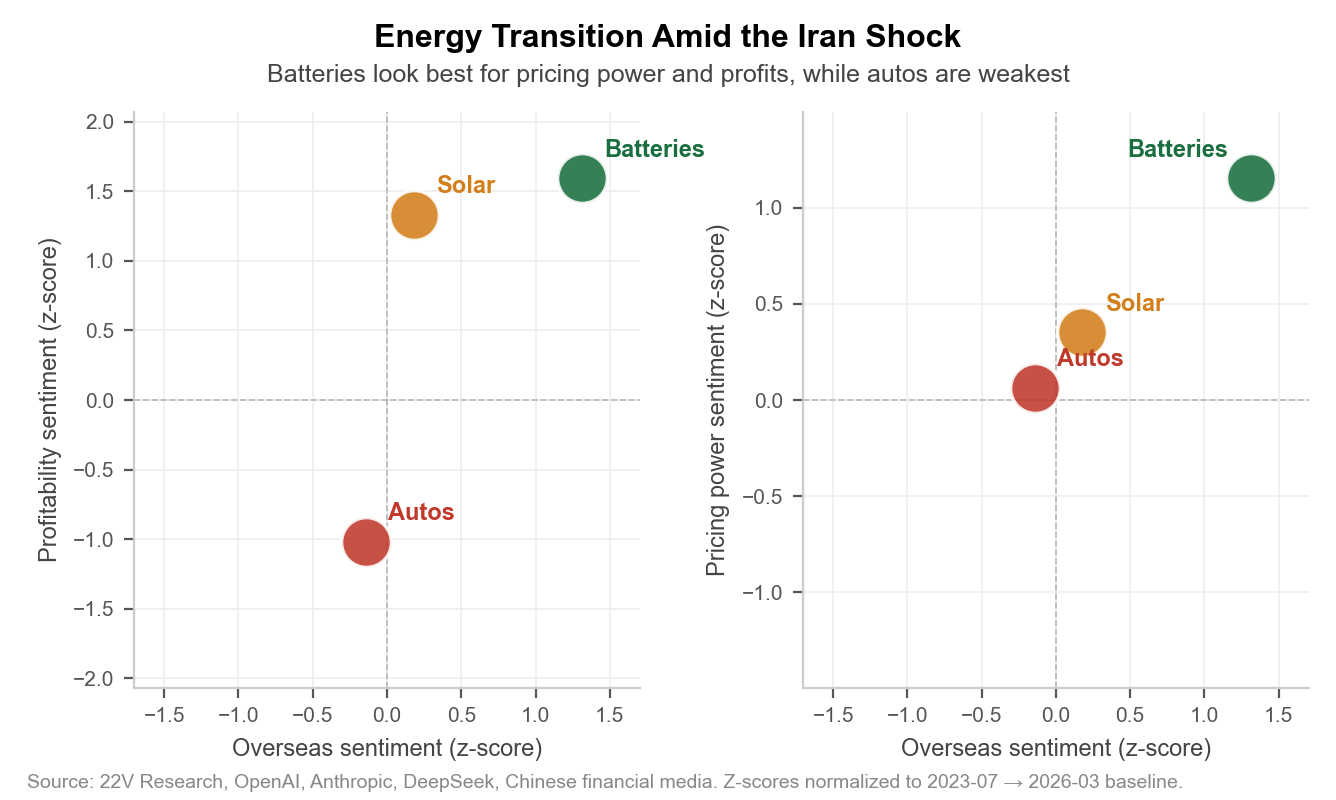
- While China’s clean tech sectors are benefitting from the energy shock, sentiment is most positive for batteries; by contrast, analysts still see a dimmer outlook for profits in the auto sector, which faces domestic overcapacity.
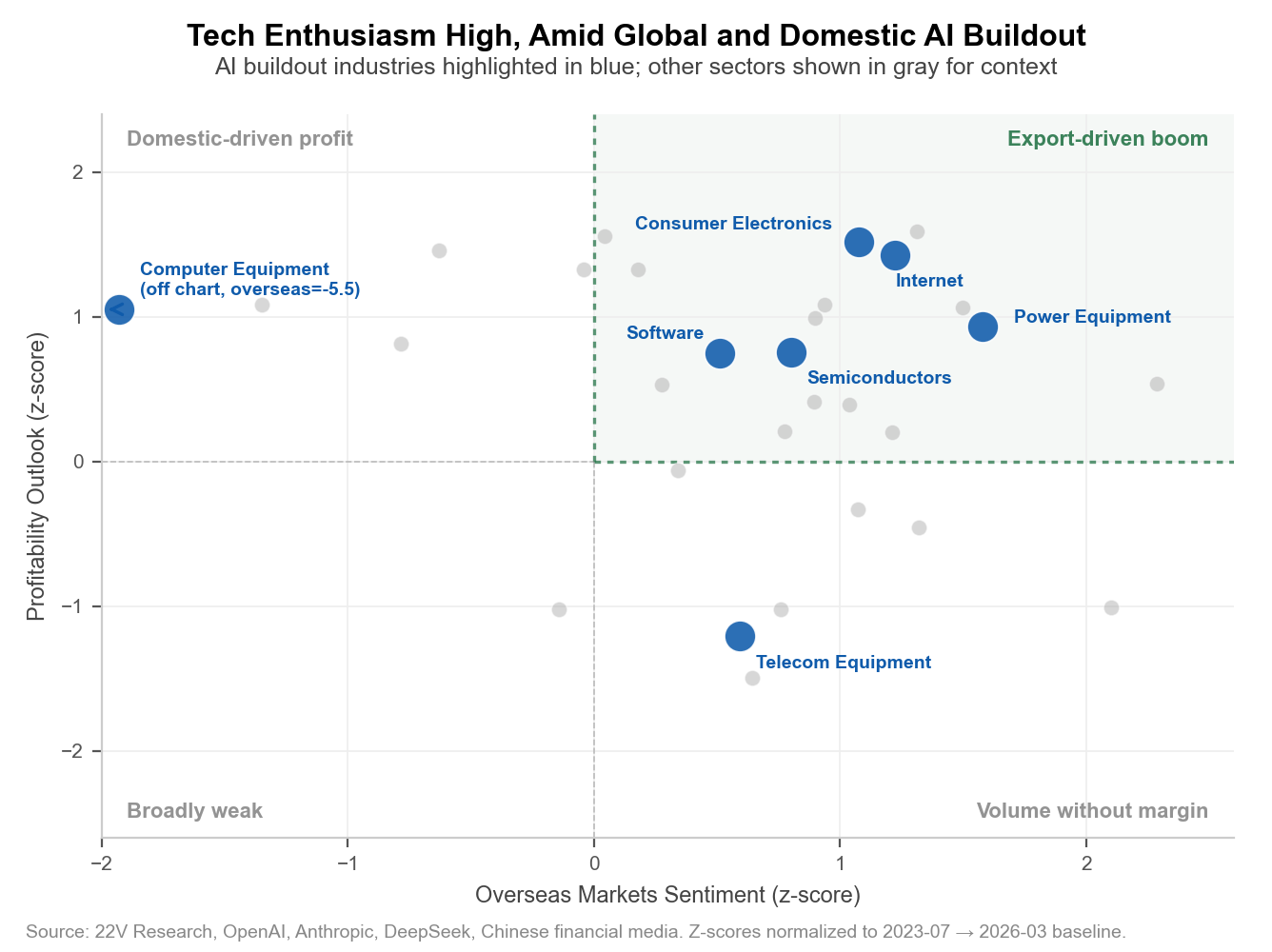
- The global AI buildout is another source of optimism, benefiting Chinese exporters in optics, power semiconductors and grid infrastructure; AI chipmakers are thus far more of an import substitution than export play, while AI model companies are still in the early stages of profitably “exporting tokens” to the rest of the world.
- Ironically, carbon-intensive sectors such as refining and chemicals have also seen a jump in positive sentiment since the Iran crisis; analysts expect Chinese chemicals firms to gain market share from German competitors, in particular.
Exports have powered China’s growth in recent years, offsetting weak domestic demand from property doldrums and a soft labor market. When the Iran conflict hit in late February, this dynamic could have taken two alternate paths: (1) fears of a collapse in China’s exports, with policymakers pivoting towards domestic demand to support growth; or (2) policymakers and firms continuing to look overseas for growth, with confidence that China’s competitiveness would offset headwinds from the energy shock.
Two months into the conflict, China’s economy has taken the latter path and doubled down on overseas markets. That has been reasonably effective thus far but introduces risks for Chinese firms (if exports falter) and foreign firms competing against them, particularly in sectors facing overcapacity within China.
In this report, we look at how China’s export juggernaut is interacting with the Iran energy shock. Which export-facing sectors are poised to benefit, which look weakest, and which foreign firms are potentially exposed to tougher competition? We examine these dynamics by analyzing the sentiment of Chinese analyst commentary, which provides color on themes at the macro level and within specific sectors. We also offer our own takes and caveats, especially when the analyst take seems overly optimistic. (For more background on our sentiment analysis tool – the China Economic Sentiment Series (CHESS) – see HERE).
THE MACRO VIEW: CAN EXPORTS CARRY GROWTH?
Narrative: Economists’ sentiment towards China’s growth outlook (blue line in the chart below) has been resilient in the face of the Iran conflict. In some respects this is no surprise, given the economy’s relative insulation from higher oil and natural gas prices due to diversified energy supplies (coal, renewables) and high inventories of crude.
What is more notable is the sentiment towards exports (orange line), which had started to fall in advance of the conflict (for reasons unrelated to the Middle East) and reached a bottom when the fighting started. Since then, export sentiment has shown a significant recovery. The threats to exports have thus been more modest than analysts expected.
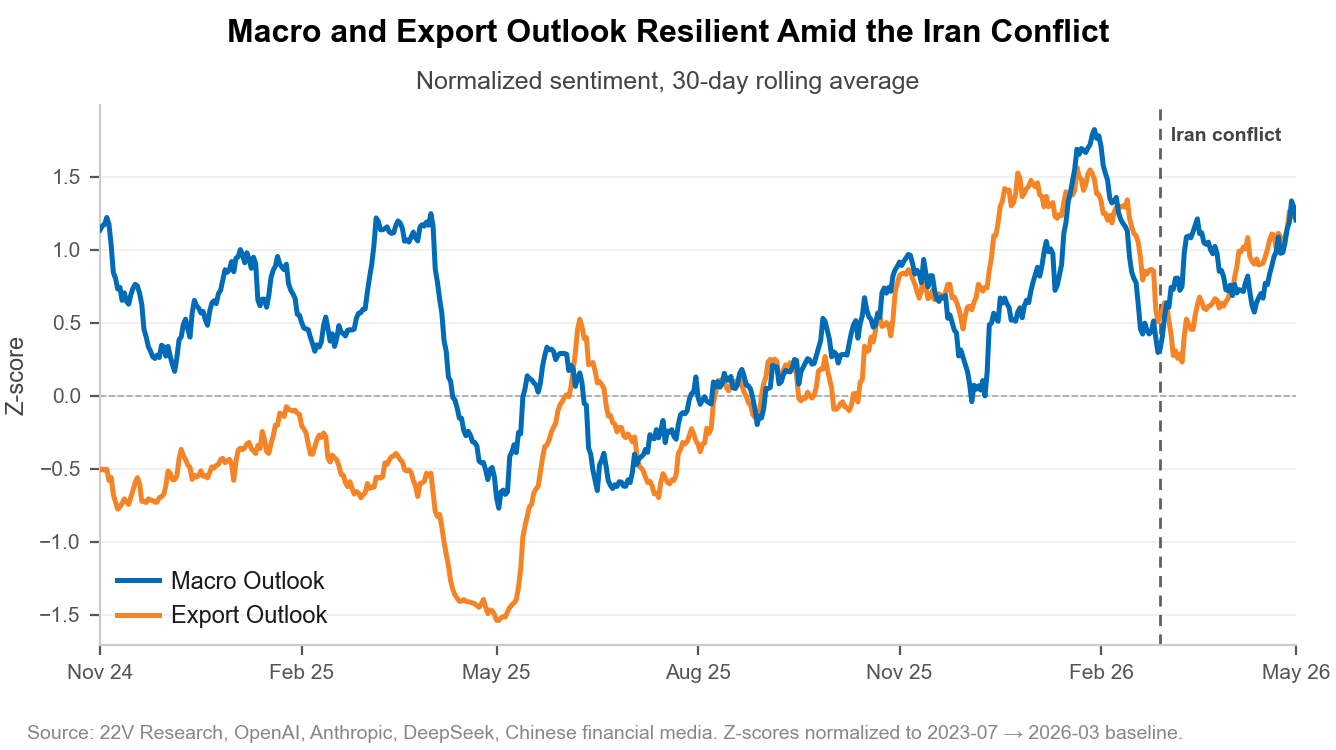
This view is consistent with some prominent voices in China’s economic policy circles: CF40, a reformist think tank that does not have a particularly bullish bias, concluded that if Brent stays around $100 per barrel, the price shock will have only a slightly negative and perhaps even neutral impact on the growth outlook. Key to that analysis is that while growth in global export volumes is likely to slow, China might offset this decline with exports of clean tech products and by grabbing market share in sectors where energy costs are rising faster for competing economies than for Chinese firms. (As discussed below, we think these two factors are too small in scale to offset the expected fall in trade volumes, especially if the conflict is prolonged).
Where we and analyst sentiment concur is that the outlook for China’s domestic demand drivers is notably soft (chart below). Stimulus expectations have fallen sharply since February, particularly after Q1 GDP growth came in at the high end of Beijing’s targeted range. Consumption sentiment has declined to its lowest level since Beijing’s late 2024 policy pivot. Property sentiment has crept up but only to a neutral level.
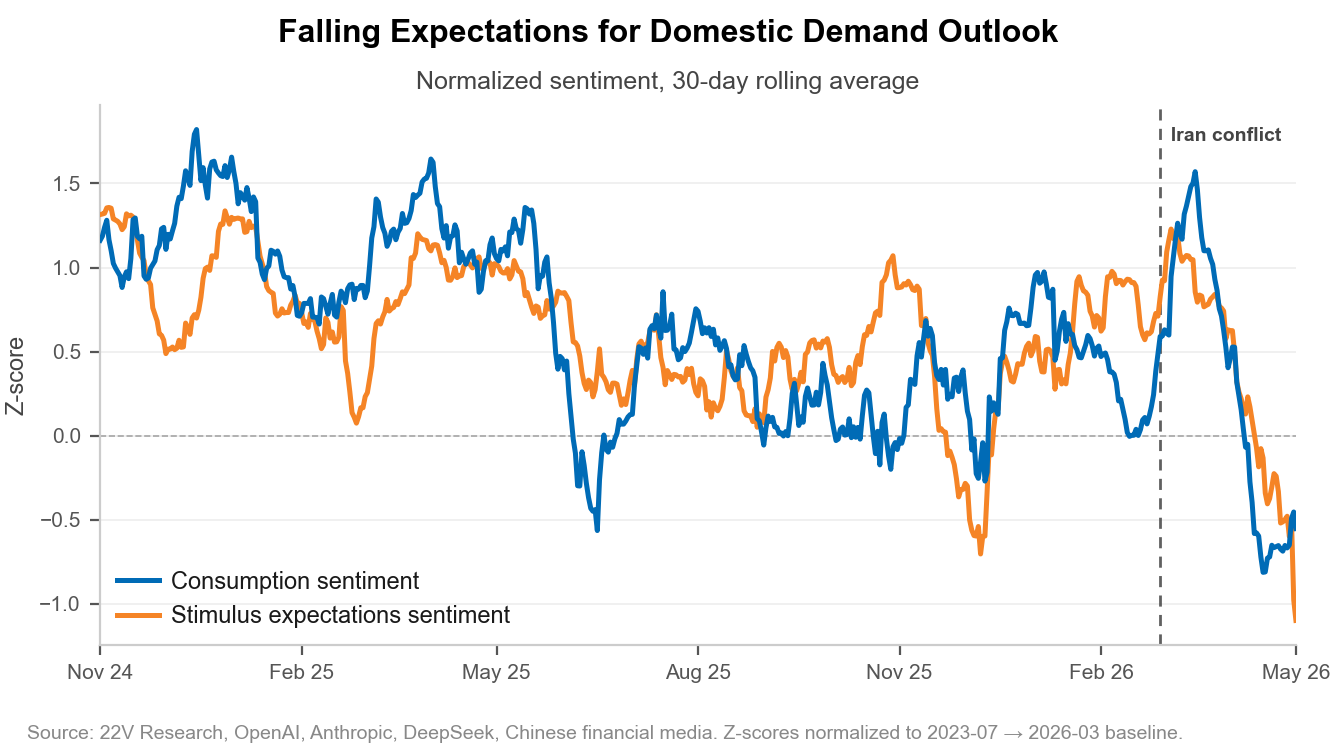
Reality Check: We are more skeptical than the analyst consensus about the ability of exports to carry broader growth, which we expect to slow in Q2. While exports have grown an impressive 14.7% y/y year-to-date, export growth slowed sharply to 2.5% y/y in March. Further, we doubt that clean tech sectors, and market share gains in other sectors, will offset potential slowdowns in other export-facing sectors. Renewables account for less than 5% of China’s total exports in 2025. Beijing will eventually need to boost domestic demand to meet the full-year growth target of 5%, but we do not expect this support to come until Q3 (see our take on signals from the April Politburo meeting HERE).
THE INDUSTRY-LEVEL VIEW: LOOKING OVERSEAS FOR PROFITS
Even if the macro export story proves too optimistic, examining analyst sentiment at the industry level is still useful for identifying where Chinese firms may be most resilient in the face of the energy shock – and most aggressive in competing against foreign rivals.
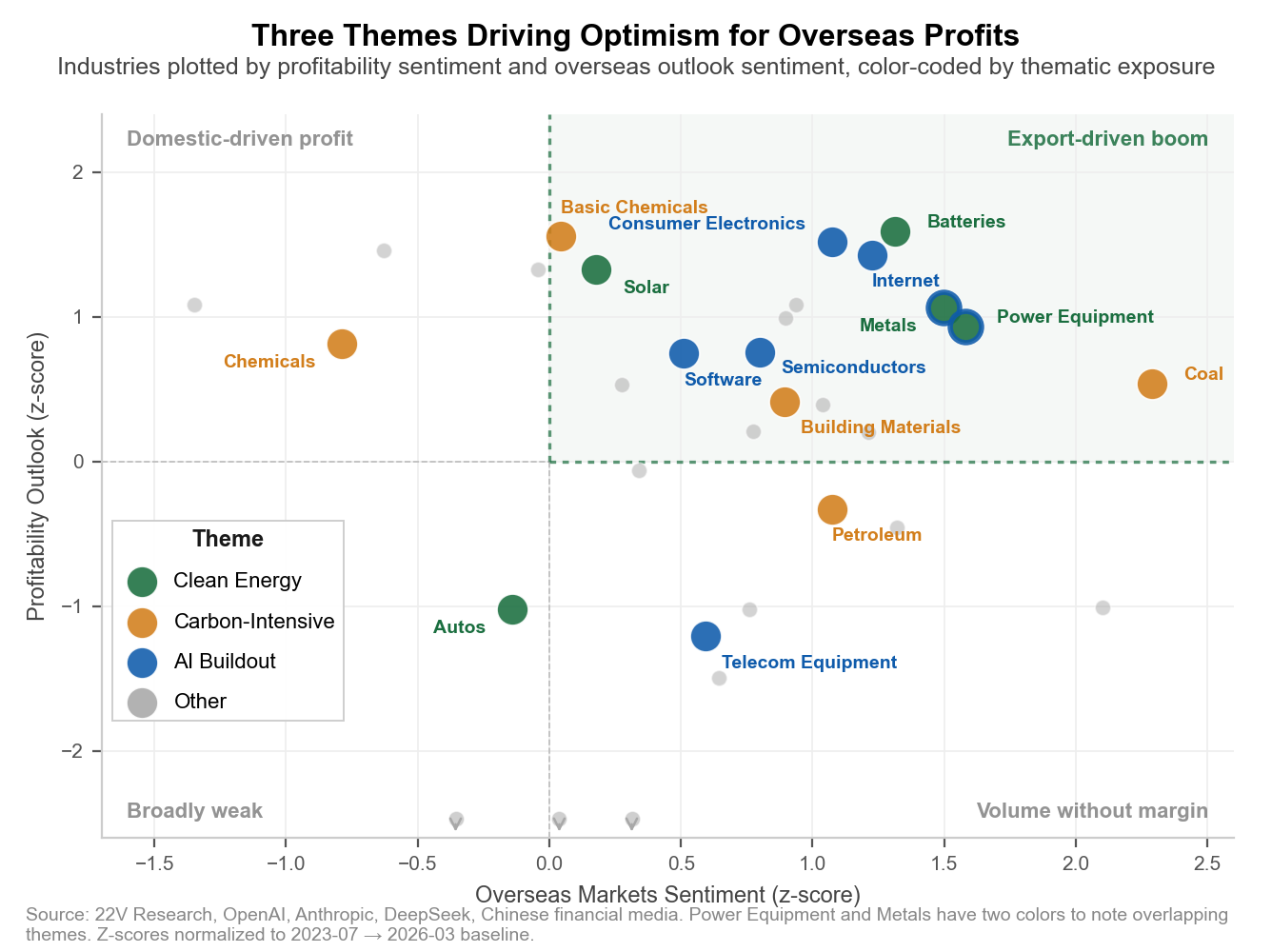
The chart below shows the sectors with positive sentiment towards overseas markets (horizontal axis) and profitability (vertical axis). Sentiment scores are normalized to each sector’s average since mid-2023. Three main themes stand out among export-oriented sectors with the most positive sentiment: the energy transition, the AI buildout, and carbon-intensive sectors benefiting primarily from China’s use of coal. Here we summarize each theme – and offer our own reality checks.
Theme 1: Clean Energy (batteries, solar, wind, electric vehicles, power equipment)
Narrative: The Iran energy shock will lead to a surge in orders and interest across China’s “New Three” clean tech sectors: electric vehicles, batteries, and solar and wind.
Reality Check: A further turn towards China as the main supplier of renewables – now viewed as a form of energy security – is very real. In Q1, China’s shipments of new energy vehicles rose 124% y/y. In March, exports of the ‘New Three’ — NEVs, batteries, and solar — were collectively up 66% y/y, the strongest monthly print in years. However, part of the growth is due to the front-running of a tax rebate reduction for solar and batteries, which took effect at the start of Q2. More broadly, these sectors are also facing significant overcapacity, bottlenecks overseas in the buildout of energy infrastructure, and rising trade barriers.
Key Chinese Beneficiaries:
- Batteries look strongest. Among the “New Three” – batteries, solar, and electric vehicles – batteries (from firms such as CATL, BYD, Eve Energy) show the strongest combination of positive sentiment towards profitability, pricing power, and overseas markets. This is in large part because high demand for energy storage (including for data centers) is offsetting some of the weakness in battery demand from the oversupplied electric vehicle sector. Solar is showing positive sentiment towards profitability, but analysts are less rosy towards pricing power and overseas markets. The auto sector shows negative sentiment both towards the overseas outlook and overall profitability. This reflects the weakness of traditional ICE vehicles but also continued evidence of overcapacity within the domestic EV sector and growing trade frictions in markets such as Europe.
- Foreign firms at risk: Global auto makers (including Tesla), who will continue to face fierce competition from Chinese automakers facing a glut at home.
Theme 2: The Global AI Buildout (Internet, Telecom Equipment, Chips, Computers)
Narrative: The global AI/data center buildout is boosting demand for infrastructure such as optical connectors and power semiconductors, while China’s chipmakers and AI models are becoming more serious threats to US leaders (Nvidia, Google, OpenAI, Anthropic).
Reality Check: The domestic AI push faces its toughest challenge in producing advanced AI chips at scale. That is also constraining the ability of China’s AI model companies to make the much-hyped transition to exporting “tokens” to the rest of the world.
Key Chinese beneficiaries:
- Among beneficiaries of the global AI buildout, analysts cite optical devices (Innolight, Eoptolink, T&S Communications, HG Optical, Source Photonics, Accelink) and power semiconductors (StarPower Semiconductor, San’an Optoelectronics, Yangjie Technology, Silan Microelectronics). For data center cooling, Envicool is widely cited.
- AI model companies, hyperscalers, and chips are more directly tied to China’s domestic AI buildout and self-sufficiency goals. China’s AI chipmakers (Cambricon, Hygon, Huawei Ascend, Moore Threads) and AI server makers (Inspur, Sugon) are driven more by Beijing’s drive for tech self-sufficiency than exports (at least at this stage). AI model companies (DeepSeek, Zhipu, MiniMax, Moonshot) and cloud providers (Alibaba, Tencent, Baidu, ByteDance) are to different degrees targeting global market share as well as the domestic market. But these firms are only in the early stages of “exporting tokens” to the rest of the world on a profitable basis.
- Foreign firms at risk: Chinese firms and Beijing are intent to groom domestic substitutes across advanced semiconductor technology (from NVIDIA to ASML, plus TSMC, Samsung, SK Hynix, Applied Materials, Lam Research) and AI (OpenAI, Anthropic), but face differing degrees of technological and commercial challenges.
Sectors Where Clean Tech and AI/Automation Converge:
- Power semiconductors: Yangjie Technology, NCE Power, StarPower, Silan Micro, CR Micro sit at the intersection of AI data center power demand and the broader EV/renewable power-management cycle. About 40% of analyst writing on these names cross-references both demand channels. AI data center demand for SiC and high-voltage MOSFETs is the louder near-term narrative (~93% AI-context exposure across the group), but the underlying technology and customer overlap with EV inverters and grid converters for the energy transition.
- Power equipment makers benefit from the energy transition and are also emerging as a tangential beneficiary of US AI data center power shortages — Dongfang Electric, Shanghai Electric, Sungrow, and grid-equipment names like Goldenpower.
- Non-ferrous metals, especially strategic metals (rare earths, tungsten, antimony) sit at the intersection of clean energy and tech themes such as semiconductors and robotics.
Theme 3: Carbon and Energy Intensive Sectors (Refining, Chemicals, Building Materials)
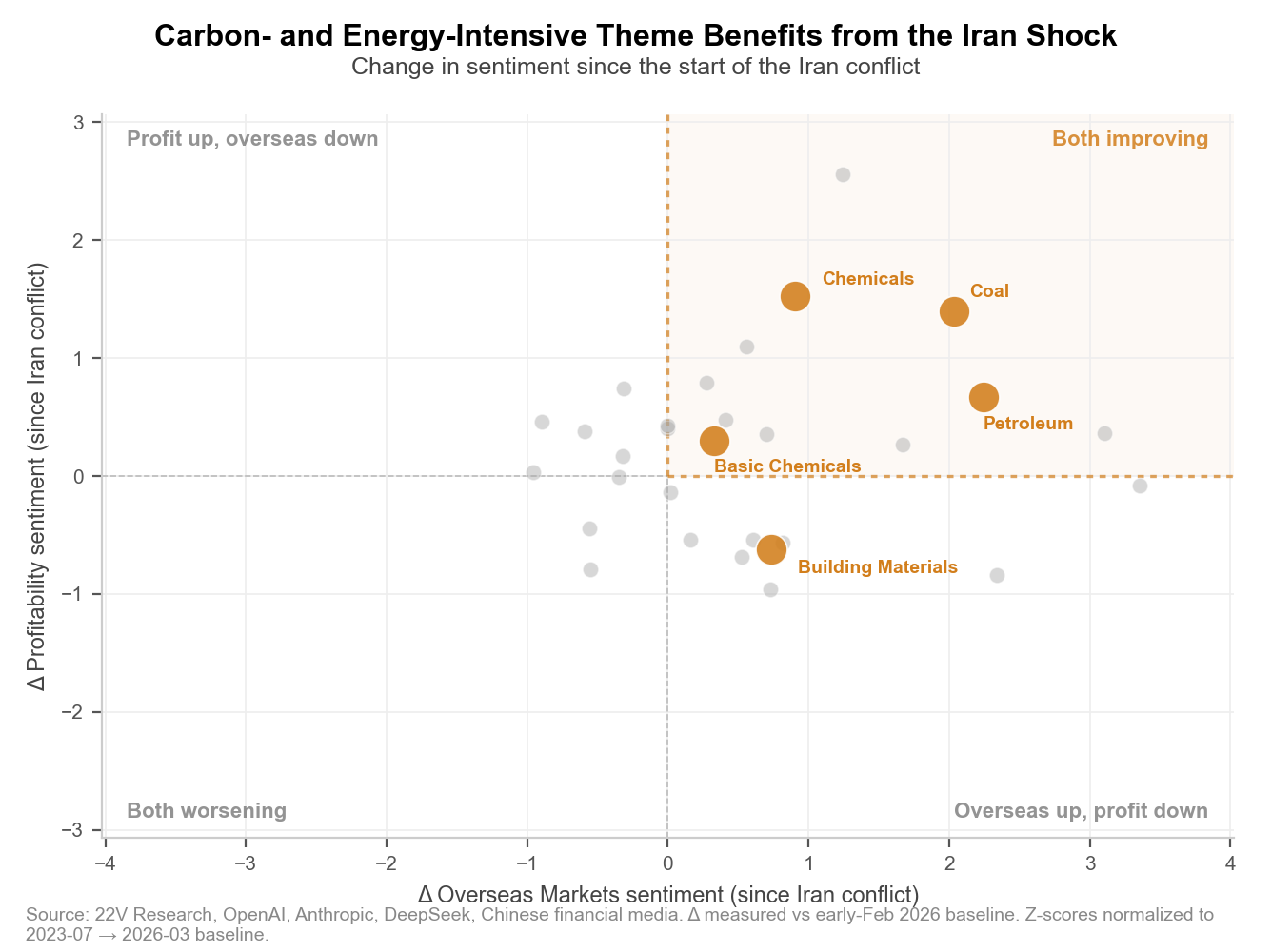
- Narrative: One of the ironies of the Iran energy shock is that in addition to benefiting China’s clean tech sector, it is also helping carbon-intensive sectors. China’s industrial use of coal is creating a cost advantage over competitors reliant on natural gas, particularly European and Japanese firms in chemicals.
- Reality Check: These sectors do not have the most positive sentiment overall, but they are among the “most improved,” with the biggest improvements in sentiment since the start of the Iran conflict (see chart below). A key question is whether these firms can hold market share gains once commodity flows through Hormuz normalize, but the crisis is not the only positive driver. China’s self-sufficiency push and efforts to rationalize capacity may provide more staying power, particularly in chemicals.
- Key Chinese beneficiaries: In the chemicals/refining complex, analysts see further gains for Chinese companies in coal chemicals (Wanhua Chemical, Hualu-Hengsheng, Baofeng Energy), fluorochemicals (Juhua Group, Sanmei Chemical), fertilizers/urea (Yuntianhua, Hualu-Hengsheng), phosphorus (Xingfa Group), pesticides (Yangnong Chemical), and polyester (Hengli Petrochemical, Tongkun Group, Rongsheng Petrochemical, Hengyi Petrochemical). Coal and building materials are mainly domestic-facing sectors but also have pockets of positive overseas momentum (metallurgical coal, fiberglass).
- Foreign firms at risk: Analysts most often cite Chinese players threatening BASF, followed by Covestro, Dow, Mitsui Chemicals, Bayer, Ineos, DuPont, Toray, and Shell. The German contingent (BASF, Covestro and Bayer) gets the most analyst mentions.