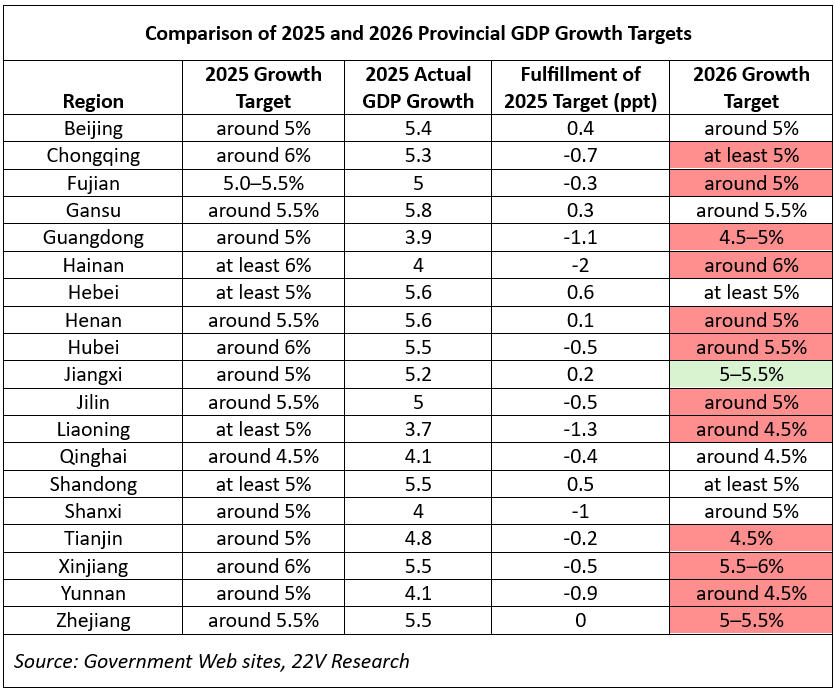
China’s leadership will announce the official GDP growth target for 2026 on March 5, the opening day of the annual National People’s Congress (NPC). In recent weeks, provincial governments have convened their own congresses to prepare for the national event, providing hints as to the forthcoming national growth target and a critical window into the country’s economic roadmap for the start of the “Fifteenth Five-Year Plan,” which will be released towards the end of the NPC in mid-March.
So far, nineteen out of thirty-one provinces have announced their 2026 growth objectives. Twelve of these nineteen provinces have lowered their targets compared to 2025, with the majority opting for a 0.5% reduction. Only one province has announced a higher target than the previous year. Based on these provincial figures, the national growth target is likely to be set within the 4.5% to 5.0% range, moderately lower than the 2025 growth target of “around 5%.” The largest provinces are aiming for the upper end of that bracket, with growth expectations trending closer to 5% than 4.5%.
While the downward revisions align with our view that growth is taking a secondary role in 2026 (see our 2026 economic outlook HERE), the immediate implications for this year’s actual output may be limited. We suspect China’s reported 5% growth in 2025 was overstated, but there are also signs in the last few months that the leadership is pressuring local officials – who are typically most responsible for these distortions – for more honest economic statistics. Consequently, a reported 2026 growth rate of approximately 4.8%, if a tad more honest, would represent a continuation of the current status quo rather than a significant deceleration.
With China’s population declining by roughly 0.2% per year, achieving a ~4.8% growth rate remains a challenge. This persistent pressure will likely necessitate additional stimulus measures from Beijing in the second half of 2026 to stay on track.
A notable indicator of long-term intent is that eight provinces have already released average growth targets through 2030. Most of these fall within the 4.5% to 5.0% corridor, suggesting that the national average target for the upcoming five-year period will likely settle in this same range. This will also be a significant challenge for the national economy, and will likely require faster progress in rebalancing growth towards consumption given limits to how much China can growth through boosting its global market share in exports. Initial previews of the Five-Year Plan did not point to ambitious targets and forceful policies for consumption growth (see our take from October HERE), but this will be a key watchpoint when the full plan comes out in mid-March.