

China’s macro policy calendar will be quiet until early December, when Beijing holds a Politburo meeting and then the annual Central Economic Work Conference to preview policy settings for 2026. (We outlined our subdued expectations for growth HERE).
In this report, we take stock of recent developments at the nexus of geopolitics, tech competition, and critical supply chains, focusing on the macro implications for China’s key trade partners.
SUMMARY
- AI Competition: While US firms have recently regained the lead in frontier AI models, leading Chinese open source models such as Moonshot AI’s Kimi K2 Thinking are nipping at their heels and much cheaper to run; it is the US AI model companies, not hardware firms, who are most vulnerable to China disruption risk.
- Rare Earths: Washington and Beijing are in the final stages of finalizing their truce on rare earths and export controls; Beijing will grant licenses for commercial users of rare earths, but its willingness to resume exports to US defense-related firms remains a question.
- China-Japan: Tensions between Beijing and Tokyo over Prime Minister Takaichi’s Taiwan comments will not subside soon; Beijing’s threats will further Takaichi’s plans to boost spending on defense and strategic industries, pressuring Japan’s fiscal outlook.
- Nexperia: The drama around the Dutch takeover of semiconductor firm Nexperia is quieting, but the episode highlights the vulnerability of supply chains to China’s growing role in mature semiconductors.
AI COMPETITION: The “China Risk” for US firms is in the models, for now…
In September, JP Morgan Asset Management’s Michael Cembalest wrote: “The biggest medium-term risk I can think of for top-heavy US equity markets: China’s Huawei and SMIC pierce the $6.3 trillion NVIDIA-TSMC-ASML moat by creating their own supernode computing clusters and deep-ultraviolet lithography machines of comparable quality.”
We are China watchers rather than US equity strategists, but we would put a gloss on Cembalest’s warning. Yes, measured in terms of amount of US equity market capitalization at risk, the erosion of Nvidia’s dominance in advanced chips is the biggest potential danger arising from China’s tech sector. But the higher probability risk for the US AI investment thesis – especially over the next two years – is that China’s open-weight models erode the moat of proprietary models from the likes of OpenAI, Anthropic, Google and xAI, with knock-on risks for these firms’ compute and infrastructure needs.
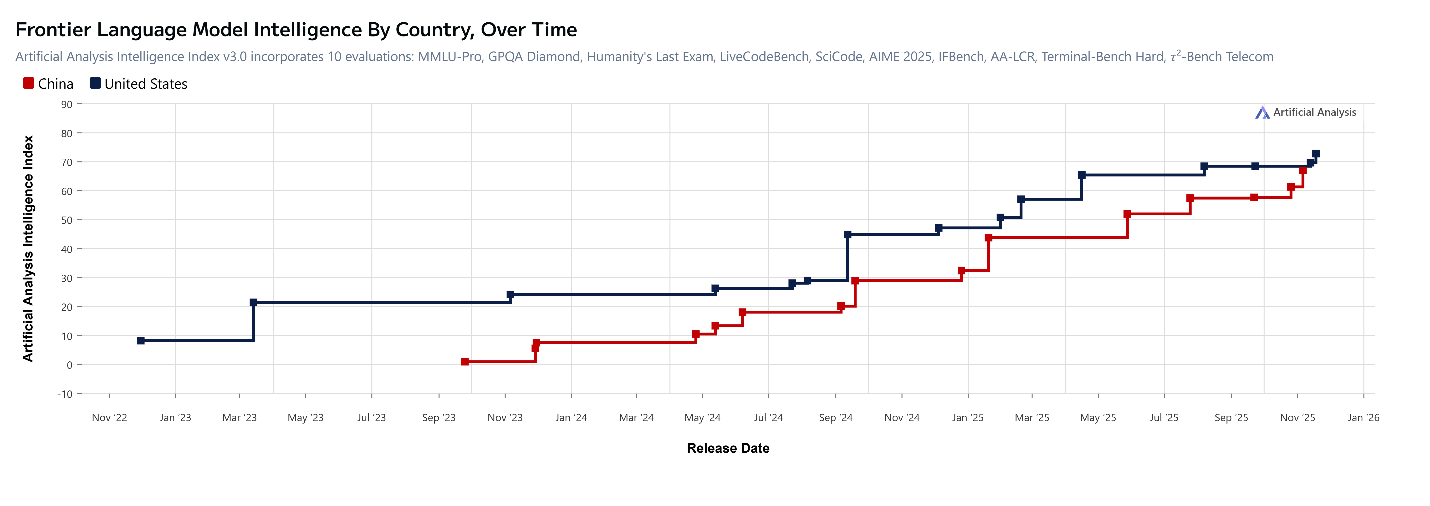
Two charts from AI benchmarking firm Artificial Analysis show the state of the AI model race. On November 6, China-based Moonshot AI (backed by Alibaba) released Kimi K2 Thinking, an open-weight model that challenged leading US models, particularly at agentic tasks. US firms have regained a clear lead in the last week, with the release of ChatGPT 5.1 and, especially, Google’s Gemini 3 Pro. Yet as Chart 1 shows, the trend has been for Chinese firms (red line) to narrow two key gaps with US peers (blue line): the vertical gap (sophistication of China’s current model relative to the US) and the horizontal gap (number of months that China lags behind the US). (See link HERE for a more readable version of the chart from the source).
It is not guaranteed that these gaps will continue to narrow. US firms will increasingly have access to Nvidia’s Blackwell series, which will remain mostly off-limits to Chinese firms in coming months. Beijing may not accept Nvidia chips until there is clear evidence that new domestic alternatives are insufficient for China’s needs, and the Trump administration may not approve them for export to China. So long as scaling laws continue to hold, access to Nvidia chips will boost the computing power and sophistication of US frontier models, though the availability of electricity for data centers will be one area in which China’s AI sector has a clear infrastructure advantage.
Source: Artificial Analysis
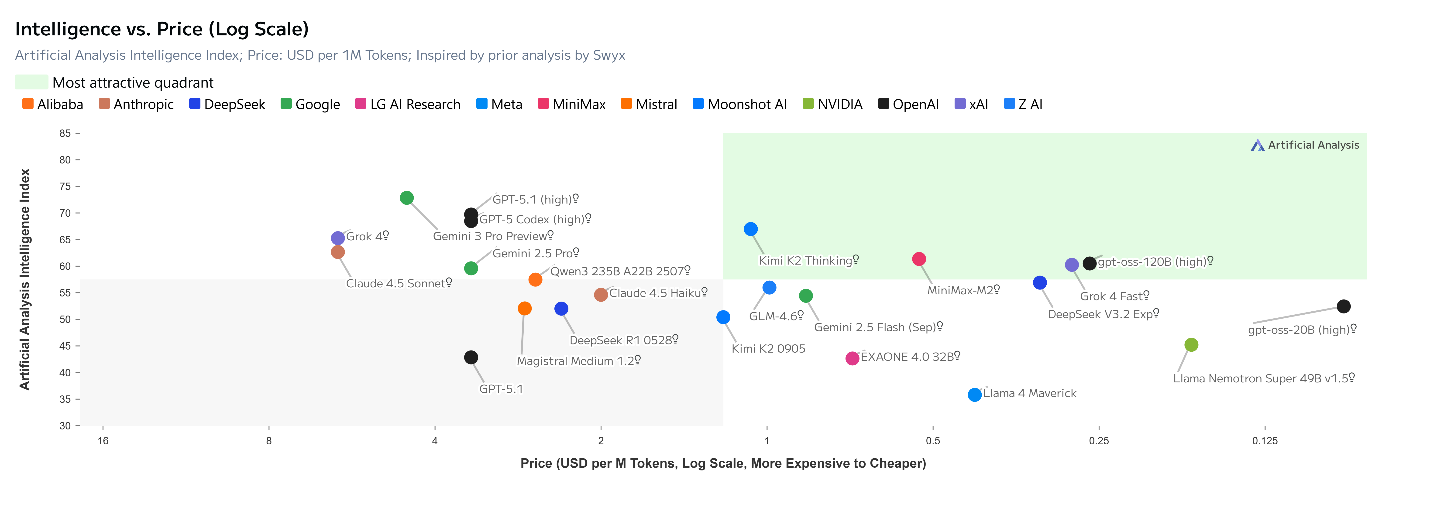
The bigger danger for the US AI investment thesis is that the leading Chinese models will be “good enough” for most users – and much cheaper to run. Consider Chart 2 (pasted below and linked to HERE), which plots model intelligence against price (USD per million tokens). Three of the five models in the “most attractive” quadrant (top right), comprised of models that are advanced but cheap, are from Chinese firms (Moonshot AI, MiniMax, and DeepSeek). This has a lot to do with China’s embrace of open weights, which lower training costs by sharing innovations across firms.
The global market share of models is hard to track, but anecdotes suggest many US AI startups as well as established firms are quietly experimenting with or using Chinese models on the back end. If that continues, it will add to jitters over the massive capex of OpenAI and its peers in training proprietary frontier models.
Source: Artificial Analysis
Cembalest’s warning about risks to the US/allied hardware stack – Nvidia-TSMC-ASML – is also important to monitor but for now the danger of China disruption is more speculative. China’s tech sector will need to make interlocking engineering breakthroughs before it can produce a self-sufficient AI hardware stack. As just one example of the challenges, Chinese firms such as Huawei are making inroads in advanced GPUs and AI accelerator chips, but face another binding constraint from a lack of high-bandwidth memory (HBM) chips, which are made by South Korean and US firms and tightly controlled by US export controls (Chinese memory chip makers YMTC and CXMT are collaborating to try to overcome this bottleneck). Even incremental progress towards these hardware milestones will increase political pressure on the Trump administration to tighten US export controls, a key reason why we see the recent rare earths truce as vulnerable over the medium term.
RARE EARTHS: US defense contractors are a key watchpoint
Almost three weeks after the Trump-Xi meeting, the US and China are still working to implement aspects of the agreements between the two leaders. The key pending item is Beijing’s issuance of general licenses for the export of the seven rare earths controlled in April. Treasury Secretary Bessent said that he expects the license to come soon “around the week of Thanksgiving.”
There is a continued risk of a mismatch in expectations for China’s licensing regime: the White House fact sheet from the Trump-Xi meeting says that “the general license means the de facto removal of controls China imposed since 2023.” This is overstated: Beijing has spent the last several years building a licensing regime to match US export control measures, which it will not dismantle. Beijing will likely still require Chinese rare earth exporters to submit information on end users, with the general license allowing multiple shipments in one year to approved firms. Western importers of rare earths for purely commercial applications will be able to receive volumes needed for production, but probably not enough to build large stockpiles.
A key question is Beijing’s willingness to allow shipments to US defense-related firms. Bessent pushed back on a Wall Street Journal report that Beijing will establish procedures to ensure rare earths do not go to military users. Beijing may not go as far as fully mirroring the US’ “verified end user” system (complete with on-the-ground inspections of firms), but we also doubt that China’s leadership will take a completely laissez faire approach to US defense contractors, particularly after the US just approved the first arms sales to Taiwan of Trump’s second term. This issue is likely to be an evolving area of tension and negotiation, with Beijing’s willingness to allow defense-related exports likely tied to Washington’s own export control actions against Chinese firms, and vice versa.
CHINA-JAPAN: Tensions will reinforce Takaichi’s resilience agenda
China-Japan tensions spiked after new Japanese Prime Minister Takaichi told legislators on Nov. 7 that a scenario of mainland military force against Taiwan might represent “an existential threat” to Japan – the threshold for Japan to become involved militarily. Beijing has responded with official and unofficial measures to curb tourism to Japan and block imports of Japanese films and seafood. There is a risk that Beijing could respond by withholding rare earths shipments to Japan, as it first did in 2010.
While Tokyo has sought to lower tensions, the episode will not blow over anytime soon. Takaichi, a defense hawk in the mold of her mentor, former PM Abe Shinzo, is very unlikely to meet Beijing’s demand that she disavow her comments. Tensions will, if anything, reinforce Takaichi’s policy agenda of boosting Japan’s military capabilities (accelerating an existing pledge to boost the defense budget to 2% of GDP) and investing in strategic industries such as AI, semiconductors, and shipbuilding.
This agenda will increase jitters around Japan’s fiscal health and the BOJ’s ability to continue to normalize rate policy given the impact of rate hikes on the government’s interest costs. Takaichi, a fiscal dove, will finalize a budget package later this month that calls for a significant increase in spending, both for stimulus and strategic priorities. Yields on Japan’s thirty-year bonds (3.4%) are the highest on record (since 1999) while the yen is close to its weakest level against the dollar in 2025.
NEXPERIA: Standoff highlights supply chain risks from mature chips
The complicated episode of the Dutch government’s takeover of Nexperia, a Chinese-controlled semiconductor company, appears headed for near-term de-escalation. The Dutch government this week suspended measures that had restricted the company’s ability to export its wafers to its China-based factories for assembly and packaging. That should provide further impetus for Beijing to remove its own restrictions on the China-based business exporting chips, which have threatened disruptions to global auto supply chains. A Dutch court has not reversed its removal of Nexperia’s Chinese CEO as part of a complicated governance dispute, which continues to rankle Beijing. The most likely outcome is an eventual separation of the Netherlands and China-based businesses.
While the immediate supply chain risks are lowered, the episode highlights the importance of China’s global role in mature (“foundational”) semiconductors found in autos and household appliances. For Beijing, expanding control in this sector is a means to climb up the value chain in advanced semiconductors and also acts as a potential deterrent against US/allied export controls.
The move will heighten calls in the US and Europe to reduce dependence on China in this area, which a U.S. congressional commission warned this week is a key vulnerability for US supply chains (along with active pharmaceutical ingredients, printed circuit boards, and critical minerals). But the economics will be difficult, given China’s massive investment plans in the sector. There are divided views as to whether China’s chip sector already faces excess capacity, but it seems clear that margins for non-Chinese firms will come under greater pressure.

