

China’s October data are now in, and collectively show growth momentum slowing sharply due to weakness in both external and – especially – domestic demand.
The main reasons behind the deceleration are clear: recent fiscal stimulus measures have been insufficient, property continues to contract, and export demand is slowing. The main policy solution is also clear: more intense fiscal stimulus to bolster demand.
But stepping up fiscal stimulus requires clear and forceful direction from China’s leadership, which is thus far showing little urgency about the economy despite the slide in momentum.
This is partially explained by the fact that, even with very weak growth in Q4, Beijing’s annual GDP growth target of 5% is in reach. Xi’s very successful meeting with Trump (from China’s perspective) has also reduced the sense of urgency, as it lowered US-China tensions and US tariffs on imports from China. And the leadership likely takes China’s strong equity markets as a sign that overall confidence is resilient.
But the remainder of the year will also be a test of whether Beijing’s political reaction function is changing, such that growth is once again slipping as a priority. Beijing was overly complacent about the weakness of the economy throughout 2023 and most of 2024, and then finally jolted into a more proactive stance with the “policy pivot” of September 2024. That sense of alertness seems to be fading, and policy once again threatens to fall behind the curve.
Our base case is that Beijing will not introduce new fiscal stimulus for the remainder of the year, and instead focus on speeding the implementation of recently introduced measures – a 500 bn CNY policy lending program (thus far ineffective), and 500 bn CNY in unused quota made available by MOF in mid-October. There is a 50/50 chance of modest monetary easing by the end of the year, depending in part on the Fed’s next move.
Barring more forceful support, this strategy will at best stabilize growth at quite weak levels by the end of the year. In early-to-mid-December, Beijing will convene a Politburo meeting and then the annual Central Economic Work Conference to preview the policy stance for 2026. That is when we will get a better sense of whether the policy reaction function has shifted.
ADDITIONAL TAKEAWAYS FROM THE DATA
Investment contracts on property and weak fiscal stimulus:
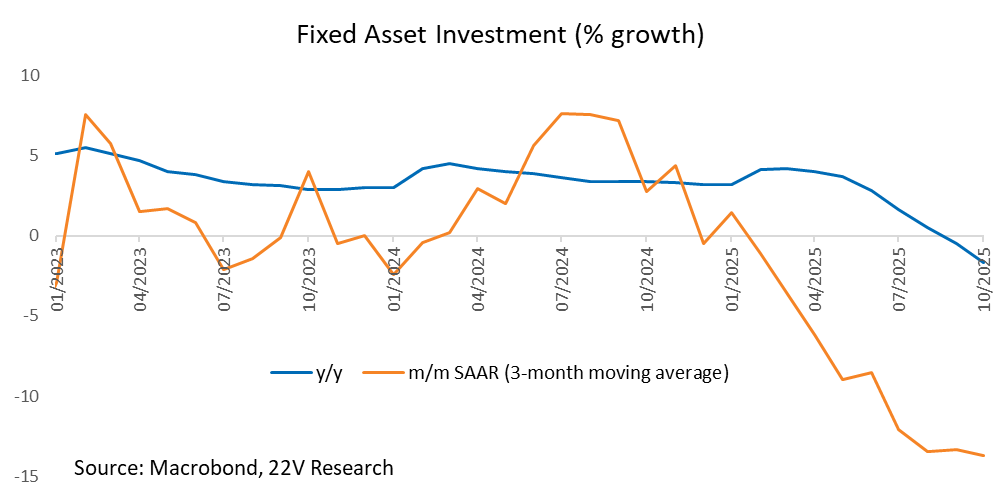
- Fixed asset investment (FAI) fell by -1.7% y/y ytd in October, the slowest pace on record. This is partly a delayed recognition of a slowdown since Q2 that has been more apparent in alternative indicators such as excavator operating hours. A steepening contraction in property investment (-14.7% ytd) was of course a key factor in the FAI decline.
- Because credit activity leads investment activity, and October credit data were also weak, it is reasonable to assume November investment activity will remain subdued (with winter conditions in northern China further diminishing the stimulus impact).
- Growth across all categories of fiscal investment slowed in October, with many posting y/y contractions. Beijing’s 500 bn CNY policy lending program is thus far not effective in boosting investment and offsetting the deeper fiscal pressures of local governments.
- Manufacturing FAI also slowed to a post-pandemic low of 2.7% y/y ytd. It is not clear how much of this was due to the “anti-involution” campaign, but we should note that cutting investment alone is not a sustainable solution to the problem of excess capacity. Given the extent of over-investment since 2022, it would likely require two years of negative manufacturing FAI growth to restore the supply-demand balance at the macro level. Demand-side support will be critical, too.
Households remain highly cautious. Despite the 120 billion yuan cash transfer to families with children in September and an extra holiday in October, retail sales failed to rebound. This suggests that the uptick in the October CPI was mainly seasonal—services inflation was negative m/m in September—rather than evidence of durable recovery. Moreover, since July, households have resumed mortgage prepayments, and October consumer credit data show no sign of slowdown. We therefore expect household spending and sentiment to weaken, rather than improve, in the coming months.
Manufacturing faces a double drag from weak domestic and external demand. Industrial value added (IVA) rose only 0.17% m/m in October, the weakest print this year. With coal and electricity output boosted by temporary factors, underlying manufacturing conditions are likely even weaker than the headline implies. As both domestic and export demand are likely to soften further, manufacturing growth will remain under pressure.

