SUMMARY: If the reaction to the ADP report is a guide, investors are starting to internalize that payroll growth of 40k-70k is all that is necessary to keep the unemployment rate flat (breakeven employment growth rate). This is a function of the significant decline in immigration. A paper from Brookings noted that just ~40k in payroll growth may keep the urate flat. This paper was going around economic circles yesterday and highlighted by Gerard (HERE).
FYI – Some quick math from Gerard suggests that to get the unemployment rate up to 4.5% by November (the Fed’s forecast), under a 40k a month breakeven employment rate assumption, would require that the total employment decline at 33k a month till then. Put simply, the bar is low on payroll growth just keep the unemployment rate flat. Running employment growth that weak would imply a significantly higher than average recession risk. This could be a major part of the reason financial conditions have eased aggressively.
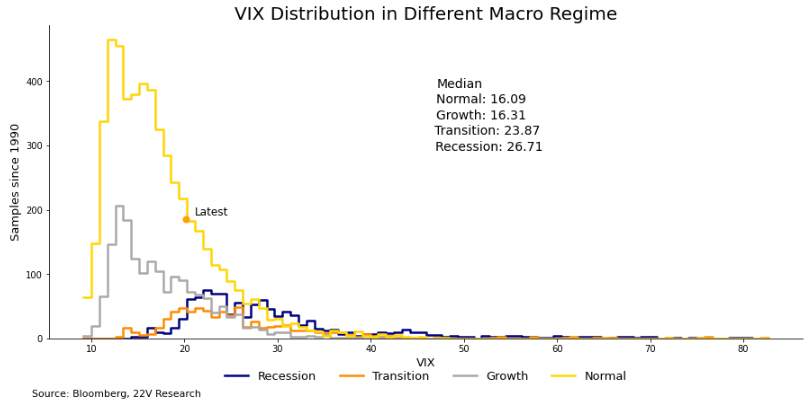
Bottom Line – If payroll growth is in the 50k range, the unemployment rate should be flat and financial conditions remain easy. The economic expansion would be forecasted to continue and vol will stay in a range consistent with a normal economic expansion (~16 historically). If the unemployment rate starts to increase, recession probabilities will increase, and risk-on factors will suffer. The unemployment rate should be the focus.
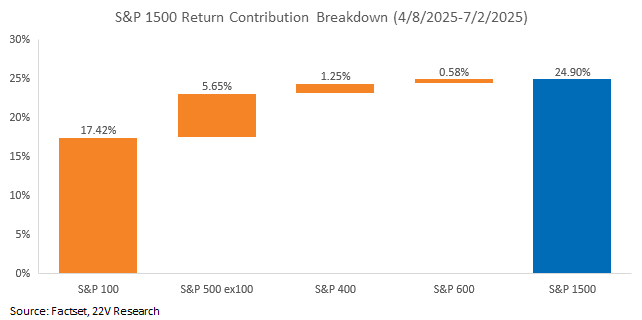
Mega cap returns have been THE major driver of the market, especially since the market low in April. 70% of S&P1500 return has been driven by the top 100 names. The top 100 S&P names have been responsible 17% of the S&P 1500’s 25% return. Some rotation into small size and other lagging factors should be expected given the aggressive easing of financial conditions and continued normal economic expansion (HERE).

We update our monthly sector and factor mean reversion section today. Mean reversion has not worked this year, but Sectors and Factors that lagged the most last month are something to be aware of from a risk management point of view.
Full report below…
MARKET VIEWS: The market shrugged off the negative ADP number, which indicated a month-over-month decline in private payrolls, and continued to rotate into riskier factors (Small caps and debt risk outperformed again). FYI – Mega cap returns have been THE major driver of the market, especially off the April low. The top 100 S&P names have been responsible 17pp of the S&P 1500’s 25% return. Some rotation into small size and other lagging factors should be expected given the aggressive easing in financial conditions and continued normal economic expansion (HERE).
The weak ADP report was shrugged off and although it is easy to dismiss the ADP noise (ADP does not provide any signal into how payroll report will print, HERE), investors might be starting to internalize that payroll growth in the 40k-70k range is all that is necessary to keep the unemployment rate flat (breakeven employment growth rate). This is a function of the significant decline in immigration. A paper from Brookings making the point that only 40kish in payroll growth was necessary to keep the unemployment rate flat was going around economic circles yesterday and was highlighted by Gerard (HERE).
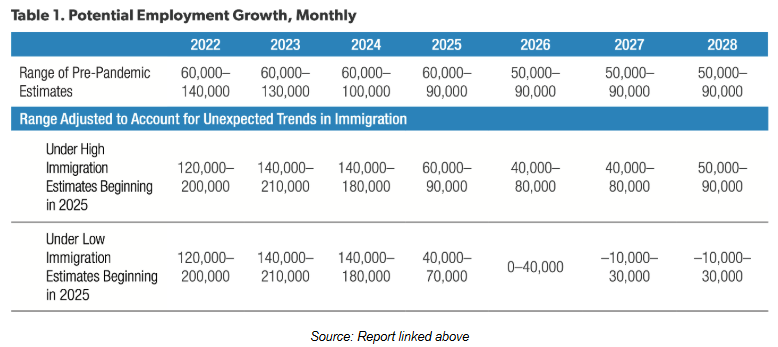
FYI – Some quick math from Gerard on what a 40k a month breakeven employment growth rate means going forward. To get the unemployment rate up to 4.5% by November (the Fed’s forecast) under these conditions would require total employment to decline at 33k a month. Put simply, the bar is really low on payroll growth, just keep the unemployment rate flat. Running employment growth so weak would imply a significantly higher than average recession risk. This could be a major part of the reason why financial conditions have eased aggressively. The net net, if payroll growth is in the 50k range, the unemployment rate should be flat and financial conditions remain easy. The economic expansion would be forecasted to continue and vol will stay in a range consistent with a normal economic expansion. If the unemployment rate starts to increase, recession probabilities will increase, and risk-on factors will suffer.
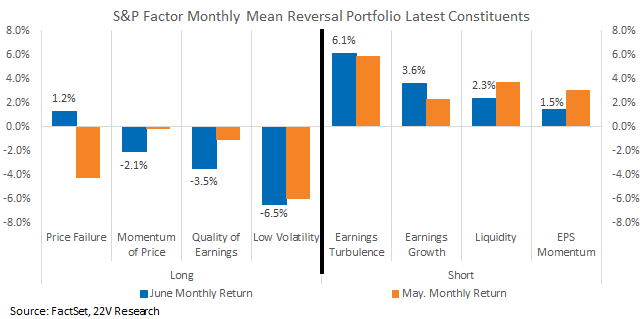
MEAN REVERSION: Every month, we highlight our industry group and factor mean reversion portfolios as an exercise in risk management. Going long the prior month’s worst performing industry groups and factors and short the prior month’s best has generated positive returns over time. In other words, changes in market narratives occur more often than not. In 2Q, the continued strength of the relative winners bucked the trend. However, for consistency, we assess what could cause another round of mean reversion, which is particularly interesting now, given that some market internals (EPS Mo) are reversing.
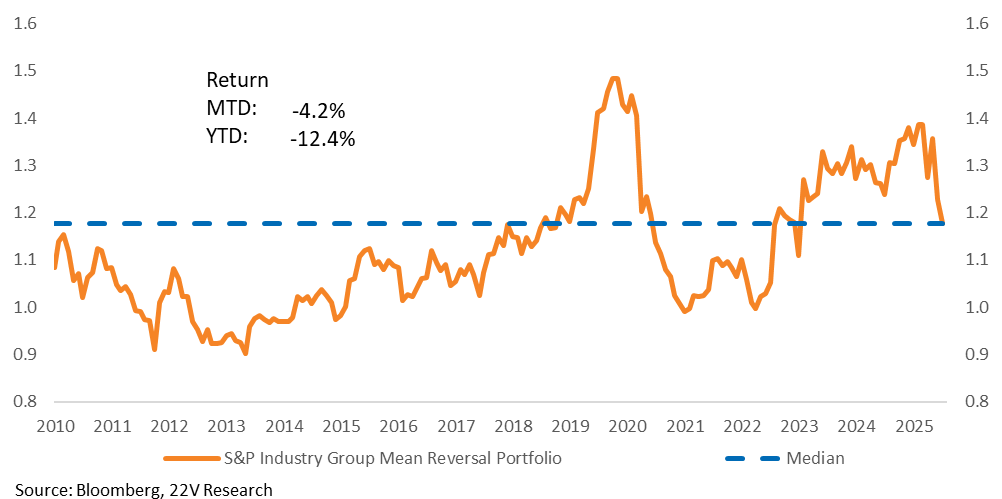
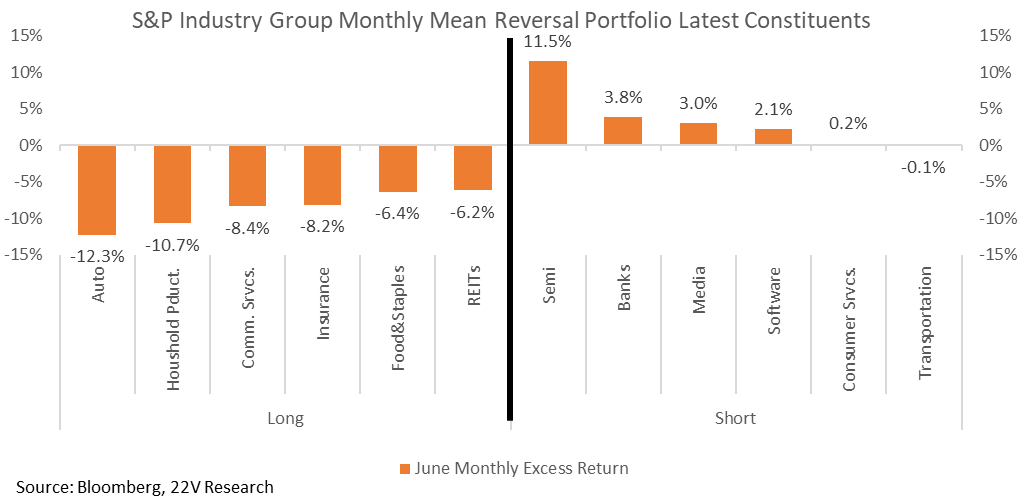
For Industry Groups, mean reversion in July would be long Autos, Household Products, Commercial Services, Insurance, Food & Staples, and REITs. Short Semis, Banks, Media, Software, Consumer Services, and Transports. That’s a Defensive vs Cyclical tilt, with an AI unwind to boot. A reemergence of macro tail risks, most likely because of weak employment data, hot inflation data, and/or policy risks that indicate higher odds of a nonlinear slowdown, are the most likely culprits for Defensives outperforming.
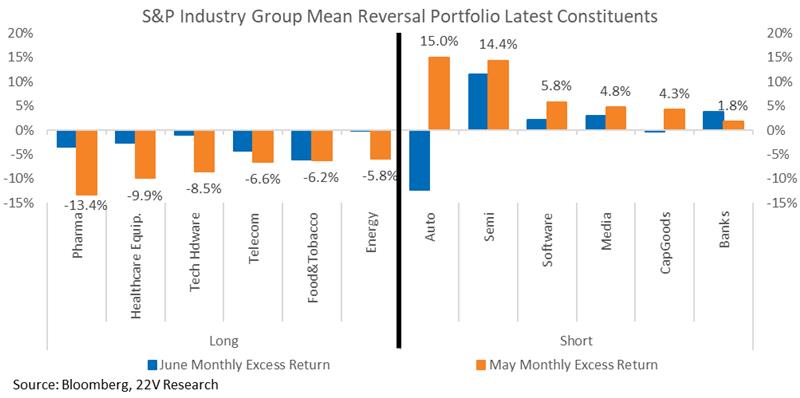
In June, all the industry groups in the long basket acted as a drag on performance. Defensive sectors like Pharma, Healthcare Equipment, Food & Tobacco, and Telecom underperformed as risk-on sentiment dominated markets. Easing financial conditions, soft-landing optimism, and a rebound in growth expectations supported cyclical and high-beta groups, which our mean reversion strategy was short. Technology Hardware also lagged as investors rotated away from hardware toward Semis and Software, which were the favored part of the AI trade.
For Factors, mean reversion in July would be long Low Vol, Quality, and Price and Growth Momentum. Short high Earnings Risk, Earnings Growth, Liquidity, and Cash Return. Long risk-off vs risk-on. That would work in the same non-linear slowdown mentioned above. In the long term, Momentum is likely to rebound after factors with a higher beta to growth re-rate, given the Fed is still targeting below-trend growth. But that is a long-term, not a short-term story.
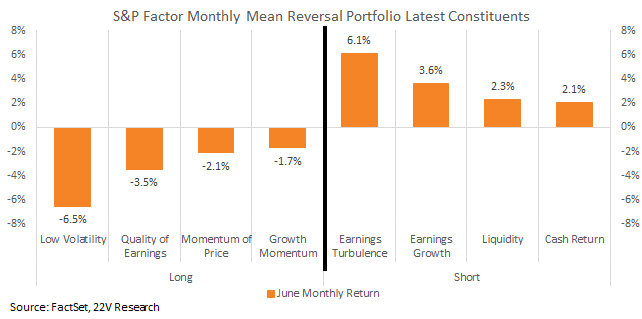
Risk-on factors led in June, again, as investor concerns over a nonlinear slowdown were allayed. Labor data held steady, estimates of tariff-induced inflation decreased, and the tariff news flow improved.