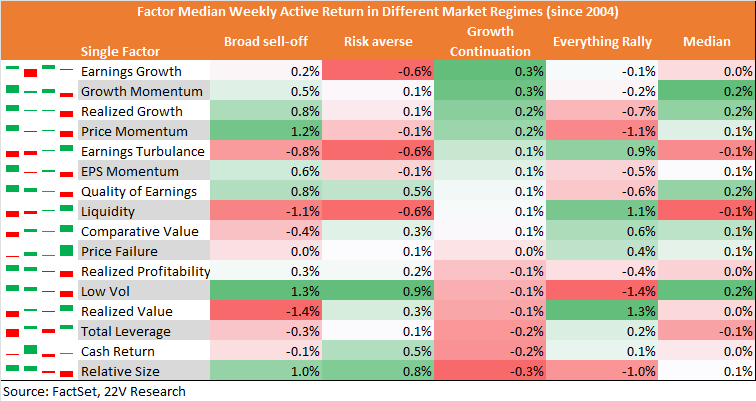
Equities are at a new high, PEs and vol have reset to their pre-trade war levels, and risk-on factors have been leading market internals. Despite the large sources of uncertainty – ongoing trade disputes, tensions in the Mideast, budget negotiations – market conditions make sense.
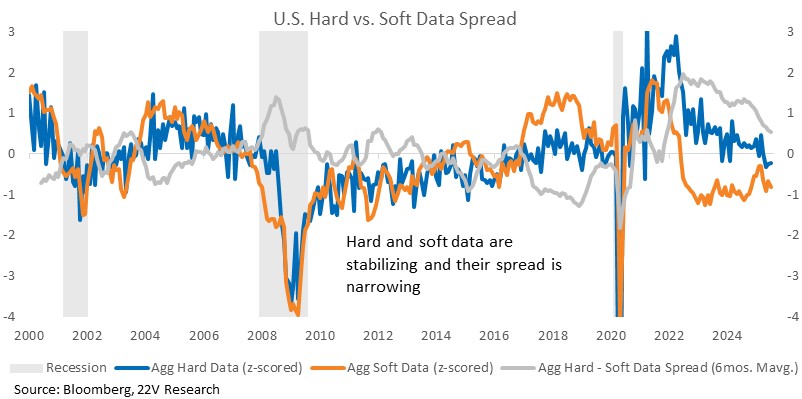
For multiple quarters, the breadth of macro data has been consistent with a normal economic expansion. Plunging sentiment earlier this year threatened that expansionary backdrop. Over the past few months, aggregated hard (counts/measures) and soft (surveys) data have stabilized and the spread between the two has narrowed. Those readings are now back to levels consistent with a growing economy.

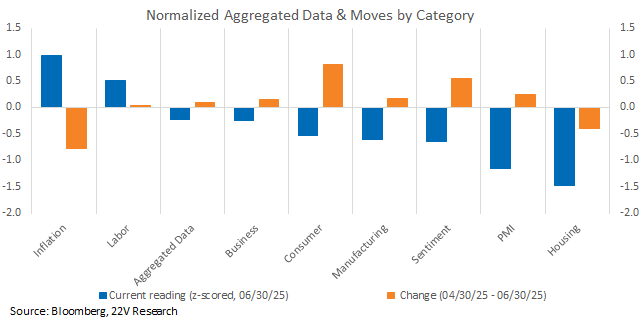
Inflation and labor demand are still running hot while Housing and PMIs are a drag. Inflation readings, both soft and hard, have eased over the past two months, tracing the reduction in tariff concerns. Tariffs are starting to impact observed inflation and will put some upward pressure on prices near-term. How much is a matter of debate and data/headlines will impact asset prices over the coming months.
Near-term inflation risks aside, the aggregate backdrop is what continues to support equities and risk-on internal trends. Driven by the Normal regime, correlations have reset to pre-Liberation Day levels and implied vol is down across assets. Our market internal regime model, which measures how all factors are moving relative to each other to arrive at an overall internal trend, has shown an increasingly risk-on tilt to factors.
The past five weeks have been a mix of Everything Rallies (pure risk-on) and Growth Continuation periods (fundamental leadership). That is a significant improvement from a few moths ago when internals were more risk-off. The bottom line is that investors are, in aggregate, increasingly favoring risk-on and fundamental factors over the defensive positioning that dominated from ~Feb-May.
Investors are Leaning Into Risk Despite Uncertainty: Equity implied volatility has dropped sharply as geopolitical and tariff risks have eased. Discounting of recession risk has dropped sharply as well, reflecting the further improvement in economic data. As has been the case for multiple quarters, our Macro Regime Classification model puts the U.S. in a Normal economic expansion regime.
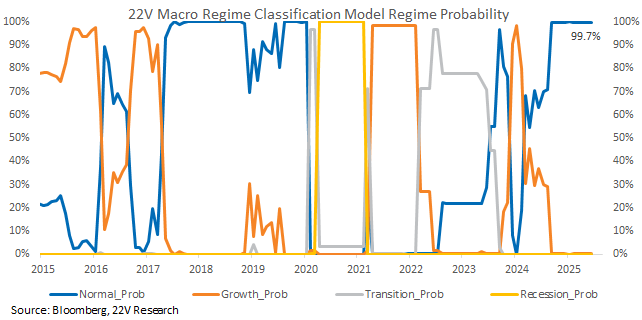
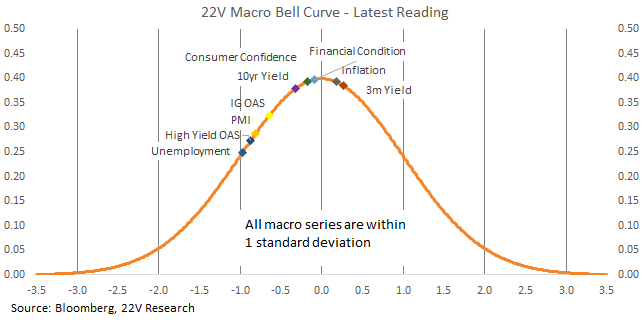
The macro backdrop has normalized further over the past month. Currently, all the main macro series in our model have moved to within 1 standard deviation of their distributions. That includes earlier outliers like the unemployment rate and credit spreads. Aggregate data suggest a stable Normal expansion and a less volatility going forward. This is a state model, not a predictive one. Inflation could shoot higher, growth could collapse. The point we are making is that trends would have to change significantly to move the macro backdrop away from one of expansion.
Earlier this year, there was an important potential portent of a deterioration. Soft data (surveys) collapsed relative to hard data (counts/measures). Soft data throws a lot of false positives, but also tends to move ahead of deteriorating hard data. People see slowdowns coming before they are reflected in data. Importantly, over the past two months both soft and hard data have stabilized and the spread between the two has narrowed. Both moves are consistent with a continuation of a Normal expansionary regime.
Breaking down macro readings by themes shows inflation and labor readings are better than normal (too strong) while housing and PMI are weak relative to their typical ranges. However, inflation readings, both hard and soft, have dropped since the tariff shock, and Consumer Sentiment has improved. Tariffs are starting to impact observed inflation and will put some upward pressure on prices near-term. How much is a matter of debate and data/headlines will impact asset prices over the coming months. From the current level of PCE, a LARGE move in inflation would be needed to change the macro backdrop.
Internally, the market regime has titled more risk-on since late-May as all the weekly regimes classified by the model were Risk-on regime (Everything Rally or Growth Continuation). That is a reversal from the risk-off regimes that dominated since earlier this year, especially in the post-“Liberation Day” period. The market regime distribution for the past 3 months has been moving more towards what we would expect in a Normal expansion.
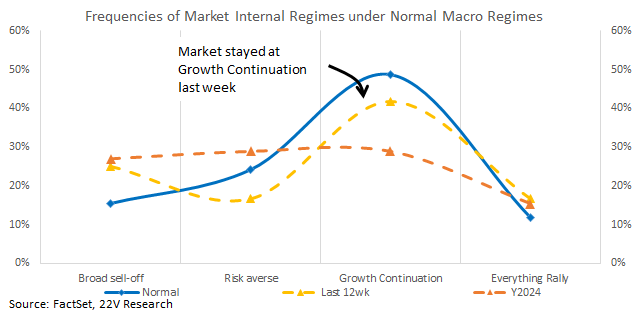
For most Growth Continuation regimes, fundamental factors, especially Momentum and Growth tend to lead at the expense of Value and Size. As we discussed (HERE), heading into reporting season Momentum and Growth have better margin and earnings growth expectations while Value has negative expected EPS growth. Both the fundamental backdrop and market regime distribution support further Momentum and Growth gains.