

SUMMARY:
- Trump’s April 2 announcement on reciprocal tariffs has a wide range of potential outcomes for China, depending on whether the President uses VAT and non-tariff barriers as criteria; Beijing is also bracing for the results of various trade policy reviews that Trump assigned to his hawkish trade team
- While China’s March PMI readings beat the consensus, underlying growth momentum remains subdued; we expect growth to slow in Q2, requiring additional stimulus in H2
- Sentiment analysis shows that domestic analysts are more optimistic about the outlook than we are, particularly when it comes to consumption
Beijing braces for Trump’s trade announcements
While there is uncertainty around the globe regarding Trump’s potential announcements on April 2, the suspense is particularly high in Beijing.
China has of course long been the largest target on trade for Trump and his team. While Trump has already hiked US tariff rates on imports from China by 20% – ostensibly due to Beijing’s lack of cooperation in countering fentanyl – there will surely be more threats coming over long-standing economic grievances, including China’s large bilateral trade surplus, subsidies for domestic producers, and market access restrictions for US firms.
When it comes to reciprocal tariffs, a critical question for China is whether Trump’s team focuses on matching other countries’ tariffs on US goods – which in China’s case are relatively low – or also includes VAT tax regimes and estimates of non-tariff barriers. If the latter two are included, Bloomberg Economics notes that Trump’s reciprocal tariffs could bring the average US tariff rate on China imports to above 50%. However, the President has recently implied that the reciprocal tariff plan may take a more conservative approach and thus may not include VAT and non-tariff barriers. If so, it would mean that the reciprocal tariff plan itself could be relatively mild for China relative to other trading partners.
But recall that April 2 is not only the planned date for Trump’s reciprocal tariff plan, but also for a slew of trade policy reviews – many of them focused on China – that Trump tasked to his cabinet in the America First Trade Policy executive order on his first day in office. These include reviews of:
- China’s adherence to the “Phase One” trade deal agreed with Trump in his first term [tasked to the US Trade Representative (USTR)]
- Whether the US should take additional measures to address the concerns in Trump’s 2018 Section 301 investigation into China’s trade practices [USTR]
- Additional discriminatory trade practices by China’s government [USTR]
- Congressional proposals to rescind/alter China’s Permanent Normal Trade Relationship status under US law [USTR]
- China’s treatment of US intellectual property [Commerce]
- Tech-oriented policies in the areas of export controls, outbound investment restrictions, and IT/data security threats [Commerce/Treasury]
The likelihood that these reports will be ready this week strikes us as very low. But the bottom line is that in addition to reciprocal tariffs, China faces the likelihood of further trade actions (such as new Section 301 investigations) as well as export/investment restrictions invoked under national security authorities.
Beijing had hoped to get in front of Trump’s initial trade moves by starting engagement on the elements of a potential trade deal. Those efforts have met with little success, as Trump’s hawkish trade team has not been eager to engage with Chinese counterparts, and Trump himself has not been in a hurry. Montana Senator Steve Daines sought to break the ice last week by attending the China Development Forum, where he met – acting as an informal envoy from Trump – with Premier Li Qiang and Vice Premier He Lifeng. But we do not believe Daines’ trip achieved a breakthrough in substance. For that to happen, Trump needs to spell out in more direct terms what he expects from Beijing and what he himself is willing to put on the table.
We expect discussions between the two sides to pick up once the dust settles on Trump’s initial tariff announcements this week. One near-term watchpoint is the April 5 deadline (unless extended by Trump) for ByteDance to find a non-Chinese buyer for TikTok or face a national ban. Trump has recently said he expects to reach a deal by that Saturday deadline.
However, we remain skeptical of a “grand bargain” between the two sides this year that would prevent further tariff increases. A more realistic scenario is a mini deal (or series of them) that at least limit the amount of escalation. In the meantime, we will have more to say about Beijing’s likely response to reciprocal tariffs – including retaliation and stimulus – after Trump’s announcements this week.
March PMIs offers little reason for optimism
China’s official March manufacturing and non-manufacturing PMIs came in at 50.5 and 50.8, respectively, indicating a modest expansion. While both figures slightly exceed the Bloomberg consensus, the PMI data offers little reason for optimism regarding growth.
First, the March PMIs were boosted by transitory factors, such as the post-Lunar New Year rebound and fiscal front-loading. Historically, the March PMI has been the strongest of the year, yet the March 2025 reading was actually lower than that of March 2024. This suggests that once seasonal effects are excluded, March 2025 was weaker than March 2024—a month that was not particularly strong to begin with.
Second, the details of the PMI data are concerning. Construction new orders (43.5) and average employment (41.4) both remain below 50 and have edged lower compared to the previous month. These levels are barely better than last September, before the policy pivot. Moreover, employment in both the services and manufacturing sectors is weak. The average employment sub-index for manufacturing and non-manufacturing PMIs stands at 47—below 50 and weaker than February’s reading.
The March PMI report is not the only recent concerning data point. Signals from top leadership over the past few weeks reinforce our view that policy will be reactive rather than proactive. Premier Li Qiang stated that China will introduce additional stimulus “only when necessary,” which we interpret as setting a high bar for further policy support. Additionally, recent policy signals suggest growing emphasis on supply-side and industrial policy, while the urgency for supporting consumption and demand appears to have diminished slightly.
In summary, the latest PMI data and policy signals reaffirm our expectation that growth will soften in Q2, with stimulus unlikely to arrive before the second half of the year.
Sentiment Update: Analysts are bullish on consumption
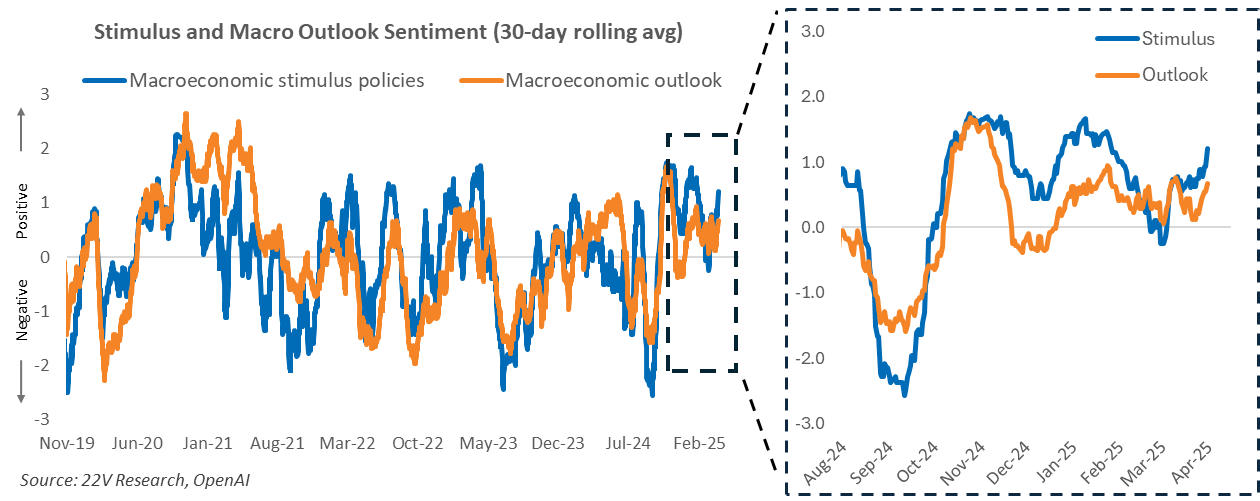
We conclude with an update of 22V’s China Economic Sentiment Series (CHESS) tool, which uses ChatGPT to assess the sentiment of analysts commenting about the outlook in China’s domestic financial media.
Sentiment towards the macroeconomic outlook (orange line below) continued to tread water in March at a level slightly above neutral. Stimulus expectations (blue line) ticked up in the last week but remain below the high levels reached after China’s late-September pivot. In short, analysts are moderately optimistic about growth prospects, fueled by the assumption of continued policy support. Our own take is slightly less optimistic, as we expect growth momentum to fade in Q2 before Beijing feels enough urgency to boost stimulus.
A key rhetorical focus of policymakers has been a pledge to boost consumption this year, including the release of an action plan on March 16. While we found the details to be underwhelming (link HERE), analysts are more optimistic than we are about the outlook for consumption (blue line) and the labor market (orange line).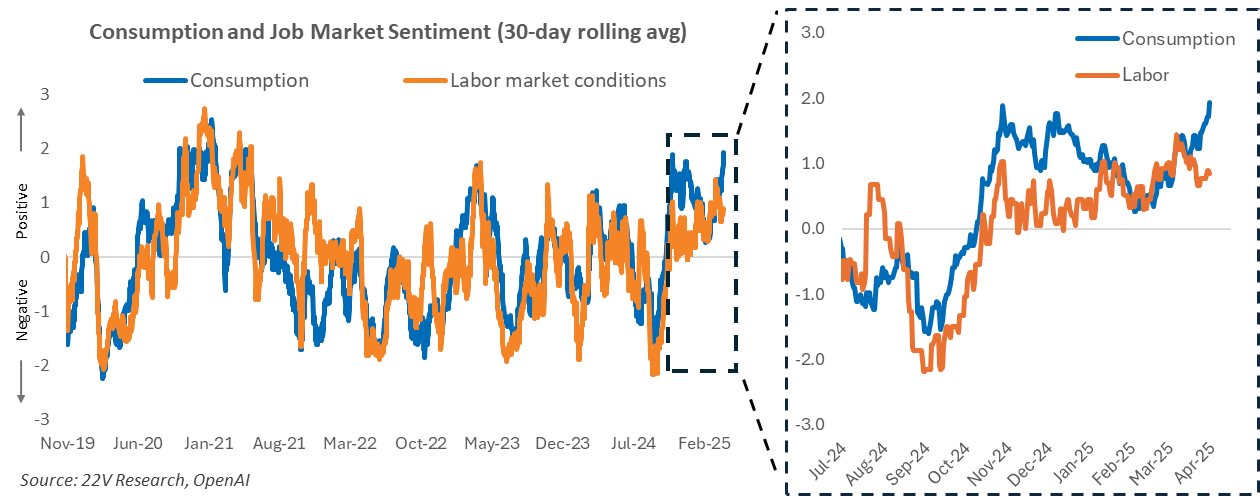
Finally, March saw a divergence between analyst sentiment towards property (orange line) and the equity market (blue line), both areas that Beijing has pledged to support since the September pivot. Property sentiment has waned since the fall, which is consistent with our view that policy measures are not powerful enough to drive a sustained rally in sales and prices. Equity market sentiment remains modestly positive.


