

SUMMARY
- Official data show economic activity improving in January and February but do not reflect the impact of recent US tariff hikes; domestic demand remains reliant on front-loaded government spending, which is likely to wane in Q2
- Beijing’s recently announced plan to boost consumption is directionally positive but lacks fiscal support and major new measures; the consumption push will remain incremental this year, with Beijing only gradually coming around to more forceful rebalancing efforts
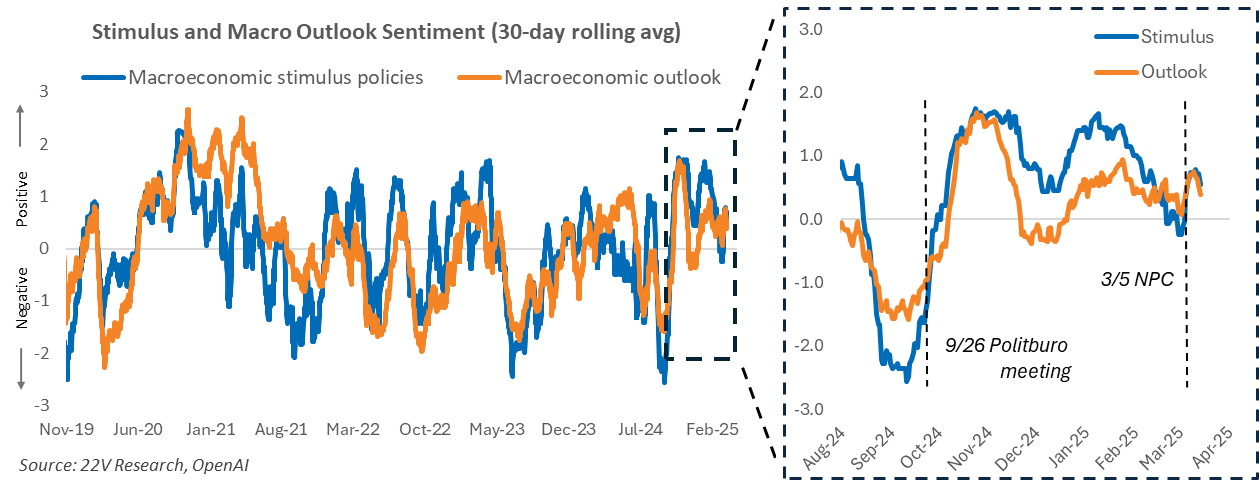
- 22V’s China Economic Sentiment Series (CHESS) tool shows that domestic analysts’ expectations for stimulus and growth are modestly positive after the recent National People’s Congress (NPC)
This China Brief has three parts. First, we review activity data for January and February. Second, we take stock of Beijing’s latest plans for boosting household consumption. Finally, we assess analyst sentiment toward China outlook using our proprietary China Economic Sentiment Series CHESS tool.
The net takeaway is that while economic policy is incrementally stepping up, it is still a modest level of support relative to the coming drag on growth from US tariff hikes. We expect the recent improvement in activity to wane by the end of Q2, as fiscal support lessens and tariffs hit. More stimulus to boost domestic demand will be necessary in H2 for China’s recovery to gain solid footing. While Beijing pledged at the recent National People’s Congress to be more proactive, we expect a growth slowdown will be necessary for China’s leadership to reach the level of urgency to boost stimulus.
JAN-FEB ACTIVITY SHOW MIXED PICTURE FOR DOMESTIC DEMAND
On Monday, China’s National Bureau of Statistics (NBS) released economic activity and property data for the months of January and February. The data show the economy broadly stable to start the year, with activity accelerating in areas such as industrial production and fixed asset investment.
However, the NBS data is a rear-view snapshot. Trump’s second 10% tariff hike on Chinese imports was announced at the end of February and came into effect in early March. Tariff disruptions barely showed in the latest data but should become more apparent going forward.
Furthermore, the NBS report is notably stronger than other recent data releases, including soft trade, credit and inflation prints. That makes it important to highlight a few concerning aspects in today’s report.
First, despite the narrowing of the decline in property sales (-2.6% y/y, from -17.1% in 2024), property will continue to be a major drag on growth. The continued weakening of property prices (prices of existing homes were down in 67 of the 70 cities) shows that property demand is not close to bottom. In the meantime, property investment remained in steep contraction at -9.8% y/y, with new starts down by -29.6% y/y.
Second, a significant divergence between auto production and sales points to weak underlying demand and excess capacity in this sector. Year-on-year, Jan/Feb auto production volumes were up by 13.9%; domestic sales were down by 4.4% y/y and exports only grew by 2.5% y/y. Moreover, unit prices have continued to decline for both domestic and export sales. Weak auto demand suggests that the recent strength in auto production is unlikely to sustain.
Third, public investment has been a major driver for growth, but its sustainability is questionable. Government and SOE investment in areas such as water management, power generation & transmission and urban infrastructure have shown meaningful acceleration. Yet, because the fiscal package announced at NPC is quite limited in size (see our NPC report HERE), the recent strength in fiscal expenditure is primarily due to Beijing’s decision to frontload fiscal spending. Fiscal expenditure will slow toward the end of Q2.
Put together, the data suggest that underlying domestic demand in China remains uneven and highly reliant on fiscal support. We reiterate our view that growth is likely to slow again by midyear, as front-loaded government spending wanes and tariff hikes show their impact.
EXPECT ONLY AN INCREMENTAL BOOST TO CONSUMPTION
Beijing published its plan to boost consumption with a 30-point document on Sunday and held a press conference on Monday to elaborate on the details. We have three takeaways.
First, the near-term boost to consumption will be modest. The document does not lay out any major new measures, and the modest 2025 fiscal budget announced at the NPC does not leave much room for ramping up consumption support. We expect H1 fiscal support for consumption will mainly be limited to the 300 billion yuan trade-in program for appliances and cars. However, However, during the press conference, officials hinted at expanding the trade-in program in the future, so it reasonable to expect some additional, incremental support for consumption to be announced in H2.
Second, Beijing is banking on household re-leveraging to boost consumption. The document mentions fiscal subsidies for consumption loans, and rate cuts for mortgage borrowing through Housing Provident Fund. However, a soft labor market and declining property values continue to depress household demand for loans. Hence, we do not expect the policy incentives to lead to significant acceleration in household borrowing.
Finally, Beijing views the shift to consumption as a long-term goal rather than urgent priority. For example, cash incentives for childbirth, one of the most highly anticipated measures, is still in the research stage. This means it is unlikely to be rolled out nationally anytime soon. In short, we should not expect a dramatic shift in economic rebalancing policies – such as broad-based direct income support to households – anytime soon. Support for consumption is increasing, but at a gradual pace.
SENTIMENT MODESTLY POSITIVE AFTER NPC
We conclude the brief with an update on how analysts in China view the outlook for growth, stimulus, and key asset markets using our China Economic Sentiment Series (CHESS) tool. As a reminder, CHESS uses ChatGPT to assess the sentiment of economic commentary in China’s domestic media. This CHESS update is particularly timely, capturing how analyst views are shifting in light of the recently concluded National People’s Congress.
Stimulus and growth expectations are modestly positive. China’s late-September policy pivot sent analyst expectations for stimulus (blue line) and for growth (orange line) soaring. Those expectations have settled back down to a level that is modestly positive, though still well above its pre-pivot levels. In short, analysts see the NPC as supportive of growth, but not with the same level of urgency or potency as Beijing had signaled last fall.
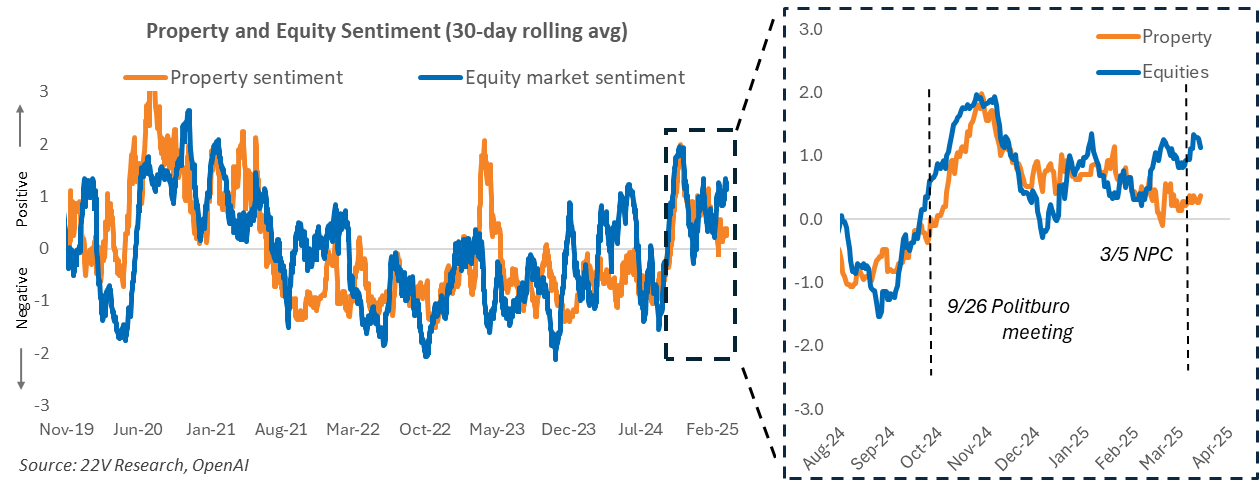
Equity sentiment remains positive, while property sentiment has cooled. Property sentiment has waned in recent months, consistent with our call that easing measures announced in the fall were not powerful enough to drive a strong and sustained recovery. That continues to be the case (see discussion above). Analyst sentiment toward equities remains positive but not ebullient: domestic A-shares have not benefitted from the hype over DeepSeek and AI but reflect a modest improvement in the macro outlook and a perception that Beijing is eager to support capital markets in a bid to revive broader confidence. That strikes us as a reasonable stance.
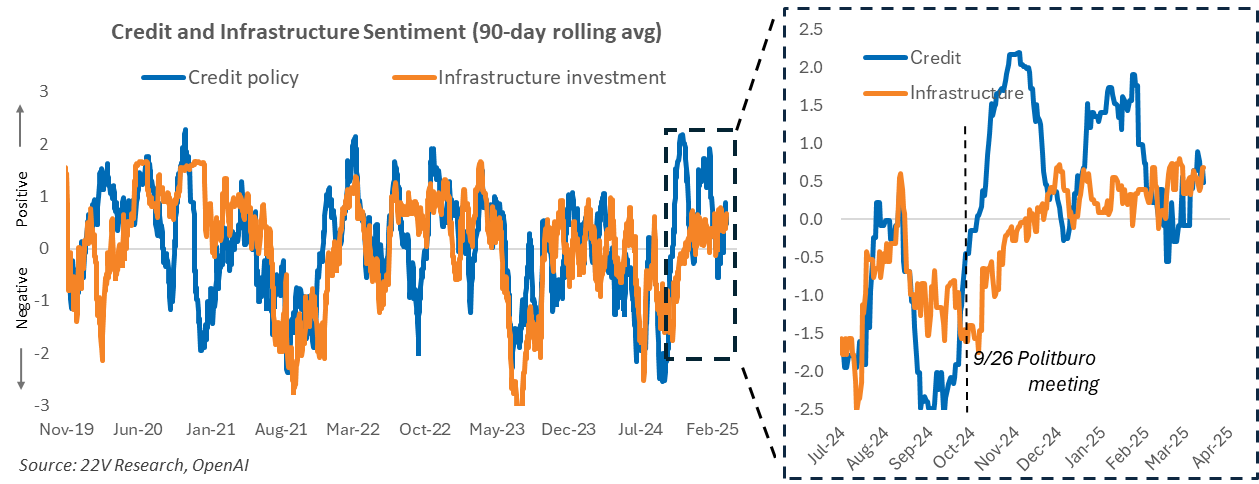
Infrastructure sentiment is picking up. Expectations for infrastructure investment (orange line below) have only recently improved, with signs that China’s front-loaded fiscal stimulus is now providing funding for local government projects. That is positive for cushioning China’s commodity demand amid the ongoing weakness in property. However, due to the limited fiscal stimulus announced at the NPC, the infrastructure spending boom is unlikely to gain additional momentum in Q2.
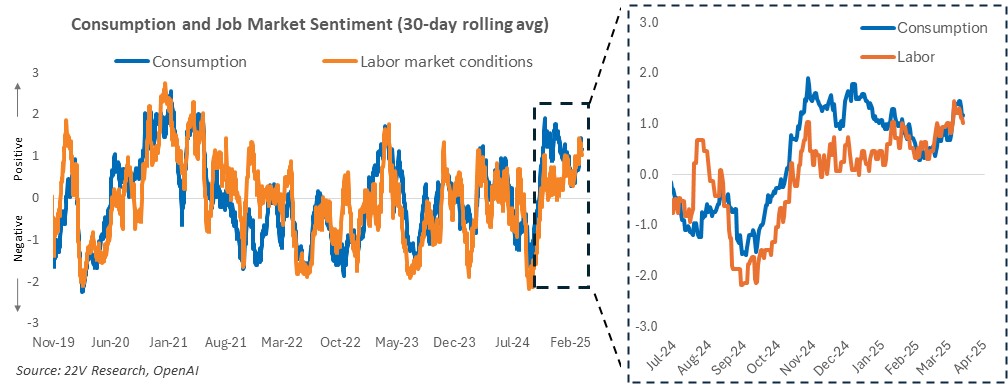
Analysts are optimistic – maybe excessively – about the consumption outlook. CHESS sentiment reflects a positive outlook for consumption (blue line) and the labor market (orange line). We are less convinced, given only incremental fiscal support and the macro headwinds from falling property prices and what we argue is a weak labor market.
CHESS is a collaborative project, leveraging the expertise of Sophia Wang, 22V’s Director of Quantitative Research, and China-based economic consultant Dr. Fei Han. The authors express thanks for contributions and insights.

