

Uncertainty is a Four-Letter Word, Even if the Worst Outcomes Aren’t Realized
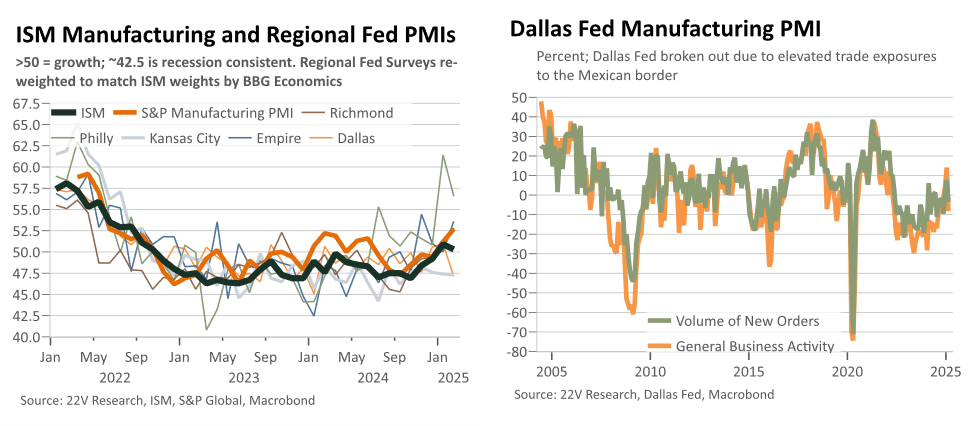
- The February PMIs make clear that large scale policy shifts across the federal government are a source of increased uncertainty and a, quite uneven, drag on business.
- Of course, this uncertainty drag is much milder than seeing the actual resolution of policy towards extreme tariff and contractionary fiscal policy outcomes. But nevertheless, it is clearly weighing on firm’s medium-term planning, pausing more than canceling for now, even as it also results in some pull forward of demand (which would be an additional mechanical hit to future activity if no upside shocks offset it).
- The administration’s discussions of tariffs as a means of addressing non-economic issues at the border, overseas subsidies and non-tariff barriers, and as a source of general purpose revenues makes understanding the ultimate aims, scope, intensity, and duration of tariffs a challenge even for those most intently glued to their screens.
- Coming into 2025 corporate optimism bounced on deregulatory and tax cut expectations. While those are still likely to be realized, we are now confronting an uncertainty shock, a possible series of rolling tariff supply shocks, and a mild (so far) government led employment shock.
- The sequencing is a challenge as the administration is beginning with the hits to growth and confidence, rather than cementing a higher floor first, the opposite of the approach in the first Trump administration which began with tax cuts and deregulation.
The commentaries associated with the most recent round of PMI reports highlight the downside impacts of tariffs and the “will they, wont they” nature of the administration’s current negotiating practice. One can debates the merits of the approach for the negotiations themselves but for the private sector the uncertainty is a drag above and beyond the tariffs themselves, in whatever form they are ultimately realized. It was quite notable to me how little pushback I got on this idea on a recent trip to Texas, where tariff risks on the southern border were clearly top of mind to many, even as dereg and tax cuts where touted as clear eventual upside surprises.
Classically tariffs are a supply shock which raises inflation and dints activity at the same time. While we have seen ‘minimal’ tariffs implemented so far (although 10% on China is nothing to sneeze at and almost as large as all the total tariffs on China in the first Trump administration), the impacts of the possible tariffs are clearly starting to be felt. This is serving as a short-term boost to activity in many areas as firms try to rush through imports and production before tariffs take effect.
A few choice quotes from the various PMI writeups in recent days:
- “Demand eased, production stabilized, and destaffing continued as panelists’ companies experience the first operational shock of the new administration’s tariff policy.” – ISM
- “Although manufacturing production grew at the strongest rates since May 2022 and new orders increased at the best pace in a year, there’s much to suggest that this improvement could be short lived. Production and purchasing were often buoyed by companies and their customers building inventory to beat price hikes and supply issues caused by tariffs.” – S&P
- “I’m very worried about the possible tariffs affecting some of our material costs, which we will have no choice but to pass along to our customers. This is a terrible policy decision and hopefully will not be very long lived” from one respondent versus another stating that “the dynamic tariff situation is one for us to follow and seek to understand… we believe the current tactic of reciprocal tariffs could drive improvement for U.S. export competitiveness.” – Dallas Fed respondent comments
Rates markets are trading the combination of tariffs, DOGE, and shutdown risks as net downside growth shocks more than inflation boons. Given the inherent uncertainty about these process that seems correct at the moment. Markets’ inflation tolerance will be less a function of the one-off tariff shocks and much more related to how firm and household inflation expectations (as well as wages and margins) respond on a longer time horizon. The initial conditions here seem much less forgiving than during the 2018-19 trade war when inflation expectations had deanchored to the downside and firms and households had little memory of bargaining power and price passthroughs (these same initial conditions are also, in fairness, part of why the right tail in rates was and should have been more sensitive to upside surprises in sentiment and additional deficit enhancing tax cuts). The 2-year long doldrums for the manufacturing and housing sectors, and the consistent failure so far to jump out of that weak but not truly bad, state of activity raises downside risks to growth in a similar way.
For now, the baseline growth impacts and the larger, probably more persistent than the baseline hits themselves, downside tails seem to be winning out on the margin. Given right tail focused initial conditions and legacy inflation concerns, this is netting out though to a more of a collared rates distribution rather than an outright left tail driven one.[1]
See the Atlanta Fed’s implied probability distributions for 3m SOFR futures. The roughly 32% chance of 3 or more cuts through Dec 2025’s SOFR contract compares with a ~25% at the local rates peak in mid-Jan; the mode has gone from a flat rate path to 1 cut though and the right tail in nominal rates has sharply shifted down. ↑

