

Is Fiscal Policy a Source of Near-term Risk? Yes, the Balance Seems Different Now
- Coming into the year it was widely assumed that while tariffs loomed as a source uncertainty and likely mild downside impulse to the economy, fiscal policy was likely to be a stimulative force with TCJA extensions and other tax cuts looming in 2026+.
- The DOGE effort, most importantly in the federal government layoffs and pauses to grant funding processes, has injected notable fiscal policy uncertainty and a series of, so far, modest negative surprises to the economy. The possible government shutdown which looms on March 15th is another source of near-term fiscal risk.
- Given the otherwise fairly healthy backdrop of the now more normal US economy, the expected impacts of these DC shocks would usually be fairly modest, with small multipliers spilling over to broader activity.
- However, with cyclical hiring having been sluggish for so long, the cycle closer to an end than its beginning (as the 4% unemployment rate attests), asset valuations stretched, and sentiment at risk, there is a fatter downside tail on top of the baseline modest drag.
The scope of the recent DOGE actions in purely numeric terms is not normally something which would suggest a large macroeconomic risk given the non-recessionary state of the economy. However, the vol-additive nature of the process, particularly in a world with tariff and tax uncertainty, and the unique nature of the moment in the business cycle means that there is a greater than normal cyclical risk from these shifts.[1]
While it is unlikely that all those current on probation across the federal government (~220k in totality, according to OMB figures) have been or will be laid off, a substantial share of them seem likely to lose their jobs. This is on top of the ~75k who took buyouts; this group may have been on the verge of retirement or quitting anyway so there seems to be less macro risk from them even if the legality of the buyouts is somewhat questionable. These direct employment shocks, which would show up in the March employment report at the earliest, may be enhanced by the current grant freezes in place. These pauses in funding may, although likely with a much longer lag given the nature of the process and a presumption that much of the funding will ultimately be restored, lead to downstream job losses, particularly in education, health care, and state and local governments. Unlike more general purpose for some those in specialized fields of research there simply may not be an outside employment option and the US does risk some long-term harm and technologic progress in pausing basic scientific research.
It is easy to assume that these job losses and risks are largely concentrated in DC, where jobless claims there have been moving higher, reflecting USAID-related hits and federal contractors, but more than 80% of probationary workers are outside the immediate DC area.
The possible government shutdown also looms as a near-term downside risk from DC. Normally shutdown risks are best faded but the first Trump administration did see the second longest one ever and the governing party seems to have little sense about aims or process priorities in the current fiscal year or for the broader medium-term. Combined with thin margins in the House and House-Senate disagreements the odds of an impactful shutdown seem larger than normal.
Normally I would be inclined to fade all three of these risks as sources of more appreciable downside to the baseline outlook. This is because with the unemployment rate low and stable and interest rates well off the zero lower bound fiscal multipliers should normally be fairly small (decently below 1; see more from the CBO; IMF; Auerbach and Gorodnichenko 2011 and 2015; researchers at the Fed Board, 2020; and many others). Assuming the unemployment rate and NFP behave largely as expected this will still be my baseline approach, particularly so when thinking through the impacts large scale tax and spending shifts largely around TCJA extension and payfors later this year and next.
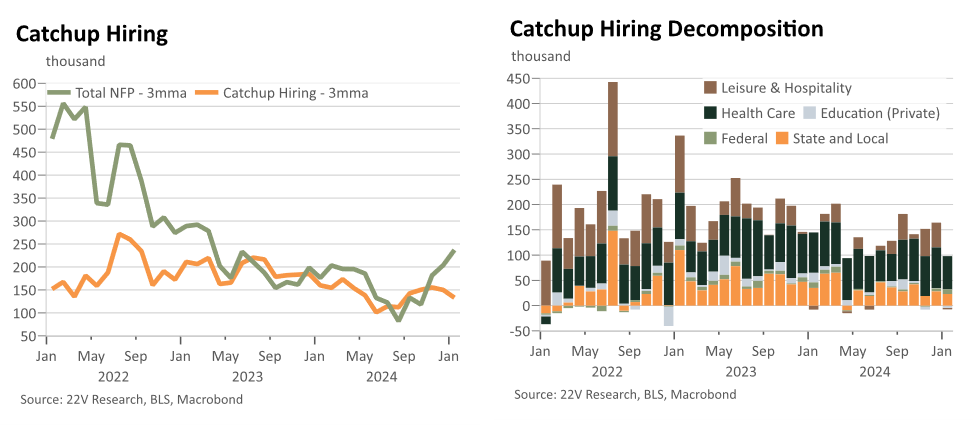
The present moment though makes me somewhat more cautious, particularly when thinking through direct employment and spending shocks (which in most studies have larger multipliers than tax policy changes). The reason for this extra caution is that while the unemployment rate is off its recent highs and NFP growth still notably positive, the composition of this stabilization of the labor market is not particularly positive. Over the past year ~75% of job gains have come from catchup hiring in government, education and health care, and leisure and hospitality and this seems set to slow anyway going forward as much of the catch-up hiring process is complete. These sectors all particularly vulnerable to enacted and looming policy shifts, as discussed above. With hiring in more cyclical sectors still fairly restrained, although it has seen a bounce over the past few months, falling immigration flows have been key to the gradual stabilization of the unemployment rate. This is a different environment than one where the unemployment rate has been cleanly falling with labor demand durably above trend labor supply growth.
If we do get these downside shocks, there simply may not be enough private sector demand to absorb them quickly. With the labor market in such a strange position its ability to absorb new slack may be weaker than usual, raising the multiplier on these policy shifts. This is particularly true because with the unemployment rate back near to cycle lows, even if other measures of labor market tightness have eased more notably, the medium-term left tail is naturally wider because barring continued positive hysteresis and supply-side gains, the ability of growth to run above potential, as it almost always does during expansions, is more limited.
Comments in Friday’s S&P PMI report for February echoed these increasing concerns. The recent bounce in the manufacturing PMIs may be ephemeral as “many manufacturers also reported that the rise in production and demand was in part linked to front-running potential cost increases or supply shortages linked to tariffs.” Beyond just tariffs (which are admittedly a part of the fiscal discussion in some ways, but beyond the scope of this note, and a tax whose incidence larger falls on lower income higher-MPC consumers), sentiment is not durably rebounding as much of the immediate post-election commentary suggested as “optimism about the coming year slumped to its lowest since December 2022, except for last September… especially in relation to federal government policies related to domestic spending cuts and tariffs” (see also the FT and WSJ).
For now, I remain a cyclical optimist but that optimism is more tempered than it was.[2] The baseline should still have a largely stable, near but a bit above 0, output gap with jointly slower supply and demand growth and high rates offsetting otherwise risk-supportive markets. The greater caution is due to policy headwinds and uncertainty increasing, the unclear balance between fading pre-recessionary headwinds in 2022-24 and some one-off supply-side gains and normalizations, high-beta parts of the economy that are weak in level terms but also already having gone through some recessionary belt tightening, and the frothiness of many parts of sentiment and markets.
If the labor market starts to retighten with broader measures of demand turning up (openings, hires, quits, in addition to the unemployment and prime-age participation rates showing a continued stabilization or retightening in slack), these concerns about the broader cyclical macroeconomic impacts of DOGE led layoffs will be notably attenuated. For now we wait and see.
Steve Cohen’s comments on Friday that DOGE is effectively “austerity” and “when that money’s been coursing through the economy over many years and now potentially it will be reduced or stopped in many ways, it’s gotta be negative for the economy,” certainly suggested we’re not alone in seeing added reason for a bit more near-term caution due to DC. He also noted that tariffs are a tax and come with tit-for-tat risks. ↑
I consider this type of statement most relevant on a reasonably forecastable 6-12m horizon. Beyond that one’s view of the output gap (as informed by inflation, the labor market, and broader supply side developments), inflation and policy risks, and the housing and corporate investment cycles help set broad probabilities but not particularly useful spot forecasts (which are basically just mean reversion at that horizon). ↑

