

Trade Or Inflation: The Economy May Have to Pick an Outlet
- While inflation is often seen as the natural consequence of an overheated economy, the trade balance can serve as an alternative outlet for a hot domestic economy.
- In the current moment when the rest of the global economy has notably more excess capacity than the US, especially with the distortions of the pandemic era and invasion of Ukraine now a more distant memory, a widening trade deficit presents an opportunity for more rapid consumption and investment growth, with lower inflationary cost, than would otherwise be possible.
- Beyond the immediate inflationary and cyclical impacts of tariffs, with them will come a reduction in the effective amount of global capacity available to meet US domestic demand. This could result in a steepening of the Phillips Curve as excess demand is attenuated less by trade flows.
- This is a more subtle and persistent effect of the reordering of global trade or, more realistically, modest deglobalization which is currently underway.
Tariffs are one part of the reordering of the global trade and financial system which is more broadly moving towards a more autarkic world economy. In the 1st Trump administration this seemed to favor a shift towards a NAFTA and allies-based trade network but the early signs in the 2nd suggest a more broad-based and economically riskier approach. More broadly, it seems hard to argue with the idea that we are experiencing a modest move towards deglobalization even if the concrete effects have so far been more about arresting globalization’s momentum than outright reversing it (see more here; this writeup of Draghi’s speeches in spring 2024 continues to summarize the moment’s secular geopolitical themes well).
Beyond the direct inflationary and cyclical impacts of tariffs (with reasonable disagreements about trade diversion, relative versus absolute and transitory vs more persistent inflationary impacts, etc), with them will come a reduction in the effective amount of global capacity available to meet US economic demand. Retaliatory tariffs, when they likely happen, will further accentuate this by adding extra trade frictions.
While sometimes neglected in more DM-focused circles, the idea that an over-heating economy can respond to moving past ‘full’ domestic supply capacities by either seeing inflation move higher or by seeing a widening trade balance (through increased imports, in effect augmenting domestic supply with that available overseas, and perhaps decreased exports as domestic demand supplants foreign) is common enough in more EM and trade focused coteries.[1]
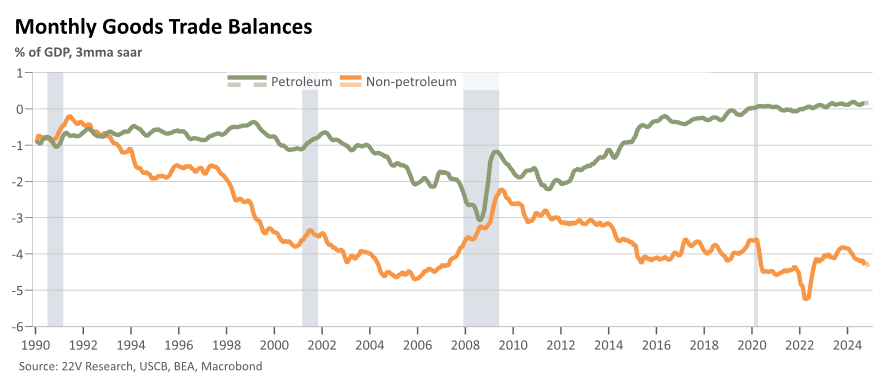
After shifting wider during the immediate post-pandemic period, non-petroleum goods trade narrowed back to roughly its pre-covid levels during 2022-23. Since late-23 it has been widening again, suggesting that hot US demand growth is taking advantage of global economic slack. Taken in isolation, the move wider in the goods trade deficit suggests that the US economy has been gradually reheating some in recent quarters. Given that private final domestic demand growth has been largely steady around 3% over this time, this rewidening tentatively suggests that potential growth may be slowing a bit as some of the post-pandemic supply shock normalizations move into the rearview.
Optimists on tariffs will suggest that by adding short-term frictions in global supply chains the economy will ultimately induce more domestic capacity, making the short-term hit worth it. While possible in the longer-term, I am somewhat skeptical that just on its own[2] this import disincentive will net out as a win for domestic supply given that hysteresis effects suggest that longer-run economic trends can be highly influenced by the short-term cyclical environment.[3] In the first Trump administration’s trade war we saw a substantial negative hit to PMI sentiment and industrial production; in my view, this downdraft in the economy and markets was as much a result of the first trade war as the gradual pace of rate hikes. Another round of, perhaps much larger, disruptions to global trade networks seems unlikely to boost domestic demand for investment in goods production enough to offset the broader consumption and sentiment hits and supply shock that that entails.
I first was exposed to this idea at the IMF when confronted by the series of modest downside inflation surprises from 2015-19. Of course, inflation and estimates of supply are always multifactorial and the gradual deanchoring of inflation expectations and the decrease in the NAIRU also played a role but the persistent downside inflation surprises also likely had some link to the trade balance which was persistently a bit larger than equilibrium suggested. ↑
Tariffs as part of a larger shift towards industrial policy focused on reshoring or friend-shoring the domestic manufacturing base with a large variety of carrots and sticks would be more likely to achieve this aim. Alone tariffs are a blunt instrument with duration, timing, and extent that make planning around them, or their absence, in the long-run quite difficult; that reads like a classic uncertainty shock in a macro model. ↑
One can see this in labor markets where robust demand conditions often induce additional further labor supply (in effect a hot labor market reduces the costs associated with job search and raises the opportunity cost of not working for those on the margin, see more in Yellen 2016) and with investment where the accelerator model, which links expected investment to lagged or forecast overall demand growth, is often very hard to outperform. ↑

