

There is No Going Back to the World of Yesterday: Draghi Says We’re in a New Geoeconomic Regime
A few recent speeches from Mario Draghi (former head of the ECB and Italian PM, and now adviser to the European Commission) caught my eye and are worth pondering for any investor with a macro bent (or concern about the broader outlook).
Draghi’s fundamental point is that globally, and especially for the Eurozone, the world is never going back to its 1991-2019 frameworks and assumptions,[1] whether in terms of geopolitics, macroeconomic policy, business practices, or for society writ large.[2] Some of this will likely be for the better but it will come with substantial transition costs.
Given that Draghi has been asked “to prepare a report on the future of European competitiveness. Because Europe will do ‘whatever it takes’ to keep its competitive edge,” (Ursula von der Leyen in her recent State of Europe speech) we can get a sense of what he sees a necessary for the EU in the coming years. According to recent Politico reporting, he told EU ministers that (to quote the reported summary) “the three pillars the EU has relied on — energy from Russia, exports from China, and the U.S. defense apparatus — are no longer as solid as before.” For the EU this means hundreds of billions of Euros in investment needs every year over the medium-term; with this fiscal spending and private investment will likely come higher rates and, at first, macroeconomic volatility.
The outlook for other DMs is similarly challenging. To quote from the conclusion of Draghi’s speech to the recent NABE conference[3]: “the transitions that our societies are undertaking, whether dictated by our choice to protect the climate, or the threats of nostalgic autocrats, or by our indifference to the social consequences of globalization, are profound. Differences between possible outcomes have never been so stark.”
He highlighted three key changes in the structure of the economy going forward:
- There are more varied and volatile shocks than during the Great Moderation or even after the Global Financial Crisis.
- Fiscal policy will play a more important and active role, with monetary policy focused on preventing inflation expectations deanchoring more than anything else.
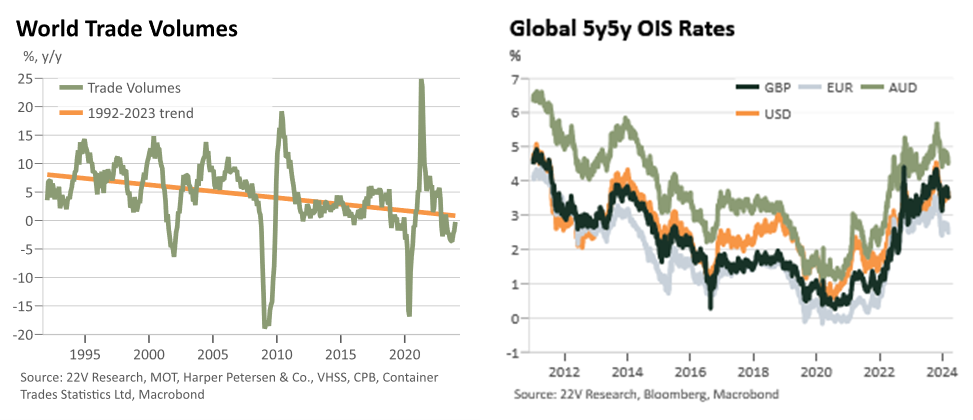
- The global savings glut is winding down, reversing its downward pressure on global real rates and term premia from the prior era.
While this has broadly been my view for some time, it is reassuring in a forecast-sense, if not in terms of global optimism, to have the ECB’s maestro weigh-in similarly if even more starkly than might have been expected.[4] The direct structural challenges Europe faces are greater than those in the US, but the issues he flags are global in nature and will have substantial impacts on the US and other DMs as well.
Draghi’s recommendation for coordinated, supportive, and somewhat accommodative, or at least less reactive, policy making in confronting these challenges seems well inside the current zeitgeist for the more geopolitically inclined, but will require some more nuanced adaptations and reaction function shifts on the part of global central bankers and market participants.
The implementation of more orthodox central banking is likely to come under continued pressure as shocks multiply, climate- and geopolitically- induced investment and depreciation accelerate, and whole-of-government policy responses are needed. One way of interpreting this is that central banking reaction functions are going to be primarily focused on guarding against the risk of inflation’s upside danchoring, rather than Taylor-rule or Yellen’s 2015-era optimal control style policy’s more direct responses to data; Draghi hinted in this direction by emphasizing the primacy on inflation expectations in allowing central banks to look through increased supply-shock noise. But guarding against deanchoring in a volatile world also likely imparts a somewhat hawkish underlying bias to policy (inflation risks from the coming supply shocks are highly asymmetric to the upside, just as they were in the other direction from the surge in globalization during 1991-2007).
Also embedded in his comments are a raft of reasons for the neutral interest rate to be higher than it was pre-pandemic. While many of these reasons are not ‘structural’ in the way many economists often insist on using the concept, the unwinding of the decades long global excess savings glut, increased investment and depreciation, more active fiscal policy, and greater supply shock volatility seem likely to be persistent across the cycle and would all directionally boost neutral.
Below I dive into a few of the key passages from Draghi’s NABE speech, with his quotes bulleted and italicized.
The World Will Face More Volatile and Varied Shocks
Perhaps the most important point Draghi made, which is in line with consensus at this point but still seems to be leaving some policy makers scrambling to understand how to adapt going forward, is that the world will be more volatile than it was.
Beyond the direct impact on the economy, the increased prevalence of supply shocks will change portfolio management approaches as the stock-bond correlation is less favorable than it was more for much of the past few decades (if not as extreme seen during 2022-23).
- “First, it will change the nature of shocks to which our economies are exposed. During the last 30y, the main sources of disruption to growth were demand shocks, often in the form of credit cycles. Globalization did cause a continuous stream of positive supply shocks… But those changes were by and large smooth and continuous… It is likely that we will experience more frequent, lumpier, and larger supply shocks while our economies adjust.”
- “These supply shocks are likely to emanate not only from new frictions in the global economy, such as geopolitical conflicts or natural disasters, but even more so from our policy response to mitigate those frictions. We need to invest an enormous amount in a relatively short time horizon to restructure supply chains and decarbonize our economies, with capital being likely destroyed faster than it can be replaced.”
Central Banks Will Have to Primarily Focus on Managing Inflation Expectations (and Not, Implicitly, Respond to Every Bit of Data)
To some extent the shocks of the pre-covid world all went in the same direction. The fall of the USSR, NAFTA, and China joing the WTO were all deflationary supply shocks. The GFC and Eurozone crisis were deflationary demand and credit shocks. The more shock-filled world of the future will require a more nimble but also cautious approach by central banks that have to focus on containing inflation trends rather than managing bullwhips and shocks they cannot fully control.
It is important to note that investment is often disruptive and inflationary when first implemented (studies on infrastructure spending often make this clear in a local sense but the green transition and supply chain shifts will be much larger in scale). After the struggles of the past few years, central banks and policy institutions will need a better inflation monitoring and analytic toolkit, operating at different horizons and focused primarily on distinguishing between deanchoring risks and one-off shocks, even if those shocks have very long lags as they filter through overall inflation. This will surely be a somewhat hawkish and messy learning by doing process.
- “Central banks should ensure that the primary compass for their decisions is inflation expectations. Monetary policy will face a challenging environment in the years to come, in which, more than ever, it will have to distinguish between temporary and permanent inflation, between catch-up wage growth and self-fulfilling spirals, and between the inflationary consequences of good and bad public spending.”
- “An accurate measurement of, and meticulous focus on, inflation expectations is the best way to ensure that central banks can contribute to an overall policy strategy without compromising on price stability or independence. This compass precisely allows to delineate temporary upward price shocks, such as relative price shifts between sectors or higher commodity prices related to higher investment, from risks of generalized inflation.”
Fiscal Policy Will Matter More than Monetary on the Margin
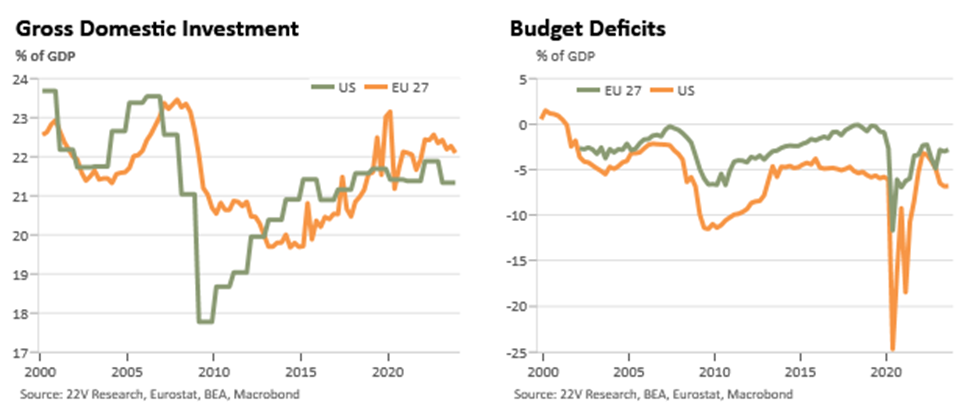
As has already been seen in response to the pandemic globally and the gas crisis in Europe following Russia’s invasion of Ukraine, barring moments of outright liquidity crisis, fiscal policy has substantially greater room to steer the cyclical and shift investment than monetary policy. Given that the climate and trade shifts will entail substantial investment needs but also losses that need to distributed more equitably than was the case with the initial round of globalization, fiscal policy will be required to play a more active role. By being more active in a time of already high debt loads, fiscal policy will also be more sensitive to monetary policy (the anti-inflationary discontent of the 2022-current period globally also shows the risks that can come from a failing to contain price shocks, regardless of their underlying cause, an issue which will be key to navigate going forward).
- “The second key change to the macroeconomic landscape is that fiscal policy will be called upon to play a greater role, meaning – I expect – persistently higher public deficits. The role of fiscal policy is classically divided into allocation, distribution and stabilization, and on all three fronts the demands on government spending are likely to increase.”
- “In near term, whether fiscal policy will have sufficient policy space to deliver on its various goals will depend on central banks’ reaction functions… Demands for policy coordination are likely to increase, which is something our macroeconomic policy architecture is not designed to deliver.
The World is Turning Inwards
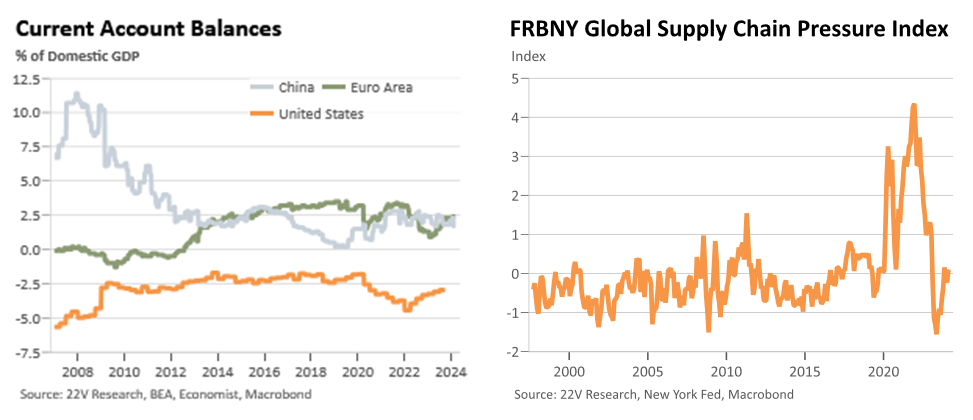
This is perhaps the least controversial of the main points Draghi made, but beyond the trade consequences the impacts are likely to be felt across supply chains but also fiscal priorities. One of the results of this is that supply for many goods and raw materials is increasing, with tremendous investment expenditure, but that the available supply for many economics blocks will be the same size or smaller. This suggests the possibilities of more frequent bullwhips as effective supply whipsaws back and forth. With this will also come more generally supportive fiscal policies, making up for, in myriad often somewhat inefficient ways, the left behind years of peak globalization that hurt many in DMs.
- “A series of events reinforced the trend [towards a more inward-looking world]. First, the pandemic underlined the risks of extended global supply chains for essential goods like medicines and semiconductors. This understanding led to the shift in many Western economies towards re-shoring of strategic industries and bringing critical supply chains closer. The war of aggression in Ukraine then caused us to re-examine not only where we buy goods, but from whom. It highlighted the dangers of excessive reliance for essential inputs on large, untrustworthy trading partners that threaten our values. Now, everywhere we are seeing security of supply – of energy, rare earths and metals – rising up the policy agenda.”
- “Both the inflation reduction act and the prospective European carbon border adjustment mechanism both prioritize climate security objectives over what were previously seen as distortionary effects on trade.”
- “The social consequences [of increasing openness and trade] manifested themselves in a secular loss in bargaining power for labor in advanced economies, as jobs were displaced by offshoring or wage demands contained by the threat of it… The political consequences followed. Faced with tepid labor markets, declining public investment, a falling labor share and offshoring of jobs, large segments of the public in Western countries justifiably felt they had been “left behind” by globalization.”
The Global Savings Glut is Winding Down
The decline of global trade flows also come with lower gross global financial flows. These flows had pulled neutral rates and term premia down in recipient countries (largely the US). Going forward, the absence of the global savings glut will have less clear impacts on domestic growth and investment, which had been held back by chronic deleveraging and risk aversion after the GFC. The pure rate multipliers on activity and valuations may end up being swamped by the investment needs highlighted above (particularly if higher neutral is accompanied by higher trend nominal growth).
- “Countries that want to keep exporting goods may have to be more willing to import other goods, or services, to earn that right – or they will face increasing retaliatory measures… In both scenarios, the downward pressure on global real rates that has marked much of the era of globalization should be reversed.”
- “This was not matched by higher demand for investment. Public investment fell by almost two percentage points across G7 countries from the 1990s to the 2010s, while private sector investment stalled once firms deleveraged after the great financial crisis.”
‘The World of Yesterday’ is a memoir by Stefan Zweig on Europe before WW1 and in the long aftermath of that war. An allusion to Barbara Tuchman’s ‘The Proud Tower: A Portrait of the World Before the War 1890-1914’ would also have been fitting but is much harder to fold into a piece title. ↑
The choice of dates here is a bit arbitrary. One could easily put in China’s ascension to the WTO, NAFTA, or the fall of the USSR as appropriate starting dates. One could argue that Brexit or Trump’s elections would be appropriate end dates, but they seem more like the beginning of the end rather than the end itself. ↑
Quotes below are all from the NABE speech, although writeups from his other recent appearances all suggest a similar tone. ↑
While I was on the IMF’s US team during the 4 years of the Trump Administration, one of the clearest takeaways I had from that experience was just how much the underlying assumptions about global geopolitics had changed across all of DC, not just in the Trump-centric part of the Republican party. ↑

