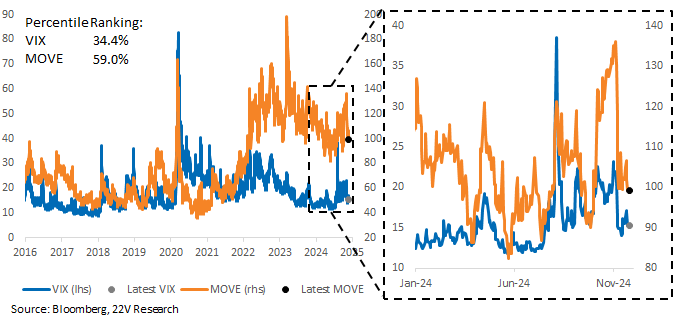
At a high level, market vol is well contained. Medium-term fiscal and monetary policy uncertainty appear to be pinning Treasury vol to a high level relative to spot VIX (78th %tile), but the VIX forward curve is consistent with a Normal expansion. That suggests the direction of travel on the MOVE will be lower ONCE there is more clarity about tariffs, fiscal, and monetary policy.
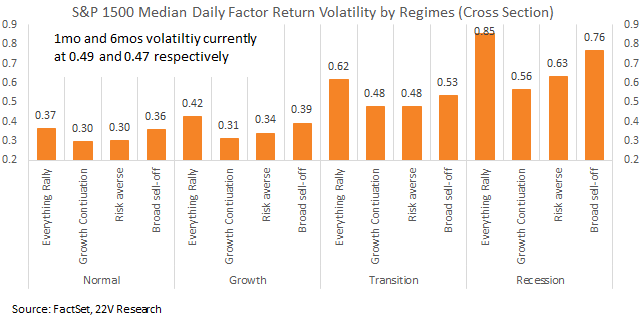
The relative calm at the market level is consistent with the low level of factor vol. Currently, 1mo and 6mo factor cross section volatility are higher than typical for Normal regimes, but only modestly so. At the industry group level though, volatility is 1) high and 2) has been climbing recently.

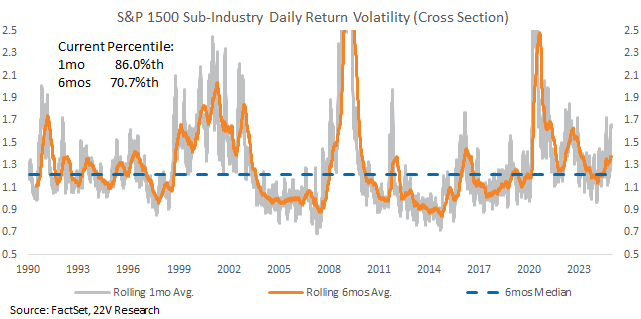
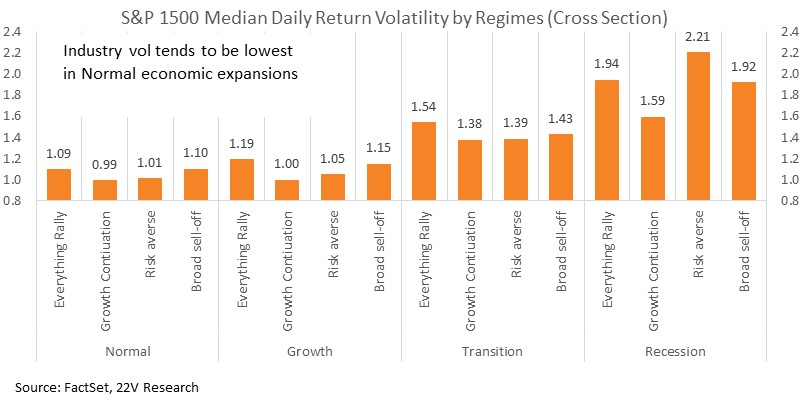
Historically, sub industry volatility tends to be higher in Recession periods, but we are FAR away from such a backdrop today. Realized short and long-term sub-industry volatility is much stronger today that is typical in Normal regimes. So, what is causing the increased level of industry group volatility?
Tariffs and more general uncertainty over the priorities of the incoming administration are likely candidates. Despite a generally steady economic expansion, political tail/headwinds seem to be leading to increased return dispersion and will remain a source of vol for several months, at least.
Given macro influence measured by the first principal component has dropped (HERE) and factor volatility is moving lower, rising volatility within sub industries and industries remains the major driver for internal volatility. Economic data continues to point to a stable, ongoing economic expansion, suggesting a narrowing of volatility over time, but that is likely a 2Q25 or later story.
Higher Sub-Industry Divergence Pushing Volatility: Equity and Treasury implied volatilities collapsed following the U.S. presidential election, but bond vol has been range bound at a high-ish level since. Medium-term fiscal and monetary policy uncertainty appear to be pinning Treasury vol to a high level relative to spot VIX (78th %tile). The VIX forward curve is more consistent with historical Normal regimes, further suggesting the direction of travel on the MOVE should be lower AFTER there is more clarity about tariffs, fiscal, and monetary policy.
The calm headline VIX masks internal, sub-industry cross sector volatility, which has climbed higher over the past several months. 6 months cross sectional volatility has climbed from its relative low in February (40th %tile) to a cycle high today (71st %tile). The more volatile 1mo reading is in its 86th %tile. The bottom line is there is a lot of vol under the market’s surface.
Historically, sub industry volatility tends to be higher in Recession periods, but we are FAR away from such a backdrop today. Realized short and long-term sub-industry volatility is much stronger today that is typical in Normal regimes Economic data continues to point to a stable, ongoing economic expansion, suggesting a narrowing of volatility over the coming months.
At the factor level, there is no such increase or deviation in cross sectional and time series measures of volatility. Rolling 1 and 6mo volatility are close to their historical medians (60th and 63rd %tiles respectively). Given macro influence measured by the first principal component has dropped (HERE) and factor volatility is moving lower, rising volatility within sub industries and industries remains the major driver for internal volatility.
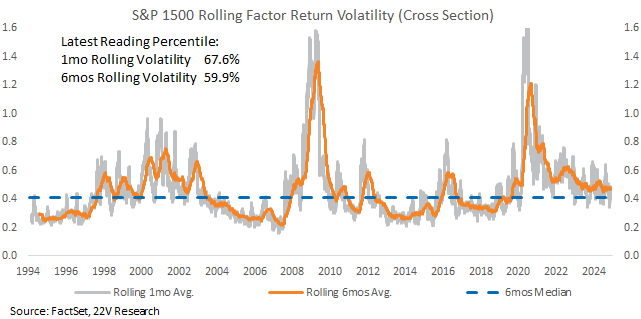
Following the pattern for sub-industries volatility, factor dispersion tends to be highest during Recession phases and Everything Rallies. Currently, 1mo and 6mo factor cross section volatility are higher than typical for Normal regimes, suggesting some downside from here. Still the opportunity to play for lower volatilities is better within industry groups.