The market gains following the election faded last week, and the risk-on mood gave way to a surge in safety trades like Low Volatility and Large Size. Internals shifted due in large part to concerns about the outlook for monetary and fiscal policy and worries about how those forces will influence rates. The result was a dramatic shift of the Market Internal Regime (MIR, more on that concept HERE) to a Risk-averse backdrop.
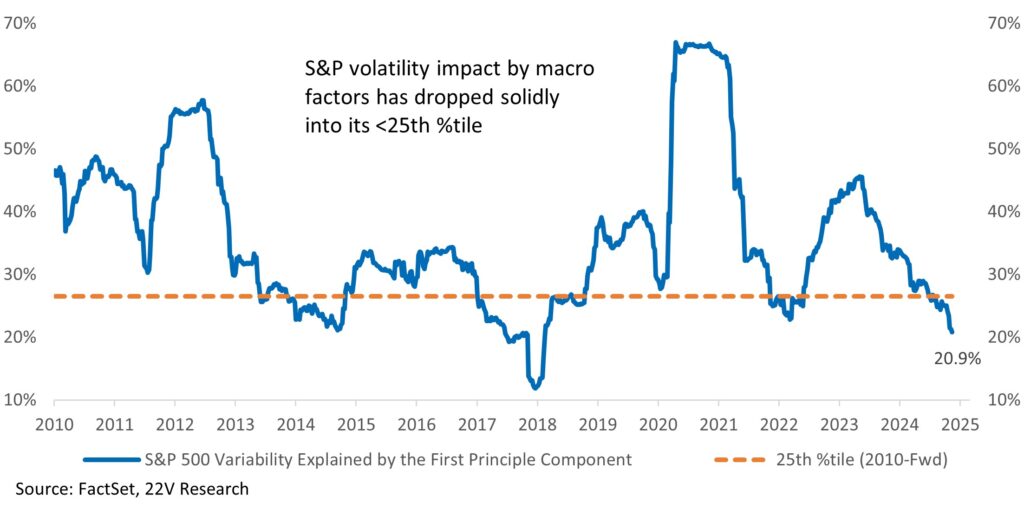
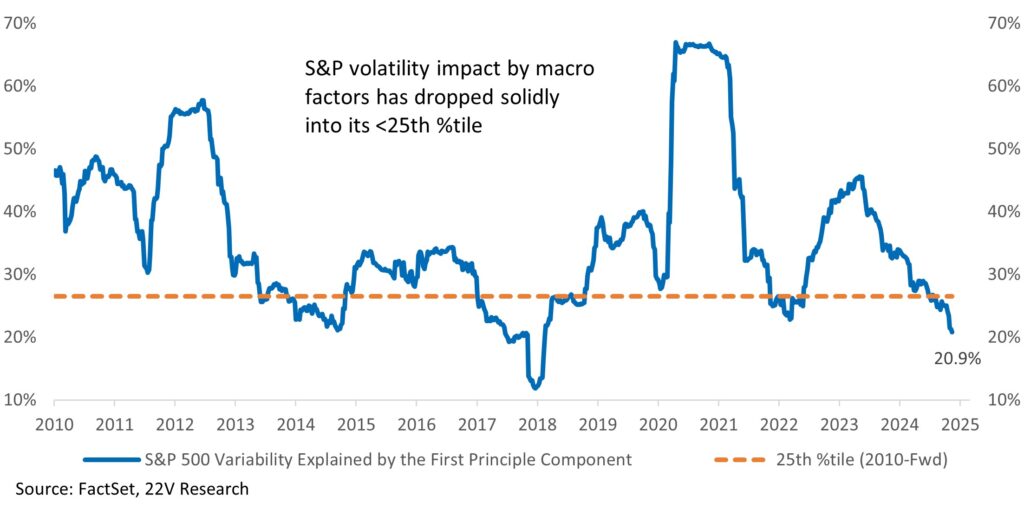
So, macro forces are clearly impacting market internals. Should we expect a more macro-driven world like we saw in the post-COVID period or in 2023, when inflation/recession concerns drove markets? So far, that is not the case. The set of factors driving the market is near a cycle high. More formally, the first principal component of the S&P explains about ~21% of market volatility, the lowest reading since ~2018, and about 7 factors are needed to explain 50% of S&P vol.
Less macro level risk in the market makes sense given the ongoing economic expansion. Typically, macro influence is greatest near recessions. Based on our regime modeling 1) there is no signs of a return to the narrow leadership of the 2023 periods, and 2) we should not expect a return to that type of market backdrop UNLESS the overall macro backdrop deteriorates.
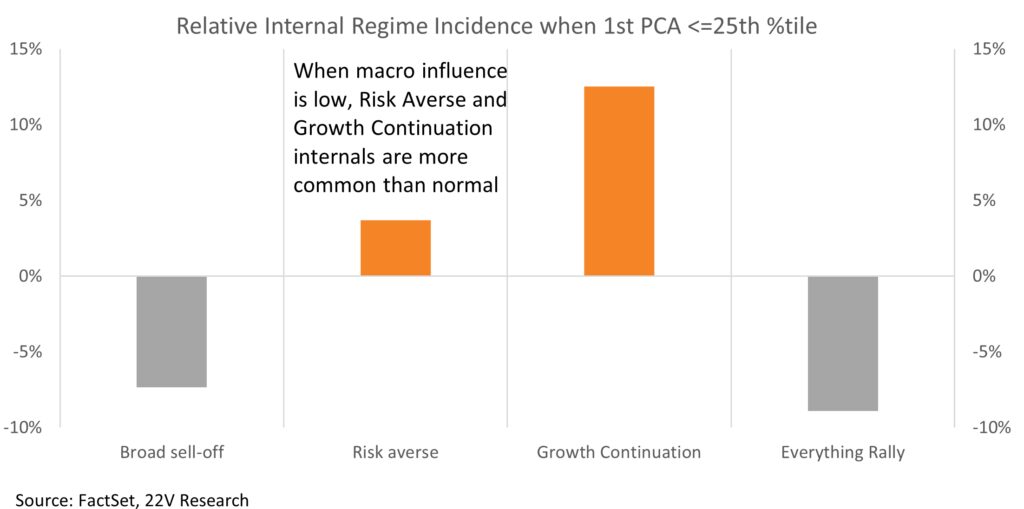
To help think through WHICH factors will matter most in today’s normal expansion, we rely on our Market Internal Regime model (HERE). When market volatility is more dispersed, as it is today, the S&P 1500 is in a Growth Continuation phase – where fundamental momentum leads and Size/Cash Return lag – about 60% of the time, considerably more often than in all periods. Everything Rallies and Broad Sell-offs, periods where risk factors lead, are much LESS common. So today’s backdrop continues to favor gains by smaller sized companies and those with fundamental momentum.
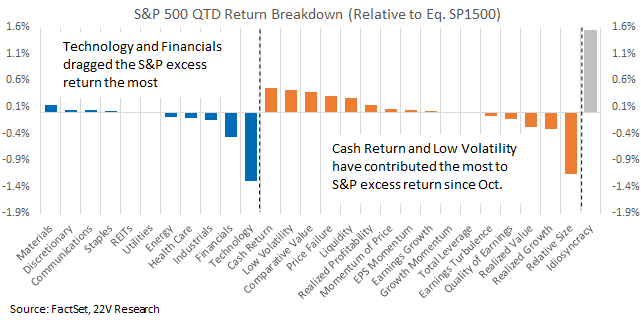
Looking deeper into sectors and factors since October, Technology and Financials were major drags relative to S&P 1500. On an absolute basis, Defensives were major drags especially Health Care and Staples. Materials also underperformed due to weak fundamentals. On factors, Size performed poorly, consistent with a normal backdrop and a more diffuse set of market factors.
Dropping Macro Impact on Equities: After the election, equity volatility is back to a level consistent with an economic expansion. That worked out as we expected. But as of the close last week, equity markets have erased their post-election gains and market internals shifted back to broadly risk-off. So, macro forces are clearly impacting market internals. Does that mean we are back in a macro driven world like we saw in the post-COVID period or in 2023, when inflation/recession concerns drove markets? So far, that is not the case. The set of factors driving the market is near a cycle high. More formally, the first principal component of the S&P explains about ~21% of market volatility, the lowest reading since ~2018.
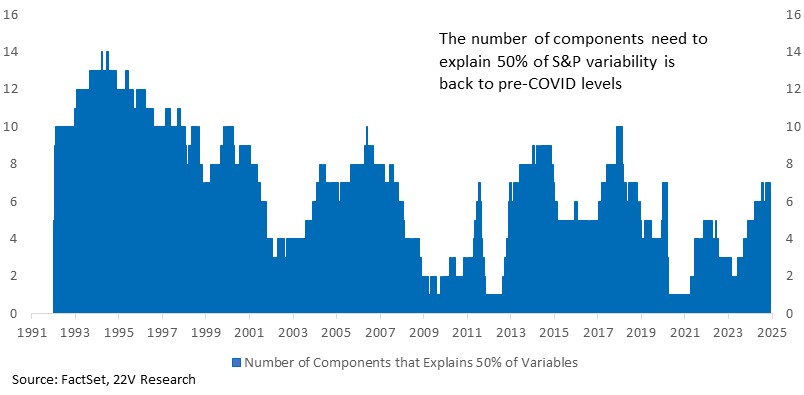
More broadly, the number of factors needed to explain 50% of S&P volatility has increased to pre-COVID levels. This is a statistical abstraction, but what it means is straightforward. In today’s backdrop there are more micro forces driving markets. Today is NOT like most of the post-COVID period, where inflation trends, recession concerns, and policy uncertainty explained HALF of S&P volatility.
Thinking in terms of regimes, during recessions, S&P vol and equity correlations surge because there is one overarching risk/narrative. Today, we are in a normal economic expansion, where typically less than a third of market volume can be attributed to a single factor. What does that mean practically? A significant market decline is less likely in today’s backdrop. Sector, industry, and factor trends will be more important sources of return dispersion.
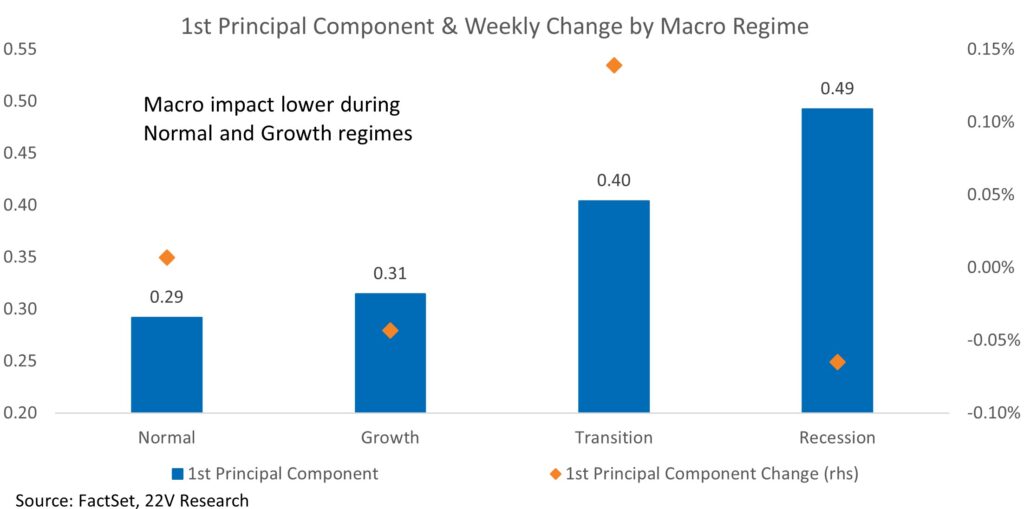
To help think through WHICH factors will matter most in today’s normal expansion, we rely on our Market Internal Regime model (HERE). When market volatility is more dispersed, as it is today, the S&P 1500 is in a Growth Continuation phase – where fundamental momentum leads and Size/Cash Return lag – about 60% of the time, considerably more often than in all periods. Everything Rallies and Broad Sell-offs, periods where risk factors lead, are much LESS common. So, today’s backdrop continues to favor gains by smaller-sized companies and those with fundamental momentum.
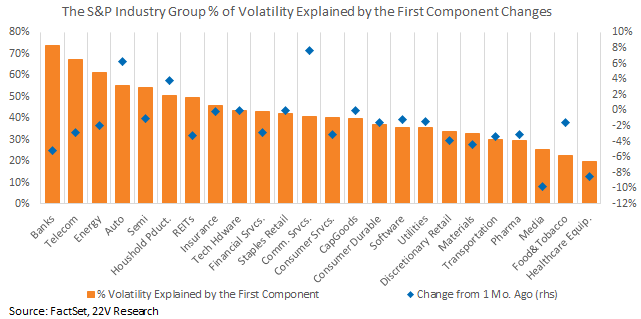
At the industry group level, Banks, Telecom and Energy have the highest macro influence, while Health Care Equipment, Food & Tobacco, and Media are more fundamentally driven. Defensive Industry group volatilities tend to be less impacted by macro. Most industry groups have seen a broadening out of factor influence except for Commercial Services and Auto, which are trading more like a group. Specific narratives appear to be driving those groups.
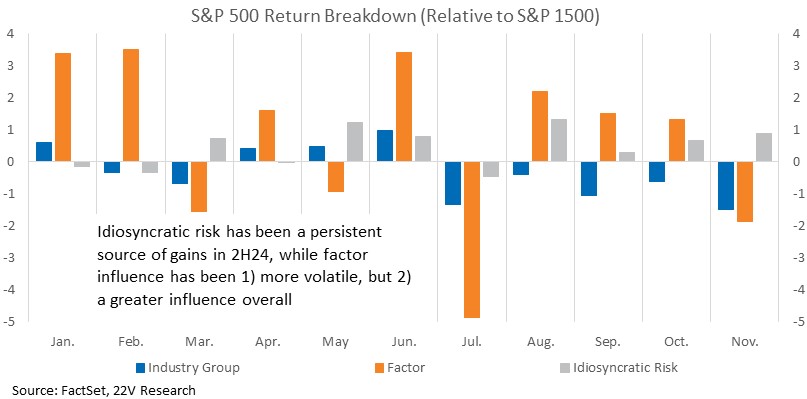
To validate the comments above, we looked at return attribution for the S&P by month YTD. The big standout is factors, which have been a volatile but also the largest contributor to returns.
Looking deeper into sectors and factors since October, Technology and Financials were major drags relative to S&P 1500. On an absolute basis, Defensives were major drags especially Health Care and Staples. Materials also underperformed due to weak fundamentals. On factors, Size performed poorly, consistent with a normal backdrop and a more diffuse set of market factors.