

SUMMARY:
- 22V’s proprietary China Economic Sentiment Series (CHESS) tool shows that analyst sentiment towards China’s broad macro outlook has dipped in the last two weeks; Donald Trump’s election and the implications for US-China trade tensions are a key driver
- Expectations towards domestic stimulus have held steady, but this has not been enough to offset concerns about external risks and relatively weak domestic demand
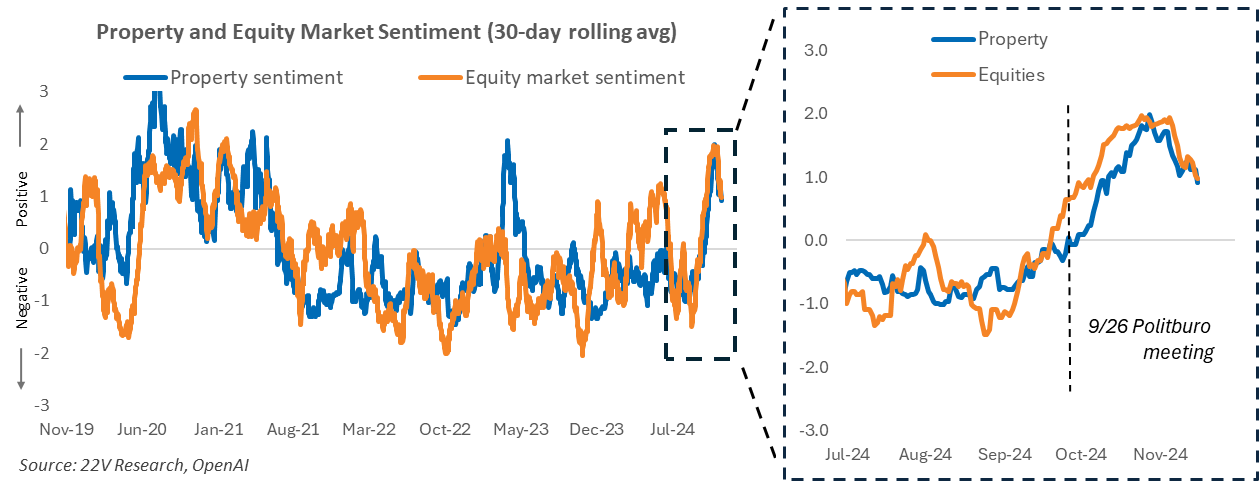
- Property and equity market sentiment both surged after China’s late-September policy pivot, but have lost some recent momentum in the absence of new support measures
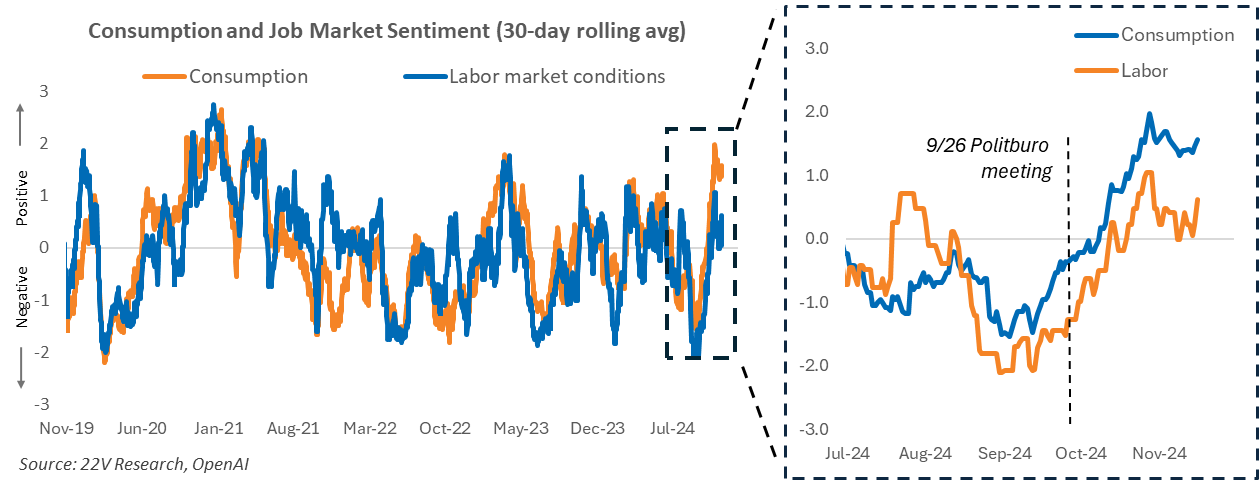
- Consumption remains a relative bright spot for sentiment, though the main driver of improved consumption trends has been China’s trade-in program for autos and appliances rather than a significantly better macro backdrop
- Coming weeks will bring important watchpoints for the outlook, including high-level meetings to preview Beijing’s 2025 economic priorities and more signals from Washington as to Trump’s approach to China

OVERVIEW
Every two weeks we provide an update of 22V’s China Economic Sentiment Series (CHESS). CHESS uses ChatGPT to assess the sentiment of economic experts commenting in China’s domestic media. It provides a quantitative and visual guide to how analyst expectations are shifting across 18 different categories (for reference, see the CHESS white paper HERE).
This CHESS update reflects commentary as of November 16, capturing analyst reaction to two important events: the US election of Donald Trump, and a closely watched fiscal support package announced by the National People’s Congress Standing Committee on November 8, which largely met subdued expectations (see our take HERE).
The chart above shows the one-month change in sentiment across all CHESS categories and tells a straightforward story. Trump’s election has resulted in worsening sentiment towards China’s external environment – exports, the exchange rate, and geopolitical/trade risks – and these concerns are starting to weigh on the broader macro outlook. Stimulus expectations remain positive since Beijing’s late September pivot but have not improved enough to fully offset the rise in external risks and only slight improvements in domestic demand.
Such caution is warranted, and indeed our in-house views are a bit more subdued than CHESS sentiment. We expect stimulus to remain modest in the months ahead, especially relative to ongoing headwinds domestically (such as from the property sector) as well as from trade risks.
Coming weeks will provide important signals as to the outlook. Beijing will outline 2025 growth goals and stimulus plans at year-end economic meetings held between late November and mid-December (see the last section on watchpoints), while Trump’s cabinet appointments will provide further indications as to what Beijing should expect coming its way from Washington. We will continue to use CHESS to monitor analyst reaction to these developments and compare them to our own assessments.
See the full report below for details.
TRUMP RISKS ARE REGISTERING
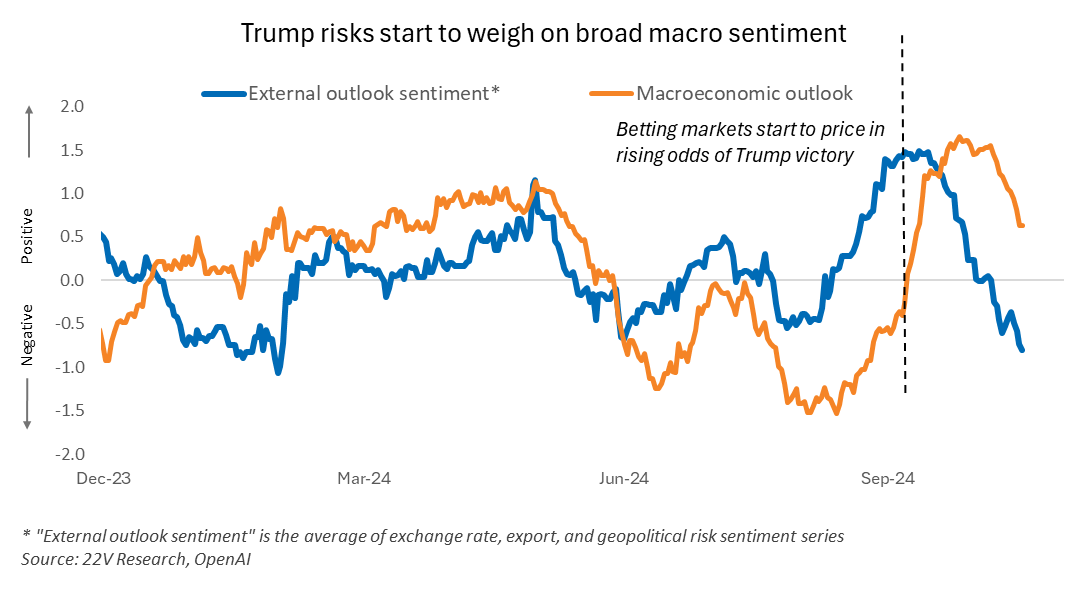
The chart below compares sentiment towards China’s external environment (blue line) and sentiment towards the overall macro outlook (orange line). The external environment is simply an average of CHESS sentiment towards China’s exchange rate, export outlook, and geopolitical/trade risks.
Sentiment towards the external environment received an initial boost around the Fed’s September 18 rate cut, but then declined starting on October 5, as betting markets such as Polymarket began pricing a likely Trump victory. The decline has continued through the election and Trump’s first set of announcements as to nominations for his cabinet.
Sentiment towards the broader macro outlook had initially been immune to those external concerns but has recently started to decline as well. This suggests that analysts are increasingly incorporating Trump risks into a less positive outlook for growth in coming quarters.
Outlook:
- There is much about Trump’s trade and foreign policy agenda that is uncertain but concern about the growth impact is warranted, given the risks of not only tariffs but also tightened tech restrictions and potential geopolitical tensions (see 22V’s Webinar on Trump’s implications for China and Europe HERE).
- Negative sentiment towards the exchange rate also makes sense in the face of tariff risks, though we do not expect rapid depreciation, especially with tariff announcements still months away. We argued before the election (link HERE) that PBOC would tolerate CNY depreciation but use its toolkit to moderate the pace. This has indeed been the case, with PBOC using the daily reference rate and sporadic intervention to limit the CNY’s pace of decline against the dollar.
STIMULUS EXPECTATIONS REMAIN STABLE
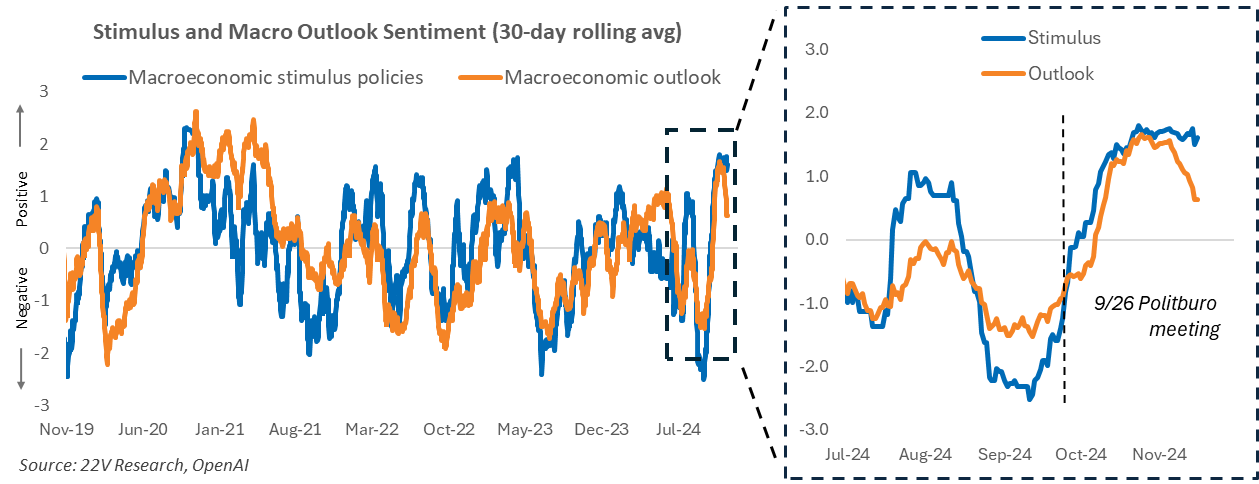
The first chart below shows sentiment towards overall stimulus (blue line) and the macro outlook (orange line). Stimulus expectations surged after Beijing’s policy pivot in late September and have remained stable since mid-October despite a series of lackluster stimulus news. One explanation is that analysts may expect – perhaps too optimistically – that Beijing do more to support growth given new headwinds, especially for exports.
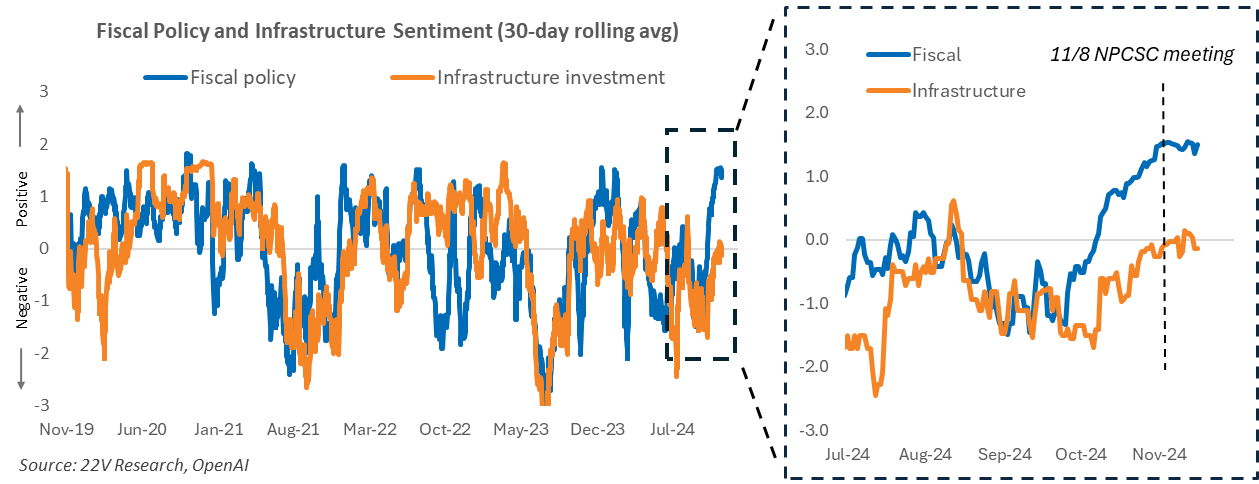
The next chart focuses on the most important aspect of the stimulus outlook: fiscal stimulus (blue line) and the related category of infrastructure spending (orange line). There are two takeaways.
- The fiscal package announced by the National People’s Congress Standing Committee on Nov. 8 did not impact sentiment. While the package was underwhelming – focused on debt relief for local governments rather than new stimulus spending – analysts appear to have taken a glass-half-full approach as they await more signals on the fiscal outlook from the upcoming Central Economic Work Conference.
- Expectations for infrastructure investment have picked up a bit but remain subdued at a level around neutral. This is another reflection of the fact that Beijing’s fiscal package aims to reduce fiscal and financial stability risks by refinancing local government debt, rather than to aggressively boost growth through spending in areas such as infrastructure.
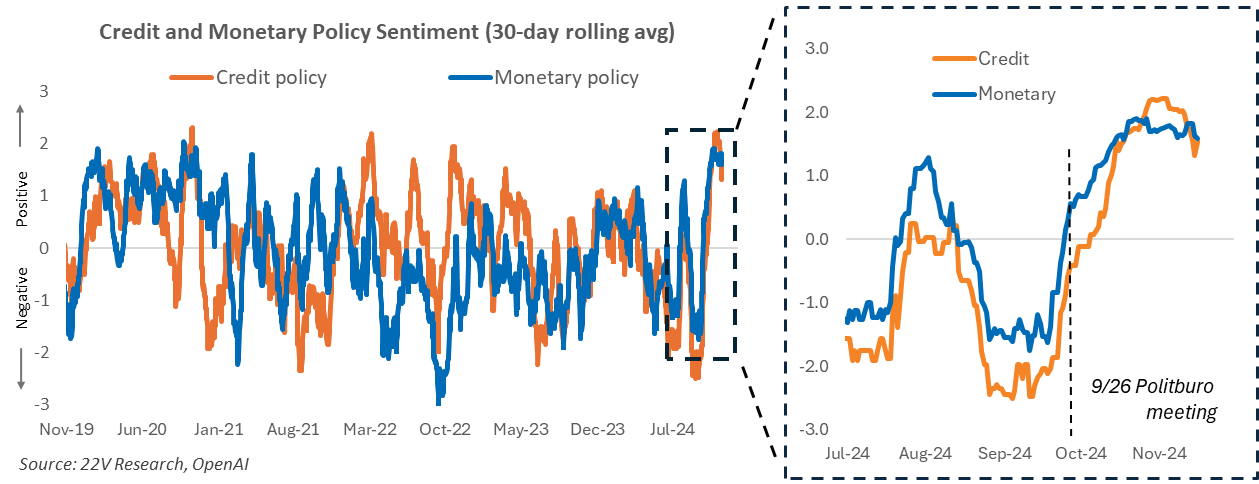
Finally, sentiment towards monetary policy (blue line) and credit policy (orange line) have stayed positive in recent weeks. This reflects the fact that PBOC continues to be the most proactive of all the economic agencies in its efforts to support market and economic confidence. However, there are major limits to what monetary and credit policy can do to boost growth in a climate of weak expectations and limited private sector demand for credit. Fiscal policy matters more for the broad outlook.
Outlook: CHESS sentiment towards the overall stimulus outlook is somewhat more optimistic than our take. Fiscal policy is providing some incremental support to economic activity, but the underwhelming NPCSC meeting shows that Beijing is saving ammunition for what may be a very long and tough four years in dealing with Trump. We will be closely watching in the next few weeks as to the signals for the 2025 stimulus outlook but expect it to be modest in strength relative to domestic and external economic headwinds. We recently outlined our expectations for the 2025 fiscal policy package HERE.
PROPERTY AND EQUITY MARKET SENTIMENT LOSE SOME STEAM
A key aim of Beijing’s recent policy pivot is to stabilize sentiment for both property (blue line) and equity markets (orange line) as a path towards reviving broader confidence. In the last two weeks, sentiment in both areas has flagged in the absence of major new policy announcements.
China’s October property data, released last week, showed a shallower decline in property prices and a rebound in housing sales, but property investment continued to worsen. Moreover, the improvements are modest given that they come after Beijing’s most aggressive easing to date, suggesting that underlying demand for property remains weak.
Beijing has continued efforts to promote a durable equity rebound, including through PBOC lending facilities as well as pressure on listed firms to boost buybacks and dividends. The main challenge for equities remains the deflationary macro backdrop, with the added challenge now of potential Trump risks.
Outlook:
- We remain skeptical that recent property measures are enough to stabilize sales and prices in coming months and view more comprehensive steps as necessary in 2025.
- Domestic equity markets will continue to face challenges from the soft macro backdrop, though Beijing’s determination to support the market should provide something of a floor for equity values.
CONSUMPTION SENTIMENT SEES MODEST GAINS
Consumption is a key area for China’s growth dynamics given the headwinds for external trade. In the last two weeks, sentiment towards consumption (blue line below) and the related category of labor market conditions (orange line) have dipped a bit after a steady climb.
Outlook: Some improvement in consumption sentiment is warranted: China’s consumer trade-in program has finally kicked into gear, leading to strong growth in sales of appliances and autos in October. However, we are not optimistic about the prospects for a strong and sustained consumption recovery outside of areas targeted by specific stimulus policies. The reasons are the broader macro backdrop: slow growth in job creation and household income, plus the continued decline in housing prices, all of which act as headwinds for consumer spending.
NEAR-TERM WATCHPOINTS
- Politburo meeting to preview the Central Economic Work Conference (Late November/early December). The Politburo meeting usually precedes the annual work conference by 2-9 days and previews its high-level themes.
- Central Economic Work Conference (Early/mid-December). The CEWC outlines economic priorities for the following year. We will be watching for signals as to how aggressively Beijing will look to support growth next year and for potential shifts in areas such as property policy and consumption stimulus.
- Additional signals from Washington. Trump’s initial choices for foreign policy positions – Sen. Marco Rubio for Secretary of State, and Rep. Mike Walz for National Security Advisor – have leaned quite hawkish towards China. The next key watchpoints will be economic positions, including the role of Robert Lighthizer on trade issues, and whether Trump’s Treasury pick will act as a moderating influence on what are likely to be aggressive tariff and tech policies.
CHESS is a collaborative project, leveraging the expertise of Sophia Wang, 22V’s Director of Quantitative Research, and China-based economic consultant Dr. Fei Han. The authors express thanks for contributions and insights.

