Consumer Credit Still Deteriorating (Normalizing Really), but the Pace is Slowing
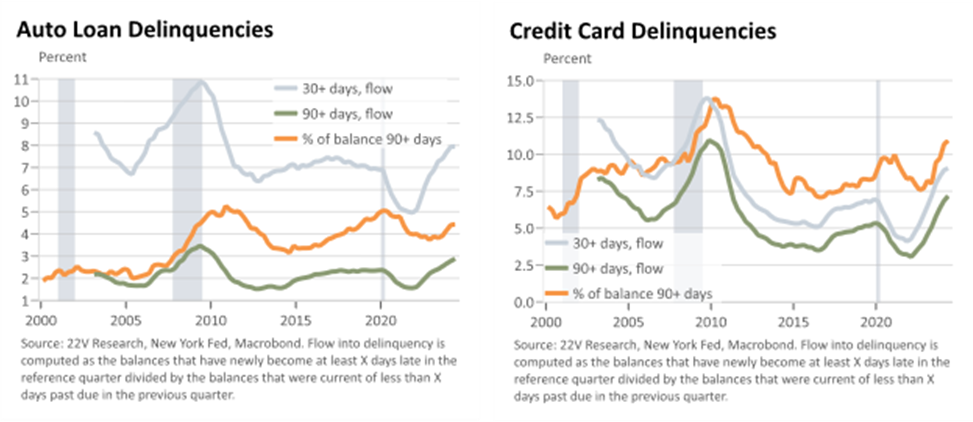
- Delinquencies, especially for auto loans and lower credit score credit cards, are still moving higher, continuing a trend that began in early 2022.
- The peak rate of change in the most effected measures was, like so much else related to macro stress, highest in late-2022 through mid-23.
- Much of this deterioration reflects an ‘artificial’ boost to credit worthiness earlier in the pandemic.
- Recent bank earnings calls suggest that the delinquency cycle is behaving largely as they expected through Q2 and more of a normalization than outright weakness. Most suggested that they expected the delinquency cycle to largely be wrapped up by the end of this year or early next.
- More broadly, the credit tightening impulse seems to be in its latter innings (as the recent SLOOS data suggest, see related work here) and while the absolute number of delinquencies is growing, this is largely inline with bank expectations and should not serve as a headwind to new credit extension but rather is acting as a drag on low-to-middle income discretionary spending. This will ultimately be a tailwind to growth but the economy needs to survive the risky period over the next 3-6m first.
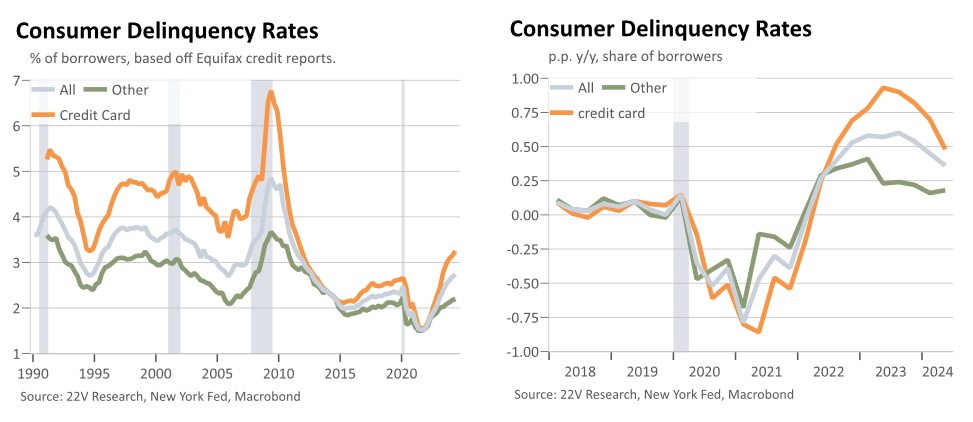
The overall data, particularly for credit cards and auto loans, looks somewhat troubling. Balances under stress continue to grow fairly rapidly as marginal borrowers struggle after seeing substantial credit extension in 2020-21. This is largely because there was a substantial amount of credit score, balance sheet, and income flattering that took place immediately after covid due to fiscal stimulus and various forms of debt forgiveness which impacted those only marginally able to get credit, and now that fundamentals are normalizing they are struggling with larger debt burdens.
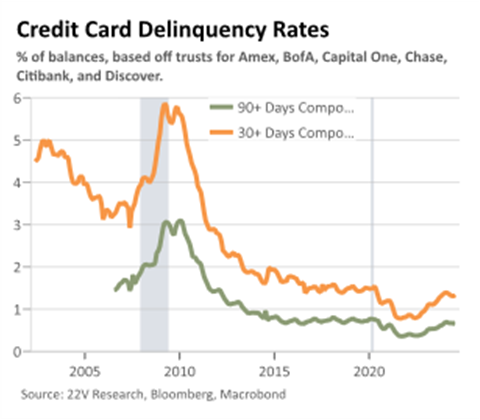
Among credit card types, the stress is much more apparent private label cards relative to the major issuer trusts (some banks have suggested that this may reflect selective distress on the part of consumers who will see less of an impact from falling into delinquency on a private label card versus a general purpose one).
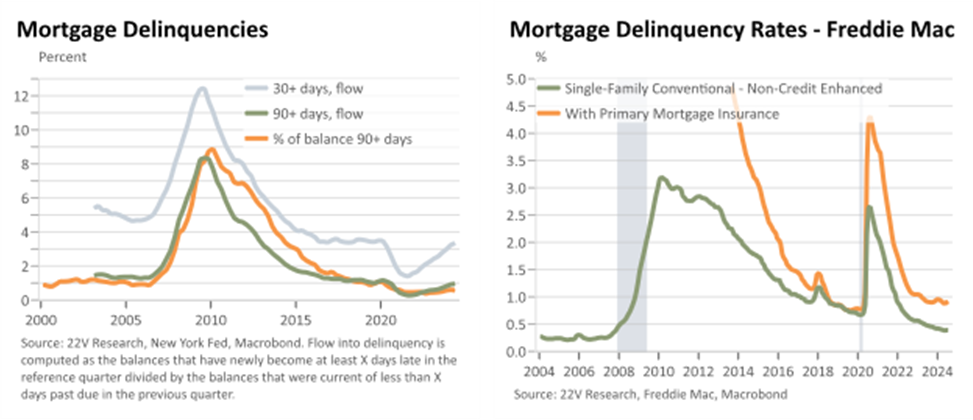
When looking at borrowers with higher incomes and credit scores the data looks notably less problematic than the aggregate numbers. For higher income consumers there was less of this extension and so less ability to get out over their skis. This should be less surprising given corporate commentary over the past few quarters, which has shown little widespread higher-income consumer weakness but with more notable and broader softening at the lower end. Mortgage delinquency rates remains below their pre-covid levels and for those without mortgage insurance they are almost exactly at their lowest ever levels.