Back Economic Research

Q3 Senior Loan Officer Opinion Survey Still Has a Bit of Tightening but Points to a Looming Tailwind

Published on August 5, 2024

Download the PDF Report

By

Peter Williams

Q3 Senior Loan Officer Opinion Survey Still Has a Bit of Tightening but Points to a Looming Tailwind

  • On net, the SLOOS still showed some modest tightening (if taken literally as the share of banks tightening on net, which it should not fully be) across most loan categories.
  • This has been the largest ever non-recessionary tightening seen in the SLOOS.
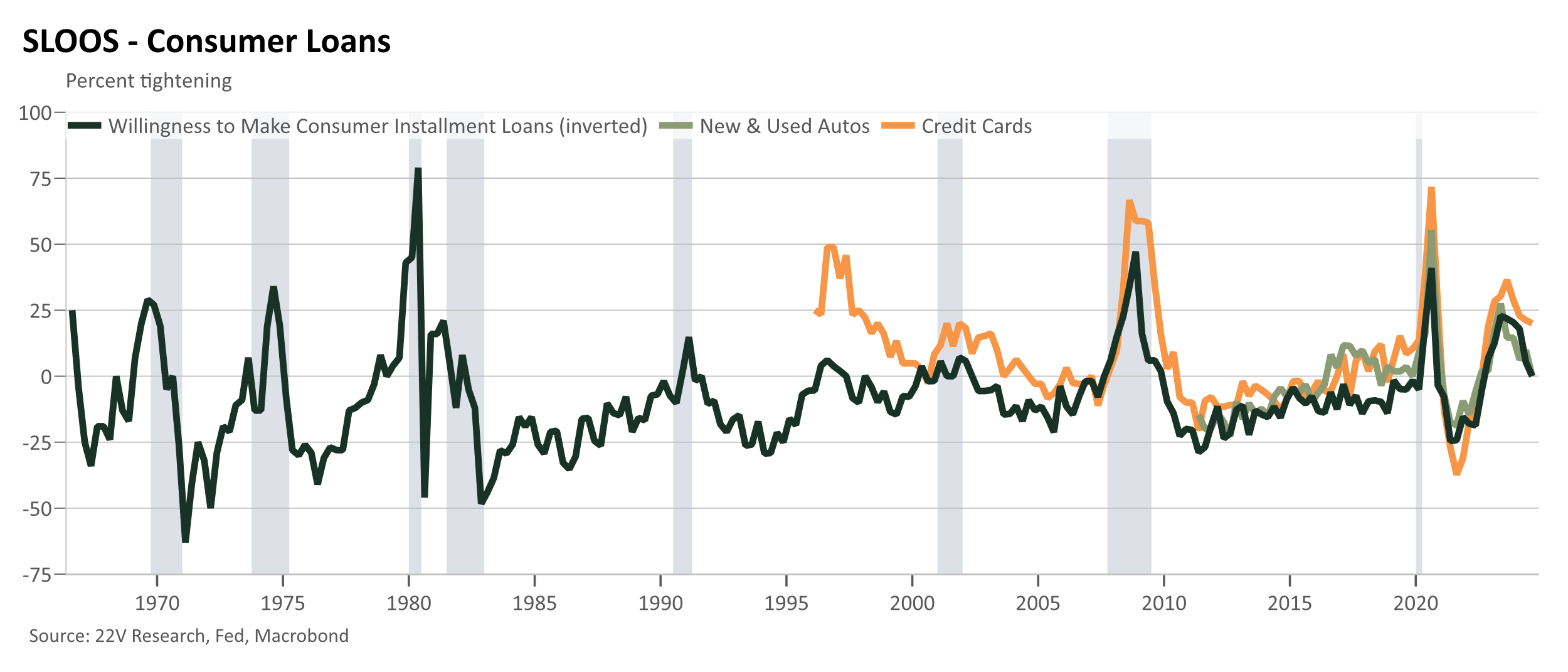
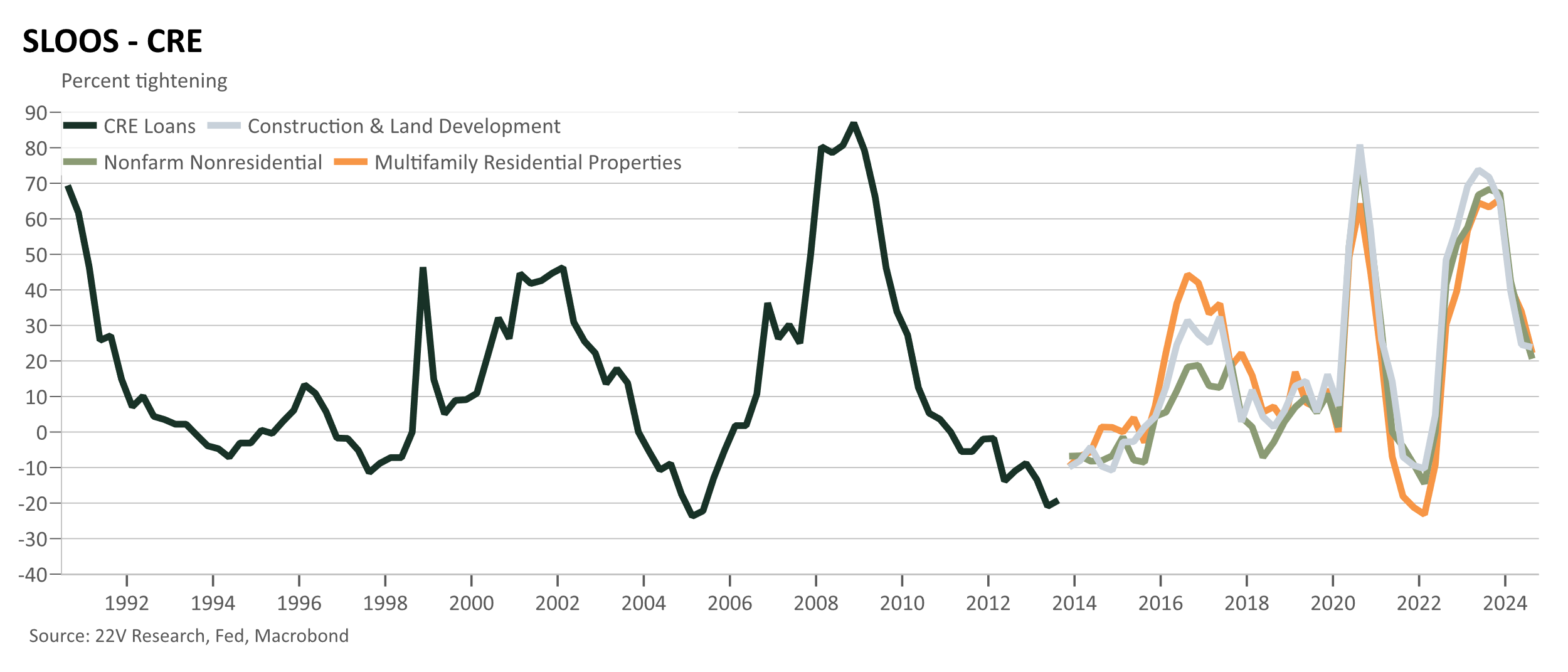
  • Perhaps unsurprisingly given commentary from banks and credit market participants, the two categories which stand out as showing the most new or marginal tightening are credit cards and multi-family real estate loans.
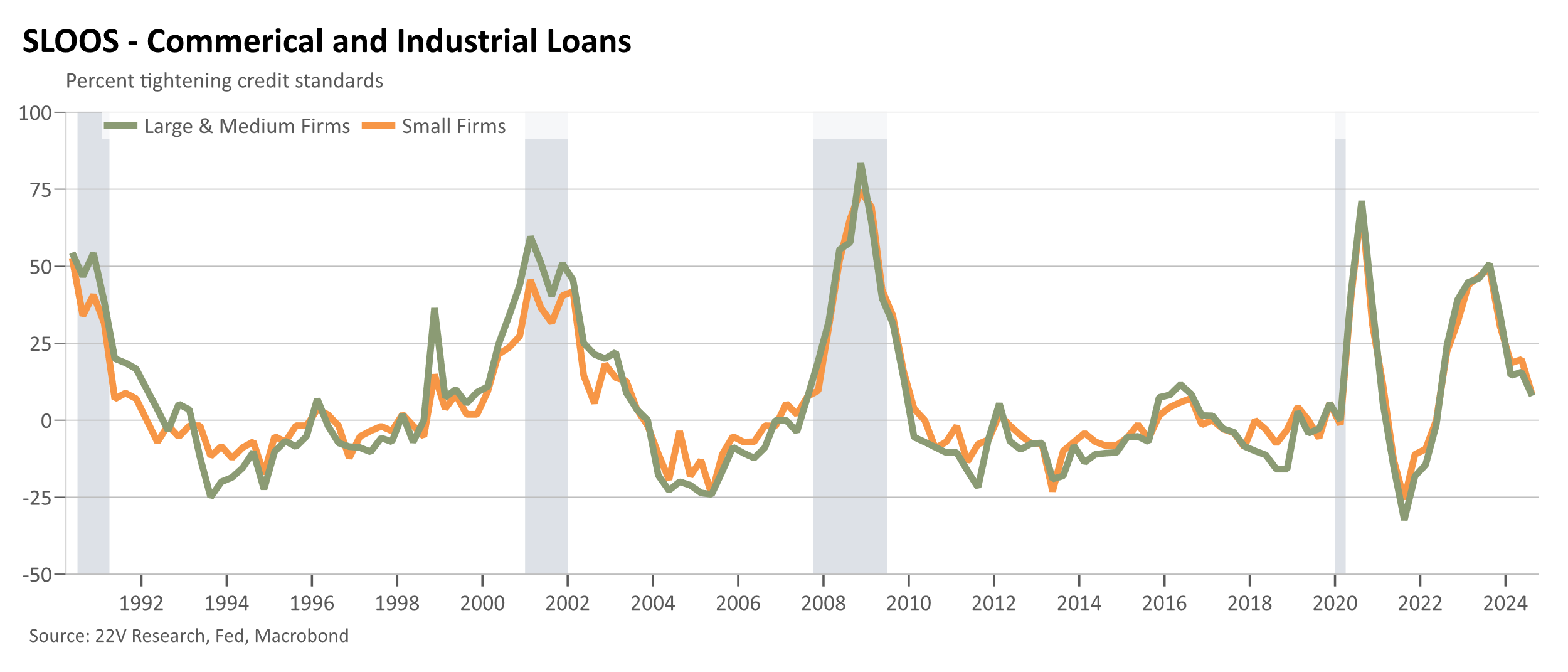
  • Consumer installment loans moved back to a neutral stance (a literal value of 0), while commercial and industrial loans ticked down to 8% of banks showing net tightening after a small but surprising bounce in the Q2 data to 16% (now just barely above its long-run average of 7%; most of the SLOOS show a small net average tightening bias).
  • We are a long way from loan standards being easy in level terms though but “responses… indicate that banks’ lending standards have eased since 2023 for most loan categories, though they remained tight relative to their historical ranges.”
  • Banks earnings season seems consistent with this data; CRE remains a key area of concern and, while still rising in level terms, consumer delinquencies and charge-offs are in the gradual process of leveling off and peaking either later this year or early next.
  • The credit standards tightening impulse is probably currently a fairly modest overall net drag but moving gradually towards being neutral or a small tailwind to future growth, after being an important drag for the past 2 or so years.
  • If a recession were to develop the SLOOS would probably show a decent move tighter but the extent of their non-recessionary tightening seen so far is, in my base case view of the world, a counter-cyclical force which has made the economy more robust to shocks rather than less by reducing the amount of leverage and the extent extent of embedded optimism in lending decisions.

Interpretively there is both a level and a change component in the SLOOS which matters for the impulse to the rest of the macroeconomy (technically one should read the SLOOS as a rate of change which cumulates over time but it’s a bit of a mixed effect in macro studies). Most measures of financial conditions show similar impacts from both rates of change and levels onto future activity outcomes. Another way of thinking about this is that the growth impact from the SLOOS is likely heading towards a neutral or slightly positive impact in the coming quarters but there is still a cumulative drag on the level of GDP.

The banks’ own answers to a question about the level of standards tightness suggests more of a rate of change effect is most important when thinking about the impacts of the SLOOS. Despite continued tightening value for the SLOOS since last summer (which should suggest a still tighter level of credit standards in general) across categories almost all banks reported a level of tightness that is still tight but easier than summer of 2023. Perhaps unsurprisingly, the most positive tones in the writeup for this section were for prime consumer loans (“moderate and modest net shares of banks reported that standards on prime credit card and prime auto loans were on the tighter end of their ranges, respectively”).

The SLOOS or credit standards channel of financial conditions tightening is an important and distinct one from rate level or more standard measures of financial conditions such as BBB spreads or the VIX. It tends to hit investment more directly (which bodes well given the relative strength of corporate investment over the past few years) and, unlike other financial conditions shocks, often has a fairly neutral impact on inflation because of the relative hit it imparts to the drivers of supply in the economy.
DISCLOSURES AND DISCLAIMERS

Analyst Certification

The analyst, 22V Research Group, primarily responsible for the preparation of this research report attests to the following: (1) that the views and opinions rendered in this research report reflect his or her personal views about the subject companies or issuers; and (2) that no part of the research analyst’s compensation was, is, or will be directly related to the specific recommendations or views in this research report.

Analyst Certifications and Independence of Research.

Each of the 22V Research analysts whose names appear on the front page of this report hereby certify that all the views expressed in this Report accurately reflect our personal views about any and all of the subject securities or issuers and that no part of our compensation was, is, or will be, directly or indirectly, related to the specific recommendations or views of in this Report.

22V Research (the “Company”) is an independent research provider. The Company is not a member of the FINRA or the SIPC and is not a registered broker dealer or investment adviser. 22V Research has no other regulated or unregulated business activities which conflict with its provision of independent research.

22V Research, LLC is a professional services and independent publication organization. 22V Research, LLC is not a securities broker-dealer, not a member of the Financial Industry Regulatory Authority (FINRA), not a registered investment advisor (RIA) and not a member of SIPC.

Securities transactions, when offered, are offered by 22V Securities, LLC through LPS Capital, LLC. Certain employees of 22V Securities, LLC are dually registered as securities representatives of LPS Capital, LLC or Analyst Hub Securities, LLC. 22V Securities, LPS Capital and Analyst Hub Securities are members FINRA, SIPC.

https://brokercheck.finra.org/

Current Ratings Definition.

SECTOR OUTPERFORM: An “outperform” rating anticipates the company will outperform the S&P Regional Banking Index (peer group).

SECTOR PERFORM: A “market perform” rating anticipates the company will perform in line with the S&P Regional Banking Index (peer group).

SECTOR UNDERPERFORM: An “underperform” rating anticipates the company will underperform the S&P Regional Banking Index (peer group).

Limitation Of Research And Information.

This Report has been prepared for distribution to only qualified institutional or professional clients of 22V Research Group. The contents of this Report represent the views, opinions, and analyses of its authors. The information contained herein does not constitute financial, legal, tax or any other advice. All third-party data presented herein were obtained from publicly available sources which are believed to be reliable; however, the Company makes no warranty, express or implied, concerning the accuracy or completeness of such information. In no event shall the Company be responsible or liable for the correctness of, or update to, any such material or for any damage or lost opportunities resulting from use of this data. Nothing contained in this Report or any distribution by the Company should be construed as any offer to sell, or any solicitation of an offer to buy, any security or investment. Any research or other material received should not be construed as individualized investment advice. Investment decisions should be made as part of an overall portfolio strategy and you should consult with a professional financial advisor, legal and tax advisor prior to making any investment decision. 22V Research Group shall not be liable for any direct or indirect, incidental or consequential loss or damage (including loss of profits, revenue or goodwill) arising from any investment decisions based on information or research obtained from 22V Research Group.

Reproduction And Distribution Strictly Prohibited.

No user of this Report may reproduce, modify, copy, distribute, sell, resell, transmit, transfer, license, assign or publish the Report itself or any information contained therein. Notwithstanding the foregoing, clients with access to working models are permitted to alter or modify the information contained therein, provided that it is solely for such client’s own use. This Report is not intended to be available or distributed for any purpose that would be deemed unlawful or otherwise prohibited by any local, state, national or international laws or regulations or would otherwise subject the Company to registration or regulation of any kind within such jurisdiction.

Copyrights, Trademarks, Intellectual Property.

22V Research Group, and any logos or marks included in this Report are proprietary materials. The use of such terms and logos and marks without the express written consent of 22V Research Group is strictly prohibited. The copyright in the pages or in the screens of the Report, and in the information and material therein, is proprietary material owned by 22V Research Group unless otherwise indicated. The unauthorized use of any material on this Report may violate numerous statutes, regulations and laws, including, but not limited to, copyright, trademark, trade secret or patent laws.