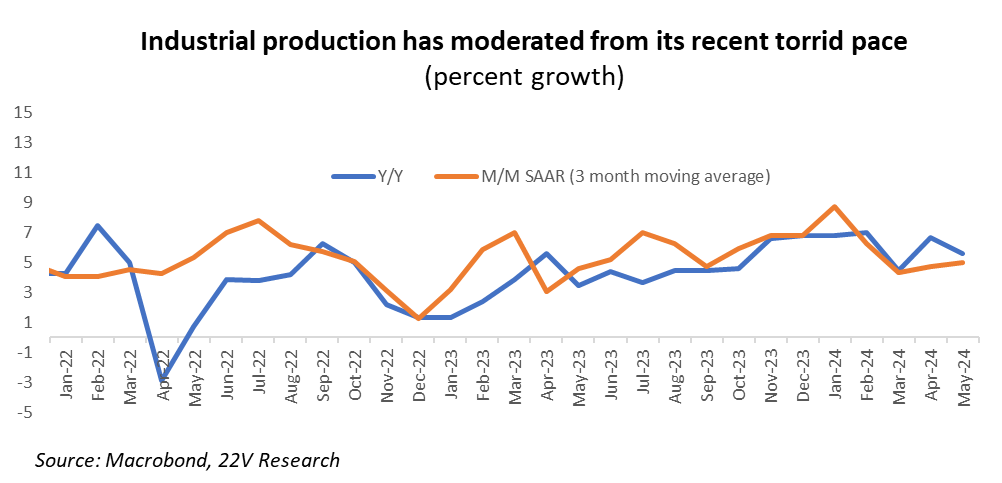
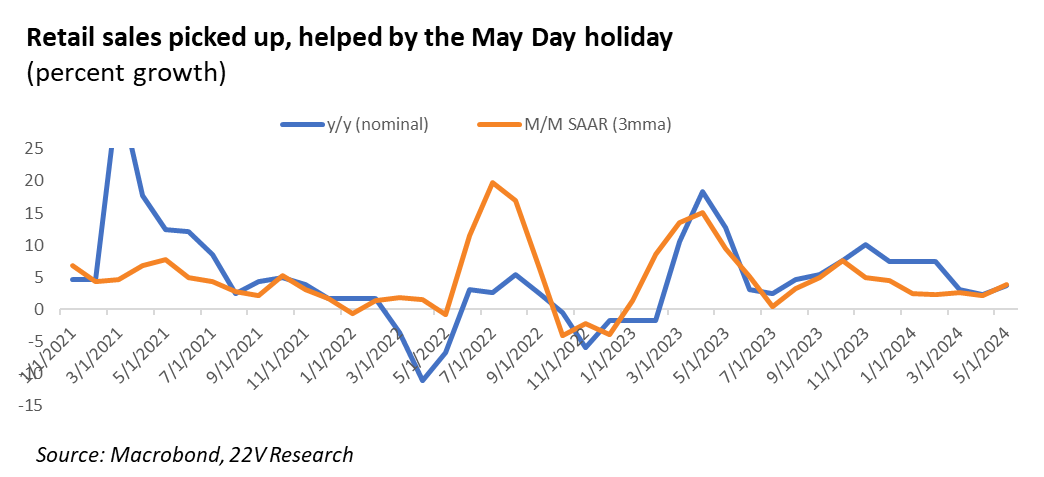
China’s May activity data came in mixed but weaker overall. Growth of industrial production (5.6% y/y, from 6.7% in April) and fixed asset investment (4% y/y ytd, from 4.2% ytd in April) both slowed and were weaker than consensus expectations. That slowdown reflects ongoing headwinds from the property sector and the limited strength of fiscal stimulus, which has waned since the first few months of the year. The upside surprise was retail sales (3.7% y/y, from 2.3% y/y in April), which showed modest signs of life after months of anemic growth.
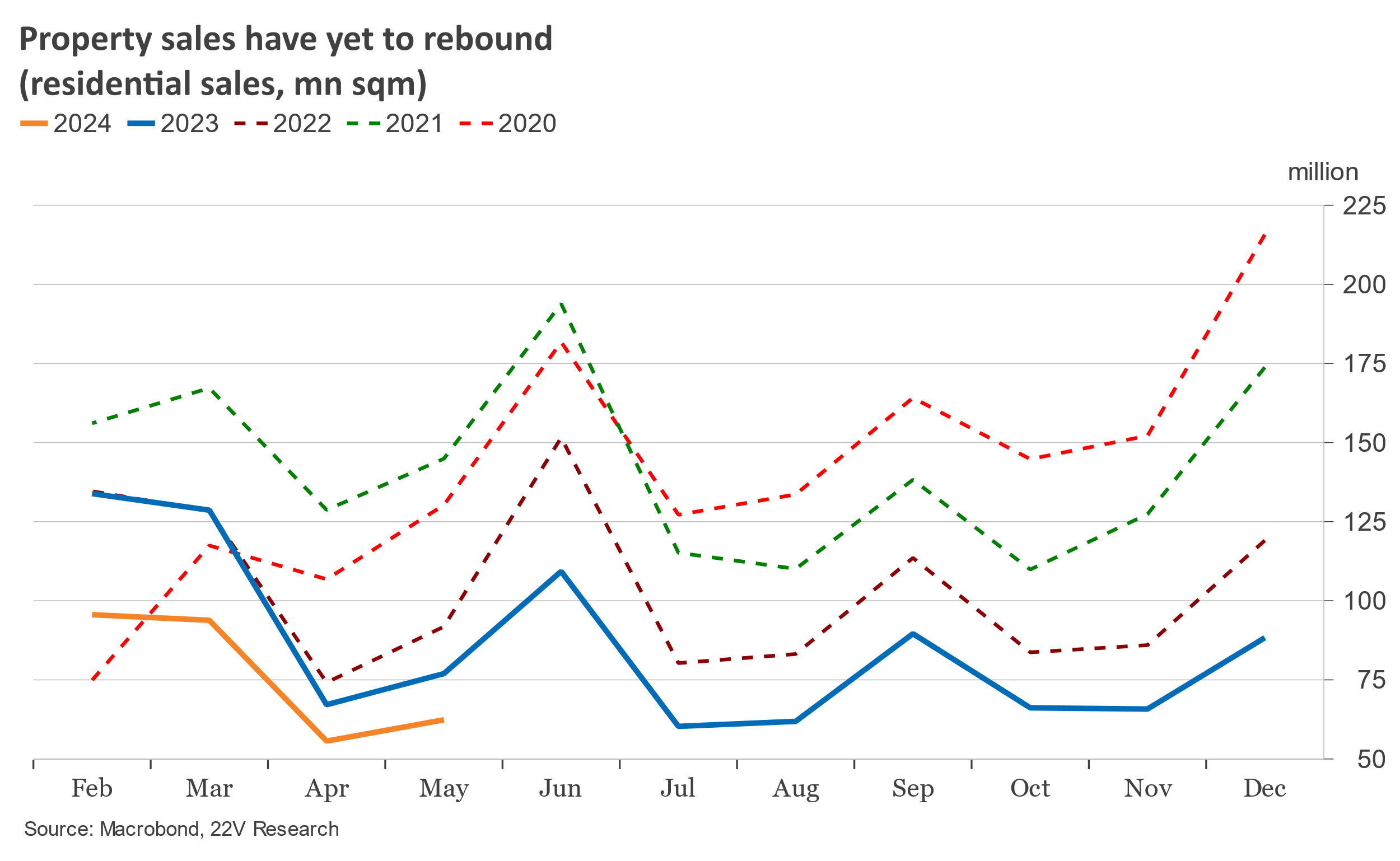
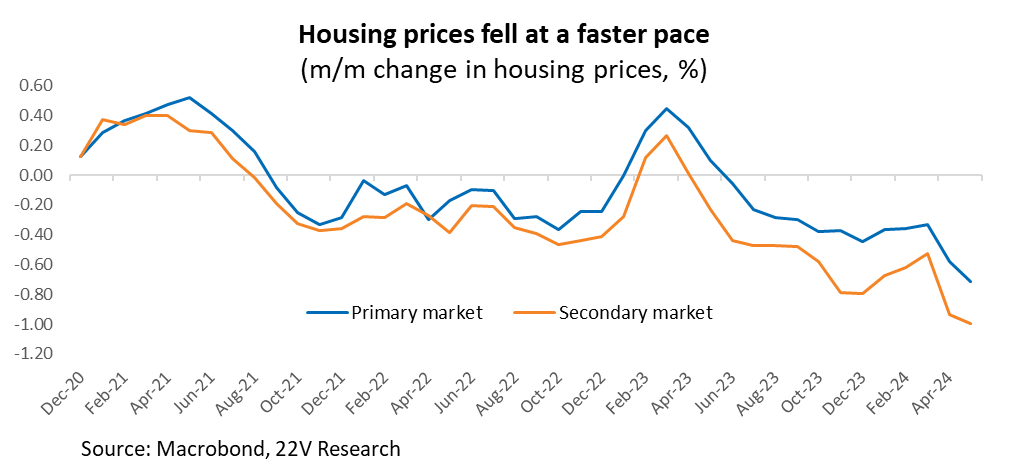
The most glaring aspect of the release was the weakness in the property sector. New home prices fell at an accelerating pace (-0.7% m/m), the fastest rate of decline since 2014. Residential property sales (-19% y/y) and housing starts (-25% y/y) have yet to convincingly bottom out. Property investment contracted further to -10.1% ytd y/y (from -9.8% ytd in April), with developers still under very tight funding constraints.
These figures come just a few weeks after the May 17 announcements of new measures to support the property sector, including cuts to mortgage rates and a PBOC relending facility to convert unsold housing stock to affordable housing. There was not enough time for the new measures to have much of an effect on the monthly data, but the weakness in May does underscore the depth of the challenge to stabilize sentiment in the sector. We had a skeptical take on the efficacy of the latest measures (see our initial take HERE), and broader domestic economic commentary is consistent with that take (see our end-May China economic sentiment update HERE).
The overall takeaway from the May data is that while exports are providing important support to growth, China’s recovery may fail to gain further traction due to the ongoing weakness of domestic demand and Beijing’s relatively restrained policy response.
To be clear, we think the leadership will provide enough support to avoid repeating the debacle of last year, when growth slowed sharply during the summer. Fiscal stimulus, which has been notably weak in Q2, will pick up again over the summer with local governments increasing their issuance of bonds to fund spending projects.
However, the overall risk this year remains policy complacency – that the leadership will do enough to achieve (or approach) its official target of 5% GDP growth, but not enough to truly kick the economic recovery into higher gear. Deflationary pressure due to weak domestic demand remains a key concern, especially for the outlook for Chinese equities.
There are several key near-term watchpoints to gauge whether policy will step up to meet the challenge:
- Property support. The weakness of May data will increase pressure on the central and local authorities to dial up the intensity of support measures. PBOC, for example, could hint at increasing the funding size of its relending programs to absorb excess housing. Such measures will be important to watch, but a key aspect of the housing market woes is the weakness of the macroeconomic environment, particularly household income. That is, one should look not only at sectoral policies, but also at fiscal and monetary policy settings (next point below). Our take on the outlook for housing remains cautious, given the restraint of those macro policy settings, the limitations of recently announced programs, and demographic/structural headwinds for property in the tier 3 and tier 4 cities.
- Stimulus signals ahead of the mid-year Politburo meeting. The leadership will review macro policy mid-year at the end-July monthly Politburo meeting. Coming weeks will provide some signals as to Beijing’s evolving thinking, including whether the leadership will move beyond the explicit stance from the April Politburo meeting of not introducing new stimulus measures.
- The Third Plenum reform meeting (July, exact dates TBD). We will have more to say about the Third Plenum in coming weeks as more signals come in. Initial signals from Xi and the leadership have been vague but are trending modestly positive in terms of underscoring the importance of structural reforms, including in areas such as the business environment and job creation. We do not think that the Third Plenum will super-charge the reform agenda, but it may surprise relative to investors’ muted expectations.