

KEY POINTS
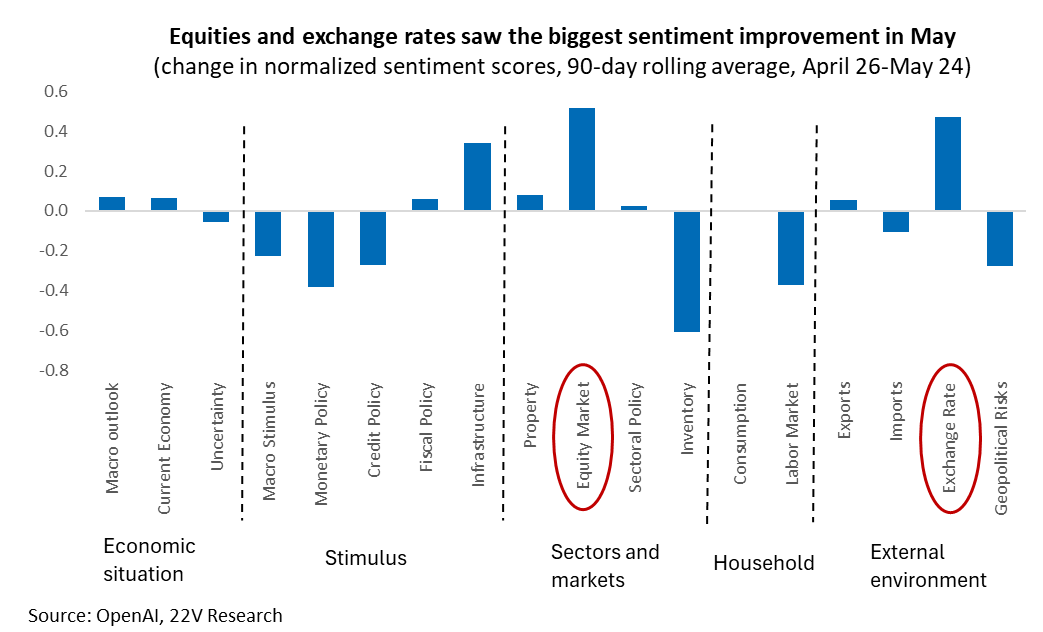
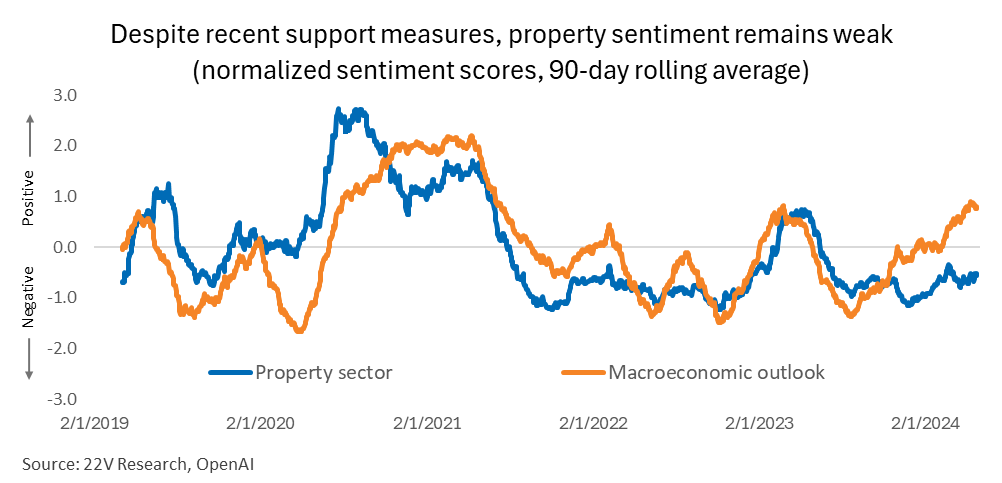
- Property support: China’s recent measures to support the property sector have helped to lift analyst sentiment towards domestic equities and the exchange rate in May; sentiment towards the property sector outlook itself remains more muted, reflecting analysts’ caution about the practical impact of these measures
- Equities: Forward-looking signals from sentiment are directionally (if modestly) positive for China’s domestic equity markets, suggesting that the recent rally in equity prices is not at risk of a near-term reversal
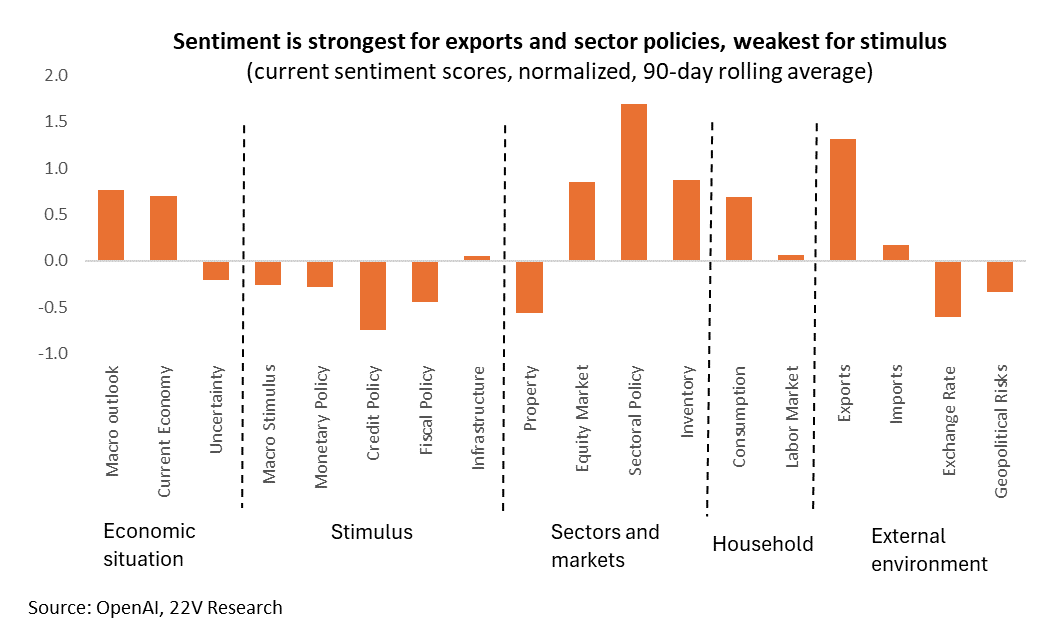
- Growth outlook: Sentiment towards the macroeconomic outlook improved modestly in May, fueled by continued optimism over the outlook for exports; weak expectations for stimulus remain a risk for growth later in the year, especially if export momentum wanes
- Data preview: Sentiment signals imply that forthcoming economic data for May, including the manufacturing PMI, will broadly keep pace with April and may show a modest sequential improvement
SUMMARY
This report is the second monthly update of the China Economic Sentiment Series (CHESS), a new tool from 22V’s China and Quant teams. CHESS uses ChatGPT to analyze the sentiment of experts commenting in China’s domestic media, with the goal of helping investors identify inflection points in the financial and economic outlook. In the debut report from April (link HERE), the main theme was an improvement in analyst sentiment towards the near-term macro outlook, fueled by exports and inventory re-stocking.
As discussed below, the biggest improvement in May came in the two sentiment indexes directly focused on financial markets: equity market sentiment and exchange rate sentiment. This improvement was partly a catch up to the recent gradual firming of economic conditions. It was also a reaction to China’s stepped up measures to support the property sector, announced on May 17. Indeed, the announcements provided a stronger lift to exchange rate sentiment and equity market sentiment than they did to property sentiment, which got a modest bump but remained quite weak overall. Despite analyst skepticism over the near-term effectiveness of the property measures, signs of a new approach by Beijing have buoyed broader confidence for now.
Sentiment towards the macro outlook and most economic categories was modest positive in May after the strong improvement in April. Expectations for monetary, credit and fiscal stimulus all continued to wane (infrastructure sentiment was stronger). While fading stimulus hopes remain a key risk for growth momentum in coming months, especially if exports slow, it is not yet impacting sentiment towards the near-term outlook. Forthcoming economic data, including the manufacturing PMI for May, should thus be resilient. Inventory sentiment showed the biggest drop in May, though this was likely a pause after a recent run-up rather than expectations of active de-stocking.
Market implications:
- For Chinese equities, signals from the relevant sentiment categories are directionally (if modestly) positive, suggesting that the recent rally in equities is not at risk of a near-term reversal
- The key factor for China’s exchange rate will remain US-China interest rate differentials, which show few signs of narrowing any time soon. The CNY will thus remain under depreciation pressure, though improved sentiment towards China’s outlook would provide some support.
- China’s demand for commodities linked mainly to domestic construction, such as steel, seems unlikely to surge anytime soon given few signs of an imminent turnaround in property activity, though infrastructure stimulus will provide some support. China’s demand is likely to remain strongest in the areas linked to exports, where sentiment remains high, and to Beijing’s industrial policies (e.g., copper and other non-ferrous metals).
DISCUSSION AND DETAILS
Property measures boost market confidence – despite skepticism over practical impact
On May 17, China announced several steps to support the property sector, including cuts to minimum downpayment ratios and the introduction of a new PBOC lending facility to help local governments buy excess housing inventory from developers. Our own take on the impact of these measures was conservative (link HERE), given the limited funding size of the inventory clearance plan, the uncertain economics of how it will work at the local level, and the macro headwinds (such as weak household economic confidence) weighing on property recovery.
The CHESS property sentiment index had similar reaction: there was a modest bump to property sentiment after the May 17 announcement but it largely faded as analysts digested the announcement. However, sentiment towards equities and the exchange rate received a stronger lift from the news. The takeaway is that even as analysts remain cautious about the near-term outlook for property, they perceive that Beijing’s stepped up sense of urgency is helpful for confidence in equities and the exchange rate.

Implications: Beijing’s increased urgency to support housing has boosted market sentiment, but there is a risk of disappointment in coming months if follow-up steps fail to boost property activity and arrest an ongoing decline in property prices.
Sentiment signals are directionally positive for Chinese equities in the near-term
Recent property measures were only part of the improvement in equity market sentiment, which has climbed steadily since early March. There were likely two main drivers here: (1) a steady improvement in sentiment towards economic conditions and the broader economic outlook; and (2) the strong rally in domestic equity markets, with the Shanghai Composite up 15% from its bottom on February 5. Improved sentiment can drive equity prices, but of course this can also work in reverse.
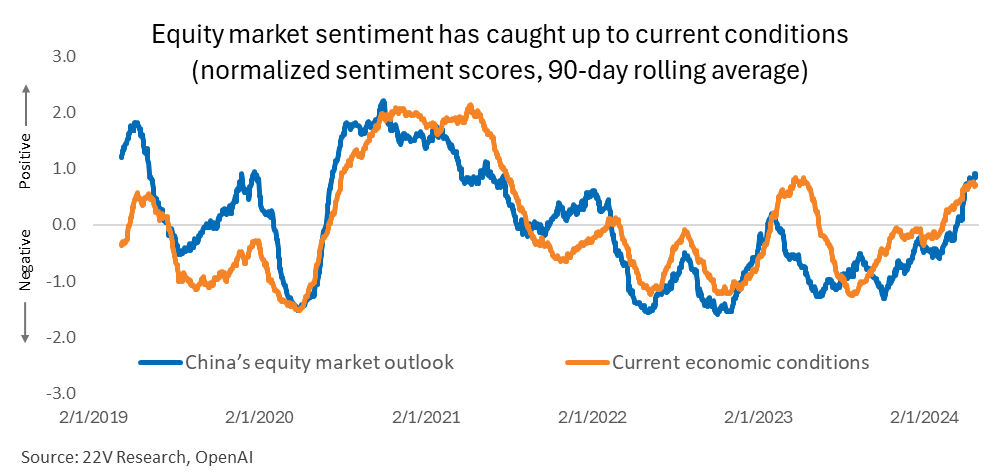
What does sentiment suggest about the sustainability of the recent rally? Our initial back-testing of CHESS data shows significant positive correlations between several sentiment categories and domestic equity prices (the Shanghai Composite index and Shenzhen Composite index); correlations are even higher for year-over-year changes in equity prices. These correlations persist even when sentiment is lagged by 15-30 days, suggesting that sentiment provides useful forward-looking signals for equities and is not just a coincident indicator. Note that sentiment data are likely to be useful as a directional signal for equities rather than as a tool to forecast price levels.
With that context, the relevant signals for the near-term equity outlook are as follows:
- The CHESS sentiment series with the highest correlations with China’s domestic equity prices are export sentiment, macroeconomic outlook sentiment, and current conditions sentiment. In May these three sentiment series showed a slight improvement.
- The sentiment series with the highest correlations with year-over-year changes in equity prices are equity market sentiment (significant improvement in May); property sentiment (modest improvement in May); exchange rate sentiment (significant improvement in May); and macroeconomic and current conditions sentiment (slight improvement in May, as noted above).
Implications: The CHESS sentiment series with relevance to equities were all directionally positive in May. One should be cautious about making specific forecasts with sentiment data (which can be volatile), but at the very least, sentiment signals are not showing any flashing red lights that equities are at risk of reversal over the coming month.
Uneven stimulus expectations are risk for growth later this year, especially if export momentum fades
Exports are a key factor behind the steady improvement of macro sentiment since a bottom in August 2023. With the global industrial production cycle turning up this year, export sentiment is now at its highest point since the waning period of the Covid lock-down export boom in 2021.
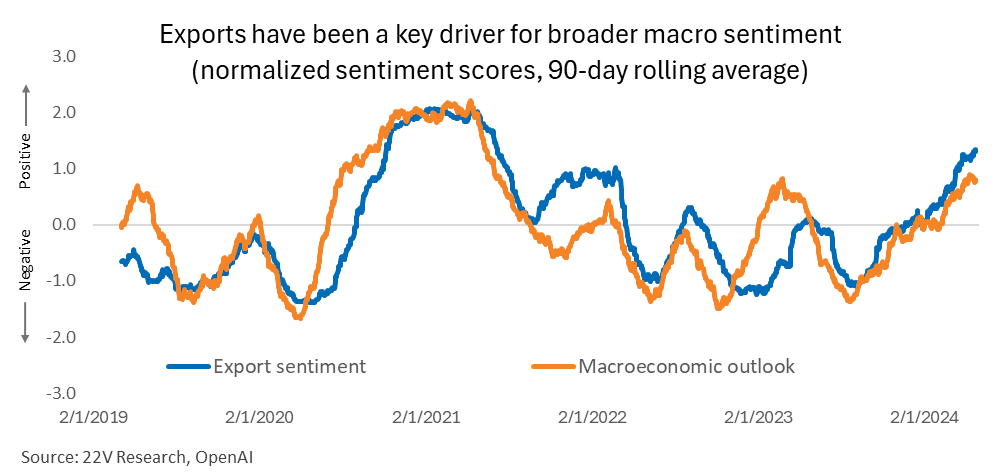
Domestic demand, by contrast, remains subdued given ongoing weakness in property and only a modest improvement in consumption. While the CHESS consumption sentiment index has improved this year, it still remains below the level of the initial post-Covid mini-boom in early 2023. From the data side, while households are partaking in the service economy (travel and entertainment), retail sales of goods were up only 2% year-over-year in April (see our write-up HERE), and other measures of consumer sentiment remain depressed.
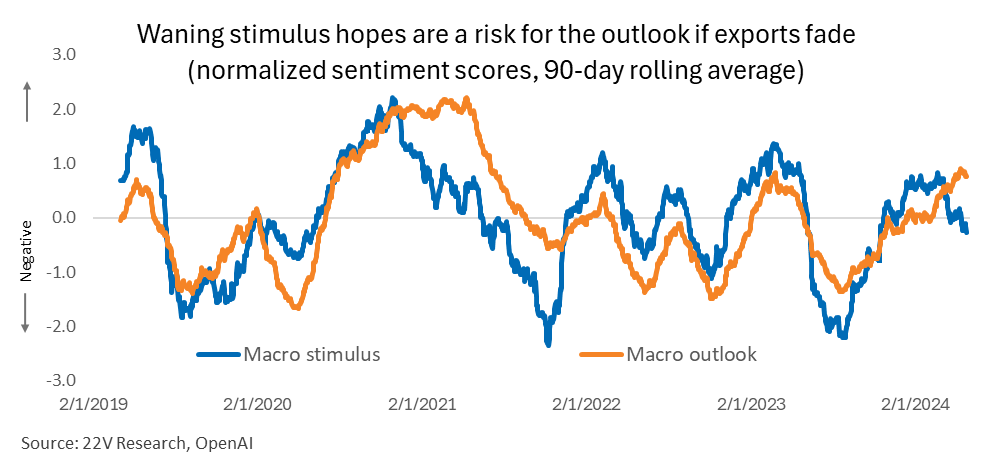
The weakness of domestic demand means that the recovery remains dependent not only on exports but also stimulus. In the April CHESS report, we noted that waning stimulus expectations pose a risk for growth momentum in coming months, particularly if the export boom loses strength. Stimulus sentiment has tended to lead sentiment towards the macro outlook (see chart below). In May, sentiment towards infrastructure picked up but overall stimulus expectations declined further. That is consistent with our takeaway from the April 30 Politburo meeting on the economy, which called for faster implementation of already planned measures (including central government bond issuance to fund infrastructure) but did not announce any new stimulus plans outside of property.
It will thus be important to see whether stimulus expectations improve in June and July. Fiscal and infrastructure stimulus will receive some support from the central government’s issuance of ultra long-term special treasury bonds in May, but the weakness of local government finances (exacerbated by falling land sales to developers) is a major vulnerability. Monetary policy is somewhat hostage to Fed policy, with the PBOC concerned that further rate cuts will widen US-China interest rate differentials and complicate efforts to slow CNY depreciation.
General Secretary Xi Jinping has sent some interesting if vague signals in recent days in meetings to prepare for the Third Plenum reform session (held every five years) in July. At a seminar earlier this week, Xi called for efforts to spur job creation, which could indicate a somewhat higher level of urgency to boost domestic demand amid growing international pushback against Chinese exports.
Implications: Limited stimulus support remains risk for the strength of China’s recovery this year. But with export growth still strong, those fears are not yet hurting sentiment towards the near-term outlook.
May data preview: Overall activity to remain resilient on the back of exports
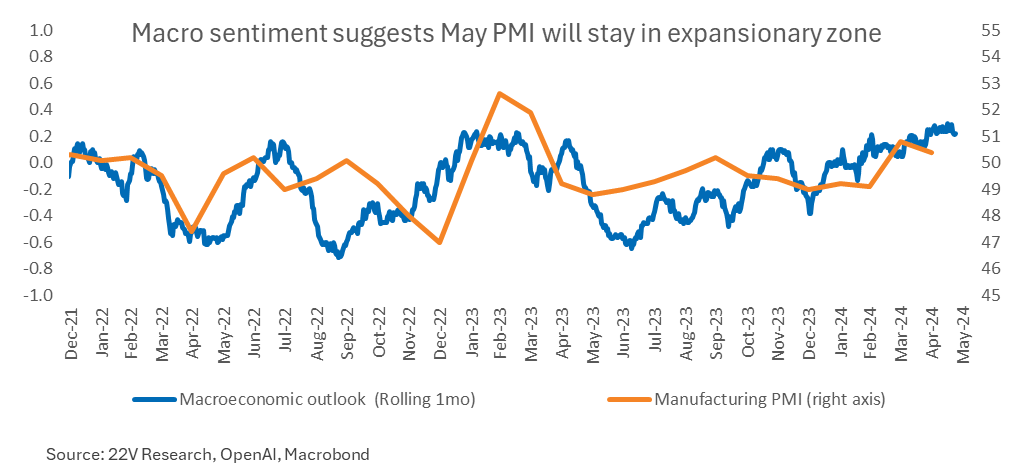
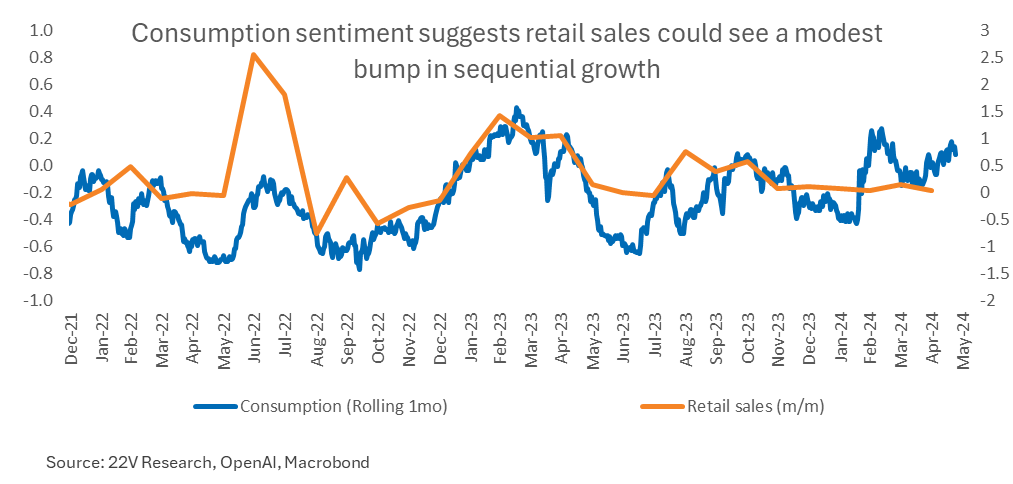
As noted in our debut report, CHESS is not designed to provide a point forecast of specific data series but can be useful in previewing expectations for the broad trend. With macro outlook sentiment and most of the other economic sentiment categories flat or modestly positive, this implies that May activity data are on the whole likely to be steady with April, with risks titled towards improvement. China’s manufacturing PMI is likely to be resilient given ongoing support to growth from exports (first chart below). Consumption sentiment has also drifted up, suggesting room for a modest improvement in sequential growth in retail sales (second chart).
CHESS is a collaborative project, leveraging the expertise of Sophia Wang, 22V’s Director of Quantitative Research, and China-based economic consultant Dr. Fei Han. The author expresses thanks for their contributions and insights.

