Back Economic Research

PMI Data Starting to Bounce after 18m in the Doldrums

Published on April 1, 2024

∙ Download the PDF Report

By

Peter Williams

PMI Data Starting to Bounce after 18m in the Doldrums

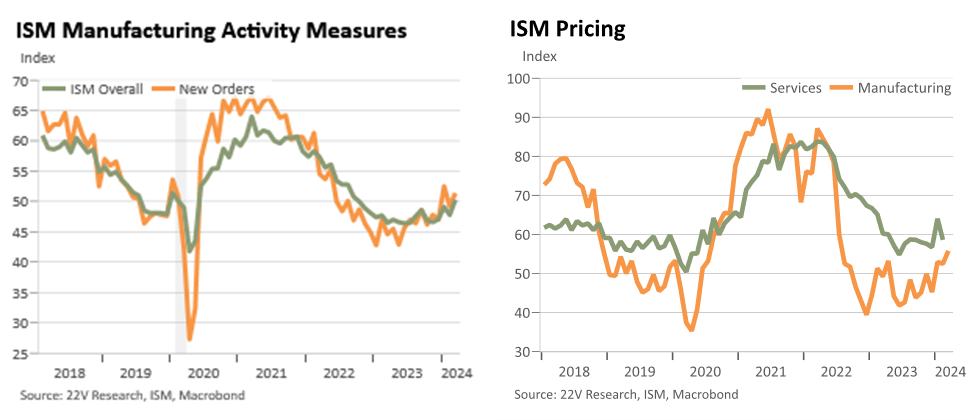
The March ISM and S&P Global PMIs both came in above 50 for the first time since September 2022.

Assuming the gradual, if perhaps noisy, recovery in the sector continues, and there is no reason to expect that it shouldn’t, this sets up a unique moment this summer when the Fed will begin cutting rates after a full ISM cycle when the series is not just inflecting higher but solidly back into positive territory (see more here, ‘A Cutting Cycle That Begins Just as the Global IP Cycle Turns Up? Another Post-Covid Novelty’).

Corporate sentiment, along with recent consumer measures as well, seems to be perking up as the long-awaited and planned for recession gets pushed to the back burner, the economy continues to move past and adjust to its covid-era shocks, and financial market performance adds an additional tailwind.

While Powell seems to want the Fed to begin cuts relatively soon if the inflation data is at all cooperative (see more from his Friday appearance here), the bounce in manufacturing and housing makes it increasingly likely that we see a much more shallow and short-lived cutting cycle than most envision. A shallow cycle would be quite in-line with historical mid-cycle cut behavior but goes against current return-to-neutral driven logic.

One also has to take quite seriously the risk that even if the March and April inflation data allows the Fed to start cutting in June, they may only end up cutting 1-2x in 2024.

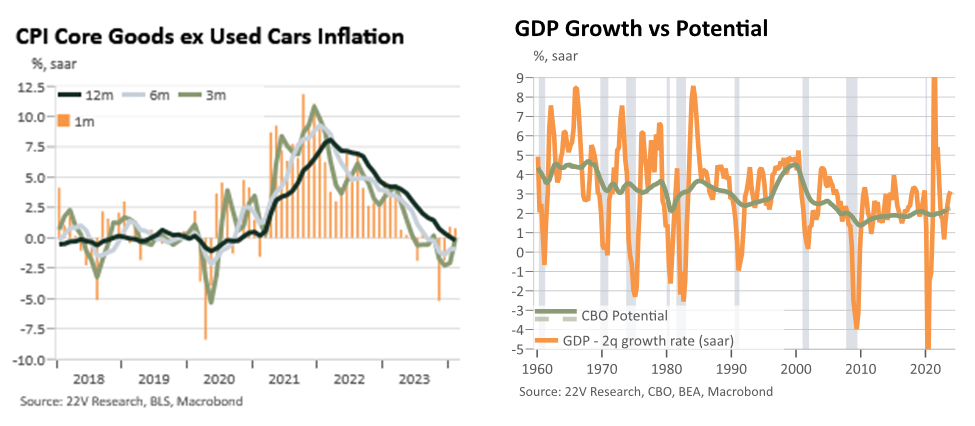
It’s been one of my higher conviction views that the troughing and gradual bounce in the manufacturing and housing sectors, the two most cyclical parts of the economy, would set a higher floor on growth in 2024 than many had assumed to start the year. Even if consumer spending decelerates some with a bit further labor market easing, this should help set a floor on growth and keep GDP growth for the year in the 2-3% range (anything more specific feels like false precision and history shows that the economy very rarely ever grows below trend outside of recession, an important base rate to keep in mind).

While besting 2023’s GDP growth still feels quite unlikely, as an investor noted to me during a back and forth a few weeks ago, ISM and housing turning up should have one thinking about right tails (as much or more than left tails).

The prices paid numbers (55.8 up from 52.5 in ISM and now seemingly somewhat durably off its cyclical low) raise the possibility that core goods deflation might wrap up sooner than helpful for the dovish inflation cases. That core goods ex used autos inflation has been positive the past few months doesn’t help the dovish case either. The risk here is not so much a large jump in core goods price levels but rather that the dovish inflation and rates forecasts for 2024 are dramatically harder to realize in a world where core goods inflation is ~0% rather than -1 to -2%. It also likely injects more volatility m/m which makes it harder for the Fed to come to any more robust conclusions about the underlying pace of inflation. A faster than expected wage growth deceleration could be an offset to this but the skews there seem a bit hawkish relative to expectations as well, although closer to neutral than my views on housing or core goods inflation.

A few quotes from each release’s writeup below tell the story quite well:

  • “Signs of improving wider economic conditions and market demand fed through to a further expansion of US manufacturing production in March, with the rate of expansion hitting a 22-month high.” – S&P
  • “Stronger demand was also evident in data for new orders, which showed an increase for the third month running. The pace of expansion was solid, but softer than that seen in February. Total new orders rose more quickly than new business from abroad, which increased only marginally in March. Firms remained confident that output will increase over the coming year, thanks to expectations for improving economic conditions, marketing efforts and improving capacity.” – S&P
  • “Demand remains at the early stages of recovery, with clear signs of improving conditions. Production execution surged compared to January and February, as panelists’ companies reenter expansion. Suppliers continue to have capacity but are showing signs of struggling, due in large part to their raw material supply chains.” – ISM
  • “Input costs increased sharply, with the rate of inflation ticking up from that seen in February. Higher oil and raw material costs, plus increased transportation rates, reportedly added to cost burdens at the end of the first quarter. Meanwhile, the impact of rising labor costs was mentioned as a factor pushing up selling prices at a number of manufacturers. As a result, the rate of output price inflation quickened for the fourth month running to a sharp pace that was the fastest in just under a year.” – S&P
  • “The Prices Index moved further upward in moderate expansion (or ‘increasing’) territory as commodity driven costs remain unstable.” – ISM
DISCLOSURES AND DISCLAIMERS

Analyst Certification

The analyst, 22V Research Group, primarily responsible for the preparation of this research report attests to the following: (1) that the views and opinions rendered in this research report reflect his or her personal views about the subject companies or issuers; and (2) that no part of the research analyst’s compensation was, is, or will be directly related to the specific recommendations or views in this research report.

Analyst Certifications and Independence of Research.

Each of the 22V Research analysts whose names appear on the front page of this report hereby certify that all the views expressed in this Report accurately reflect our personal views about any and all of the subject securities or issuers and that no part of our compensation was, is, or will be, directly or indirectly, related to the specific recommendations or views of in this Report.

22V Research (the “Company”) is an independent research provider. The Company is not a member of the FINRA or the SIPC and is not a registered broker dealer or investment adviser. 22V Research has no other regulated or unregulated business activities which conflict with its provision of independent research.

22V Research, LLC is a professional services and independent publication organization. 22V Research, LLC is not a securities broker-dealer, not a member of the Financial Industry Regulatory Authority (FINRA), not a registered investment advisor (RIA) and not a member of SIPC.

Securities transactions, when offered, are offered by 22V Securities, LLC through LPS Capital, LLC. Certain employees of 22V Securities, LLC are dually registered as securities representatives of LPS Capital, LLC or Analyst Hub Securities, LLC. 22V Securities, LPS Capital and Analyst Hub Securities are members FINRA, SIPC.

https://brokercheck.finra.org/

Current Ratings Definition.

SECTOR OUTPERFORM: An “outperform” rating anticipates the company will outperform the S&P Regional Banking Index (peer group).

SECTOR PERFORM: A “market perform” rating anticipates the company will perform in line with the S&P Regional Banking Index (peer group).

SECTOR UNDERPERFORM: An “underperform” rating anticipates the company will underperform the S&P Regional Banking Index (peer group).

Limitation Of Research And Information.

This Report has been prepared for distribution to only qualified institutional or professional clients of 22V Research Group. The contents of this Report represent the views, opinions, and analyses of its authors. The information contained herein does not constitute financial, legal, tax or any other advice. All third-party data presented herein were obtained from publicly available sources which are believed to be reliable; however, the Company makes no warranty, express or implied, concerning the accuracy or completeness of such information. In no event shall the Company be responsible or liable for the correctness of, or update to, any such material or for any damage or lost opportunities resulting from use of this data. Nothing contained in this Report or any distribution by the Company should be construed as any offer to sell, or any solicitation of an offer to buy, any security or investment. Any research or other material received should not be construed as individualized investment advice. Investment decisions should be made as part of an overall portfolio strategy and you should consult with a professional financial advisor, legal and tax advisor prior to making any investment decision. 22V Research Group shall not be liable for any direct or indirect, incidental or consequential loss or damage (including loss of profits, revenue or goodwill) arising from any investment decisions based on information or research obtained from 22V Research Group.

Reproduction And Distribution Strictly Prohibited.

No user of this Report may reproduce, modify, copy, distribute, sell, resell, transmit, transfer, license, assign or publish the Report itself or any information contained therein. Notwithstanding the foregoing, clients with access to working models are permitted to alter or modify the information contained therein, provided that it is solely for such client’s own use. This Report is not intended to be available or distributed for any purpose that would be deemed unlawful or otherwise prohibited by any local, state, national or international laws or regulations or would otherwise subject the Company to registration or regulation of any kind within such jurisdiction.

Copyrights, Trademarks, Intellectual Property.

22V Research Group, and any logos or marks included in this Report are proprietary materials. The use of such terms and logos and marks without the express written consent of 22V Research Group is strictly prohibited. The copyright in the pages or in the screens of the Report, and in the information and material therein, is proprietary material owned by 22V Research Group unless otherwise indicated. The unauthorized use of any material on this Report may violate numerous statutes, regulations and laws, including, but not limited to, copyright, trademark, trade secret or patent laws.
