

A Cutting Cycle That Begins Just as the Global IP Cycle Turns Up? Another Post-Covid Novelty
The covid-and-beyond era has been full of novel economic developments, and we are likely to experience another one quite soon: historically is has been quite rare for the Fed (and other central banks) to begin a rate cutting cycle once the industrial production (or ISM in the US case) cycle has started to rebound. Hot inflation has meant the Fed kept hiking long after the IP, housing, and financial conditions cycles all downshifted, setting up a (modest) cutting cycle into cyclical strength.
Given my underlying cyclical optimism in the US and, with a bit less conviction, view that the IP cycle globally is also starting to turn, this rebound in the most-cyclical part of the economy will ultimately lean against dovish cases for rate cuts, after an initial 50-100bps of risk management or insurance cuts takes place, by putting a floor under activity and core goods pricing (see more here).
As our commodities maestro Colin Fenton has noted, recent commodity price developments, especially in oil and copper, also suggest that global supply-demand dynamics for key inputs and transportation also point to an increase in underlying activity (see his recent notes “On taking the under and the over” and 2/13’s edition of “The Nugget“). If recent price trends extend, this could, although it seems like a notably more remote risk than it would have been in 2021-22, raise concerns about commodity price to inflation expectations spillovers.
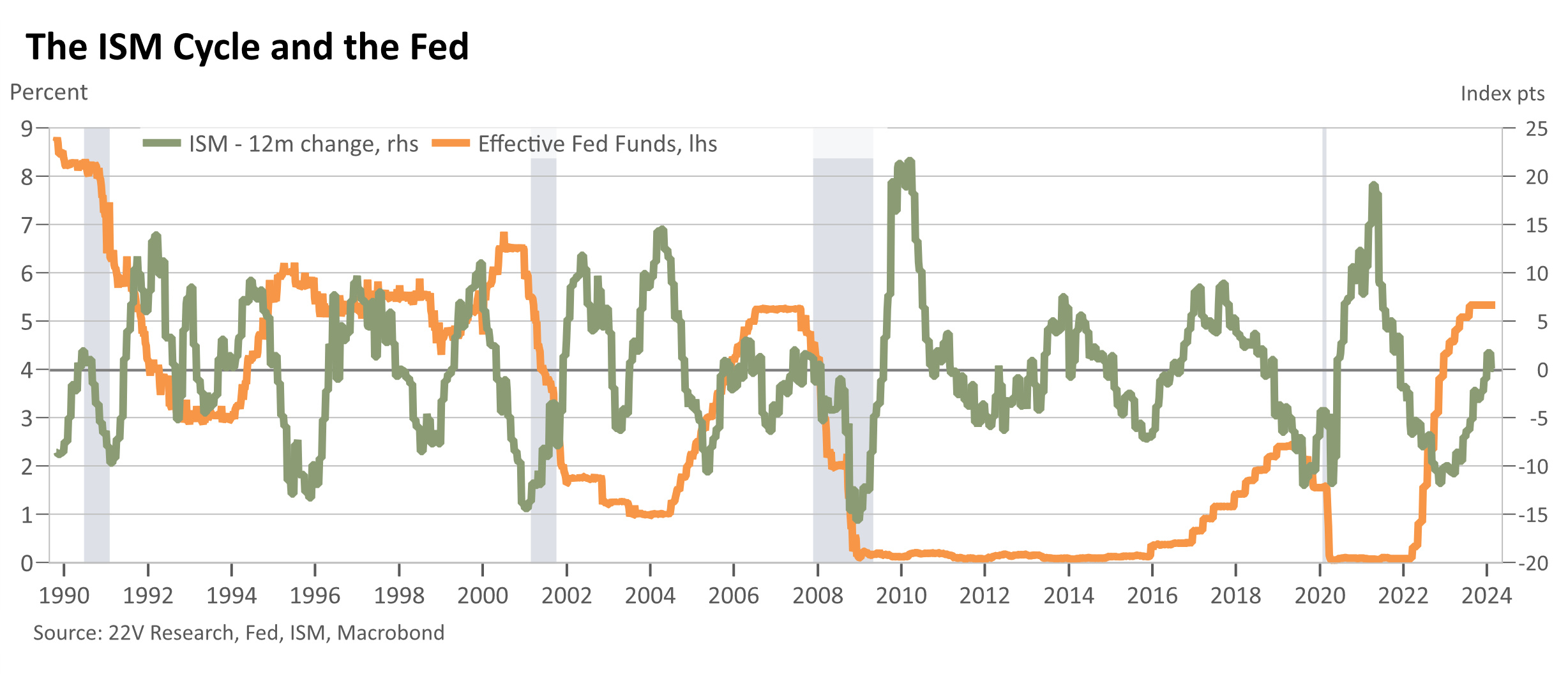
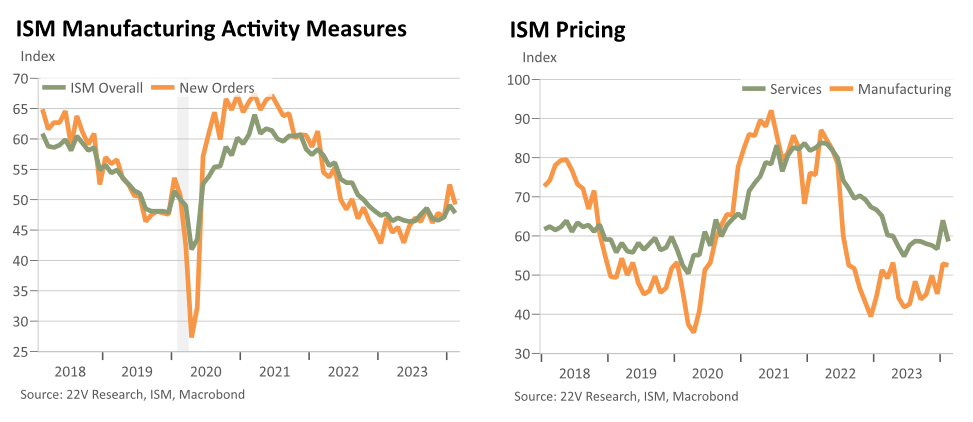
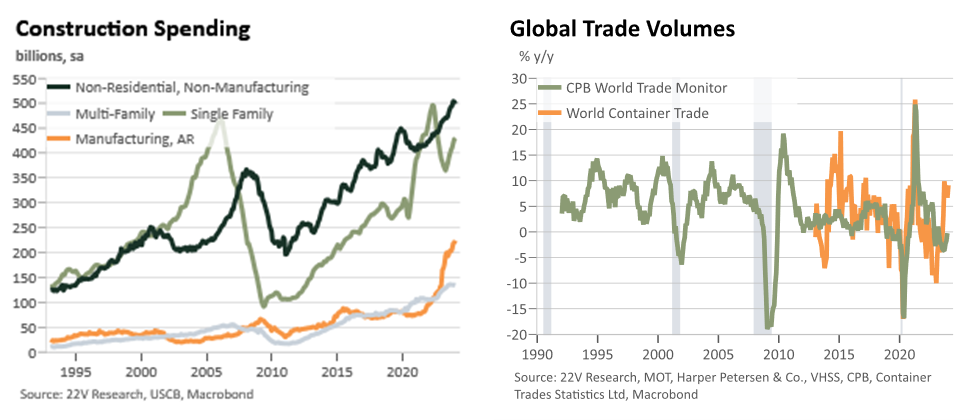
In the US, the evidence suggests that the manufacturing and durable goods economy is starting to slowly turn up after a sluggish, but generally not outright contractionary, past 18-24m.[1] The ISM manufacturing PMI has been in an extended trough but appears to be tentatively making its way up towards 50; the new orders component shows a bit clearer degree of cyclicality. The S&P Global PMI, which I weight more highly given its broader sample and historically better correlation with activity measures, has followed a similar path and is now slightly above 50, to its highest level since May 2022.[2] At least partly thanks for the CHIPS Act, construction spending on manufacturing structures in the US is booming as well.
To me the two most useful mid-cycle analogs include the mid-90s weakness and rebound and the 2014-16 period of weakness that followed the popping of the shale bubble and initial talk of tightening. The post-WW2 era is also perhaps the most relevant example but the paucity of data and substantially different economic and policy making structure make extracting underlying signal from those cycles, beyond the importance of fiscal policy and the volatile nature of an economy going through numerous bullwhips, more challenging.
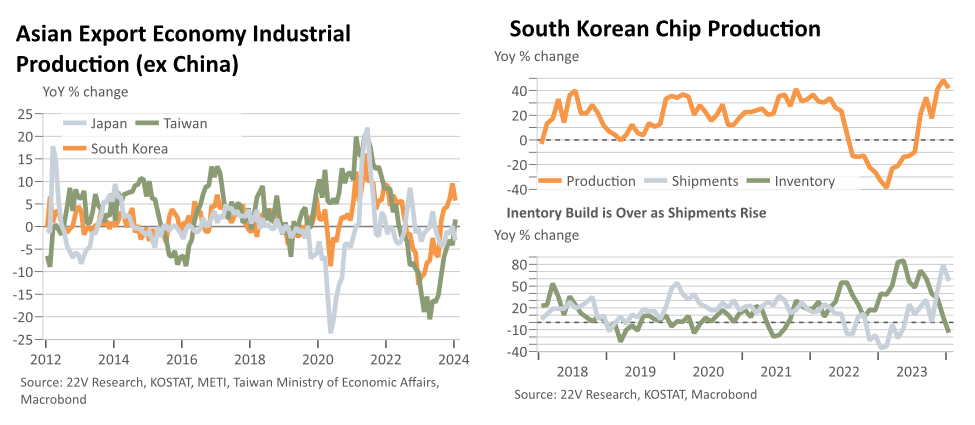
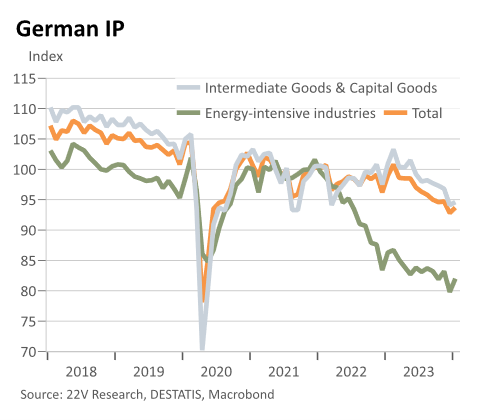
Globally there are a number of more tentative but admittedly less synchronized signs of an emerging bottom in the IP cycle as well. The global picture is of course complicated by the permanent hits to energy-dependent German industry and the still sluggish post-covid recovery in China. Nevertheless, I think the data suggests that broader global IP cycle is starting to pick back up. Industrial Production in Taiwan, South Korea, and, with notably less assurance, Japan seems to be picking up from recent doldrums. South Korean chip exports, which as we learned during covid go in to absolutely everything, have jumped in recent months as well. Global container trade volumes are also staging a notable recovery (although their longer-term trends to slower and perhaps eventually negative growth remains an important part of the broader backdrop).
For the Fed, and other DM central banks to varying extent, this rebound sets up two important medium-term trends. It is important to note that I do not think this rebound is particularly likely to impact the timing of the initial rate cut or two.
- The most cyclical part of the economy, which often drives mid-cycle variation inside the broader unemployment-driven business cycle, is turning up. This will help set a floor under growth even as the rest of the economy continues to normalize. This removes a dovish pull towards deeper cuts, rather than preventing their initiation based off of falling inflation and desire to be a bit closer towards reasonable estimates of neutral.
- These rebounds will also help lead to the end of outright core goods deflation later this year. By removing a current source of very helpful deflationary drag on overall inflation, this makes the trajectory of inflation more dependent on sticky services and housing measures (a point I dived into more here).
- These two forces are key parts of my view that the non-recessionary floor for rates this cycle is at the lowest 3.5% (my view of neutral) and more likely in the low-to-mid 4s.
On net, these continue to feel like underappreciated themes globally. This is particularly true in the US where the housing market’s rebound is also supporting growth (despite still very elevated rate levels).
In the near-term though, it is hard to focus too much on the ultimate destination of this mid-cycle adjustment, and what comes after the first 50-100bps of cuts, when the next move is so clearly one-sided (for those able to comfortably put on and hold longer-horizon hold-to-maturity trades this is somewhat less the case).
Ebullient stock markets will only help boost corporate sentiment as well. ↑
I find the PMI writeups to always be worth reading, here is the March S&P one and the February ISM. The key line I took away from them, beyond noted increasing pricing concerns, was this line from the Feb ISM writeup: “Demand is at the early stages of recovery, and production execution is relatively stable compared to January, as panelists’ companies begin to prepare for expansion.” ↑

