

The Tensions in the Fed Outlook
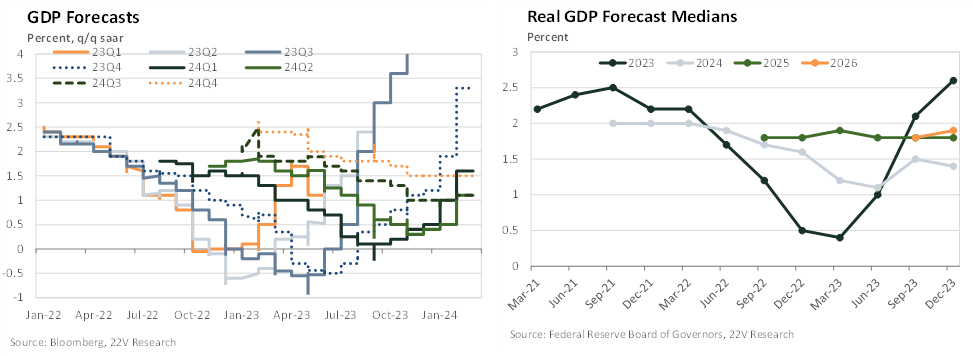
After a number of conversations with investors and in listening to the deluge of Fedspeak this week, a few key issues in the Fed forecasts and rate path outlook seem worth highlighting. Perhaps first among these is the Fed’s continued forecast for below trend growth in the near-to-medium-term, present for a few years now, rather than the more optimistic framing a bottoms-up approach to the growth forecast currently provides.
While I think 3 cuts, starting in May or June, remains a very tentative, well below 50%, base case (given the range of possible outcomes for the fed funds rate at end-24 it wild to have any single one modal and >50%), driven as much by a Fed desire to feel more comfortable with the stance of rates as any explicit need to cut or permission from inflation to do, the directional risks around that now seem notably more skewed to the upside (fewer cuts) than downside. The Fed may be uncomfortable cutting rates if core inflation has bounced some in 24H1 and later on in the year the likely outperformance of their growth forecasts could reduce the risk management case for doing so.
On net, my relative hawkishness is less about the timing of the first cut but rather the likely depth of cuts outside of a recession. The Fed seems to want to cut, if inflation gives it the opportunity, at least 50-100bps to re-symmetrize the medium-term risks around the mandates. But my suspicion is that with underlying growth holding up and inflation risks still skewed to the upside, the Fed will underdeliver on the dots and current market pricing over the medium-term.
History suggests that even notable financial conditions shocks usually only require 50-100bps of cuts to stabilize things so the getting a fed funds path well below 4% (i.e. it is unlikely to get to the center of my 3-4% range on the current nominal neutral rate of interest) is a bet on 6-24m recession odds and/or that pre-covid estimates of the neutral rate (2.5%) are correct and also exert a powerful drag on growth, which has just so far failed to assert itself in the aggregate.
Below are a few of the key issues I struggle with when trying to arrive at the Fed’s forecasts for the macroeconomy and the fed funds rate, related to the themes and risks above. Of course, the Fed’s forecasts are statements designed to shape outcomes in the present moment and also project the future. The recent more anti-dovish, rather than outright hawkish, move suggests that the below-potential growth baseline and downside risk management concerns it tied into at the December meeting were closer to the second honest-forecast explanation than the first.
- The Fed’s forecasts on growth remain too pessimistic as a base case with 2024 expected to come in at 1.4% in December SEP. They are likely to revise this up some in March (see more here) but this below potential feature of the forecast has been very sticky. This is largely driven by their views on the restrictive stance of policy and the impacts of long lags on the <1y growth outlook (see more here).
- One way of framing this likely forecasting error is that the Fed has adopted a forecast which is too top-down. With a positive output gap, itself fully dependent on the assessed level of potential GDP, the natural tendency of the economy is to slow with growth somewhat below potential GDP growth until output gap closes from above.[1] Normally this a recession and examples of growth growing in a non-recessionary but below trend pace for consecutive quarters are difficult to find.
- A more bottoms-up growth forecast suggests that that while services spending is likely slows a bit from last year, the most cyclical and rates sensitive parts of the economy (durable goods, manufacturing, housing, and, with a bit less confidence, the bank credit tightening cycle) are starting to turn up and no longer a drag on growth. This sets a higher floor for growth and takes away the channels for much of the Fed’s expected weakness.
- Without growth below trend, the Fed’s 2024 dot seems likely to have shown incredibly inertial policy which suggests that the Fed think’s the short-run neutral rate is extremely elevated or, in an observationally equivalent way, they are still engaged in anti-inflationary robust control which hasn’t yet seen structural inflation concerns abate.
- Despite all that, embracing the two-handed economist trope, it seems like the Fed wants to ease policy and is somewhat innately uncomfortable with rates at their present levels.
- This has become less urgent with the series of positive growth surprises to start the year but the default question is quite clearly how many cuts and when do they start, not what is the direction of travel for policy.
- This is largely driven by the Fed’s views on the longer-run stars, which have gone largely unchanged since before covid. As such they’re inclined to see the economy as somewhat more unstable in its present position rather than my view view that peak cyclical risks were in late-22 and early-23 (when the labor market was slowing banking shocks hit and the housing and manufacturing cycles rolled over).
- There is little agreement on what exactly constitutes sufficient continued good news on the inflation front and if there is a level of inflation above 2% (in a trend sort of way not exactly the as reported numbers) where cuts are likely to make sense from a risk balancing perspective (inflation slightly too high but endogenous cyclical risks present on the growth and labor market side), regardless of the rest of the outlook.
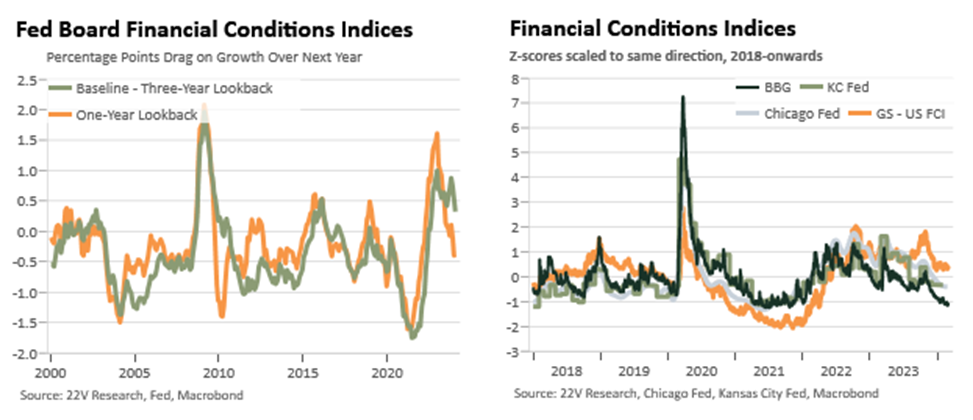
- Jefferson’s speech last week looking at the historical precedents of Fed cutting cycles was informative in this regard. He noted that the 1994-96 cycle was dominated by inflation concerns growing and then receding, but in every other cutting cycle he studied the cuts were initiated by acute shocks to either underlying growth or financial conditions (which raised medium-term growth tail risks).
- It’s unclear if these remarks were intended to be a tell about the Fed’s future responses to growth outperformance but they do emphasize just how inertial policy cycles are in the absence of a large gap upwards in the unemployment rate.
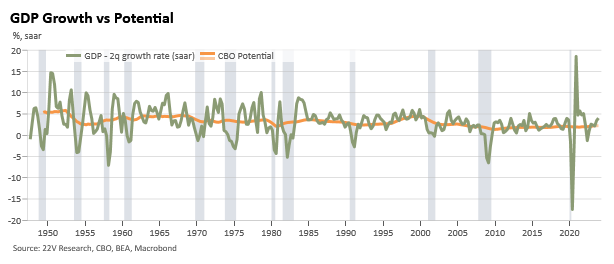
In reverse, when the output gap is negative but the economy outside recession the natural tendency of the economy is to grow somewhat above potential in most standard models (this is also what we see in history). ↑

