

Updating Fed Views After a Punchy Start to the Year
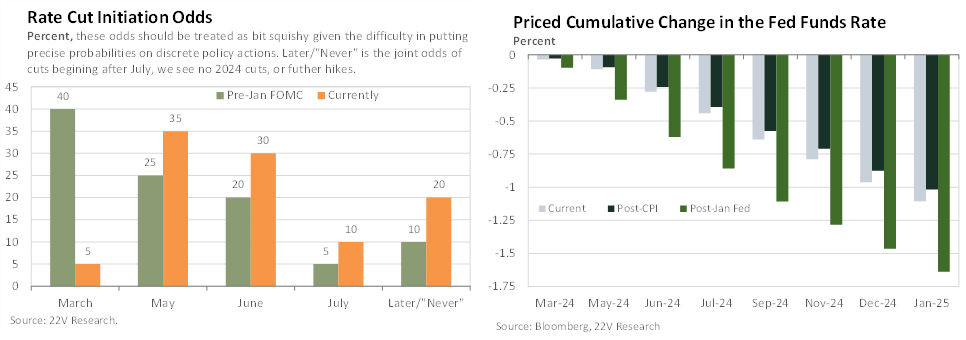
- May vs June is a close call and will be data and risk assessment (much more qualitative in nature) dependent. I lean a bit towards May as it allows the Fed to cut and then start winding down QT at the June meeting but that depends on the next few months’ inflation data being fairly well behaved, if not quite 23Q4 good.
- Over the course of 2024 I lean towards 3 total cuts as a base case, but 4, or 2, are possible in a base case economic environment as well.
- The exact timing of when the Fed begins to cut matters less than why they begin cutting. Non-recessionary cuts, even if they start in May, are likely to be fairly limited in nature. The start of the cutting cycle is primarily an inflation issue, while its speed and depth will be driven by the strength of activity and health of the labor market.
- The directional risks around this base case cuts seem roughly symmetric now, though the distribution of possible outcomes to the upside in rates is narrower than to the downside given likely Fed reaction to a substantial weakening in the labor market.
- The possibility of very late or no cuts (or the much more remote possibility of another hike or two) has grown notably with the hotter Jan inflation data and the continued general strength of the economy.
The Base Case
My base case remains that the Fed begins cutting rates in May, or June without too much practical difference, and then cuts a few more times over the second half of the year for 3 cuts over the course of the year. In this scenario, growth has remained above trend but cooled off from the blistering pace of 23H2, underlying inflation pressures slowly dissipate, and the labor market remains fairly healthy.
In the base case, cuts are not strictly necessary due to any signs of economic weakness or inflation well below target but rather about keeping the risk management concerns between both sides of the mandate fairly balanced. The Fed will have some residual inflationary concerns, which will lag the data notably given their fear of a resurgence in inflation that time more than the precise level of inflation will resolve, but the mid-to-late cycle environment and many signs of moderating activity, along with their current views on where the neutral rate is, mean that risk management concerns will favor some modest amount of cuts over 2024-25.
What is the Cutting Cycle Likely to Look Like?
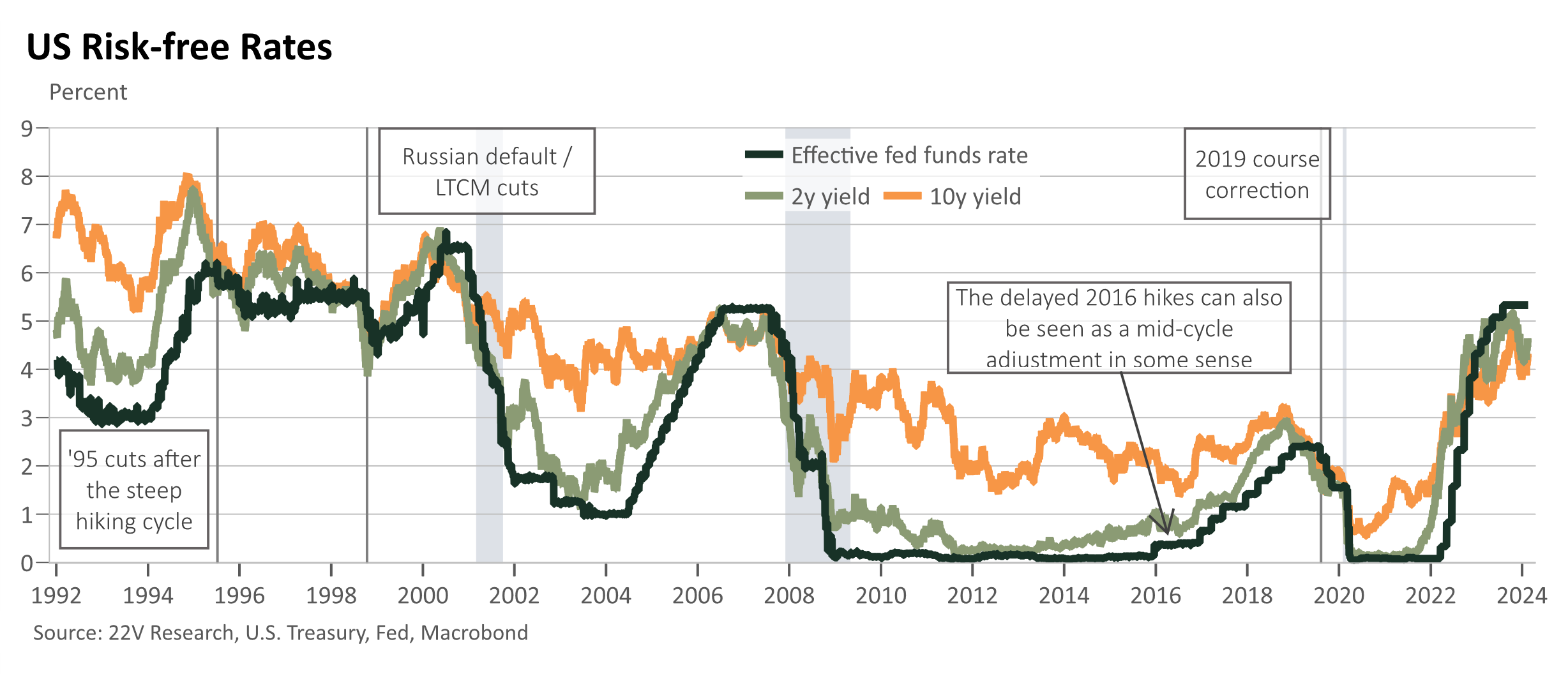
Prior experiences with mid-cycles corrections suggest that the process is unlikely to a smooth and gradual return to neutral (see more on prior mid-cycle corrections from the Fed here). This is somewhat attenuated by the much larger than historically normal gap between current policy and the Fed’s views on neutral, which lends a natural asymmetry to their medium-term views and assessments of risks to the employment side of the mandate.
If there is enough evidence to initiate cuts at all there is likely to be some momentum to that view; despite what they say about meeting-by-meeting they’re highly unlikely to start cutting unless they can do at least a few. This make me somewhat torn on the timing as a few fairly closely sequence cuts (2-4) could quickly get the Fed into a more symmetric risk management position from which the rate cut outlook into 2025 because less immediately obvious if the economy is continuing to hold up. But the seeming default, especially averaging across a wide range of possible paths, is to assume that gradual cuts get spaced out in a roughly every other meeting pattern but assume reality is likely to be bumpier than that.
In the event the labor market roles over more appreciably, or starts to threaten, cuts will naturally come more aggressively. In the event the labor market easing only modestly (call it a gradual move up to the mid-4s on the unemployment rate), 150-250bps of more rapid Fed cuts over the next 12-18m, and notable downdraft in market rates, will likely be enough to support the economy given the positioning in many more clearly cyclical and rate sensitive sectors. In this case the fed funds rate likely returns to roughly me estimate of nominal neutral (roughly 350bps) but doesn’t need to go much farther. If the unemployment rate starts to jump in a more non-linear manner (i.e. a couple sharp discrete moves higher than don’t revert away) the Fed will end up cutting towards a, highly approximate, recessionary floor around 1.5%. History suggests that while cuts happen more quickly than hikes generally do, they won’t be instantaneously at their floor, especially if inflation retains some initial inertia.
Sequencing Issues and Recent Hot Inflation Data Raise the Odds of Late or No Cuts
The odds of cuts beginning after June has increased notably since the January meeting. To some extent this hotter data has taken me partway back to where my views were in early fall 2023 with a very wide distribution of possible rates cut timing and a long hawkish tail.
July is of course an option but the late or “never” (in 2024 at least) tail has appreciably grown. I wonder if by not taking the dovish path when it had the chance the Fed is potentially pushing its cut initiation timeline into a somewhat more challenging moment later in the year when the data’s momentum might be a bit less helpful.
I see a few different reasons for why the Fed might end up going much later than currently anticipated, or not at all:
- In the first rationale, growth stays above the Fed’s current estimates of trend and while borrowing rates head a bit higher, they don’t choke off activity much so the Fed sees little non-model based reason to cut and takes its time. This could mean a later start to cuts or notably fewer cuts being seen as appropriate, especially cumulatively over 2024-25.
- The second possibility is that inflation inflects a bit higher as core goods deflation wraps up and CSEH and rents remain a bit stickier to the upside than currently expected in the base case. In this scenario, the Fed may be in the uncomfortable position of not cutting when 12m core PCE is extremely close to 2% but 3m and 6m have inflected above. Recent leaked comments from Powell, as well as those from Barr and Goolsbee, all suggest there’s some m/m inflation noise tolerance, but it remains an open question as to how much, if any, upturn is acceptable if it’s a bit more sustained.
The possibility of further hikes still seem a very remote one but if the economy continues to hold up, suggesting stronger underlying momentum and a higher neutral rate, and the inflation all shifts in a less dovish way, it remains possible. More likely the next possible hikes happen after the Fed’s initial cutting cycle (2-8 cuts in, sometime in 2025) and a period of reequilibration and stabilization. For now, both those seem like remote or distant scenarios but the data and policy environments that could lead to either are worth keeping in mind.

