

Reviewing Fedspeak Around this Cycle’s Cutting Criteria and Prior Mid-Cycle Adjustments
Assessing when, under what conditions, and how deeply the Fed will start cutting rates in 2024 continues to be a challenging endeavor. Market pricing has moved very aggressively and looks to be probing the downside limits of possible soft-landing consistent cutting paces (we’ll have more on our outlook and views on how best to position in subsequent pieces for both the December meeting and 2024).
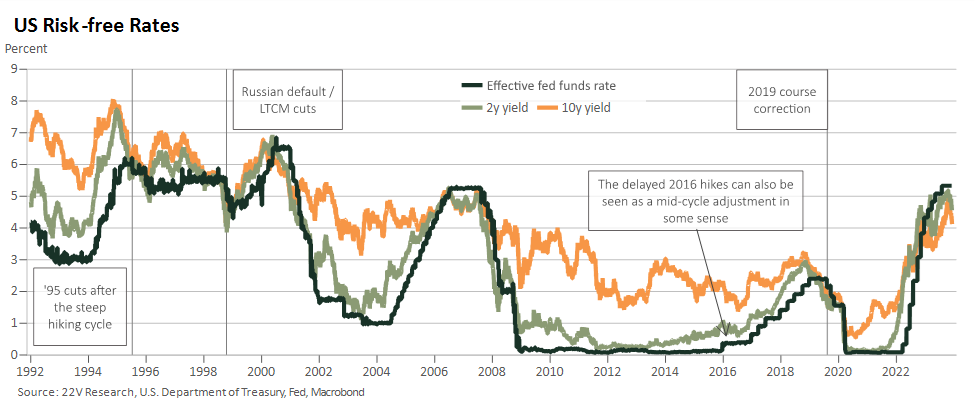
This piece explores recent comments from key Fed officials on the looming cutting cycle, as well as the justifications and debates from prior mid-cycle policy adjustments (1995, 1998, 2019, and, less exactingly the same, the 2016 pause in hikes). Hopefully it can serve as a handy reference going forward. Of course, the FOMC is far more publicly communicative now than it was then, changing the nature of how quickly financial conditions reflect or anticipate changes in policy[1] as well as which exact communications matter. Still, this is hopefully a nice window into the Fed’s thinking in modern era.
The most important point is that the data and evolving forward-looking risk management concerns around durably achieving 2% inflation will drive the process. My strong suspicion remains that the cutting cycle is unlikely to be a smooth process of rates converging to the current estimate of neutral over 18-24 months after cuts begin, regardless of what gets penciled in or models say.
A few themes come out from the historical evidence:
- Mid-cycle adjustments happen because the inflation and activity outlook, or risks around it, change enough to warrant a downshift in a previously restrictive stance of policy.
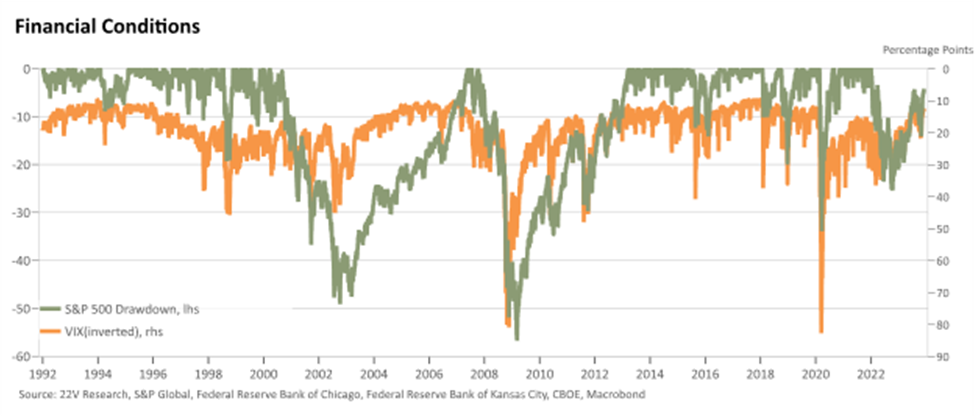
- In all cases financial conditions had tightened before the cutting cycles but in 1995 and 2019 financial conditions started easing by the time the cuts materialized; the current moment stands out for the depth and duration of the drawdown in the S&P which has preceded any cuts.
- Preemptive FCI easing isn’t likely to drive the Fed particularly more hawkish on any given day but long-term rates and risk assets are an important driver of the cycle and can shift the outlook in a way that requires a response (sometimes just doing more of the same).
- In both 1990s cases the cuts were ultimately followed by further hikes (in 2015 the hikes were delayed but the cycle ultimately resumed with a lower expected peak rate). With current nominal rates far above reasonable estimates of nominal neutral it’s wildly challenging to imagine the Fed returning to current levels after cutting but the lesson here is that concepts of neutral are less powerful as anchors over the medium-term than the data is. If the economy reaccelerates after cuts, especially a larger number of them, the future rate path may become increasingly symmetric or upside skewed.
Fed Comments on This Cutting Cycle
With policy shifting towards a strong base case that the Fed will be cutting rates at some in 2024 the questions of pace, timing, and extent remain difficult to project. So far only Governor Waller has given a particularly explicit verbal answer to even one of those issues. Of course, we need to remember that the SEP and dot plot have long shown cuts over the medium-term so while the Fed hasn’t been debating cutting as a part of the current paradigm for long it has surely been a part of their broader thinking and framing so we may start hearing more answers soon.
- “When we reach our terminal rate, how long we stay at that level will largely be driven by our progress in bringing down inflation.” – Gov. Waller 11/16/22
- “Historical experience cautions strongly against prematurely loosening policy. I guess I would say it this way: I wouldn’t see us considering rate cuts until the Committee is confident that inflation is moving down to 2 percent in a sustained way. So that’s the test I would articulate.” – Powell Dec 2022 press conference
- “The implication is, you know, we will do what it takes to get inflation down, and in principle, that, that could mean that if financial conditions get looser, we have to do more. But what tends to happen, though, is, financial conditions get in and out of alignment with what we’re doing, and, and, ultimately, over time, we get where we need to go.” – Powell July 2023 press conference
- “I do think that from my perspective, to keep maintaining a restrictive stance may very well involved cutting the federal funds rate next year, or year after, but really it’s about how are we affecting real interest rates — not nominal rates. My outlook is really one where inflation comes back to 2 percent over the next two years, and the economy comes into better balance, and eventually monetary policy will need over the next few years to get back to a more normal — whatever that normal is — a more normal setting of policy.” – Pres. Williams 8/7/23
- “As we go into next year, that’s the question we’ll be asking is—you know, taking into account lags and, and everything else we know about the economy and everything we know about monetary policy, the, the time will come at some point, and I’m not saying when, that it’s—that it’s appropriate to cut. Part of that may be that real rates are rising because inflation is coming down. Part of it just may be that—it’ll be all the factors that we see in the economy.” – Powell September 2023 press conference
- “Really, we’re going to be looking at the broader picture. You know, what’s happening with our progress toward the 2 percent inflation goal? Is the labor market continuing to, broadly, cool off and achieve a better balance? We’ll be looking at that. You know, growth—we look at growth insofar as it has implications for our two mandate goals. We look at that, and we look at broader financial conditions.” – Powell November 2023 press conference
- “I am increasingly confident that policy is currently well positioned to slow the economy and get inflation back to 2 percent. That said, there is still significant uncertainty about the pace of future activity, and so I cannot say for sure whether the FOMC has done enough to achieve price stability. Hopefully, the data we receive over the next couple of months will help answer that question.” – Gov. Waller 11/28/23
- “If you see this [lower] inflation continuing for several more months, I don’t know how long that might be—3 months? 4 months? 5 months?…. you could then start lowering the policy rate because inflation’s lower. It has nothing to do with trying to save the economy or recession… If inflation goes down, you would lower the policy rate.” – Gov. Waller 11/28/23
1995-96
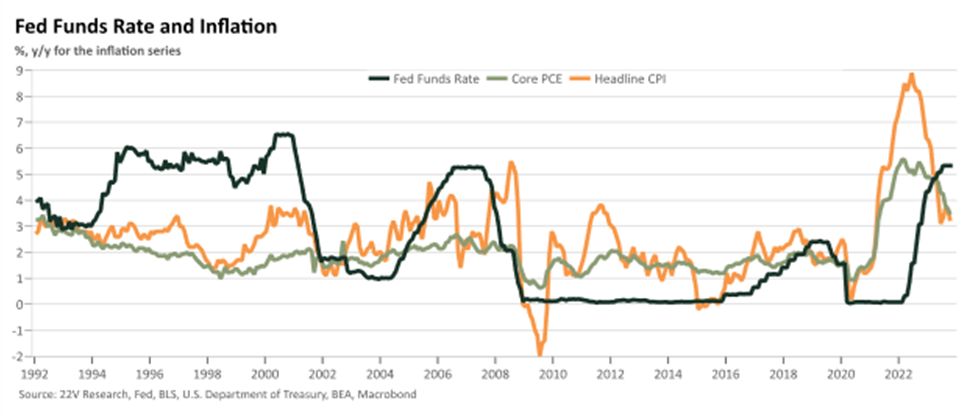
Following an aggressive and relatively short hiking cycle in 1994 and early-95, recessionary concerns had started to grow and inflationary pressures were seen as trending down. The 1995-96 mid-cycle adjustment began in July with a 25bps cut. The FOMC then was on hold until December when it cut in two consecutive 25bps increments, ending at 5.25% and then held there until March 1997. It is particularly worth noting the interplay between the FOMC’s actions and market expectations in these quotes as the Committee is cautious of markets getting ahead of them but also aware that lower long-term rates are supporting activity after the large tightening cycle impulse. It is also worth flagging that the FOMC began cutting even as it expected growth to pick up over the coming year.
- “As a result of the monetary tightening initiated in early 1994, inflationary pressures have receded enough to accommodate a modest adjustment in monetary conditions.” – July 1995 statement
- “We accordingly and appropriately moved the rate up as we confronted new circumstances in early 1994. Today, we have defused to a significant degree the inflationary pressures that were building through the early weeks of this year…. In this regard we have quite encouraging evidence that the cyclical peak in inflation may be close at hand. I think inflation is being held down by events in the rest of the world. The crucial question we must ask ourselves is whether we need a 3 percent real federal funds rate to continue the secular disinflation that we have been involved with for a number of years.” – Greenspan July 1995 meeting transcript
- “If as Don Kohn says… the current real short-term federal funds rate is above some notion of the equilibrium or natural rate, and hence that rate is consistent with a degree of restraint that is not appropriate to the disinflationary trend that we envisage is occurring, then the issue is whether we should bring the rate down.” – Greenspan July 1995 meeting transcript
- “A month or so ago when a very rapid decline in inflationary pressures seemed to be building up, I would have been inclined to say that we probably were safe in moving the rate down 50 basis points as a mid-course correction. In retrospect, I think that was a wrong view because I don’t think the markets would believe an announcement in which we tried to make clear that it was a mid-course correction and that it was as far as we would go, which is frankly as far as I think we ought to go.” – Greenspan July 1995 meeting transcript
- “I would like to see a cut to prevent a further backup in long-term interest rates, namely, to ratify the expectations implicit in the current structure of longer-term yields. I certainly am not arguing that we should be setting monetary policy by following the fed funds futures, but I think we should recognize situations when the market has gotten things right and act accordingly.” – then Gov. Yellen July 1995 meeting transcript
- “The apparent pause in the expansion was likely to prove temporary, and their forecasts generally pointed to an upturn in overall economic activity to a pace in the neighborhood of the economy’s potential by the latter part of this year or early 1996. Many emphasized that the prospects for a strengthening economy were enhanced by the drop in intermediate- and long-term interest rates and the rise in equity prices.” – July 1995 minutes
- “A few members preferred somewhat greater easing. They stressed that such a move was warranted by the recent pause in the expansion and the apparent vulnerability of the economy to a variety of downside risks… The declines in intermediate- and long-term interest rates were helping to support the expansion, but those declines rested in part on market expectations of significant monetary policy easing; failure to ratify such expectations could well result in at least a partial reversal of those desirably lower rates.” – July 1995 minutes
1998
The 1998 cutting cycle was much less deliberate and macroeconomically driven than the 1995-96 one. Rolling financial shocks, culminating in the Russian sovereign default and blowup of LTCM, led the Fed to cutting 3x 25bp increments across 6 weeks, including one inter-meeting cut. The fairly rapid rebound in broader financial conditions in the US and strong underlying domestic momentum meant that these cuts were short-lived and by June 1999 the Fed was hiking again.
- “The action [cutting 25bps] was taken to cushion the effects on prospective economic growth in the United States of increasing weakness in foreign economies and of less accommodative financial conditions domestically. The recent changes in the global economy and adjustments in U.S. financial markets mean that a slightly lower federal funds rate should now be consistent with keeping inflation low and sustaining economic growth going forward.” – September 1998 statement
- “On balance, however, credit conditions were likely to remain tighter and equity prices lower than earlier, and in the context of continued damped inflation, monetary policy had the room to adjust to these new circumstances. In any event, an easing policy action at this point could provide added insurance against the risk of a further worsening in financial conditions and a related curtailment in the availability of credit to many borrowers.” – September 1998 minutes
- “The case for easing does not rest on incoming data about the economy… Rather, the case for easing relies on projections that have been marked down by developments overseas and in U.S. financial markets.” – Don Kohn Board economist, September meeting transcript
- “As I noted earlier, an easing has to be justified as a preemptive response to a significant change in the forecast. In regard to that forecast, we have changes that involve some combination of a lower central tendency for growth next year and wider downside risks.” – Gov Meyer, September meeting transcript
- “Growing caution by lenders and unsettled conditions in financial markets more generally are likely to be restraining aggregate demand in the future. Against this backdrop, further easing of the stance of monetary policy was judged to be warranted to sustain economic growth in the context of contained inflation.” – Inter-meeting cut statement in Oct 1998
- “Last fall the Committee reduced interest rates to counter a significant seizing-up of financial markets in the United States. Since then much of the financial strain has eased, foreign economies have firmed, and economic activity in the United States has moved forward at a brisk pace. Accordingly, the full degree of adjustment is judged no longer necessary.” – June 1999 statement as hikes began again.
2016
Given that 2016 involved no cuts it is perhaps a bit odd to include it here, however the lack of follow-through on hikes after Dec 2015 until Dec 2016 represents an important pivot and example of data dependence in action. In the Dec 2015 dot plot, the FOMC median projected 4 hikes in 2016; ultimately only 1 was realized. Staff and FOMC forecasts at the time suggested that the unemployment rate was about to move below its longer-run level of 5% (ultimately revised down to 4% or so) but at the same time Larry Summers revisiting of secular stagnation was beginning to see increasing influence in policy circles (after much of the immediate post-GFC period had assumed things would look the same as before it).
- “The persistent weakness in core price inflation deserves continued vigilance. In determining the outlook for inflation, the gravitational force of long-term inflation expectations is especially important… The slow progress on inflation, together with the likely low level of the longer-term neutral real rate and the slow pace at which the very low shorter-term rate may move to the longer-term rate, suggest that the federal funds rate is likely to adjust more gradually and to a lower level than in previous expansions. In short, “gradual and low” is likely to be the new normal.” – Brainard speech in December 2015
- “A number of participants pointed out that because inflation was still running well below the Committee’s objective and the outlook for inflation was subject to considerable uncertainty, it would probably take some time for the data to confirm that inflation was on a trajectory to return to 2 percent over the medium term.” – Minutes of the December 2015 meeting
- “I assume liftoff at this meeting and a total of three increases of 25 basis points each for 2016 and three more in 2017. I believe that for the next couple of years, economic weakness around the world will mean that the Committee can and should remove accommodation only gradually.” – then Gov. Powell, December 2015 transcript
- “Inflation expectations, however, continue to raise concerns, and this underscores the need to actually achieve 2 percent inflation… To wrap up, while I do expect both spending and labor market data to remain solid for the next few quarters, the weaker recent labor market data suggest reason for caution in the near term.” – then Gov. Powell, June 2016 transcript
- “Nonetheless, the labor market has continued to tighten, and the forecast is for output to strengthen and inflation to continue on its path of gradual increases. If that forecast is broadly realized, then I believe that it will be appropriate to raise the federal funds rate soon. I’ve written down one rate increase for this year and two for next year… Inflation is below our 2 percent objective and has been every single month since the second quarter of 2012. We’re making progress toward 2 percent inflation, and my baseline case that we can continue to do that.” – then Gov. Powell, June 2017 transcript
2019
With markets weak and inflation still running below target on a trend basis, and notably weaker after Chair Powell’s “long way from neutral” comments in fall 2018, the FOMC cut 3x 25bps starting in July 2019. The Fed had gradually moved rates up to its estimate of neutral but the persistence of inflation below target and markets that were ultimately more brittle than expected led the Fed to reverse the course relatively quickly.
Despite the usual anchoring to the SEP meetings in Fed watching (a reasonable and somewhat hard to escape from tendency), it is important to note that in the June 2019 SEP the FOMC projected an unchanged Fed funds rate through the end of 2019, with one median cut in 2020, before returning to the 2.25-2.5% range in 2021. This was a shift down over 2020 and 2021 of 50 and 25bps respectively, when compared to the March 2019 SEP.[2]
- “In light of the implications of global developments for the economic outlook as well as muted inflation pressures, the Committee decided to lower the target range for the federal funds rate to 2 to 2-1/4 percent.” – July 2019 meeting statement
- “First, while the overall outlook remained favorable, there had been signs of deceleration in economic activity in recent quarters, particularly in business fixed investment and manufacturing…. Second, a policy easing at this meeting would be a prudent step from a risk-management perspective… Third, there were concerns about the outlook for inflation. A number of participants observed that overall inflation had continued to run below the Committee’s 2 percent objective.” – July 2019 minutes
- “Most participants viewed a proposed quarter-point policy easing at this meeting as part of a recalibration of the stance of policy, or mid-cycle adjustment, in response to the evolution of the economic outlook over recent months. A number of participants suggested that the nature of many of the risks they judged to be weighing on the economy, and the absence of clarity regarding when those risks might be resolved, highlighted the need for policymakers to remain flexible and focused on the implications of incoming data for the outlook.” – July 2019 minutes
We note this line from Chair Powell at the November 2022 press conference: “One big difference now is that it used to be that you would raise the federal funds rate, financial conditions would react, and then that would affect economic activity and inflation. Now financial conditions react well before in expectation of monetary policy [actions]. That’s the way it has moved for a quarter of a century—in the direction of financial conditions, then monetary policy—because the markets are thinking, what is the central bank going to do?” ↑
I look forward to the release of the transcripts for the June and July 2019 meetings in a few years to see if the SEP was actually an honest forecast in June or if public-facing inertia ruled the day but they were strongly anticipating cutting in the near-term. ↑

