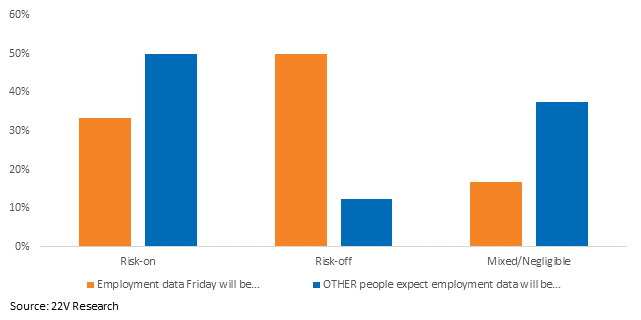
SUMMARY: Most investors we polled yesterday expect Payrolls today to be risk-off but don’t realize that is a surprisingly popular answer (they think other people are looking for a risk-on reaction). An in-line reading would be best for our risk on factor call, even if in-line data doesn’t deliver a cut in March. We laid out why a May vs. March cut is not a scene changer in yesterday’s report HERE.
Important point on the FOMC Ahead of Payroll: Powell was slightly hawkish on the near-term reaction function, but as Gerard noted, “their actual forecast and the logical behind it are benign and clearly dovish for the medium term”. Specifically, Powell noted the importance of 12 month inflation rates (which will decline given lagging rents impact), he noted that policy is “well into restrictive territory”, that implies more focus on real rates than broader financial conditions (i.e. they are much less focused on the recent FCI easing and its potential to keep inflation too high) and lastly he highlighted that nominal wage growth is slowing and he expects that trend to continue. If wage data today confirms Powell’s take, FCI will remain easy and risk-on factors and the average stock will do well.
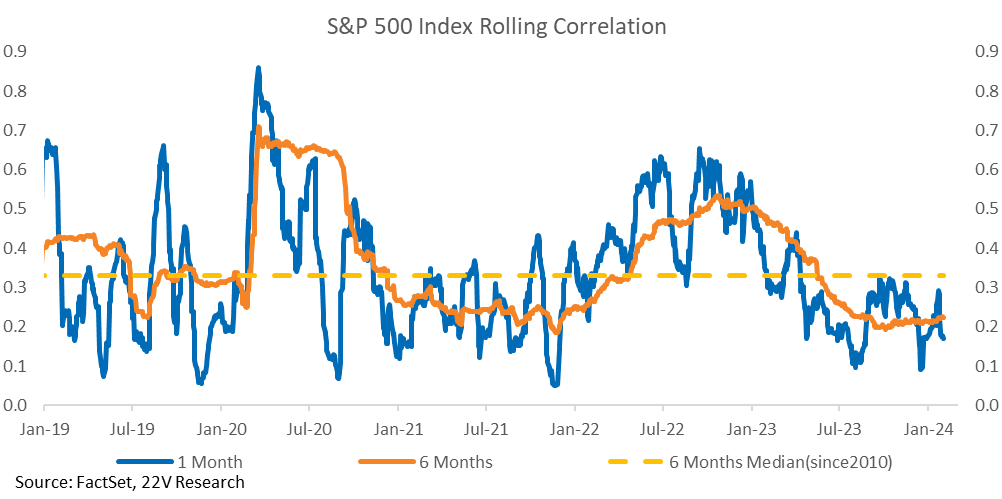
MEGA CAP EARNINGS: Apple is down -3% overnight after posting disappointing sales in China. Meta is up over +17% after beating earnings and announcing a dividend and massive buyback. Amazon is up +7% after a robust beat and strong outlook. The return dispersion of mega caps this week echoes one of our broad points – correlations are falling and now is a good time to add idiosyncratic risk. Correlations should stay around these levels barring data surprises.
MONITORING VOLATILITY: At the beginning of the year, small caps and risk factors underperformed. Despite economic data showing the strength we expected. After a post-mortem analysis still-elevated implied rate volatility, much higher implied equity vol for small caps than large, and the increasing cost of hedging tail risk. All showed uncertainty under the surface. Those vol metrics have eased, which is good for our calls going forward. Getting through recent clearing events has helped. Near-term policy volatility will still be relatively elevated, but unless some event leads to a material change in the economic outlook (2-2.5% GDP growth with 3-4 cuts), we will continue to be a buyer of policy induced spikes in risk on factor vol. CPI revisions next Friday is the next clearing event.

Implied rate vol increased following the FOMC, from its 60th to its 71st percentile. The direction is bad, but it’s a far cry from the 91st percentile during the risk-off rally to start the year. Implied volatility in small caps is increasing relative to large caps again. And hedging costs are increasing, particularly in short-dated contracts.
More details in the full report below…
MARKET VIEWS: Most of the investors we polled yesterday expect Payrolls today to be risk-off, but that is a surprisingly popular answer. Our consensus estimates for today’s data are Payrolls 180k, AHE split between 4% and 4.1%, and urate 3.8%. That’s roughly in line with bbg consensus (investors are slightly lower on Payrolls and AHE). An in-line reading would be best for our small cap call, even if in-line data doesn’t deliver a cut in March. We laid out why a May cut instead of a March cut is not a scene changer in yesterday’s report HERE. We expect investors would be sensitive to outlier strength (Fed needs to tighten) and weakness (Powell just emphasized needing more inflation data).
MEGA CAP EARNINGS: Apple is down -3% overnight after disappointing sales in China. Meta is up over +17% after beating earnings and announcing a dividend and massive buybacks. Amazon is up +7% after a robust beat and strong outlook. Mega cap earnings have been mixed this quarter and return dispersion wide. The dispersion echoes one of our broad points – correlations are down and now is a good time to add idiosyncratic risk. Correlations should stay around these levels barring data surprises.
MONITORING VOLATILITY: At the beginning of the year, our call for a small cap, risk-on rally was wrong, despite economic data showing the strength we expected. After a post-mortem analysis, we figured we missed still-elevated implied rate volatility, much higher implied equity vol for small caps than large, and the increasing cost of hedging tail risk, all showing uncertainty under the surface. Those metrics of vol eased over the subsequent weeks, and our call worked. Now following Powell, as we said yesterday (HERE), there is a risk that uncertainty weighs on risk-on factors despite the economic backdrop remaining constructive for a catchup trade. So today we run through the metrics we missed last time. The net net of the below is that uncertainty has increased/is increasing, but not enough to change our framework of buying broad risk asset declines. We expect near-term volatility and will keep monitoring the below for material changes.
First, implied rate vol had dipped down to its 60th percentile pre-FOMC. Now, it’s back up to its 71st. The direction is not encouraging, but it’s a far cry from the 90th percentile like at the beginning of the year when risk-off assets were outperforming.
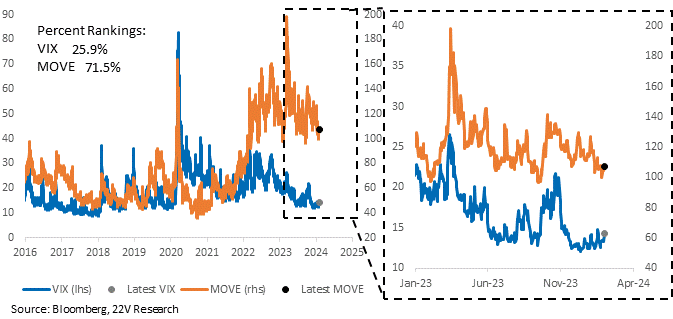
Implied vol for small caps is rising relative to large again.
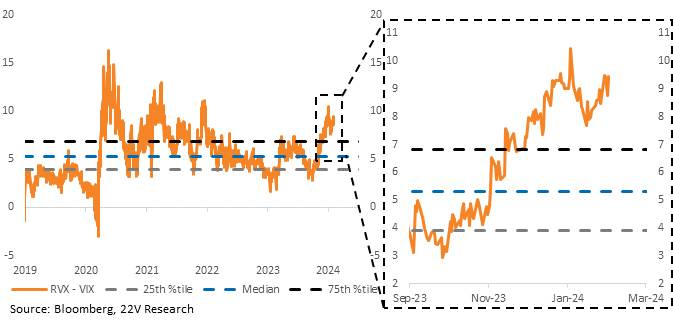
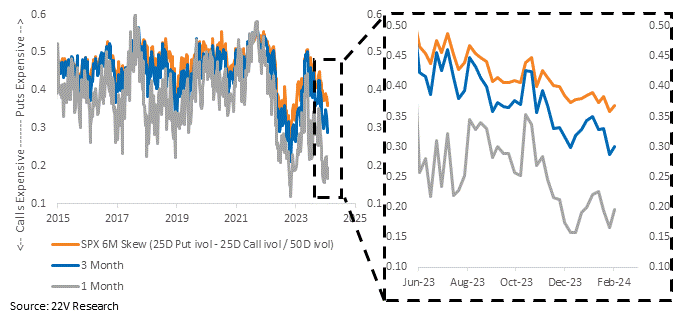
And hedging costs have bounced, particularly for contracts expiring in a month. There is some evidence of higher uncertainty, especially in the short term.
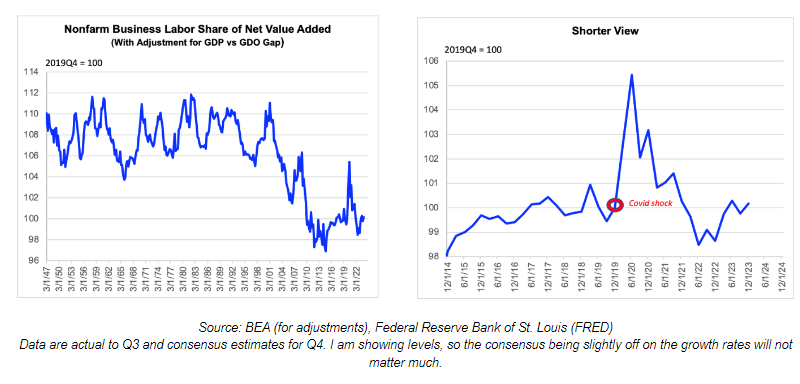
TAIL RISK: The following is not a short-term concern. We have seen an argument that real wages can catch up to their pre-covid trend. Ie, wages have lagged inflation, and nominal wage growth > inflation is no problem because there is a gap that is closing. We disagree. The catchup effect would be the case if the labor share had dropped during the inflation shock and needed to be clawed back. But that didn’t happen (see the chart below). So, from here, an acceleration of real wages could be met with 1) higher prices (inflation) or 2) worse margins. Neither is good. Sustained higher real wages (which isn’t our economic call) would be a tail risk to risk assets.