Economic data for 4Q has surprised to the upside, leading to upward revision to near/medium term growth expectations. Financial conditions have been easing since late October without any push back from the Fed, which suggests better growth prospects ahead. The improvement in consensus expectations are consistent with the steady improvement of our Macro Regime Classification (MRC) model (HERE). The bottom line is that a broad set of data are pointing to faster than expected growth.
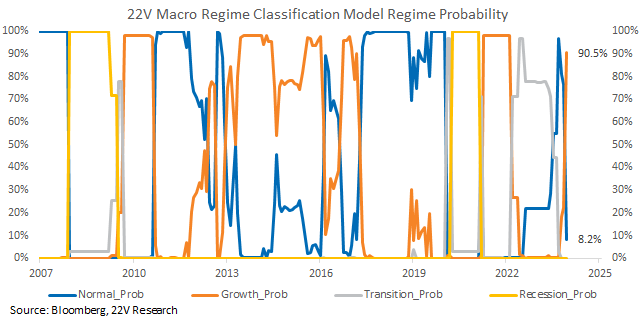
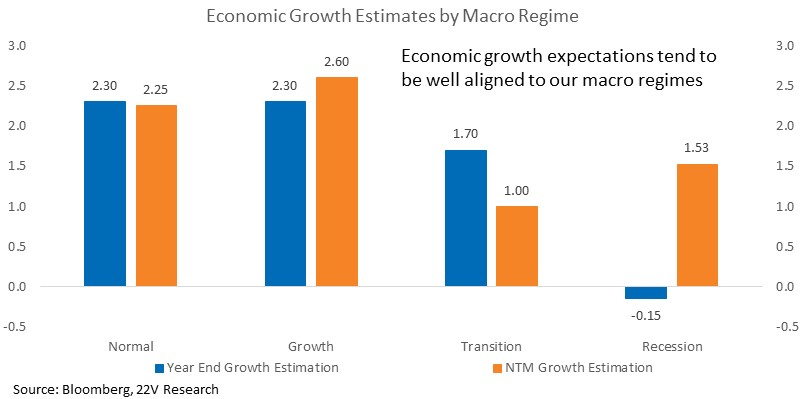
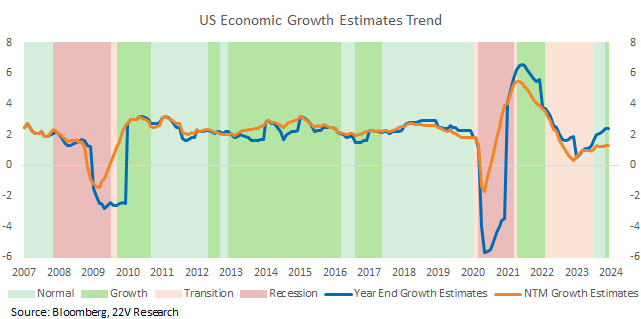
Over the past month, the MRC estimated probability of the economy being in a Growth regime has climbed sharply. The economy has moved decidedly into an expansion phase, pushing recession odds lower. Consensus growth estimates tend to be strongest during MRC expansion regimes, weaker during Transition periods (mostly recently 2022 to mid-’23), and Recession periods. The point is that the regime model tends to capture shifts in growth estimates, and the recent surge into a Growth regime suggests further upward revisions to NTM growth estimates over the coming months.

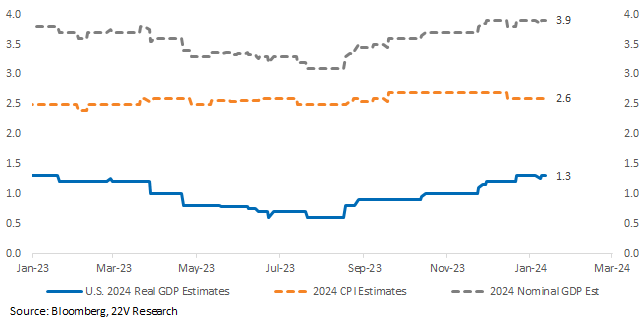
Consensus estimates for 2023 growth have improved over the past year to ~1.3% (real). That level is lower than the median for historical Normal and Growth regimes. Economic growth remaining firm despite the rapid pace of rate hikes during the most recent cycle suggests a higher sustainable level of rates/growth than in the post-GFC period.
That is important because to start 2024, investors remain concerned about slower growth (HERE), but the latest payroll and inflation readings both suggest stronger than expected growth. We expected to see further upward revisions to growth estimates over the coming months.
Growth Expectations & Regimes: Economic data for 4Q has surprised to the upside, leading to upward revision to near/medium term growth expectations. Financial conditions have been easing since late October without any push back from the Fed, which suggests better growth prospects ahead. The improvement in consensus expectations are consistent with the steady improvement of our Macro Regime Classification (MRC) model (HERE). The bottom line is that a broad set of data are pointing to faster than expected growth.
Over the past month, the MRC estimated probability of the economy being in a Growth regime has climbed sharply. The economy has moved decidedly into an expansion phase, pushing recession odds lower. The rotations we expect to see near term are between Growth – fast expansion – and Normal – slower growth, but still expanding. A recession call today would require a shock or a broad deterioration of data.
Consensus growth estimates tend to be strongest during MRC expansion regimes, weaker during Transition periods (mostly recently 2022 to mid-’23), and Recession periods. The volatility of estimates during Recession periods is larger with average NTM estimates positive, but annual estimates negative. That is consistent as recessions are 1) rare, 2) have tended to be short, and 3) see significant growth rebounds. The point is that the regime model tends to capture shifts in growth estimates, and the recent surge into a Growth regime suggests further upward revisions to NTM growth estimates over the coming months.
Consensus estimates for 2023 growth have improved over the past year to ~1.3% (real). That level is lower than the median for historical Normal and Growth regimes. Economic growth remaining firm despite the rapid pace of rate hikes during the most recent cycle suggests a higher sustainable level of rates/growth than in the post-GFC period. What that means is growth is likely to accelerate further from here.
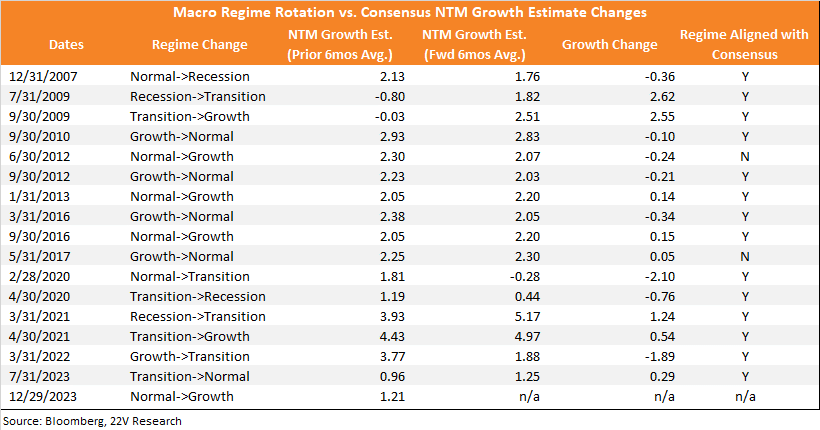
A more detailed comparison of regime changes and NTM GDP estimates changes shows that for the 16 regime changes over the past 17 years (the period where bbg consensus growth estimates are available) there have only been two regime shifts that were not confirmed by changes in consensus estimates. Last year, the model signaled rotation back Normal a quarter ahead of market consensus estimates bottoming. To start 2024, investors remain concerned about slower growth (HERE), but the latest payroll and inflation readings both suggest stronger than expected growth. We expected to see further upward revisions to growth estimates over the coming months.
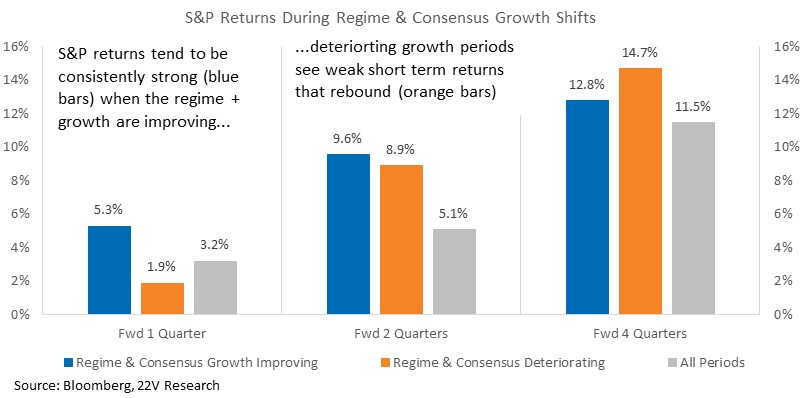
An Aside About Growth & the S&P: Regime and consensus growth estimate changes tend to have a limited impact on the path of index returns. Periods where the regime and consensus estimates are improving see stronger and more consistent returns, particularly over short periods. But, even when the regime/growth estimates are deteriorating, outside of near-term (1Q) weakness, equities tend to rise. The important takeaway here is that growth trends are NOT the determining factor for index returns. They matter far more for internals.