Back China Strategy

Taiwan election: Final polls show DPP’s Lai leading a competitive race

Published on January 4, 2024

∙ Download the PDF Report

By

Michael Hirson

Taiwan will hold presidential and legislative elections on January 13. Our preview report last week laid out the geopolitical and market implications of this event (see link HERE). In this note we provide a quick update on the latest dynamics.

SUMMARY

  • Vice president William Lai of the Democrat Progressive Party (DPP) remains the front-runner to win’s Taiwan January 13 presidential election; a Lai victory would mean that China-Taiwan tensions remain elevated for the next four years, a neutral-to-negative outcome for markets
  • A victory by Hou Yu-ih of the Kuomintang Party (KMT) is very possible and would imply at least a temporary reduction in China-Taiwan tensions that should be favorable to Taiwan assets in particular; Ko Wen-je of the Taiwan People’s Party is in third place but could play spoiler in the presidential race as well as in legislative elections
  • Factors that could swing the election include the candidates’ final performance on the campaign trail, the potential for China to issue threats in a bid to influence the election, and the extent to which Ko’s supporters defect for the two leading candidates

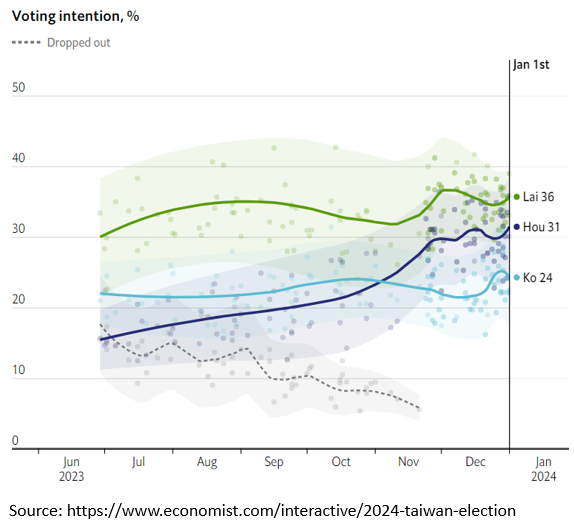
Taiwan’s election law limits the release of public opinion polls within ten days of the election, so the final polls are now out, as of Jan. 2. These show DPP candidate William Lai (Lai Ching-te), Taiwan’s vice president, leading his two opponents in a race that remains competitive into the home stretch. Pictured below is Economist.com’s aggregate of recent polls, which is consistent with other sources.
A graph of the number of people in the united states

Description automatically generated with medium confidence

Lai has a five point lead over KMT challenger Hou Yu-ih. This margin makes it a much closer race than in 2016 and 2020, in which the DPP’s Tsai Ing-wen was leading the KMT candidate by double-digits and went on to win comfortably. An additional wildcard in this election is a third party candidate, Ko Wen-je of the Taiwan People’s Party. Ko has a chance for second, and his supporters could potentially tip the election to Hou if they end up defecting to the KMT in sizable numbers (by no means assured, as discussed below).

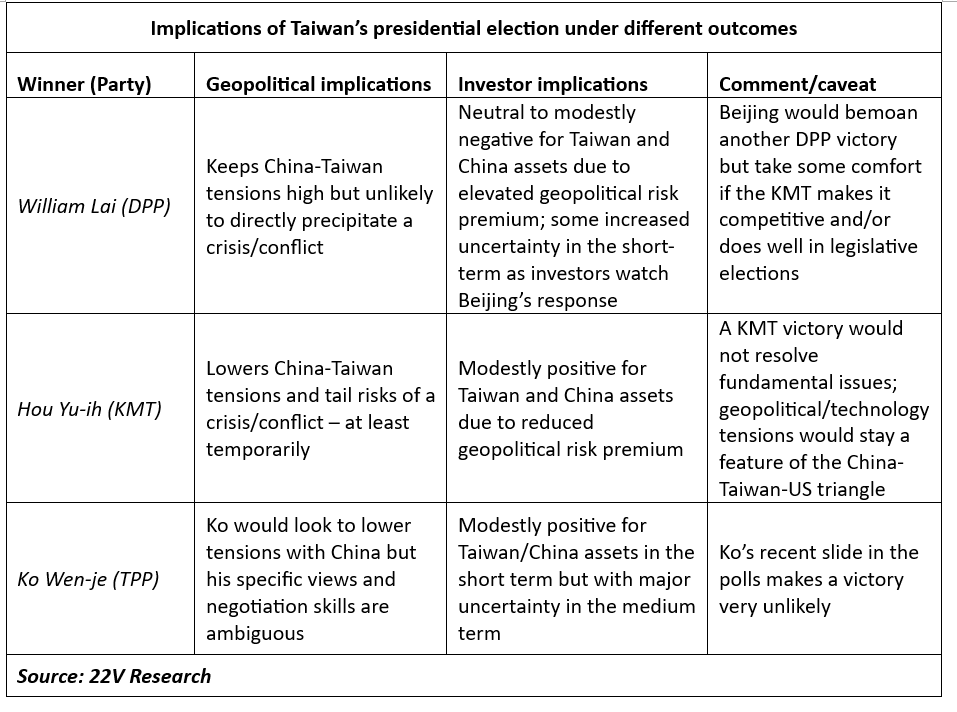
As a reminder of the key geopolitical and market implications (see also table at bottom):

  • A victory by the DPP (Lai) is market-neutral to -negative, in that it would mean that China-Taiwan tensions remain high for the next four years; Taiwan would also remain a highly sensitive flashpoint for US-China relations.
  • A victory by the KMT (Hou Yu-ih) would be at least modestly market positive, especially for Taiwan assets, as it would lower China-Taiwan tensions and the tail risks of a crisis or conflict – at least temporarily.
  • A victory by Ko Wen-je of the TPP is highly unlikely but would also lower China-Taiwan tensions for a while.

Nathan Batto, a political scientist who runs a highly informative blog on elections on Taiwan (https://frozengarlic.wordpress.com/), emphasizes the uncertainty in the home stretch:

The polls suggest that Lai is the most likely to win, but it is no sure thing. Likewise, the polls suggest that Ko will finish last, but that’s also not written in stone. Hou is most likely to finish second, but I wouldn’t bet my house against him either winning or coming in last place. This is one of those elections where we have to wait until they count the votes. The crystal ball is pretty cloudy.

And remember, there are still 10 days to go, and we won’t have any polling during that period. Lots of crazy things can happen in that time to make all this previous polling irrelevant.

What are some of the “crazy things” and other factors that could impact the final results?

  • Swings in momentum such as due to gaffs by candidates. Polls show 11% of respondents are undecided.
  • Potential actions by China to influence the election. Beijing has learned that aggressive saber-rattling close to the election can backfire but this does not rule out surprises. Beijing’s overt threats have thus far been relatively restrained. Its most visible move has been to fly surveillance balloons around and over Taiwan in the last month in a subtle (by Beijing’s standards) reminder of how closely China is watching.
  • “Strategic voting.” If Ko’s supporters conclude that he is unlikely to win and decide to vote for other candidates, the KMT’s Hou is likely to be the net beneficiary. Batto’s blog has a deep dive on this topic (link HERE) and concludes that strategic voting may not be as powerful a factor for Hou as some observers expect but could play a role especially in a tight race.

Barring major events in the final days of the campaign, the next watchpoint will be the results themselves. Bloomberg News notes that based on past elections, results should be clear by around 8pm in Taiwan, or 7am ET on January 13.

As discussed in our outlook piece, it is worth remembering that voters will also cast ballots for the legislature (known as the Legislative Yuan). While not as important for geopolitics as the presidential election, the legislative elections are part of the picture. Most forecasters expect the DPP to lose its majority in the legislature. For Beijing, a particularly strong showing by the KMT and/or TPP in legislative elections – demonstrating political support for parties in favor of dialogue with China – could make the DPP winning the presidency a bit more tolerable.
A white and black chart with black text

Description automatically generated

DISCLOSURES AND DISCLAIMERS

Analyst Certification

The analyst, 22V Research Group, primarily responsible for the preparation of this research report attests to the following: (1) that the views and opinions rendered in this research report reflect his or her personal views about the subject companies or issuers; and (2) that no part of the research analyst’s compensation was, is, or will be directly related to the specific recommendations or views in this research report.

Analyst Certifications and Independence of Research.

Each of the 22V Research analysts whose names appear on the front page of this report hereby certify that all the views expressed in this Report accurately reflect our personal views about any and all of the subject securities or issuers and that no part of our compensation was, is, or will be, directly or indirectly, related to the specific recommendations or views of in this Report.

22V Research (the “Company”) is an independent research provider. The Company is not a member of the FINRA or the SIPC and is not a registered broker dealer or investment adviser. 22V Research has no other regulated or unregulated business activities which conflict with its provision of independent research.

22V Research, LLC is a professional services and independent publication organization. 22V Research, LLC is not a securities broker-dealer, not a member of the Financial Industry Regulatory Authority (FINRA), not a registered investment advisor (RIA) and not a member of SIPC.

Securities transactions, when offered, are offered by 22V Securities, LLC through LPS Capital, LLC. Certain employees of 22V Securities, LLC are dually registered as securities representatives of LPS Capital, LLC or Analyst Hub Securities, LLC. 22V Securities, LPS Capital and Analyst Hub Securities are members FINRA, SIPC.

https://brokercheck.finra.org/

Current Ratings Definition.

SECTOR OUTPERFORM: An “outperform” rating anticipates the company will outperform the S&P Regional Banking Index (peer group).

SECTOR PERFORM: A “market perform” rating anticipates the company will perform in line with the S&P Regional Banking Index (peer group).

SECTOR UNDERPERFORM: An “underperform” rating anticipates the company will underperform the S&P Regional Banking Index (peer group).

Limitation Of Research And Information.

This Report has been prepared for distribution to only qualified institutional or professional clients of 22V Research Group. The contents of this Report represent the views, opinions, and analyses of its authors. The information contained herein does not constitute financial, legal, tax or any other advice. All third-party data presented herein were obtained from publicly available sources which are believed to be reliable; however, the Company makes no warranty, express or implied, concerning the accuracy or completeness of such information. In no event shall the Company be responsible or liable for the correctness of, or update to, any such material or for any damage or lost opportunities resulting from use of this data. Nothing contained in this Report or any distribution by the Company should be construed as any offer to sell, or any solicitation of an offer to buy, any security or investment. Any research or other material received should not be construed as individualized investment advice. Investment decisions should be made as part of an overall portfolio strategy and you should consult with a professional financial advisor, legal and tax advisor prior to making any investment decision. 22V Research Group shall not be liable for any direct or indirect, incidental or consequential loss or damage (including loss of profits, revenue or goodwill) arising from any investment decisions based on information or research obtained from 22V Research Group.

Reproduction And Distribution Strictly Prohibited.

No user of this Report may reproduce, modify, copy, distribute, sell, resell, transmit, transfer, license, assign or publish the Report itself or any information contained therein. Notwithstanding the foregoing, clients with access to working models are permitted to alter or modify the information contained therein, provided that it is solely for such client’s own use. This Report is not intended to be available or distributed for any purpose that would be deemed unlawful or otherwise prohibited by any local, state, national or international laws or regulations or would otherwise subject the Company to registration or regulation of any kind within such jurisdiction.

Copyrights, Trademarks, Intellectual Property.

22V Research Group, and any logos or marks included in this Report are proprietary materials. The use of such terms and logos and marks without the express written consent of 22V Research Group is strictly prohibited. The copyright in the pages or in the screens of the Report, and in the information and material therein, is proprietary material owned by 22V Research Group unless otherwise indicated. The unauthorized use of any material on this Report may violate numerous statutes, regulations and laws, including, but not limited to, copyright, trademark, trade secret or patent laws.
