

SUMMARY
- The outcome of Taiwan’s Jan 13 presidential election will directly impact China-Taiwan tensions, and by extension US-China tensions, for the next four years; the race is competitive between Vice President William Lai of the Democratic Progressive Party (DPP) and Hou Yu-ih of the Kuomintang Party (KMT), with Ko Wen-je of the Taiwan People’s Party (TPP) now in distant third place.
- Victory by front-runner William Lai of the DPP would keep China-Taiwan tensions elevated and be neutral to modestly negative for Taiwan and China assets; Taiwan and China assets come under short-term pressure immediately following the election as Beijing increases saber-rattling and other coercive measures, but the election itself is unlikely to provoke an acute crisis.
- An upset victory by the KMT’s Hou Yu-ih would lower China-Taiwan tensions at least temporarily as Beijing turns from “sticks” to “carrots” to encourage political and economic integration; while this outcome would be at least modestly positive for Taiwan assets, it would not resolve the fundamental drivers of geopolitical risk in the China-Taiwan-US triangle.
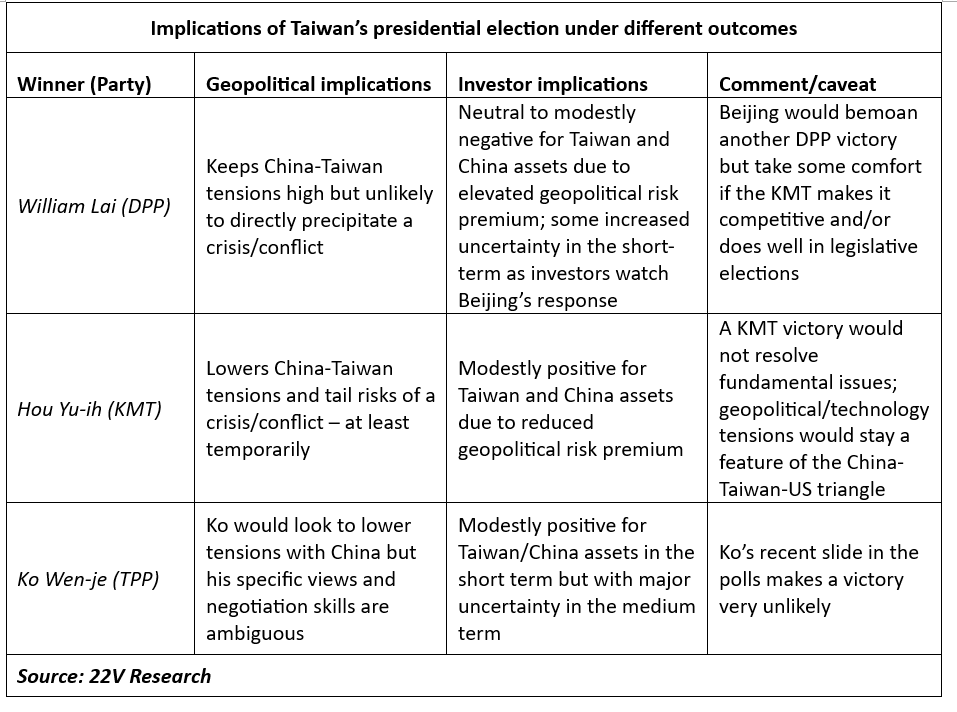
Geopolitical dynamics get off to an early start next year with presidential and legislative elections in Taiwan on January 13. This note lays out key implications of the elections in different scenarios, focusing on geopolitical considerations for global investors. We will continue to cover the run-up to elections and the results.
Why do these elections matter for global investors?
The elections will have a significant bearing on the tense relationship between China and Taiwan. Taiwan’s president, Tsai Ing-wen of the Democratic Progressive Party (DPP), is stepping down after two four-year terms. Her vice president, William Lai (Lai Ching-te), is the front-runner in the race to succeed her. The DPP advocates for Taiwan’s autonomy, if not formal independence (a redline for Beijing), from the People’s Republic of China. Should Lai win the election, it would at the very least ensure that China-Taiwan (“cross-Strait”) tensions stay high for the next four years. Taiwan would remain the most sensitive issue in the US-China relationship as well. These tensions, including the tail risk of a China-Taiwan conflict that involves the US, would continue to hang over Taiwan and Chinese assets.
An upset victory by Taiwan’s opposition would reduce China-Taiwan tensions for at least the short term. The second place candidate is Hou Yu-ih of the Kuomintang Party (KMT), which favors political dialogue with Beijing as the best means of avoiding conflict. A victory by the KMT would not resolve cross-Strait tensions or put China and Taiwan on the path towards reunification, for which there is little support in Taiwan. A KMT victory would, however, lead Beijing to switch to “carrots” (economic incentives) from “sticks” (economic coercion and military pressure) in appealing to a KMT-led Taiwan, at least in the short term. It would also lower the risks of a military conflict for the next several years. This should at least modestly lower perceived geopolitical risks for Taiwan assets and (to a lesser degree) China assets.
The third-place candidate in the race, Ko Wen-je of the Taiwan People’s Party, is now a distant long-shot after fading in polls in the last six weeks. Ko would also represent a more palatable choice for Beijing compared to the DPP, though his detailed views on cross-Strait relations remain ambiguous.
What is the status of the race as it heads into the home stretch?
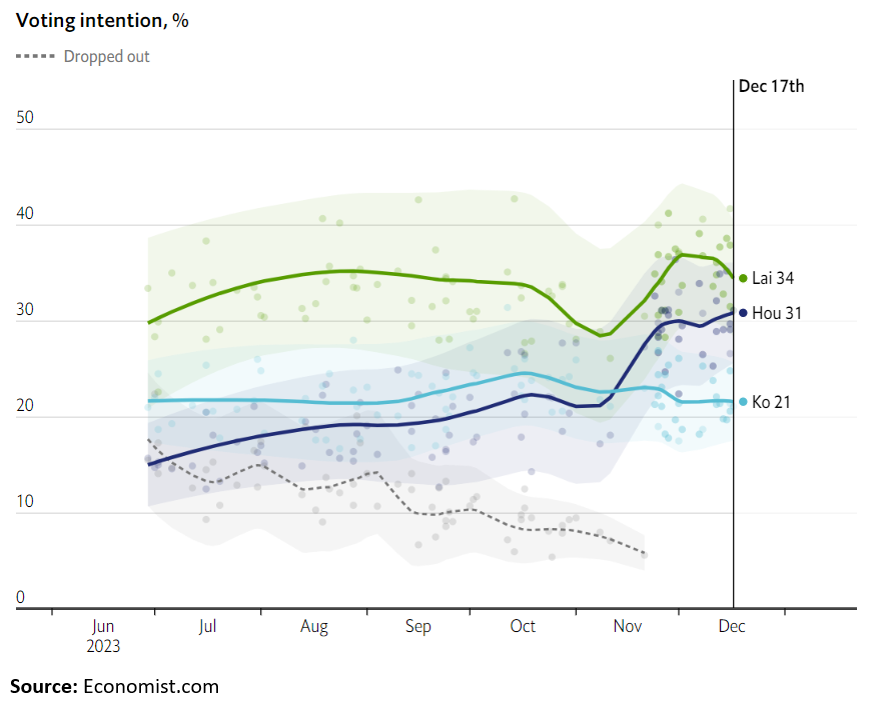
The race has tightened since early November, with the KMT’s Hou passing the third party candidate Ko to draw close to front-runner Lai (see chart below). The Economist’s tracker of national polls (as of Dec. 17) gave Lai a 34% share of voters’ intensions, compared to 31% for the KMT’s Hou and 21% for the TPP’s Ko. This is a much closer race than was the case in the DPP’s victories under Tsai in 2016 and 2020. In the last few days Lai seems to have widened his margin a bit but the race still appears competitive. The latest poll by Myformosa.com, released Dec. 27, has Lai with a nine point lead over Hou, compared to a four point lead in the poll released on Dec. 23. Note that Taiwan’s election law prohibits polls after Jan. 3, ten days before the election. Results of the election should be out late on Jan. 13 in Taiwan, or by mid-day Jan. 13 in the United States.
A key challenge for Lai is voter fatigue with the DPP after eight years in power. Since 2000, voters have alternated between the KMT and DPP every eight years, so a third term for the DPP would be unusual. President Tsai Ing-wen’s approval ratings are net positive but have declined since 2022, when the KMT performed well in local elections. Cross-Strait issues rank second among voter concerns, with socio-economic issues (including economic opportunity, housing affordability, and the social safety net) ranking first.
How would a DPP victory impact geopolitics and markets?
Beijing would be deeply disappointed by a third straight term for the DPP, which would underscore the continued political woes of the KMT and national candidates who favor political engagement with China. (Beijing would be at least slightly cheered if the KMT at least makes the race competitive or does well in the legislative elections, discussed further below).
Beijing is particularly suspicious of Lai, who famously described himself in 2017 as a “political worker for Taiwan’s independence” but has moderated his language on independence as vice president and on the campaign trail. While Beijing would reach out through unofficial channels to communicate with Lai, it is very unlikely that the two sides would find enough common ground to restart high level political engagement.
China’s leadership would look to maintain or increase pressure on Taiwan following the election to warn Lai against taking provocative actions and to underscore Beijing’s determination to reunify China and Taiwan. We expect mainly incremental measures by China that serve as a warning to Taiwan but do not risk an acute crisis or military escalation with the United States. Potential measures include:
- Formal and informal economic measures, such as actions that limit Taiwan’s exports to China. Beijing recently suspended tariff cuts on some imports of chemicals from Taiwan, which Taipei criticized as “typical economic coercion” ahead of the election. In our view such measures are unlikely to be severe enough to have a major impact on Taiwan’s growth outlook.
- Mostly symbolic political measures that emphasize Beijing’s determination to pursue reunification. In a recent analysis (link HERE), Jude Blanchette of the Center for Strategic and International Studies notes that one such possibility is reviving talk of a “National Reunification Law” in China, which among other items could spell out sanctions for those in Taiwan or abroad that thwart steps towards reunification.
- Military saber-rattling. Blanchette notes that potential actions range from an intensification of recent Chinese military activities near Taiwan to (on the more escalatory end of the spectrum) military exercises that would temporarily simulate a possible future blockade, including the inspection of commercial/civil shipping traffic to and from Taiwan.
Steps such as the above could increase near-term pressure on Taiwan assets but we would expect most of the impact to be temporary as Beijing looks to avoid an acute crisis. Major military action by China, such as an extended blockade of Taiwan, would hurt China’s struggling economy and risk military escalation and sanctions from the United States. Given that Lai would continue the status quo under Tsai – and not make moves towards formal independence – Xi would not feel great urgency to resort to military force now given the risks for his broader political and economic agenda for China.
Over the longer term, our special report from May on Taiwan geopolitical risks [link HERE] put a low probability (perhaps 5%) on a Chinese invasion of Taiwan through 2027 but noted that the risks rise to 25% by 2035. We also noted a higher probability of a crisis in coming years that falls short of full conflict but could impact global trade (such as disrupting shipping in the Taiwan Strait). On its own, a Lai victory would modestly increase these probabilities but not fundamentally shift that assessment.
Following the election there will be other important watchpoints in 2024 to assess the risks of conflict or crisis. These include:
- Potential shifts in Beijing’s rhetoric at the March 2024 National People’s Congress, such as suggestions that the leadership is losing “strategic patience” with Taiwan, which would increase dangers of conflict/crisis; and
- The US presidential election in November 2024. We would not expect Trump to fundamentally change US policy towards Taiwan, but he is less concerned with preserving the status quo than Biden and injects a higher degree of uncertainty into complicated dynamics of military and political support for Taiwan.
How would a KMT victory impact geopolitics and markets?
A victory by the KMT in the presidential election would be a major relief to Beijing, which would seek to resume political discussions that trailed off after the KMT lost power in 2016. As noted, Beijing would turn from sticks to carrots, incentivizing Taiwan and the KMT for resuming engagement. For at least the next two years or so, the prospects of military conflict or an acute crisis would be much lower than under a DPP administration. And Taiwan’s economy would see at least marginal benefits from China’s efforts to boost trade and investment. We would expect these factors to result in at least a modest boost to Taiwan equities and the Taiwan dollar.
However, a KMT election would not on its own alter the fundamental drivers of China-Taiwan tensions – and would raise new questions of its own. There is very little political support in Taiwan for reunification with China. Taiwan’s population has steadily shifted away from identification as “Chinese” (as opposed to “Taiwanese”) in the last fifteen years, driven by generational change but also China’s hardline policies and Xi’s crackdown in Hong Kong. A KMT administration would be hard-pressed to find negotiating space on political issues that represents major progress to Beijing and is politically acceptable at home. Indeed, there is a risk that Beijing eventually increases coercive pressure to try to force the KMT to accept political compromise during what China might perceive as a narrow and closing window before the DPP returns to power.
A KMT victory would also force some degree of recalculation in Washington, where political support for Taiwan and its autonomy has surged amid growing US-China tensions, Russia’s invasion of Ukraine, and the strategic importance of Taiwan’s semiconductor industry. To be sure, the KMT and Washington would both reaffirm support for the relationship. However, the Biden administration and Congress would seek to understand the KMT’s position on political and economic cooperation with China and its commitment to boosting Taiwan’s defense capabilities. US-Taiwan engagement on issues such as export controls – i.e., limiting TSMC’s provision of advanced semiconductors to Chinese firms – could become more complicated if the KMT seeks to avoid angering Beijing. Simply put, geopolitical tensions, including on issues of semiconductors and AI, would remain a reality for Taiwan’s economic and financial outlook.
Finally, it will be important to watch for evidence as to Beijing’s degree of interference in the election — particularly if the KMT wins. Major interference could hurt the legitimacy of the election and could lead to a spike in tensions between Beijing and Washington, which has warned China against interference.
Do legislative elections matter for geopolitics as well?
Yes, though not as much as the presidential election. Since 2008, the party that has won the presidency has also won a majority in the legislature. That is likely to change this time, with forecasters expecting neither the DPP nor the KMT to win a majority. Ko Wen-je’s Taiwan People’s Party could become a key swing player, demanding concessions from the KMT or DPP to pass legislation.
From the perspective of geopolitics, the prospect of divided government would at least marginally soften the blow for Beijing of a DPP win in the presidential election. A divided government would complicate the ability of the DPP to implement its agenda, and Beijing would see any signs of KMT political strength as a positive.

