

The Fed and US Economy in 2024 – It’s Not All About When Cuts Start
Recent FCI easing seems unlikely to substantially change the timing of the initial rate cut(s) but will boost growth and help ensure that growth in 2024, particularly H1, comes in notably above current weak consensus and Fed forecasts. Inflation is likely to be generally well behaved as covid-effected sectors’ price normalizations continue but m/m core PCE likely troughs in H1 as those price level normalizations start to fade out. Recession risks have to be respected relative to their general baseline, but we take the under on consensus odds of recession (50% on BBG).
The timing of the initial cut leans towards March but the distribution is flatter than many now appreciate, with some chance the first cut doesn’t happen until later in the summer (March is modal but sub-50%). On net, we lean slightly towards seeing 4 tactical cuts as the base case for 2024, though with admittedly not much to differentiate that from 3 at this point. The initiation of the cutting cycle is being driven by the improving inflation data and the real rate normalization framework, but the depth of it will ultimately come from labor market and growth outcomes.
On net our more medium-term positioning ideas boil down to: moving to a mild duration underweight; some willingness to be quasi-short rates vol through range trading long-term rates or longs in spread/credit products (our view that recession risks are above historical averages but below consensus makes us still somewhat skeptical of suggesting blanket vol selling); and expressing explicit recession hedges in equities rather than rates given better risk:reward on offer. More tactically, we think that the near-term the risks around rates, especially inside the 3y, remain skewed to the further dovish moves until the data looks to pushing back notably on cuts cumulative size or initiation timing (earlier trigger), or until after the first cut is actually delivered (later trigger).
Little to Fear in the Near-term for the Macroeconomy, Given Steady Labors Markets and Improving Financial Conditions
Recent FCI easing seems perhaps unlikely to substantially change the timing of the initial rate cut(s) but will boost growth and help ensure that growth in 2024, particularly H1, comes in notably above current weak consensus and Fed forecasts. Inflation is likely to be well behaved in H1 as supply shock and demand surge hit sectors’ price normalizations continues but the trough in core PCE may come in H1 as those drags start to fade out.
- With GDPNow tracking Q4 at 2.7%, the recent data flow suggests that October was a local soft spot rather than a more durable shift in the data into a substantially below trend pace of growth.
- With FCIs easing substantially to close out 2023, even as growth was extremely punchy in 23Q3 and fairly healthy over the rest of the year, the current consensus and Fed implied slowdown in growth from 23Q4-24H1 is likely to be beat to the upside.
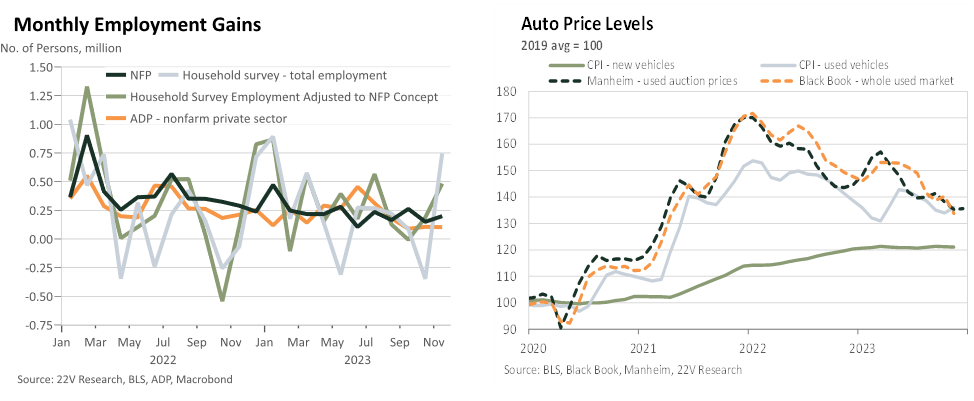
- This is because: housing, and related parts of the economy including durable goods, is likely to be a more positive impulse to growth than assumed as mortgage rates fall from their likely cycle highs in October[1]; the absence of a recession so far and easing financial conditions will support corporate sentiment; nominal income growth continues to be robust; industrial activity and durables demand also seem to be picking up from a long trough; and credit conditions are also now tightening much more slowly than they were. Some versions of all these things normally precede recessions but having avoided one so far and with directions of travel on most of them in the right direction, or at least not deteriorating, it is hard to be too pessimistic and many of them now look more like tailwinds than headwinds.
- When combining economist consensus, our surveys, and options implied distributions there seems to be a fairly strongly held recessionary view held by many. We see relatively little reason, beyond standard base rates and being mid-to-late cycle, to be recessionarily biased over the forecastable horizon. This is due to the pre-recessionary factors mentioned above resolving as well as: healthy household balance sheets, low levels of commodity prices (whose spikes often precede recessions), an easy level of fiscal policy, and a private sector financial balance which is strengthening rather than deteriorating.
- The supply-side recovery is likely still a tailwind to growth (and dint to inflation) through the first half of the year, but it remains less clear if those forces can be sustained on an ongoing basis after that. Supply chains can only recover so much and the bullwhips and hits from the tightening cycle may weigh on some types of supply (multifamily apartments most obviously) in late 2024 and 2025. Labor supply’s recovery is also likely to be a bit slower going forward as catch-up immigration fades, but prime-age participation should continue its cyclical recovery.
- The labor market likely continues to ease but only very modestly and much of this easing likely stems from continued right sizing in job openings rather than a broader deterioration in employment outcomes. Afterall, most of the labor market data suggests that the labor market has been moving roughly sideways since the early summer, suggesting that the impact of fed tightening and lags was quite front-loaded relative.
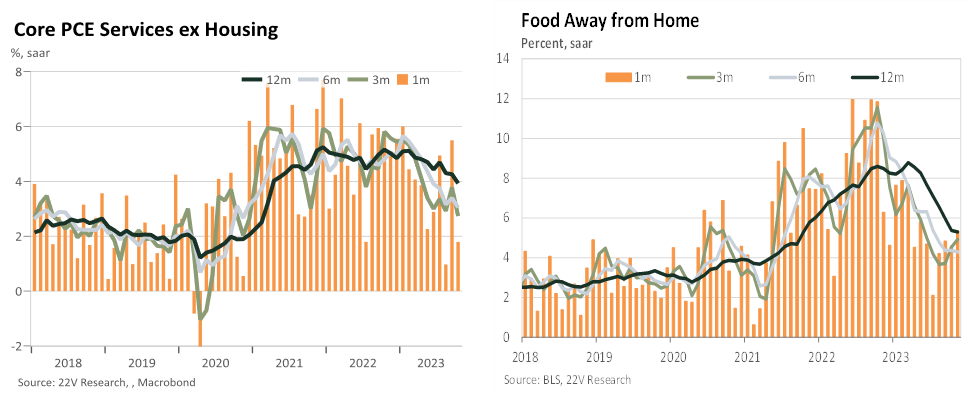
- The inflation outlook for H1 seems relatively benign given continued used cars and broader core goods deflation, as well as some slowing in official rent measures. There seems a decent chance on short-term measures inflation may actually bounce some in H2 as these disinflationary impulses fade and underlying inflation decelerates more slowly. Recent data has also highlighted the disinflationary tailwind from a number of the core PCE non-market prices, largely in financial services.
- While the 23H2 inflation news has been very good from the Fed’s perspective, especially in PCE terms, there are some signs that underlying inflationary pressures are normalizing more slowly and perhaps not exactly to the Fed’s 2% target once the bullwhip unwinds finish. These include the more tepid moves down in trimmed mean and median measures (admittedly partly biased up by lagging rent measures), food away from home bouncing over the past few months (part of core PCE and highly cyclical), and wage growth still above 2% inflation consistent levels, even with somewhat optimistic productivity assumptions. These may all continue to normalize but are likely to do more slowly than overall core and are worth flagging as a sign that the triggers for cutting could be disrupted or become more inflation risk-averse on the part of the Fed if the economy looks hotter than expected.
- The recent move down in the dollar, despite substantial US economic outperformance, suggests that the broad dollar may at least not be a restraining force on manufacturing activity going forward and also hints, more tentatively, that RoW weakness may all be in the price currently.
- The investments, and accelerated depreciation schedules in some areas, associated with the defense spending shifts, on- or friend-shoring, and green energy transitions will continue apace. The buildout phases of all these developments are persistent and resource intensive sources of demand which help set a floor under activity in some of the most cyclical parts of the economy (this is likely one reason the economy was able to whether the hits of the past 12-18 months without a broader recession).
Fed – Cutting in H1 But Less Than Priced
The timing of the initial cut leans towards March but the distribution is flatter than many now appreciate, with some chance the first cut doesn’t happen until later in the summer (March is modal but sub-50%). On net, we lean to seeing 4 tactical cuts as the base case for 2024, though with little reason to differentiate between that and 3 cuts at this point.
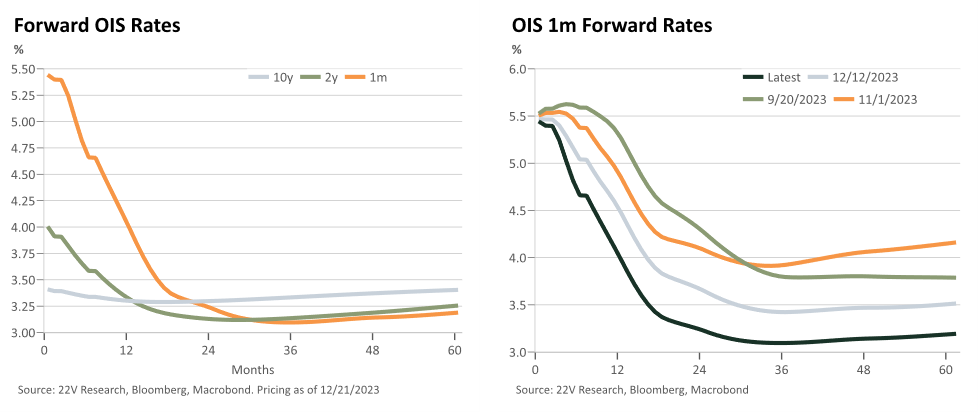
- With 6 cuts priced into rates markets in 2024, taking the fed funds rate to 3.8% and then ultimately to ~3.25% by end-26, the market has priced in a fairly aggressive, perhaps the most aggressive possible, version of a soft-landing and rates normalization trade. Realistically, this reflects some mix of a slower paced set of cuts under a non-recessionary environment and a surprisingly high weight recessionary tail that drags down the priced average.
- In the base case the Fed is likely to begin cuts March (tentatively) then cut sequentially 2-3 more times before going on an extended pause. This could easily end up looking like March, May, June, and September or December.
- Hotter than expected data may end up pushing back the start of cuts into the summer but we would expect a similar general tempo to the initial cuts with 3-4 cuts over 3-5 meetings before going on pause to learn from the data.
- One issue in forecasting the Fed is their willingness to jettison frameworks over the course of this cycle as it has suited their policy desires, which are formed much more discretionarily based off assessments of the stance of policy (i.e. how much are the current level of rates impacting current and future growth), the outlook, and the balance of risks. To some extent, this tendency is fair enough in a world of elevated uncertainty but it also means that forecasting based on the framework of the day require caution against about over extrapolation.
- The initiation of the cutting cycle is being driven by the improving inflation data and the real rates framework, but the depth of it will ultimately come from the labor market.
- At least so far, many on the FOMC are taking a fairly benign view of what inflation measures to use when thinking about the conditions for initiating rate cuts. Focusing on core PCE now incorporates, as it did hawkishly on the way up, the temporary deflationary impact of normalizing supply chains. This opens up the ability to cut in the spring in a way that the same threshold levels applied to trimmed mean or median measures would not (so far at least).
- Mechanically the Fed’s models and frameworks tuned to a real neutral rate of 0.5% will continue to show some medium-term drag on inflation and activity so long as real rates are above that level. This is driving much of the current cutting logic. One under-appreciated question, which seems to impact the medium-term more than the initial timing of cuts currently, is given the inherent uncertainty of those neutral estimates, how much will that model-based logic matter if growth and the labor market are steady, perhaps still a bit hot, and inflation is relatively stable? This can be summed perhaps simply as “why cut if the economy is at equilibrium and has been fairly stable there for some time?” This sounds somewhat less like Waller and Williams but more like a Chair who has historically expressed a substantial degree of skepticism about the utility of stars-driven policy making in real-time.
- As a result, the current emphasis of many on real rate stabilization and normalization (which is the intellectual force behind Waller’s comments) will have data-dependent expiration date as the data flow will matter more than a model-driven pull to neutral once cuts get going; after all it was Chair Powell who said “we know [neutral] by its works. We only know it by its works, really… you only know when you get there and… by the way the economy reacts.”
- I put less stock than many at the Fed do on: the continued substantial impact of rate level tightening on the rate of GDP growth (there is likely still some effect but it is fairly small, long and variable lags is much more about the impact on the level of GDP than growth), with the speed of rate changes being more important; the primary channel of policy tightening coming from spot real rates, which seem theoretically inferior to deflating by forward inflation expectations, rather than longer-term nominal rates and changes in broader measures of financial conditions; and pre-covid estimates of the neutral rate. If correct, these views all lean medium-term hawkish but are unlikely to shift much in the near-term.
- The Fed’s new financial conditions index (which Gerard has dived into deeply on a number of occasions) captures the quantitative essence of the many statements that financial conditions continue to weigh on forward growth. This is perhaps mechanically correct in some model-based sense but it seems a bit out of keeping with the recent data flow, especially in housing. But more importantly when used on a forward-looking basis it seems to have had that negative growth impulse taken away from the Fed’s 1.8-2% views on potential while reality suggests that if that drag is estimated correctly it is coming off a much higher, if still decelerating, non-recessionary post-covid boom pace.[2]
- The opening up of the downside tail in option-implied probabilities for end-24 and beyond actually strikes us as somewhat the wrong message to take from the December FOMC, or at least highlights the different implications between risk-free rates and risk assets. The risk of a Fed-induced recession has been and continues to fall on the back of Fed which is increasingly more symmetrically concerned about the risks to growth and inflation. This should fatten the distribution of rates between 2.5-3.5% but truncate away larger declines. The decline in realized inflation allows the Fed to cut more rapidly if needed and, especially over the medium-term, this ability will limit the risks to the economy, helping prevent small shocks from spiraling into larger ones.
- If the unemployment rate starts moving up in a meaningful way, the Fed will be in a position to cut rates fairly aggressively, although the emergency paces of 2008 or 2020 are unlikely to be realized. Without too much precision I expect the floor in rates to be roughly 150bps in the event of a normal recession; the ability to cut and minimal signs of fundamental misalignment suggest that a recession, if it occurs, is likely to be modest in size and likely fairly quickly truncated away.
Positioning for a Mid-cycle Adjustment
On net our more medium-term positioning ideas boil down to: moving to a mild duration underweight; some willingness to be quasi-short rates vol through range trading or spread/credit products (our view that recession risks are above historical averages but below consensus makes us still somewhat skeptical to suggest too much explicit vol selling); and expressing explicit recession hedges in equities rather than risk-free rates given risk:rewards on offer. More tactically, while we think that the near-term risks around rates, especially inside the 2y, remain skewed to the downside until the data looks to pushing back notably on cuts cumulative size or initiation timing (earlier trigger), or until after the first cut is actually delivered (latter trigger).
- For long-only investors a modest duration underweight seems prudent, after longs were more obviously correct earlier in the fall, given the very aggressive pace of cuts priced in and growth that seems liking to best consensus estimates. Shorter-dated credit seems particularly attractive as a long given high carry / vol on offer.
- Carry and hold likely suffers small loses in most states of the world for leveraged investors (modal pricing is notably above average for the near-term fed funds rate path) but still has some (admittedly much smaller than it was) positive skew if you think a recession is likely or want to hedge other more growth-oriented exposures.
- Equity price action has seemed more attuned to the better growth outlook while risk-free rates seem more focused on an aggressive cutting path which, especially farther out, seems hard to realize with likely near-term growth outcomes.
- I defer to the equity strategy and quant teams for much of the alpha on offer in 2024, as equity markets may be more exciting in a robust growth but sideways to slightly up long-term rates environment.
- Realistically, near-term bets against further cuts pricing may run into the issue, seen exceptionally clearly after the December Fed meeting, that the Fed moving incrementally dovish and not pushing back against markets will see momentum push further in that direction until something stops it out, with any additional dovish Fed actions just furthering the trade.
- My suspicion is that the best timing for putting on any rates shorts, if such things still seem appropriate at the time, is likely to be into Feb if the data appears strong enough to push out cumulative rate cuts or, if the data comes in a bit on the softer side, after the first cut actually takes place and it is all, and then some, in the price.
- The risk to duration shorts before then is that the real rate normalization framework currently driving the Fed is relatively anchorless so any dovish data point can rip rates down. Eventually the ‘totality of the data’ (Chair Powell) will return to driving the process and reanchor rates to some extent but that will take time.
- After such large moves, quasi-vol selling through short-duration credit longs and longer-term nominal rates range trading seems reasonable strategy.
- For the 10y yield, if growth continues to come in above trend as we expect but inflation remains fairly well behaved, data-driven range trading between roughly 325-425 seems likely to be the play. Early in the year, especially if the Fed cuts in March/May, the 10y may end up treading the bottom of this range but with more durable growth and some disinflationary forces fade as the year progress the 10y likely to settle in near 3.75-4% (very crudely = non-recessionary floor 350-400bps – 25-50bps of recession drag, in the belly especially, average + 50-75bps of trend term premium), above current forwards.
- The 2y will move lower, although somewhat above forward pricing, but the downside rates skew any short makes it difficult to press too hard.
- Currently elevated recession pricing means that trading the 2y2y, and the belly more broadly, is likely more about trading the ups and downs of recession probabilities than views on modal cuts which will evolve more slowly and are currently fairly aligned with our base case.
- The belly likely remains a drag on the curve compared to baseline expectations (when looking at forward rates) until the Fed calls an end to the cutting cycle and increases the symmetry around the modal outlook somewhat. Obviously, this may be a long time coming.
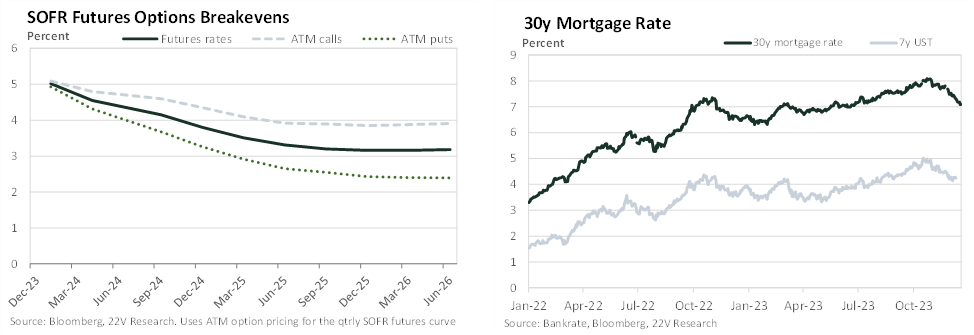
- Elevated implied volatilities make option-based shorts in near-term SOFR futures, and similar instruments, challenging but from a portfolio perspective some put positions targeting 0-4 cuts next year, perhaps a leaving a bit of rates upside not fully truncated away, seem like worthwhile additions to portfolio as hedge it and forget trades.
- For those who want a recession hedge but are fairly timing and magnitude indifferent, downside optionality appears much cheaper in equities and credit than it does in rates. But even with forward rates having moved down so much incorporating much of the recessionary probability mass and implied vols where they are, some recession targeted trades still seem to offer moderately attractive payout ratios (roughly 3:1 payouts seem possible on the assumption rates floor in a recession is likely around 1.5%) in SFRM5 and beyond. But more attractive payouts seem available in index puts given lower (relative to history) implied volatilities and forward prices above spot, rather than pricing aggressive cuts already like in rates.
I consider the general durability of growth over the past few years in the face of rate hikes not evidence that interest rates or Fed policy don’t matter (the economy is less rate sensitive than many assume though) but rather that the whole economy neutral rate is likely higher than it was pre-covid. These are empirically difficult to separate but there were clear cyclical hits in exactly the places we would expect from higher rates, on somewhat different timelines, but the higher pace of nominal growth and elevated rate of desired investment kept the economy from rolling over more broadly. ↑
There’s a side point here that growth almost never grows at potential for any durable length of time. Either the economy is not in a recession in which case growth comes in above estimated potential, closing the output gap if it is negative, or the economy is in recession in which case growth is well below potential. Some of this is mechanical as potential estimates are formed based off of realized inflation outcomes and trends in GDP growth. Thus, after large shocks potential growth is often revised down (in models much faster than qualitative assessments) then over time as the expansion lengthens potential estimates are procyclically pulled higher in the absence of inflation. ↑

