The November Employment Report Pushes Back on Recession Worries
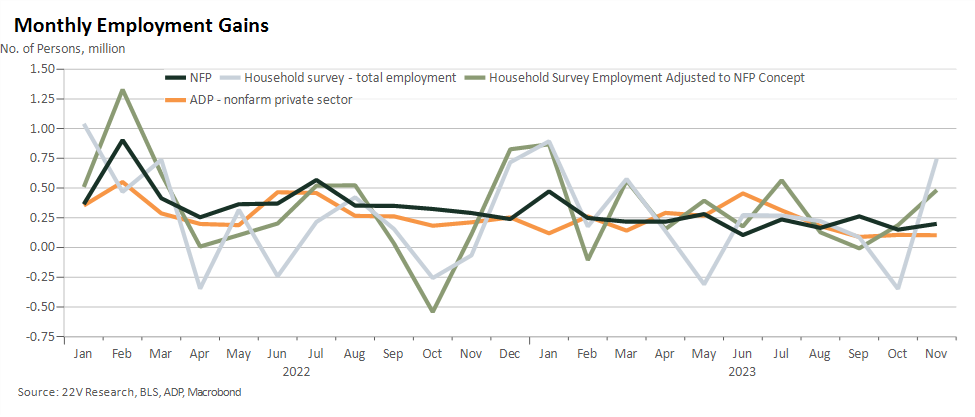
Headline non-farm payrolls growth came in just a smidge above consensus (199k vs 185k), but with an offset of -35k from the prior two months revisions.
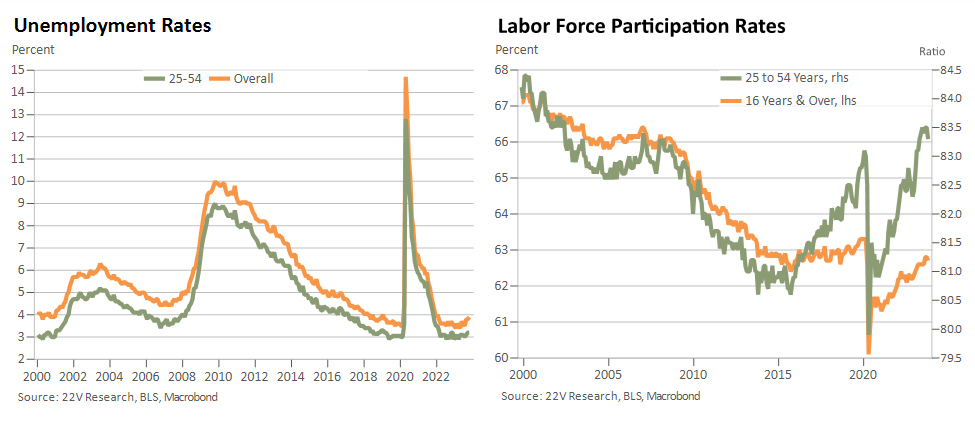
The household survey, after looking notably weak in October, partially due to odd seasonality as we flagged at the time, bounced back notably and strongly leans against many of the nearest term recessionary concerns. The unemployment rate fell from 3.9% to 3.7% even though the labor force participation rate also ticked up by 0.1p.p. (which would just on its own mechanically raise U3).
Price action after the fact suggests the market may have been primed for a worse print (as did our surveys) after such a strong rally in fixed income in recent weeks, which took near-term Fed pricing to the very most edge of soft-landing consistent outcomes.
There is not too much of a net near-term Fed impact here, given that the near-term policy shifts seem more likely to be driven by inflation than labor market data. But the data does lean against the odds of cuts being urgent rather than a lower inflation driven adjustment, which does change the distribution. In addition, every time the data doesn’t weaken appreciably and rebuts labor market driven risk-management concerns it suggests that neutral may be higher and/or the pending impact of policy tightening on growth smaller than currently expected; this has been a gradual process of accumulating evidence but still bears keeping in mind.
A few broader points before hopping into some of the further details:
- The labor market is currently at very healthy levels and it appears there’s been little sign of further slowing, outside the job openings rate, since early summer.
- Overall, the recent data flow, wiggles aside, has been soft-landing consistent.
- There is little in the data which feels pre-recessionary beyond the fact that the unemployment rate is low, as it usually is before recessions, and job growth is generally slowing from a high pace. But causally there is little (non-cherry picked or overfit) data that suggests real immediate issues of concern.
- The October data was likely the near-term soft spot given: the various strikes, the peak in private sector interest rates, weak equities, and some odd seasonality. Falling gas prices since then will also boost real incomes and spending power.
Across measures from ADP, the employer survey, and the household survey job growth looked solid. The ADP and NFP measures tend to be less volatile m/m and suggest a somewhat more muted November but the broader story over the past 3-6m of healthy but slowing growth holds for all of them.
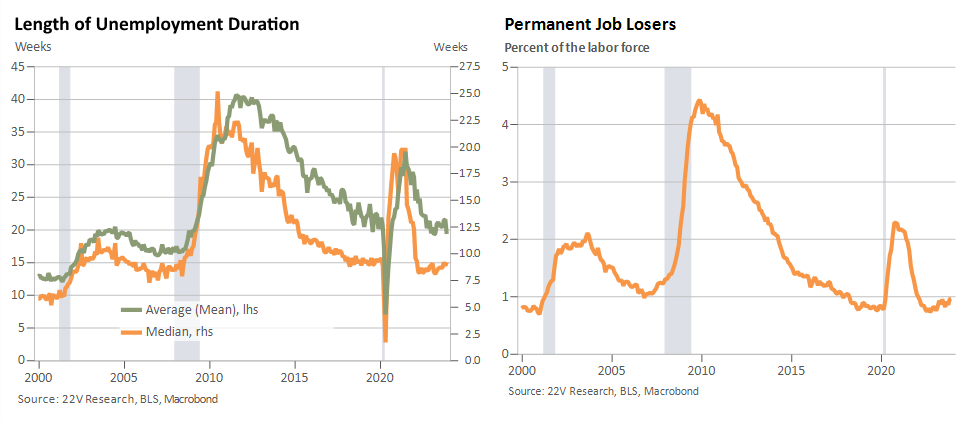
After an oddly weak October the household survey sharply bounced back with almost every measure improving. Household survey employment gains came in at 747k after -347k last month, which meant that the unemployment rate fell from 3.9% to 3.7% even though the labor force participation rate also ticked up by 0.1p.p. The gains in labor supply though came mostly from non prime-age workers, whose participation rate was flat m/m after a surging over a full percentage point since last fall, but other age groups. Other measures of slack from household survey such as the U-6 un- and under-employment rate ticked down, as did the average duration of unemployment.
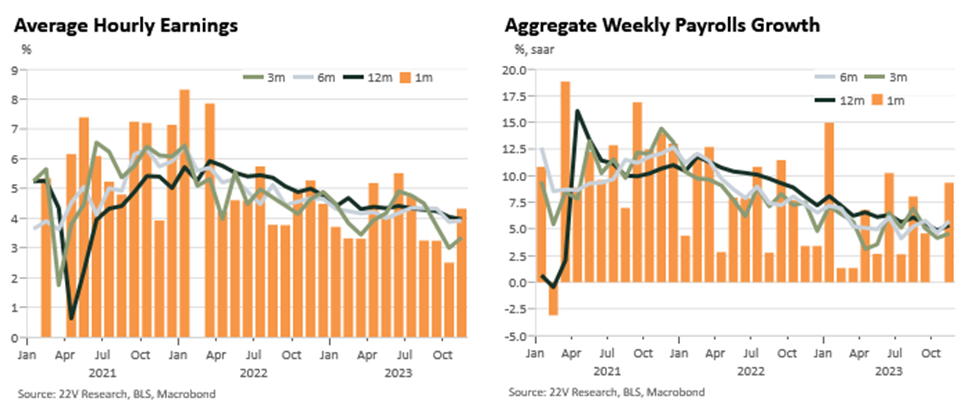
Wage and aggregate income growth was notably punchier in November. Combined with falling gas prices this suggests strong real income growth in the month. This comes after a few weaker months. The 3-6 trends still seem healthy but this is a nice reminder that the data is likely to be somewhat volatile and assessing underlying wage growth and inflation data amidst the various bullwhips and supply shocks (job churn, reopening, durable goods and housing demand, Russia-Ukraine) remains challenging.